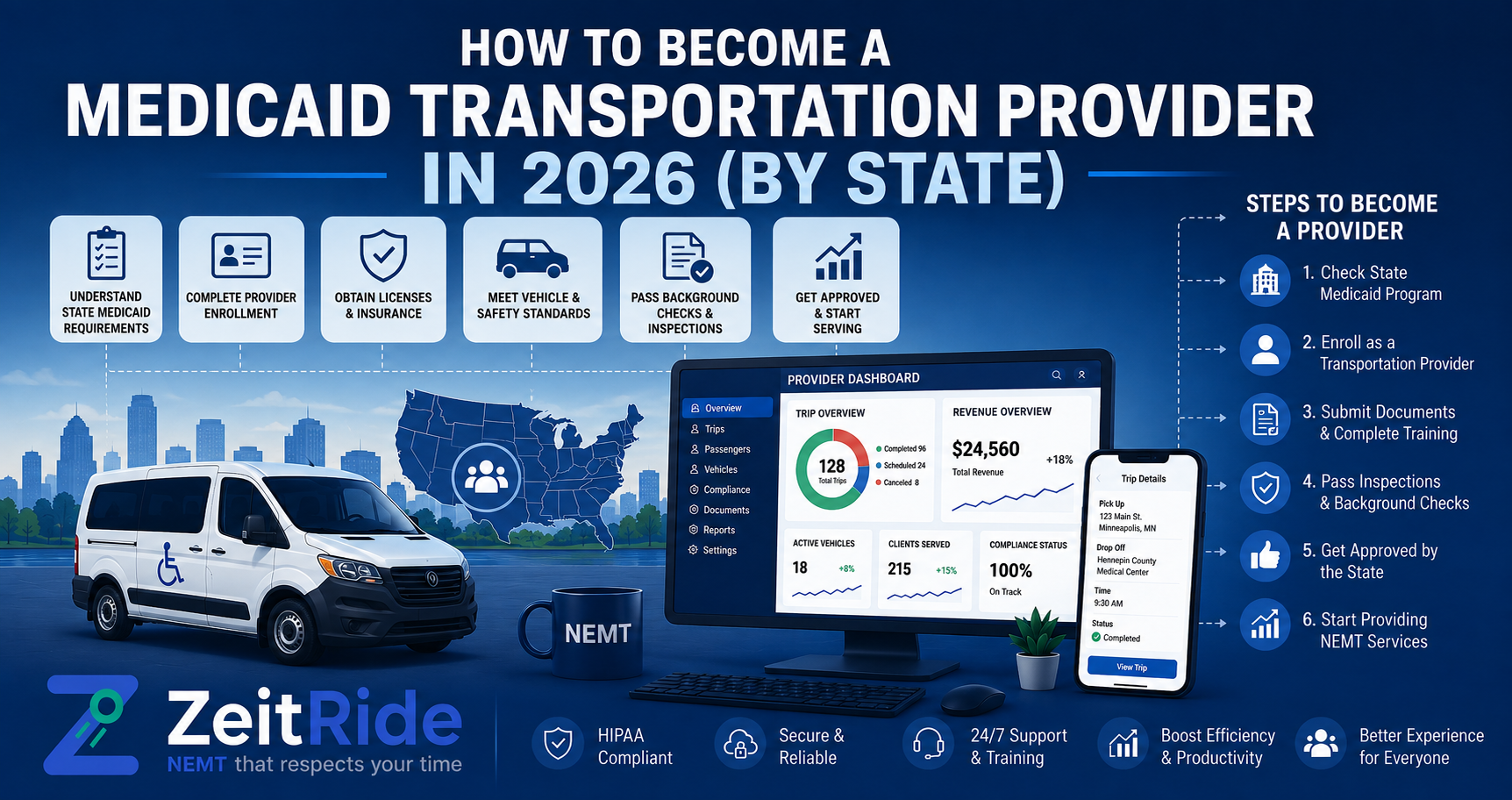
How to Become a Medicaid Transportation Provider in 2026 (By State)
The complete 2026 guide to becoming a Medicaid transportation provider — enrollment steps by state, NPI and insurance requirements, and how enrollment differs from broker credentialing.
Quick answer
To become a Medicaid transportation provider, enroll with your state Medicaid agency as a NEMT provider, obtain a Type 2 NPI through NPPES, secure commercial auto and general liability insurance, and equip compliant vehicles and screened drivers. After enrollment, credential with the brokers that assign trips in your state. Enrollment typically takes 30–120 days (estimated).
ZeitRide Team
NEMT Operations Expert
Before you can bill for a single trip, join a broker network, or turn on dispatch software, you have to complete one foundational step: becoming an authorized provider in your state's Medicaid program. Learning how to become a Medicaid transportation provider is what separates operators who are actually running trips from those still stuck at the paperwork stage. This guide walks through the whole process — the federal rules, the NPI and insurance requirements, the state-by-state enrollment portals, and the single most misunderstood part of the journey: how Medicaid enrollment is different from broker credentialing. Once you understand where you're headed, our NEMT brokers by state directory shows exactly which broker networks you'll join next.
The short answer: To become a Medicaid transportation provider, enroll with your state Medicaid agency as a non-emergency medical transportation (NEMT) provider, obtain a Type 2 NPI through NPPES, secure commercial auto and general liability insurance, and equip ADA-compliant vehicles with screened drivers. After you're enrolled, you credential with the brokers that assign Medicaid trips in your state. Start to finish, enrollment typically takes 30–120 days (estimated), depending on your state.
Do You Need a License to Bill Medicaid for Transportation?
You don't need a special "Medicaid license," but you do need to be an enrolled Medicaid provider before you can bill for NEMT trips — either directly with the state or through a broker that bills on your behalf. Non-emergency medical transportation is a mandatory Medicaid benefit under federal law (42 CFR § 431.53), which requires every state Medicaid program to ensure transportation for eligible beneficiaries who have no other way to reach covered care. That federal mandate is what makes NEMT a stable, recession-resistant business — the demand is guaranteed by law. What you actually need is a combination of state Medicaid enrollment, a Type 2 NPI, proper insurance, compliant vehicles, and screened drivers, all detailed below.
What Is a Medicaid Transportation Provider?
A Medicaid transportation provider is a business authorized to transport Medicaid-eligible patients to and from covered medical services — routine appointments, dialysis, chemotherapy, physical therapy, and behavioral health visits. Providers are reimbursed either directly by the state Medicaid agency, by a managed care organization (MCO), or by a transportation broker that manages NEMT on the state's behalf. The provider owns the vehicles, employs or contracts the drivers, and is responsible for delivering safe, documented, on-time trips — which is the part that determines whether you keep getting assigned volume.
Medicaid Provider vs Broker Credentialing vs NEMTAC: The 3 Things Everyone Confuses
This is the single biggest source of confusion for new operators, and getting it wrong costs weeks. Medicaid provider enrollment, broker credentialing, and NEMTAC accreditation are three different things. Understanding the difference between Medicaid provider vs broker credentialing — and where optional accreditation fits — is what lets you sequence the steps correctly instead of doing them out of order.
| State Medicaid Enrollment | Broker Credentialing | NEMTAC Accreditation | |
|---|---|---|---|
| What it is | Getting authorized by your state Medicaid agency to provide/bill NEMT | Getting approved by a broker (ModivCare, MTM, etc.) to receive their trips | Voluntary industry accreditation (Certified Transport Specialist / CTS) |
| Required? | Yes (in most states, directly or via broker) | Yes, if the broker manages trips in your state | No — optional, but can strengthen competitive bids |
| Who runs it | State Medicaid agency / MCO | The individual broker | NEMTAC (industry body) |
| When | First | After enrollment | Anytime (optional) |
In short: enrollment comes first, credentialing comes second, and accreditation is an optional extra — not a legal requirement to operate. Once you're enrolled, your next move is credentialing with brokers, which we cover step-by-step in guides like how to become a ModivCare provider and how to become an MTM Health transportation provider.
Medicaid Transportation Provider Requirements
While exact requirements vary by state, Medicaid transportation provider enrollment nearly always requires the same core items. Have these ready before you start your application:
- Active business entity (LLC or corporation) and business license
- A Type 2 (organizational) NPI registered through NPPES
- Commercial auto liability insurance — commonly $1,000,000 combined single limit (varies by state and service type)
- Commercial general liability insurance
- Workers' compensation, if you have employees
- ADA-compliant vehicles for wheelchair or stretcher service, with valid inspections
- Background-checked, drug-tested drivers with clean motor vehicle records and required certifications
- State-specific NEMT operating authority or permit, where required
Insurance is usually the largest upfront cost and the most common source of delays. Our guide to NEMT insurance costs in 2026 breaks down realistic per-vehicle premiums so you can budget before you bind coverage.
NPI for NEMT Providers: What You Need to Know
A Type 2 NPI (National Provider Identifier) is effectively non-negotiable. Even in states where Medicaid technically classifies NEMT as an atypical service, virtually every broker and MCO requires an NPI to process your enrollment and claims. The NPI for NEMT provider enrollment is free, applied for through the NPPES registry, and typically arrives within 1–5 business days. Use taxonomy code 343900000X (Non-Emergency Medical Transport / Ambulette) and make sure your business name, address, and taxonomy are accurate — errors here ripple into every downstream broker application.
Service Tiers That Change Your Requirements
The type of transport you offer determines your vehicle and insurance requirements and which trips you'll be assigned:
| Service Tier | Who It Serves | Vehicle Requirement |
|---|---|---|
| Ambulatory | Patients who can walk and enter a standard vehicle unassisted | Standard sedan or minivan — lowest-cost entry point |
| Wheelchair | Patients using manual or power wheelchairs | ADA lift/ramp, lowered floor, certified securement systems |
| Stretcher | Bed-confined patients who cannot sit upright | Stretcher-equipped van — among the highest-reimbursed trips |
Choosing your service tier shapes your entire business model, so decide before you buy vehicles. If you're still at the vehicle stage, our guide on which NEMT vehicle to buy walks through the trade-offs.
How to Enroll as a NEMT Provider by State
Enrollment happens at the state level, and each state runs its own Medicaid provider portal with its own forms, licensing rules, and timelines. Below is how to enroll as a NEMT provider by state for the markets we cover in depth — each links to a full state guide with licensing, costs, and broker details.
| State | What to Know | Full Guide |
|---|---|---|
| Pennsylvania | MATP program; county-based model | Pennsylvania NEMT guide |
| Florida | AHCA enrollment; strong broker + Medicare Advantage market | Florida NEMT guide |
| Texas | MTP program; managed care heavy | Texas NEMT guide |
| California | Medi-Cal; DHCS enrollment (DHCS 6209 for changes) | California NEMT guide |
| New York | Medicaid transportation via state broker | New York NEMT guide |
| Virginia | DMAS enrollment; FFS and MCO paths | Virginia NEMT guide |
| Maryland | State Medicaid enrollment | Maryland NEMT guide |
| Minnesota | State-administered NEMT | Minnesota NEMT guide |
| Arizona | AHCCCS; non-medical transport rules differ | Arizona guide |
Not in one of these states? The same sequence applies everywhere: find your state Medicaid agency's provider enrollment portal, complete NEMT provider enrollment, then credential with the brokers active in your region using our NEMT brokers by state directory.
The Medicaid Transportation Provider Enrollment Process: Step by Step
Although portals differ, the Medicaid transportation provider enrollment process follows the same logical sequence in nearly every state:
- Form your business entity and obtain a federal EIN and business license.
- Apply for your Type 2 NPI through NPPES (free, 1–5 business days).
- Secure commercial auto and general liability insurance at your state's required limits.
- Acquire and inspect vehicles appropriate to your service tier.
- Screen and certify drivers (background checks, drug tests, required training).
- Complete your state Medicaid provider enrollment application through the state portal.
- Obtain any state-specific NEMT operating authority or permit.
- Once enrolled, credential with the brokers and MCOs that assign trips in your area.
The whole process typically takes 30–120 days (estimated), with state Medicaid review usually the longest single bottleneck. Getting your documentation audit-ready from the start prevents the back-and-forth that stretches timelines — our NEMT documentation requirements checklist shows how to build that file once and reuse it for every broker application.
After Enrollment: Credentialing With Brokers and Getting Trips
Enrollment authorizes you; brokers actually feed you trips. In most states, the majority of Medicaid NEMT trips flow through one or more brokers, so your next step is credentialing with each broker active in your county. Every application reuses most of the same documentation you assembled for enrollment. Beyond brokers, you can also pursue facility and private-pay work — our guide on how to get NEMT contracts maps all three channels.
Once trips start flowing, brokers score you on on-time performance, documentation accuracy, and clean claims — and those scores directly control how much volume you receive. Our breakdown of NEMT KPIs and broker scorecard metrics shows exactly what they measure.
After You're Live: Running and Billing Trips Profitably
Enrollment gets you authorized. Software gets you paid. Once you're a Medicaid transportation provider running broker trips, you're responsible for EVV-compliant documentation, on-time dispatch, and clean claims — and most states now require Electronic Visit Verification on Medicaid NEMT trips. Read our NEMT EVV compliance guide and how to bill Medicaid for NEMT before your first month of trips to avoid the documentation-related denials that cost new operators real revenue.
This is where the right operations platform pays for itself. ZeitRide's NEMT software imports trips from every broker onto one board, captures EVV automatically in the driver app, sequences routes with AI, and reconciles billing in the same place you dispatch — at a flat $49/vehicle/month. It's the difference between staying in good standing across every broker and drowning in portals.
Ready to turn enrollment into revenue? Once you know how to become a Medicaid transportation provider and you're moving toward broker credentialing, book a 15-minute ZeitRide demo, bring a real route, and we'll show you how to dispatch, capture EVV, and bill clean claims across every broker on one board at $49/vehicle/month.
Frequently Asked Questions
Q: Do you need a license to bill Medicaid for transportation?
There's no special Medicaid license, but you must be an enrolled Medicaid provider before billing for NEMT — either directly with the state or through a broker. NEMT is a mandatory Medicaid benefit under 42 CFR § 431.53. You'll need state Medicaid enrollment, a Type 2 NPI, insurance, compliant vehicles, and screened drivers.
Q: How long does Medicaid provider enrollment take?
Start to finish, becoming a Medicaid transportation provider typically takes 30–120 days (estimated), depending on your state. State Medicaid review is usually the longest bottleneck, followed by insurance and vehicle preparation.
Q: What is the difference between Medicaid enrollment and broker credentialing?
State Medicaid enrollment authorizes you to provide and bill for NEMT in your state. Broker credentialing is separate approval by an individual broker (like ModivCare or MTM) to receive the trips they manage. You enroll first, then credential with brokers active in your area.
Q: Do you need an NPI to become a Medicaid transportation provider?
Yes, in practice. Nearly every broker and managed care organization requires a Type 2 NPI to process enrollment and claims, even where Medicaid classifies NEMT as an atypical service. It's free through NPPES and typically arrives in 1–5 business days (taxonomy 343900000X).
Q: How much does it cost to become a Medicaid transportation provider?
Costs vary widely by state and service tier. The NPI is free, but you'll budget for business formation, commercial insurance (usually the largest line), vehicles appropriate to your service tier, and driver screening and training. See our NEMT startup cost and insurance guides for realistic estimates.
Q: Can you provide NEMT without enrolling in Medicaid?
You can run private-pay or facility-contracted transportation without Medicaid enrollment, but you cannot bill Medicaid or receive Medicaid broker trips until you're an enrolled provider. Most operators enroll because Medicaid trip volume is the backbone of the business.
Q: Is NEMTAC certification required to become a Medicaid provider?
No. NEMTAC accreditation (including the Certified Transport Specialist course) is voluntary. It can strengthen competitive bids and signal quality, but it is not a legal requirement for Medicaid enrollment or for operating as a NEMT provider.
Rather see it than read about it?
Bring a real route, a couple of drivers, and your current process. 15 minutes, zero pitch.