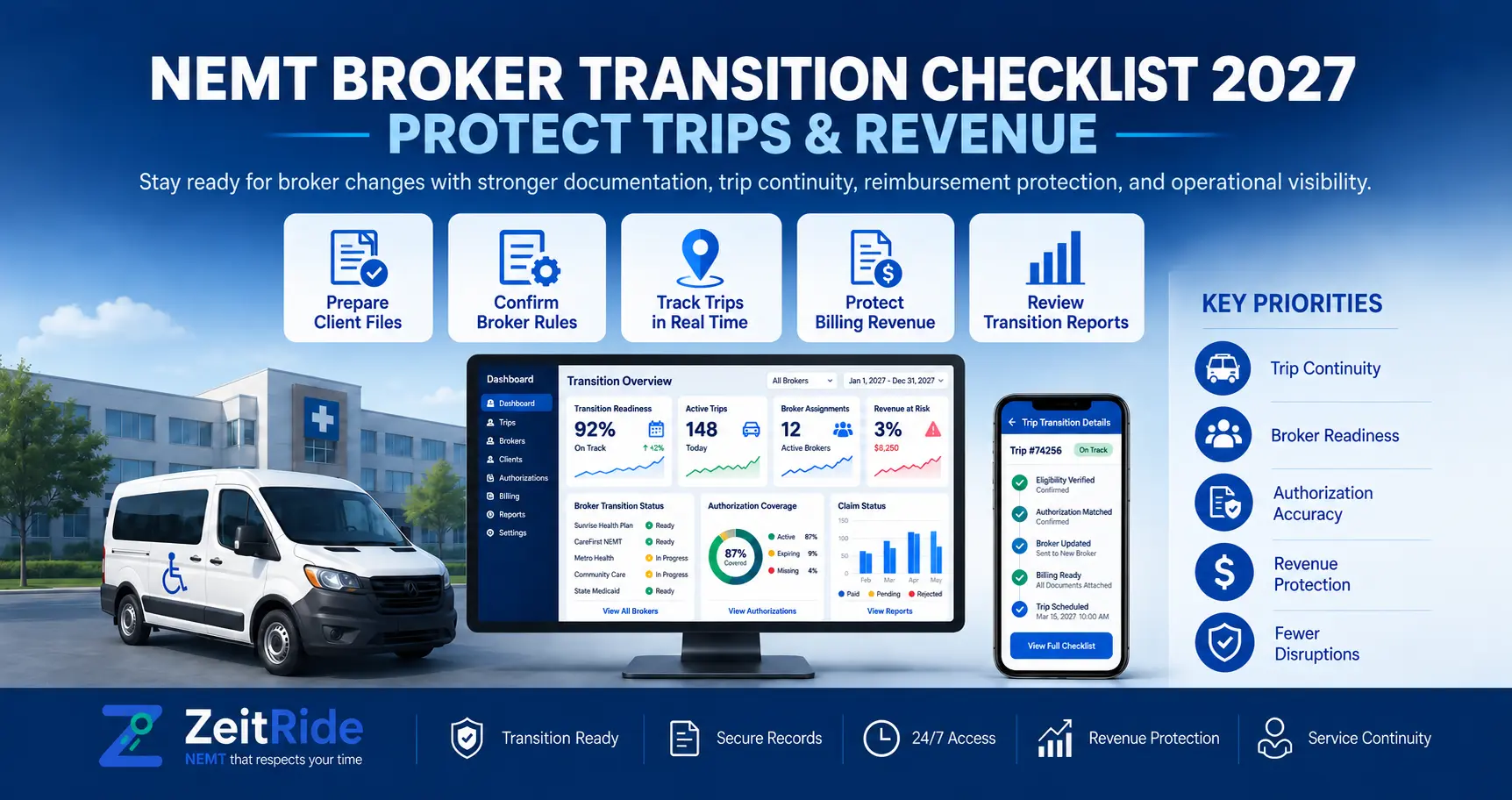
NEMT Broker Transition Checklist 2027: Protect Trips & Revenue
A practical NEMT broker transition checklist for protecting standing orders, credentials, trip assignments, billing, and revenue during a broker switch.
Quick answer
When an NEMT broker changes, providers should confirm new credentialing, reconcile standing orders and future trips, test broker intake before go-live, and separate old-broker billing from new-broker dates of service. Start as soon as the transition is announced.
ZeitRide Team
NEMT Operations Expert
A broker change can look simple on a payer notice: one transportation company ends and another begins on a specific date. For the NEMT provider actually operating those rides, the cutover can affect credentials, standing orders, future assignments, trip intake, rates, dispatch workflows and billing at the same time. This NEMT broker transition checklist focuses on the provider side of that change so you can protect the trips you expect to operate and the revenue you still need to collect.
Quick Answer: What Should You Do When Your NEMT Broker Changes?
Start as soon as the transition is announced. Confirm whether your company must contract or credential with the new broker, identify the exact cutover date, reconcile future and recurring trips, test how new assignments enter dispatch, and keep old-broker billing separate from new-broker dates of service. Do not assume that a member's reservation transferring automatically means your transportation company keeps the assignment.
What Is an NEMT Broker Transition?
An NEMT broker transition happens when a Medicaid program, managed care plan or other payer moves transportation administration from one broker or transportation manager to another. The rider may continue receiving essentially the same transportation benefit, but the provider workflow can change behind the scenes.
| Workflow | Before Cutover | After Cutover | Provider Action |
|---|---|---|---|
| Contract | Old broker agreement | New broker agreement | Confirm participation |
| Credentials | Existing approval | New broker review | Complete credentialing |
| Trip intake | Old portal or integration | New assignment source | Test trip intake |
| Standing orders | Existing recurring rides | New broker records | Reconcile every series |
| Rates | Existing terms | New terms | Verify applicable rates |
| Billing | Old workflow | New workflow | Separate by date of service |
| Payments | Old receivables | New receivables | Track separately |
The safest approach is to treat the transition as an operational cutover rather than simply a broker-name change.
Why NEMT Broker Transitions Matter Right Now
Several 2026 transitions show why providers need a repeatable cutover process. Blue Cross and Blue Shield of Texas moved Medicaid NEMT from Modivcare to MTM Health effective October 1, 2026, with recurring and already-scheduled trips after the effective date moving to MTM. You can review the official BCBSTX transportation transition notice for the payer-specific details.
Blue Cross and Blue Shield of New Mexico announced a similar Modivcare-to-MTM transition effective November 1, 2026. Montana Medicaid also moved NEMT program enrollment and billing administration to Modivcare effective October 1, while Virginia Cardinal Care Fee-for-Service transportation moved to MTM for its new transportation contract period.
The details vary by program, which is exactly why providers should not assume that a workflow used in one state or health plan automatically applies elsewhere. ZeitRide's BCBS Medicaid transportation change guide provides a more detailed example of a specific Modivcare-to-MTM transition.
NEMT Broker Change Checklist: Start as Soon as the Change Is Announced
Do not wait until the week before go-live. As soon as you receive an official broker-change notice, create a transition owner and document the affected programs, dates and workflows.
- Record the exact transition or cutover date.
- Identify which members, plans, counties or programs are affected.
- Determine whether your existing provider agreement carries over.
- Contact the incoming broker about contracting and credentialing.
- Identify new portal, integration or trip-file requirements.
- Document outstanding work and receivables with the outgoing broker.
- Identify recurring riders whose trips extend beyond the cutover date.
If the incoming broker requires additional documentation, compare the request with your existing NEMT broker requirements process, but treat the new broker's current instructions as the controlling requirement. Your driver and vehicle credential records should also be reviewed early enough to resolve missing or expiring documents before they interfere with trip assignments.
30–60 Days Before Cutover: Build the New Broker Workflow
Once participation with the new broker is underway, map how one assigned trip will move through your operation. The objective is to verify the full chain before your first live day rather than discovering workflow gaps after vehicles are already on the road.
- Confirm how new trip assignments will arrive.
- Confirm how trip changes and cancellations will be received.
- Identify which broker and authorization identifiers must stay attached to each trip.
- Make sure dispatchers can clearly identify the new trip source.
- Confirm required driver status events and proof-of-service steps.
- Verify how GPS, timestamps or other trip evidence must be handled.
- Confirm how completed trips move into billing.
If the incoming broker is MTM Health and your account supports it, review how MTM Link integration can move broker trip information into the provider workflow. Do not wait for the first live morning to discover that assignments import correctly while a required field, change, cancellation or status workflow does not.
14 Days Before Go-Live: Reconcile Standing Orders and Future Trips
Recurring transportation deserves special attention during an NEMT standing orders broker transition. Dialysis, therapy, behavioral health and other repeating rides can extend across the cutover date, so providers should verify which company has actually been assigned every future ride.
| Record | What to Check |
|---|---|
| Old broker manifest | Expected future recurring trips |
| New broker assignments | Trips actually transferred or reassigned |
| Your dispatch schedule | Trips your team currently expects to operate |
Mark each future ride as Matched, Missing, Duplicate or Changed. Do not assume that because a member's recurring reservation transferred, your company automatically retained the transportation assignment. For broader recurring-trip management, use ZeitRide's dedicated NEMT standing orders guide instead of duplicating the full standing-order workflow here.
Test One Trip From Broker Intake Through Billing
Before cutover, run a controlled workflow test wherever the incoming broker allows it. Follow one representative trip through broker assignment, scheduling, dispatch, driver activity, trip statuses, documentation, completion and billing.
- Did the correct member and trip identifiers arrive?
- Did pickup and destination information remain intact?
- Can dispatch assign the correct driver and vehicle?
- Does the driver receive the correct trip information?
- Do required status events and documentation remain connected?
- Does the completed trip enter the correct billing workflow?
A successful cutover test should confirm more than whether a trip appears on the schedule. Broker transitions often expose fragmented systems where trip intake works but dispatch, driver activity or billing still requires manual reconstruction.
Go-Live Day: Watch for Missing and Duplicate Trips
On cutover day, compare the new broker feed or manifest with the schedule your dispatch team expects to operate. One successful assignment is not enough to prove the transition worked.
- Missing recurring rides
- Duplicate trip assignments
- Changed pickup times
- Changed destinations
- Canceled trips that still appear on the schedule
- Drivers or vehicles rejected because of credential issues
- Trips still arriving from the wrong source
Resolve exceptions as early as possible. A missing trip discovered before dispatch begins is an operational issue; the same trip discovered after the scheduled pickup can become a service failure.
How Should NEMT Billing Work During a Broker Transition?
NEMT billing during broker transition should be separated according to the contract and date of service governing each ride. Trips completed before cutover may still need to be billed, corrected, appealed or reconciled through the outgoing broker. Trips completed under the new arrangement should follow the incoming broker's billing rules and payment terms.
- Completed but unbilled trips
- Submitted but unpaid trips
- Short-pays
- Denied claims
- Corrected or resubmitted claims
- Unresolved payment exceptions
Maintain a separate old-broker receivables list until every item is resolved. ZeitRide's NEMT trip reconciliation guide explains how to match completed trips, billing records and broker payments so older receivables do not disappear after the operational team has already moved to the new broker.
First 30 Days After the Broker Switch
The transition is not finished on go-live day. During the first month, review both operational and revenue exceptions frequently so small cutover problems do not become recurring problems.
- Expected versus received trip volume
- Missing standing-order assignments
- Duplicate trips
- Provider, driver or vehicle credential exceptions
- Status or GPS transmission issues
- Rejected or denied billing
- Payment timing
- Outstanding old-broker receivables
A short daily exception review during the first week, followed by a weekly review for the remainder of the first month, gives teams a better chance to detect issues before they become normal operating behavior.
How ZeitRide Helps With Broker-Connected Operations
ZeitRide NEMT software connects broker trip intake, scheduling, recurring transportation, dispatch, driver activity, billing and reconciliation in one operating platform. That matters during a broker transition because providers may temporarily need visibility across two worlds: unresolved trips and receivables from the outgoing broker while new assignments are already entering through the replacement broker.
Software does not replace broker contracting, credential approval or payer rules. Its role is to reduce operational fragmentation around those requirements so your team can follow the trip from assignment through completion and payment without rebuilding the same record across disconnected systems.
Final NEMT Broker Transition Checklist
- New provider agreement or participation is confirmed.
- Required company, driver and vehicle credentials are approved.
- New trip intake has been tested.
- Standing orders and future rides have been reconciled.
- Missing and duplicate trips have been resolved.
- New rates and billing requirements have been reviewed.
- Dispatch and driver workflows have been tested.
- Old-broker receivables are still being tracked.
- New-broker completed trips are reaching billing.
- The first month of assignments and payments is being monitored.
The best NEMT broker transition checklist protects both sides of the cutover: the trips you need to keep operating and the revenue you still need to collect.
Review Your Broker Transition Before Go-Live
Bring your transition date and one real recurring trip to a 15-minute ZeitRide workflow review. Follow the ride from broker intake and standing-order scheduling through dispatch, driver activity, billing and reconciliation. Review your broker transition workflow before go-live.
Frequently Asked Questions
Q: What is an NEMT broker transition?
An NEMT broker transition occurs when a Medicaid program, health plan or payer changes the organization managing transportation. Providers may need to address new contracting, credentialing, trip-assignment, technology and billing workflows around the cutover date.
Q: Do NEMT providers have to reapply when a broker changes?
Provider participation with the incoming broker may need to be confirmed separately. Providers should follow the payer and incoming broker's official instructions rather than assuming the outgoing broker agreement automatically transfers.
Q: Do NEMT standing orders automatically transfer to a new broker?
Some member reservations may transfer, but providers should independently reconcile future recurring rides and confirm which transportation company has actually been assigned each trip after cutover.
Q: Who pays for trips completed before the broker transition date?
Billing generally follows the payer, broker and contract governing the applicable date of service. Providers should confirm final billing deadlines, corrections, appeals and payment procedures with the outgoing broker.
Q: When should an NEMT provider start preparing for a broker switch?
Preparation should begin as soon as an official transition is announced so contracting, credentialing, integrations, standing orders and billing workflows can be reviewed before go-live.
Q: Do I need to change NEMT software when my broker changes?
Not automatically. First verify whether your current platform can receive the incoming broker's trips, preserve required identifiers, support dispatch and driver workflows, and connect completed trips with the correct billing process.
Rather see it than read about it?
Bring a real route, a couple of drivers, and your current process. 15 minutes, zero pitch.