NEMT insurance cost in 2026
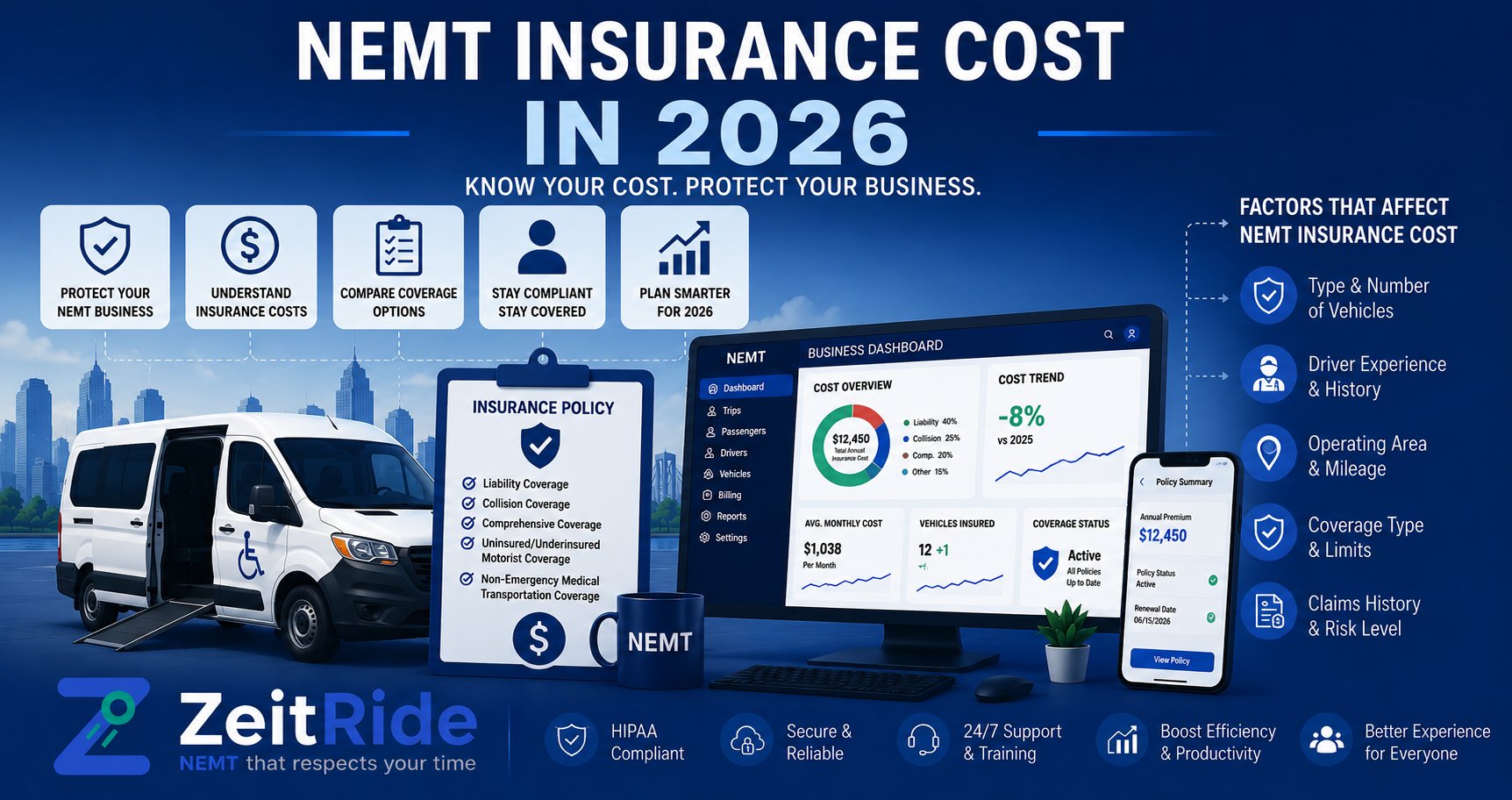
NEMT insurance costs $4,500–$18,000+ per vehicle annually in 2026. Learn what affects premiums, required coverage, and ways to reduce costs.
Quick answer
NEMT insurance is expensive because providers transport medically vulnerable passengers, operate high-mileage vehicles, and face greater liability risks than standard transportation companies.
ZeitRide Team
NEMT Operations Expert
NEMT insurance cost is the single largest fixed expense for most fleet owners — and one of the most misunderstood. The wrong coverage leaves you exposed; the right coverage, priced right, keeps your business solvent. This guide breaks down exactly what you'll pay in 2026, what drives those numbers up or down, and what smart operators are doing to lower premiums without gutting their coverage. Ready to stop guessing and start planning? Book a 15-minute demo bring a real route and we'll run it live in ZeitRide.
What NEMT insurance actually covers (and why it costs what it does)
NEMT insurance is not a single policy. It's a stack of coverages, and most operators need all of them to stay compliant with Medicaid broker contracts and state licensing requirements.
The core coverage types every NEMT operator carries:
- Commercial auto liability — Covers bodily injury and property damage to third parties. Most state Medicaid programs require a minimum of $1,000,000 per occurrence. Some states require $1.5 million or higher.
- General liability — Covers incidents outside the vehicle: a passenger slipping during a transfer, a wheelchair tipping during loading, or an injury at a pickup location. Standard limits are $1M per occurrence / $2M aggregate.
- Non-owned and hired auto — Fills the gap when drivers use personal vehicles for company trips or you rent vehicles for overflow capacity.
- Uninsured/underinsured motorist — Required in most states. Protects your passengers when the at-fault driver doesn't carry enough coverage.
- Workers' compensation — Legally required in nearly every state the moment you bring on a W-2 driver. Covers medical expenses and lost wages for on-the-job injuries.
Why does this cost more than standard commercial auto? Because your passengers are medically vulnerable. A dialysis patient with bone density issues faces a fundamentally different injury outcome in a minor collision than a healthy commuter. Insurers model that risk accurately and price accordingly. Add high annual mileage (NEMT vans often log 50,000–80,000 miles per year) and frequent driver turnover, and you have a risk profile that commercial auto actuaries put in a category of its own.
NEMT insurance cost in 2026: what the numbers actually look like
Here are the ranges operators are seeing when they pull quotes in 2026. These vary by state, vehicle type, fleet size, and your loss history.
Annual premium per vehicle:
| Vehicle Type | New Operator | |
|---|---|---|
| Standard sedan | $6,500 – $10,000 | $4,500 – $7,000 |
| Wheelchair-accessible van (WAV) | $9,000 – $14,000 | $6,500 – $10,000 |
| Stretcher/gurney van | $11,000 – $18,000 | $8,000 – $13,000 |
Monthly equivalents (approximate):
- Single sedan, new operator: $540 – $835/month
- Single WAV, new operator: $750 – $1,165/month
- Single WAV, new operator: $750 – $1,165/month
A 10-vehicle fleet with mixed vehicle types can easily run $80,000 – $140,000 per year in total insurance premiums before a single driver is paid or a single trip is billed.
The new operator penalty. If you're launching a new NEMT business, expect to pay 25–40% more than an established operator in your first two years. Insurers call it a loss history surcharge — you have no track record to prove you're a safe operation. Every claim you avoid, every clean year you document, works toward bringing that premium down at renewal.
What drives NEMT insurance premiums higher (and lower)
Understanding the rating factors gives you something to actually work with.
- Inexperienced or newly hired drivers. Each new driver represents an unknown risk. Frequent turnover hurts you at renewal.
- Poor or absent driver documentation. If you can't produce background check records, MVR reports, or training certifications, insurers assume the worst.
- High annual mileage per vehicle. The more miles you run, the higher your exposure. This is directly tied to route efficiency.
- Prior claims history. One at-fault accident in a WAV can add 20–30% to your renewal.
- State of operation. Florida and California consistently see higher minimums and higher rates than states like Tennessee or Georgia.
- Vehicle age and maintenance records. Older vehicles without documented maintenance histories are rated as higher risk.
Factors that push premiums down:
- Clean multi-year loss history. This is the biggest lever. Two to three clean years can cut your per-vehicle premium significantly.
- Telematics data. Some NEMT insurance brokers offer discounts of 5–15% for fleets using GPS tracking with trip-level data — because it documents driver behavior and speeds up claims resolution.
- Driver training documentation. CPR certifications, passenger assistance training, and defensive driving completions reduce underwriter uncertainty.
- Fleet size. Larger fleets get better rates per vehicle. A 20-vehicle operation typically pays less per unit than a 3-vehicle startup.
- Fewer miles driven per vehicle. Lower annual mileage = lower exposure. This one is more controllable than most operators realize.
How operational efficiency directly affects your insurance cost
Here's the connection that most NEMT insurance guides miss entirely.
Insurance premiums are exposure-based. The more miles your vehicles run, the more exposure you carry. A van that drives 80,000 miles per year is statistically more likely to be involved in an incident than one that drives 60,000. Underwriters know this and price for it. ZeitRide's AI route optimization averages a 20% reduction in miles driven per vehicle. On a 10-vehicle fleet each logging 70,000 miles annually, that's 140,000 fewer miles across your operation each year. Fewer miles driven means lower exposure per vehicle — which is a real, documentable input when you go back to your NEMT insurance broker at renewal time. If you want to understand how route efficiency translates to total operating cost, the breakdown at what is the average cost of non-emergency medical transportation puts the full picture together.
How clean software records help you at insurance renewal
This is where your NEMT software either works for you or against you. When your NEMT insurance broker underwrites your renewal, they're looking for proof that you run a tight operation. The documentation that matters most:
- Accurate trip records. Every completed trip logged with timestamps, pickup and drop-off confirmations, and driver ID. Electronic trip records are cleaner and harder to dispute than paper logs.
- EVV compliance data. States with Electronic Visit Verification mandates require timestamped location data for every trip. If you're already capturing EVV data correctly, you have a clean audit trail that reduces claim disputes.
- Driver assignment records. Knowing exactly which driver operated which vehicle on which trip matters enormously when a claim comes in. If your dispatch system doesn't track this clearly, you're at a disadvantage.
- HIPAA-compliant documentation. Brokers and Medicaid managed care organizations want to know you handle patient data correctly. A HIPAA-aware platform signals that you run a professional operation.
ZeitRide captures all of this automatically — trip records, EVV data, driver assignments, and broker remittance documentation — in a HIPAA-aware, encrypted platform with a 99.9% uptime target. When you walk into a renewal conversation, you can pull a clean loss run alongside complete trip documentation. That combination gives your broker something concrete to work with. ZeitRide integrates directly with MTM Health, CTS Transit, Provide A Ride, ProCare, DD Med Trans, and Tennessee Carriers — so your broker billing and trip records stay in sync across your entire operation. Operators using NEMT billing software that automates this documentation are in a fundamentally stronger position at renewal than those running manual billing from spreadsheets.
Who this guide is for
Different roles in an NEMT operation interact with insurance differently.
- Fleet owners and operators carry the liability. You're the one signing the policy and absorbing the premium. Your job is to understand what each coverage type protects and to make sure your loss history is as clean as possible before each renewal. Reducing miles driven, documenting driver training, and maintaining accurate trip records are the three levers you control directly.
- Fleet managers and operations directors are the ones who actually influence the risk profile day to day. Driver onboarding quality, route efficiency, vehicle maintenance scheduling, and incident documentation all run through your department. The cleaner you run operations, the better position your owner is in at renewal.
- Dispatch coordinators affect insurance cost indirectly through trip accuracy. A missed pickup that gets documented incorrectly, or a driver assignment that isn't logged, creates gaps that become problems when a claim is filed. Clean dispatch records are part of your NEMT insurance risk profile even if you never see a policy document.
For operators in states like Pennsylvania and Florida — which have higher Medicaid broker requirements and, in some cases, higher minimum coverage thresholds — getting the documentation side right from day one matters more than in lower-requirement states. ZeitRide operates in 10+ states and is built to meet the requirements of the Medicaid brokers active in those markets.
If you're running operations in high-volume markets, the state-specific context at NEMT software for Pennsylvania and NEMT software for Florida covers broker-specific requirements in detail.
Bottom line on NEMT insurance cost
NEMT insurance cost in 2026 runs $4,500 to $18,000+ per vehicle annually — and it's one of the few operating expenses where your day-to-day decisions directly affect what you pay. Clean loss history, driver documentation, accurate trip records, and fewer miles driven all move the needle at renewal. ZeitRide reduces miles driven by an average of 20% through AI route optimization, captures HIPAA-aware trip records and EVV data automatically, and keeps your broker billing documentation clean across integrations with MTM Health, Provide A Ride, and five other major brokers — all at $49 per vehicle per month with no contracts. Start your first live route within a day. $49/vehicle. No contracts. Book your demo.
Frequently Asked Questions
Q: How much does NEMT insurance cost per vehicle in 2026?
Most NEMT operators pay between $4,500 and $14,000 per vehicle per year depending on vehicle type, state, fleet size, and loss history. New operators typically pay 25–40% more than established operators with clean records. Wheelchair-accessible vans run higher than standard sedans due to the complexity of transfers and the vulnerability of the passengers being transported.
Q: What types of insurance do NEMT providers need?
NEMT providers need commercial auto liability (minimum $1M per occurrence in most states), general liability, workers' compensation for W-2 employees, and typically uninsured/underinsured motorist coverage. Some brokers and Medicaid managed care contracts also require non-owned and hired auto coverage if drivers use personal vehicles.
Q: Do NEMT insurance requirements vary by state?
Yes, significantly. States like Florida and California set higher minimums and generate higher actuarial rates. Tennessee and Georgia typically run lower. Your specific Medicaid broker contract may set requirements above your state's minimum, so always read your broker agreement before finalizing coverage.
Q: Can NEMT software lower my insurance cost?
Directly, no — your software doesn't negotiate your policy. Indirectly, yes. NEMT software that captures clean trip records, EVV data, driver assignments, and broker remittance documentation gives your insurance broker proof of a well-run operation. That documentation can support lower renewal rates. ZeitRide's route optimization also reduces miles driven by an average of 20% — which directly reduces your per-vehicle exposure.
Q: What is the cheapest way to get NEMT insurance?
The cheapest long-term path is building a clean loss history over two to three years while keeping driver documentation current and mileage per vehicle controlled. Short-term, working with a broker who specializes in non-emergency medical transportation insurance — not general commercial auto — gets you access to insurers who understand the NEMT risk profile and price it accordingly rather than applying a generic commercial surcharge.
Rather see it than read about it?
Bring a real route, a couple of drivers, and your current process. 15 minutes, zero pitch.