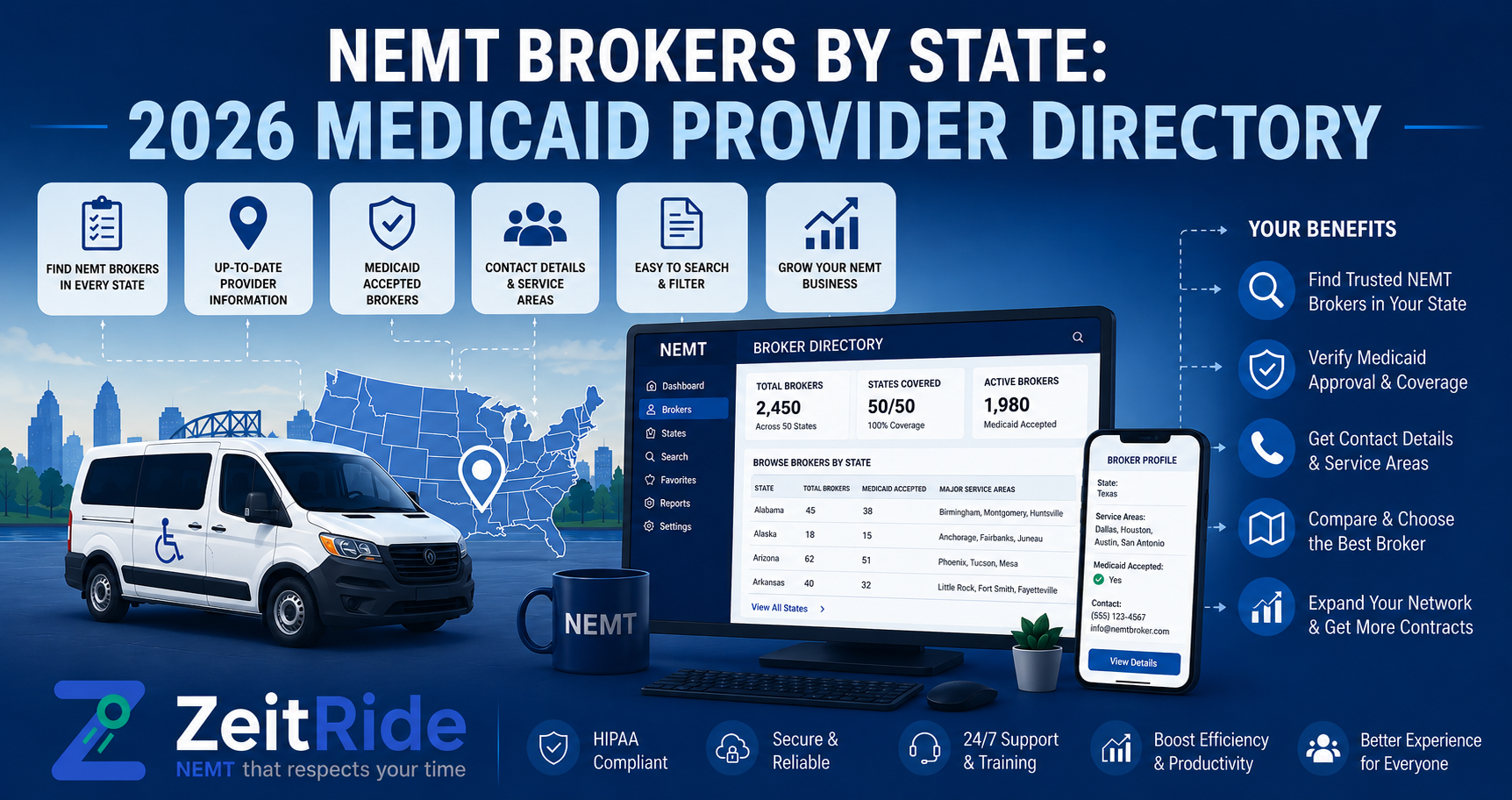
NEMT Brokers by State: 2026 Medicaid Provider Directory
Find the NEMT broker or Medicaid transportation administrator in every state, plus provider enrollment paths and major 2026 broker changes.
Quick answer
The NEMT broker in your state depends on whether Medicaid uses a statewide broker, regional brokers, managed-care vendors, or direct administration. Use the directory below, then verify the member’s county and health plan before applying.
ZeitRide Team
NEMT Operations Expert
Medicaid transportation is not administered the same way in every state. Some programs use one statewide broker, while others assign rides through regional organizations, counties, tribes, managed care plans, or the state Medicaid agency. That structure determines where an NEMT company applies, who sends trips, and which documentation is required for payment.
This provider-focused directory identifies the main NEMT administration path in all 50 states and Washington, D.C. It is intended for transportation companies researching network enrollment—not members scheduling a ride. After identifying the correct network, ZeitRide’s NEMT broker integration workflow can help move assignments into scheduling, dispatch, documentation, and billing.
The directory is based on the federal Medicaid Transportation Coverage Guide, CCAM-TAC state NEMT profiles, official state sources, and current health-plan notices. Contracts can change, so verify the member’s county, program, and health plan before applying or accepting trips.
Who Is the NEMT Broker in My State?
The NEMT broker in your state may be a single statewide company, a regional organization, a county program, a health plan’s transportation vendor, or the Medicaid agency itself. Use the directory as a starting point, then confirm whether the member is enrolled in fee-for-service Medicaid, managed care, a tribal program, or another covered population.
How to Use This NEMT Broker List
- Find the state and note whether its model is direct, statewide, regional, or mixed.
- Confirm the member population, county, Medicaid plan, and transportation mode you intend to serve.
- Complete state Medicaid enrollment first when required, then apply to the broker or plan network.
- Verify rates, service areas, insurance limits, EVV rules, vehicle standards, and trip-delivery methods before signing.
Broker approval does not always replace state enrollment. Many providers need both an active Medicaid record and a separate credentialing file. Review how to get NEMT contracts before submitting applications.
2026 NEMT Brokers by State Directory
Last verified: August 1, 2026. “MCO-specific” means the vendor depends on the member’s health plan. “Direct” means a public entity retains the main administrative role instead of using one commercial statewide broker.
| State | 2026 NEMT model | Primary broker or administrator | Provider starting point |
|---|---|---|---|
| Alabama | Direct | Alabama Medicaid Agency | Enroll with Alabama Medicaid; verify NET authorization and billing rules. |
| Alaska | Direct | Alaska Medicaid | Enroll with the state; confirm local ground, air, ferry, and taxi rules. |
| Arizona | Mixed: direct + MCO | AHCCCS plans; AIHP direct pathway | Register with AHCCCS, then join relevant plan or vendor networks. |
| Arkansas | Regional brokers | Verida, CADC, and AAA of Southeast Arkansas | Identify your NET region and apply to its assigned broker. |
| California | Mixed: direct + managed care | Medi-Cal plans, counties, and plan vendors | Enroll with Medi-Cal and target plans serving your counties. |
| Colorado | Statewide transition | MediDrive | Follow MediDrive contracting and confirm your county’s transition phase. |
| Connecticut | Statewide broker | MTM Health | Apply to the MTM transportation provider network. |
| Delaware | Statewide broker | ModivCare | Complete Medicaid enrollment and ModivCare credentialing. |
| District of Columbia | Mixed: statewide + MCO | MTM for Straight Medicaid; MCO vendors | Join MTM and relevant managed-care transportation networks. |
| Florida | Mixed: direct + MCO | AHCA and plan-specific brokers; MTM for UHC | Enroll with Florida Medicaid, then credential with target plans. |
| Georgia | Regional broker | Verida regional network | Apply to Verida and confirm your DCH service region. |
| Hawaii | Mixed: direct + MCO | Med-QUEST and health-plan vendors | Enroll with Med-QUEST and applicable plan networks. |
| Idaho | Statewide broker | MTM Health | Complete Idaho Medicaid requirements, then apply to MTM. |
| Illinois | Mixed: direct + MCO | HFS/NETSPAP and MCO vendors | Enroll through IMPACT and join applicable MCO networks. |
| Indiana | Mixed: statewide + MCO | Verida for Traditional Medicaid; MCO vendors | Maintain IHCP enrollment and verify each program’s vendor. |
| Iowa | Mixed: statewide + MCO | MTM and MCO-designated vendors | Confirm the member plan and join required networks. |
| Kansas | MCO-contracted | KanCare plan transportation vendors | Apply to each KanCare plan vendor you intend to serve. |
| Kentucky | Regional brokers | HSTD regional coordinators | Enroll with Medicaid and each relevant regional coordinator. |
| Louisiana | Mixed: statewide + MCO | Verida and plan-specific brokers | Complete Medicaid enrollment and applicable broker contracts. |
| Maine | Regional brokers | ModivCare and community-action partners | Check MaineCare’s county broker list before applying. |
| Maryland | County administered | Local health departments and county programs | Contact the local health department transportation manager. |
| Massachusetts | Regional brokers | MART and GATRA | Apply to the broker covering your cities and towns. |
| Michigan | Mixed: county + plan pathways | County MDHHS offices and plan vendors | Confirm the member’s county and health plan. |
| Minnesota | Mixed: county/tribal + MCO | Counties, tribes, and health plans | Enroll with Medicaid, then contract with relevant local or plan networks. |
| Mississippi | Mixed: statewide + MCO | ModivCare and MCO vendors | Enroll with Medicaid and applicable transportation networks. |
| Missouri | Statewide broker | MTM Health | Apply to MTM’s Missouri provider network. |
| Montana | Direct | Montana Medicaid | Enroll with the state and follow authorization and claims rules. |
| Nebraska | Mixed: direct + MCO | DHHS and plan vendors; MTM for UHC | Maintain state enrollment and join each relevant MCO vendor. |
| Nevada | Statewide broker | MTM Health | Apply to MTM and confirm Nevada-specific standards. |
| New Hampshire | Mixed: statewide + MCO | CTS, MTM, and plan vendors | Apply to the vendor tied to the member’s program or MCO. |
| New Jersey | Statewide broker | ModivCare | Complete NJ FamilyCare requirements and apply to ModivCare. |
| New Mexico | Mixed: direct + MCO | Centennial Care plan brokers | Enroll with Medicaid and applicable MCO networks. |
| New York | Statewide broker | Medical Answering Services (MAS) | Complete Medicaid enrollment and MAS provider requirements. |
| North Carolina | Mixed: county + MCO | County DSS; ModivCare, MTM, or plan vendors | Contract with county DSS and/or the applicable managed-care broker. |
| North Dakota | Direct | Human service zones and tribal offices | Enroll with Medicaid and work with the relevant zone or tribe. |
| Ohio | Mixed: county + MCO | County JFS offices and MCE vendors | Contract with county JFS and relevant managed-care vendors. |
| Oklahoma | Mixed: statewide + MCO | ModivCare for SoonerRide; plan vendors | Confirm whether the member uses SoonerRide or SoonerSelect. |
| Oregon | Regional brokerages | CCO transportation brokerages | Apply to the brokerage serving each CCO and region. |
| Pennsylvania | County + regional | County MATP programs; ModivCare in Philadelphia | Contact county MATP or ModivCare for Philadelphia. |
| Rhode Island | Statewide broker | MTM Health | Apply to MTM’s Rhode Island network. |
| South Carolina | Regional model | ModivCare regional structure | Apply to ModivCare and confirm your service region. |
| South Dakota | Direct | South Dakota Medicaid | Enroll with the state and follow direct reimbursement rules. |
| Tennessee | MCO-contracted | Verida and Tennessee Carriers | Identify the TennCare MCO and apply to its broker. |
| Texas | Mixed: state + MCO | HHSC and MCO brokers; SafeRide for UHC | Join the transportation vendor for each target managed-care plan. |
| Utah | Statewide broker | ModivCare | Complete Utah Medicaid requirements and contract with ModivCare. |
| Vermont | Regional/public network | VPTA and local transit providers | Contact the local transit provider serving the member. |
| Virginia | Mixed: statewide + MCO | ModivCare and plan vendors; SafeRide for UHC | Maintain DMAS enrollment and join relevant plan networks. |
| Washington | Regional brokers | HCA nonprofit brokers, including Hopelink and Paratransit | Use the HCA county directory and apply to the assigned broker. |
| West Virginia | Statewide broker | ModivCare | Apply to ModivCare and confirm state-specific requirements. |
| Wisconsin | Statewide transition pending | MTM currently; Verida selected in notice of intent | Keep current processes until DHS publishes transition steps. |
| Wyoming | Direct | Wyoming Medicaid | Enroll with the state and follow authorization and billing rules. |
This table is a provider-research starting point, not a substitute for a current contract, provider manual, or health-plan roster. Providers serving several counties or member populations may need multiple agreements.
What the Main NEMT Broker Models Mean
| Model | How it works | What providers usually need |
|---|---|---|
| Direct | A state, county, tribe, or public agency authorizes and pays for transportation. | Medicaid enrollment, local approval, prior authorization, and correct fee-for-service billing. |
| Statewide broker | One company manages eligibility, reservations, trip assignment, network standards, and often payment. | State enrollment where required plus the broker’s driver, vehicle, insurance, and contract review. |
| Regional broker | Different organizations cover assigned counties, districts, or transit regions. | A separate contract for each region the provider intends to serve. |
| Mixed or MCO-contracted | Fee-for-service and managed-care members follow different transportation pathways. | The member’s plan must be identified before accepting, documenting, or billing the trip. |
For branded network requirements, see the ZeitRide guides on how to become a ModivCare provider and join the MTM Health transportation network.
Important NEMT Broker Changes in 2026
Several 2026 changes show why state-level research is not enough. Colorado began a phased transition to MediDrive, Wisconsin announced an intended future change, Maine adjusted regional coverage, and UnitedHealthcare changed vendors in several states.
| Market | 2026 change | Provider implication |
|---|---|---|
| Colorado | MediDrive began serving the nine-county metro area July 1. | Follow the transition instructions for your county. |
| Wisconsin | DHS issued a notice of intent to select Verida; MTM remains active until further notice. | Keep current workflows until DHS announces the handoff. |
| Maine | ModivCare expanded into the midcoast region July 1. | Check the current MaineCare county broker list. |
| Nebraska — UHC | MTM became the plan’s NEMT vendor January 1. | Join MTM separately if serving this plan. |
| Texas — UHC | SafeRide Health began managing NEMT January 1. | Confirm SafeRide network and workflow requirements. |
| Florida — UHC | MTM began managing NEMT March 1. | Verify plan-specific reservation and claims rules. |
| Virginia — UHC | SafeRide Health began managing NEMT March 1. | DMAS enrollment does not replace vendor credentialing. |
Official references include Colorado provider information, Wisconsin’s vendor announcement, and MaineCare transportation information. Providers should also monitor notices from each health plan they serve.
How to Become a Provider for the Broker in Your State
Use this sequence as a general starting point, then follow the state and broker instructions for your market.
- Register the business and obtain required state, local, or transportation licenses.
- Obtain the appropriate NPI and complete Medicaid provider enrollment when required.
- Prepare commercial insurance, driver screening and training records, vehicle inspections, and accessibility documents.
- Apply for the exact counties, transportation modes, and member populations you can serve reliably.
- Review rates, no-show rules, wait-time policies, payment timelines, audit rights, and performance standards.
- Configure trip intake, dispatch, GPS timestamps, signatures, EVV records, billing, and remittance review before launch.
Maintain one controlled credentialing folder instead of rebuilding documents for each application. The NEMT documentation requirements checklist explains the trip, driver, vehicle, insurance, and authorization records commonly needed for audits.
What to Verify Before Signing a Broker Agreement
| Contract area | Question to confirm |
|---|---|
| Coverage | Which counties, plans, facilities, and transportation modes are included? |
| Rates | How are base fares, mileage, wait time, no-shows, tolls, and after-hours trips paid? |
| Trip evidence | Which GPS, timestamp, signature, mileage, authorization, and EVV fields are mandatory? |
| Operations | How are new trips, cancellations, and same-day changes delivered to providers? |
| Performance | Which on-time, acceptance, complaint, and documentation metrics affect future assignments? |
| Payments | What are the billing cycle, denial process, dispute window, and remittance format? |
A high trip count does not guarantee a profitable contract. Compare reimbursement with loaded and unloaded mileage, driver availability, documentation workload, payment timing, and the service levels your fleet can perform consistently.
Managing Trips From Multiple Medicaid Transportation Brokers
Multiple broker contracts can increase trip volume, but they also create different file formats, service codes, member identifiers, cancellation feeds, billing rules, and scorecards. Manual re-entry raises the risk of missed updates, incorrect pickup times, and incomplete payment documentation.
A connected workflow should move each trip through intake, scheduling, route optimization, live dispatch, driver GPS events, signatures, billing, and remittance review. After enrollment, use the provider playbook for getting more NEMT trips from brokers to strengthen on-time performance and clean documentation.
Build compliance into the first trip by capturing the assigned driver and vehicle, pickup and drop-off timestamps, GPS locations, authorization number, mileage, service level, signatures, wait time, and exception notes. The NEMT EVV compliance guide explains how to create a stronger audit trail.
Frequently Asked Questions
Q: Who is the NEMT broker in my state?
It depends on the state’s model and the member’s Medicaid program. The responsible organization may be a statewide broker, regional broker, county agency, managed-care transportation vendor, tribe, or state Medicaid office.
Q: Do all states use an NEMT broker?
No. Some states administer NEMT directly through state, county, tribal, or local agencies. Others use statewide brokers, regional networks, managed-care vendors, or a combination of models.
Q: How do I find NEMT brokers in my area?
Start with the state row, then confirm the member’s county and Medicaid health plan. In regional and mixed states, the county or MCO often determines the correct transportation network.
Q: Do I need Medicaid enrollment before applying to a broker?
Often, yes. Many brokers require an active state Medicaid provider record before final contracting, although some may begin preliminary network review earlier.
Q: Can one NEMT company work with multiple brokers?
Yes. Providers may contract with several brokers, MCO vendors, county programs, and facilities. Each agreement can have different rates, service areas, portals, documentation rules, and performance standards.
Q: Does ZeitRide integrate with every broker in this directory?
Not automatically. ZeitRide supports confirmed integrations with selected networks and evaluates additional connections as requirements change. Request a check using the exact broker, state, plan, and trip format.
Turn Broker Approval Into a Repeatable Operation
Finding the right network is only the first step. The provider must still import assignments accurately, build efficient routes, keep dispatchers and drivers aligned, capture audit-ready evidence, and bill completed trips. Book a broker integration demo and bring one real trip file so ZeitRide can map the workflow from intake through billing.
Rather see it than read about it?
Bring a real route, a couple of drivers, and your current process. 15 minutes, zero pitch.