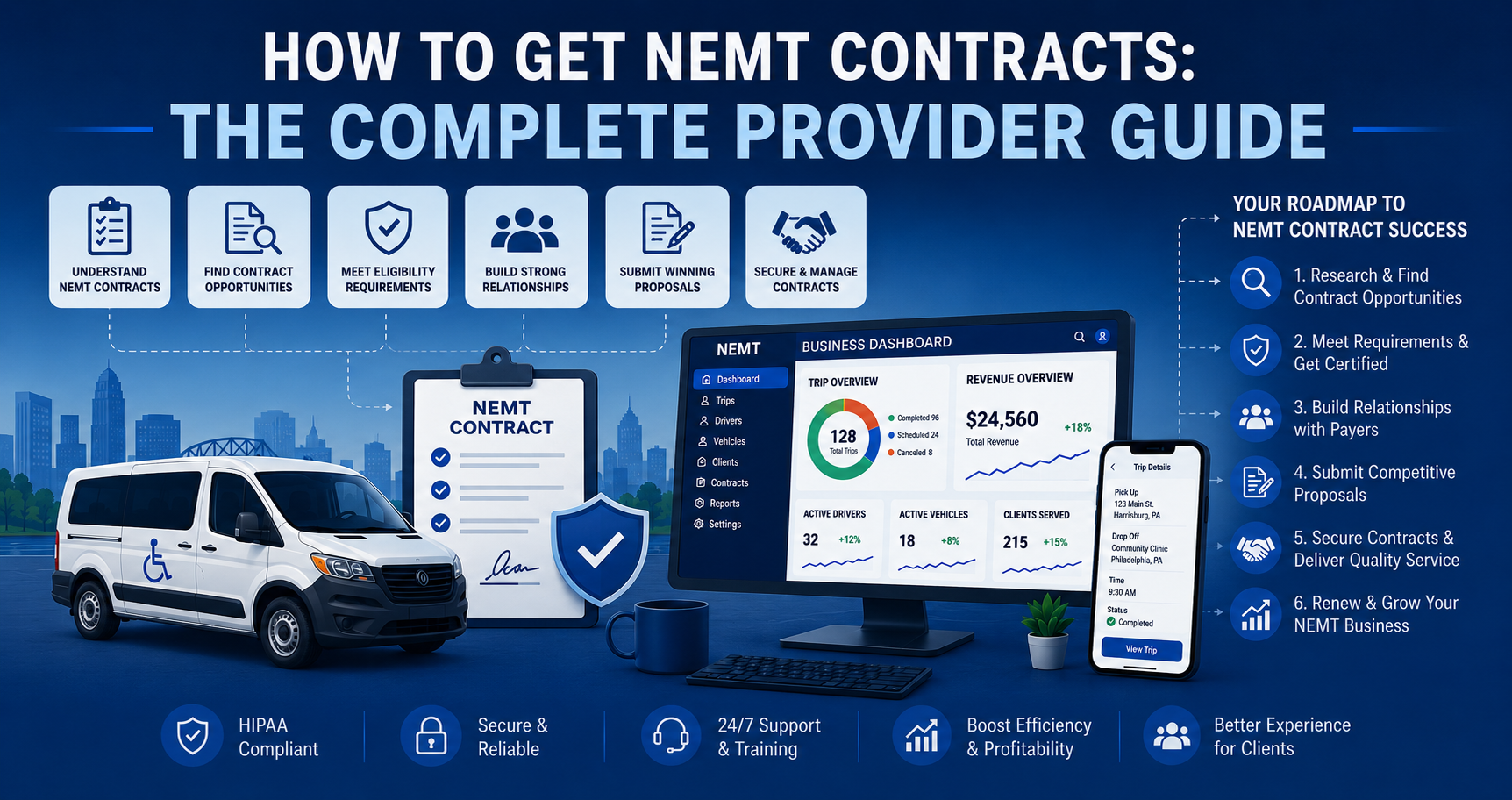
How to Get NEMT Contracts: The Complete Provider Guide
Broker networks, facility agreements, Medicaid RFPs, private pay — the four ways NEMT providers win contracts, what each pays, and how to qualify.
Quick answer
NEMT providers get contracts four ways: enrolling with Medicaid brokers (ModivCare, MTM, MAS), signing direct agreements with dialysis centers and nursing homes, bidding on state Medicaid or MCO RFPs, and serving private-pay clients. Each requires insurance, credentialed drivers, and GPS trip records.
ZeitRide Team
NEMT Operations Expert
Vehicles without contracts are just parked capital. If you're researching how to get NEMT contracts, you're at the moment that decides whether your fleet runs full manifests or sits half-empty — and most advice out there stops at "network with facilities." This guide goes further. We'll break down the four contract channels available to US providers, what each realistically pays, what brokers and facilities check before awarding trips, and a 30-day plan to land your first agreement. The same playbook applies whether you searched for how to start a NEMT business last month or you're a five-van fleet looking to diversify revenue.
NEMT providers get contracts through four channels: Medicaid broker networks like ModivCare, MTM Health, and MAS; direct agreements with healthcare facilities such as dialysis centers and nursing homes; state Medicaid or MCO contracts won through RFPs; and private-pay clients. Every channel evaluates the same fundamentals before awarding work: proper insurance, credentialed drivers, compliant vehicles, and the ability to prove on-time performance with GPS trip records.
NEMT contract vs. service agreement: know the difference
A contract is a formal, usually competitively awarded commitment — a broker network agreement or a state RFP award — with defined rates, service levels, and penalties. A service agreement is a lighter arrangement with a facility (a dialysis clinic, an adult day program) that says: when we have riders, you get the call at these rates. New fleets almost always start with broker enrollment plus facility service agreements, then graduate to formal contracts as they build a performance record.
The 4 types of NEMT contracts compared
| Contract type | Who awards it | |||
|---|---|---|---|---|
| Contract type | Who awards it | Typical pay level | Payment speed | Best for |
| Broker network (ModivCare, MTM, MAS, SafeRide) | Medicaid transportation brokers | Lowest per trip, highest volume | 2–6 weeks after clean claims | New fleets needing immediate trip flow |
| Facility agreements | Dialysis centers, nursing homes, hospitals, adult day care | Mid-to-high per trip | Net-30 invoicing, typically | 1–10 van fleets building recurring routes |
| Direct Medicaid / MCO | State Medicaid agency or managed care plan via RFP | Set by contract; stable | Per contract terms | Established fleets with performance data |
| Private pay | Individuals and families | Highest per trip | Immediate (card/cash) | Filling schedule gaps, weekend work |
Before you pitch anyone: the credentialing checklist
Every contract channel screens for operational readiness before rates are even discussed. Get these in order first — most rejections happen here, not at the negotiation table.
- Commercial auto and general liability insurance at broker-required minimums — see our guide to NEMT insurance requirements
- Driver files: background checks, drug screening, license verification, and training certificates
- Vehicle standards: ADA-compliant wheelchair securement, inspections, maintenance logs
- Medicaid provider enrollment in your state (where required)
- Dispatch capability with GPS tracking and electronic trip records — brokers verify this during credentialing
- EVV compliance where your state mandates it
Path 1 — NEMT broker contracts: your fastest route to volume
For most US fleets, NEMT broker contracts are the first and largest revenue source. States contract brokers to manage Medicaid transportation, and brokers subcontract trips to credentialed local providers. Enrollment is free — the cost is paperwork and patience, with credentialing typically taking several weeks to a few months.
Start with the brokers active in your state. We've published step-by-step enrollment guides for the major networks: how to become a ModivCare provider, MTM Health provider enrollment, Medical Answering Services (MAS) in New York, and SafeRide Health.
How brokers decide who gets trips
Signing a broker agreement doesn't guarantee volume — brokers score providers continuously on on-time pickup rate, cancellation rate, complaint frequency, and documentation accuracy, then route trips toward the top of the leaderboard. Providers running dispatch software with live GPS and automated trip records consistently outscore fleets working from spreadsheets, because every data point brokers measure is captured automatically. Once you're enrolled, our guide on how to get more NEMT trips from brokers covers the scorecard mechanics in detail.
Path 2 — NEMT contracts with hospitals and nursing homes
Facility agreements pay better than broker trips and build predictable routes — but they're won through relationships, not applications. Your targets: skilled nursing facilities coordinating resident appointments, hospital discharge planners who need same-day rides home, rehabilitation centers, cancer treatment clinics, and adult day programs with daily group transport needs.
The decision-maker is usually a discharge planner, social worker, or facility administrator. What they care about is painfully simple: will the vehicle actually show up on time, and can you prove it? Walk in with your insurance certificate, driver credentials, and — this is the differentiator — sample GPS trip reports showing your on-time performance. That single artifact separates you from every provider pitching on a handshake.
Dialysis transportation contracts: the highest-value niche
Dialysis transportation contracts deserve their own focus because of the math: patients typically travel three times per week, every week, year-round. One clinic agreement can anchor a vehicle's entire schedule. Dialysis patients are among the largest rider groups in the industry — our breakdown of who uses NEMT covers what each rider type means for your fleet. Pitch clinic administrators on reliability for standing appointment times, and expect scrutiny on wheelchair capability and driver sensitivity training.
A simple outreach approach that works
- Identify 10 facilities within your service radius (dialysis clinics, SNFs, adult day programs)
- Call to ask who coordinates patient transportation — get a name, not a department
- Email a one-page capability sheet: insurance, vehicle types, service hours, sample on-time report
- Follow up in person within a week; offer a trial period at standard rates
- After 30 days of clean service, propose a written service agreement
Path 3 — Direct Medicaid and MCO contracts
Some states and managed care organizations contract directly with transportation providers instead of (or alongside) brokers, particularly in rural regions. These opportunities are published as RFPs on state procurement portals and require registration with your state Medicaid agency. Contract standards and program design vary widely by state — the federal Medicaid transportation program overview explains the coverage mandate behind it all. This path suits established fleets: RFPs demand documented performance history, financial statements, and compliance infrastructure a first-year operation rarely has. Watch your state's portal anyway — knowing renewal dates a year out is how incumbents get displaced.
Path 4 — Private pay and community clients
Private-pay riders — families arranging transport for aging parents, hospital discharges without coverage, seniors in independent living — pay the highest per-trip rates and pay immediately. This channel rarely fills a fleet alone, but it's ideal for weekend utilization and schedule gaps. A basic local presence (Google Business Profile, relationships with senior living communities) generates steady inquiries in most markets.
How much do NEMT contracts pay?
Rates vary by state, trip type, and channel, so treat these as planning ranges drawn from typical US market rates rather than quotes:
| Trip type | Typical per-trip range | |
|---|---|---|
| Ambulatory | $25–$50 | Base rate plus per-mile charges |
| Wheelchair | $45–$115 | Higher base; securement time factored in |
| Stretcher | $200+ | Requires specialized vehicle and staffing |
Broker trips sit at the lower end with mileage reimbursement layered on top — see our state-by-state look at how much Medicaid pays per mile. Facility and private-pay work typically commands 20–40% more per trip than broker rates for the same trip type. The real profitability lever isn't the rate, though — it's how many trips per vehicle per day your routing achieves, and how few claims you lose to denials.
Why providers lose contracts (and how to not be that provider)
- Missed and late pickups — the #1 reason brokers cut volume and facilities quietly stop calling
- Documentation gaps — missing signatures or trip logs turn completed rides into denied claims
- No performance reporting — when a facility asks for your on-time rate and you can't answer, the contract goes to someone who can
- Slow communication — dispatchers who can't tell a clinic where the vehicle is right now
Notice the pattern: contracts are lost operationally, not commercially. This is where software stops being overhead and becomes a sales asset — a live dispatch board, driver GPS, e-signatures, and automated reports are precisely the proof every contract channel asks for. That's the core of what NEMT software like ZeitRide does for $49 per vehicle.
Your 30-day plan to land your first NEMT contract
- Week 1: Complete the credentialing checklist — insurance certificates, driver files, vehicle documentation
- Week 1–2: Submit broker applications for every network active in your state
- Week 2: Set up dispatch software so GPS records and trip documentation start accumulating from day one
- Week 2–3: Build your one-page capability sheet and contact 10 local facilities
- Week 3–4: Follow up in person with the 3–4 warmest facilities; offer a trial period
- Week 4: List your private-pay service locally; while broker credentialing processes, facility trials and private trips generate your first revenue and your first performance data
Frequently Asked Questions
Q: How do NEMT providers get contracts?
Through four channels: enrolling in Medicaid broker networks like ModivCare, MTM, and MAS; signing service agreements with facilities such as dialysis centers and nursing homes; bidding on state Medicaid or MCO RFPs; and serving private-pay clients. Broker enrollment plus facility outreach is the standard starting combination.
Q: How do I get medical transportation contracts with dialysis centers?
Contact the clinic administrator or social worker, present proof of insurance, wheelchair-capable vehicles, and GPS-backed on-time performance, and offer a trial period. Dialysis patients ride three times weekly, so clinics prioritize proven reliability over price.
Q: How much do NEMT contracts pay?
Typical US ranges are $25–$50 per ambulatory trip, $45–$115 per wheelchair trip, and $200+ for stretcher transport, plus per-mile reimbursement. Broker rates sit at the lower end; facility and private-pay agreements usually pay 20–40% more.
Q: Do I need a broker to get NEMT trips?
No, but most Medicaid volume in most states flows through brokers, so skipping them means relying entirely on facility agreements and private pay. Most successful fleets run both channels.
Q: Can I get NEMT contracts with only one van?
Yes. Brokers credential single-vehicle providers, and a one-van fleet can anchor its schedule with a single dialysis clinic agreement. What matters is insurance, credentialing, and documented reliability — not fleet size.
Q: How long does broker credentialing take?
Typically several weeks to a few months, depending on the broker and how complete your documentation is. Submitting insurance, driver, and vehicle files correctly the first time is the biggest factor in avoiding delays.
Q: What's the difference between an NEMT contract and a service agreement?
A contract is a formal, often competitively awarded commitment with defined rates and service levels. A service agreement is a lighter facility arrangement — they call you when riders need transport at agreed rates. New providers usually start with service agreements.
Every channel in this guide asks for the same proof: on-time performance, GPS trip records, and clean documentation. ZeitRide captures all of it automatically while running your dispatch, routing, and billing — for a flat $49 per vehicle per month. Book a 15-minute demo, bring a real route, and we'll show you the exact reports contract managers ask for.
Rather see it than read about it?
Bring a real route, a couple of drivers, and your current process. 15 minutes, zero pitch.