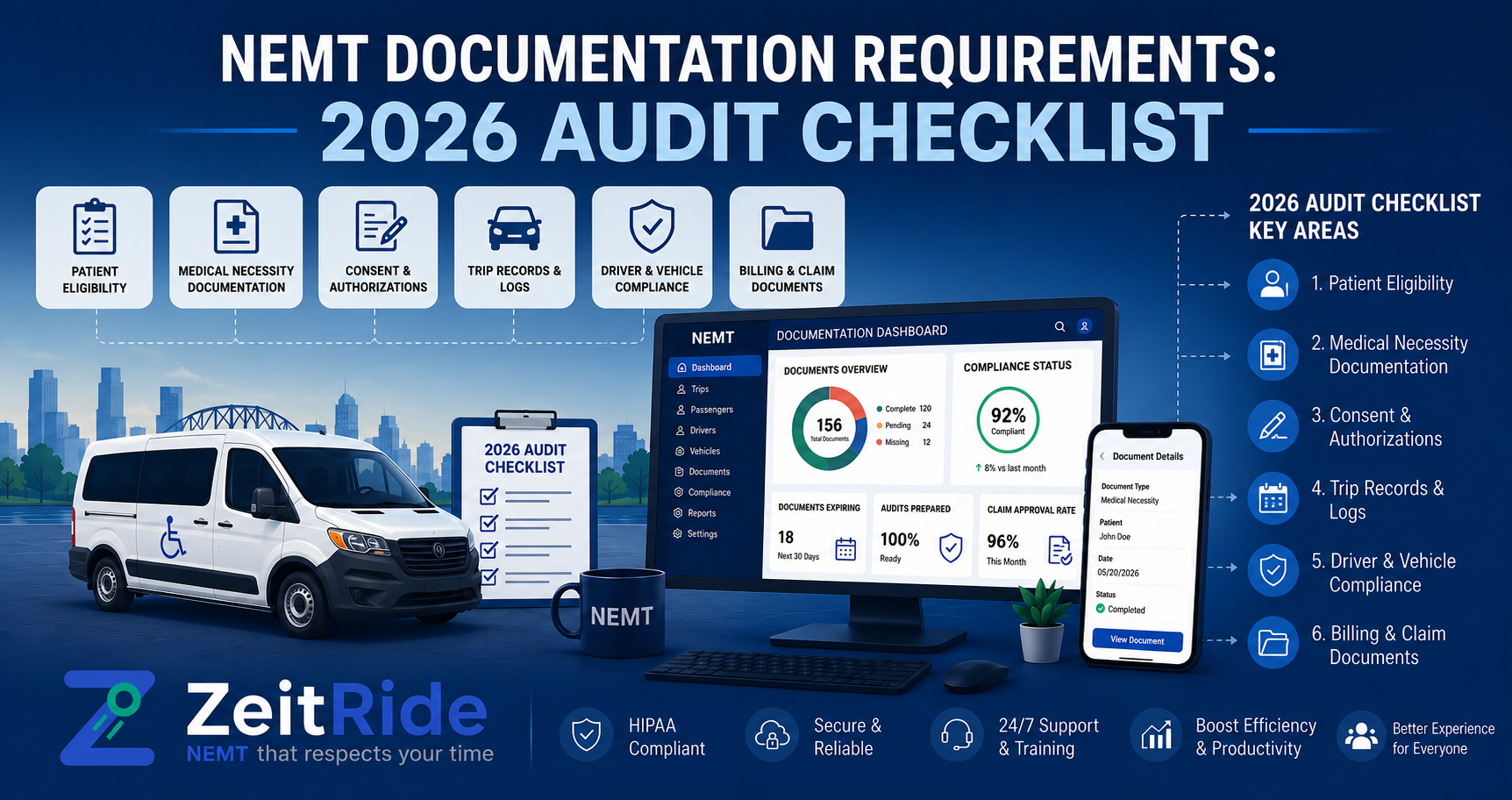
NEMT Documentation Requirements: 2026 Audit Checklist
Learn which trip records, authorizations, signatures, driver files, and vehicle documents NEMT providers need for Medicaid audits.
Quick answer
NEMT providers should keep records connecting each authorized trip to the rider, driver, vehicle, pickup and drop-off details, timestamps, mileage, proof of service, and billing claim. Exact requirements and retention periods vary by state, payer, and broker.
ZeitRide Team
NEMT Operations Expert
Completing an NEMT trip is only part of a provider's responsibility. The provider must also be able to show that the trip was authorized, delivered to the correct member, completed by a qualified driver and vehicle, and billed according to the applicable program requirements.
Incomplete records can lead to delayed payments, claim denials, repayment demands, broker disputes, or corrective action plans. A reliable documentation process should create evidence while the trip is happening—not force the billing team to reconstruct it later.
Providers using separate spreadsheets, paper manifests, driver text messages, and billing tools should understand how connected NEMT dispatch and billing software supports compliance.
Important: This guide provides general operational information for U.S. NEMT providers. Requirements vary by state Medicaid program, payer, managed-care organization, transportation broker, service type, and contract.
What Are NEMT Documentation Requirements?
NEMT documentation requirements are the records a transportation provider must create and retain to support the services it schedules, performs, and bills.
A complete record should clearly show who received the transportation, why the trip was authorized, who performed it, which vehicle was used, when and where the service occurred, and whether the submitted claim matches the completed service.
Exact requirements vary between programs, but providers generally need documentation covering the member, authorization, trip activity, driver, vehicle, proof of service, billing, and any later corrections.
CMS provides official NEMT resources for providers covering service-delivery systems, driver and vehicle criteria, and program-integrity considerations.
Why NEMT Documentation Matters in 2026
The HHS Office of Inspector General added Medicaid NEMT audits to its active work plan in May 2026. Previous reviews have examined prior authorizations, provider and driver qualifications, vehicle compliance, supporting trip records, and whether claims accurately reflected the services delivered.
Providers can review the current HHS OIG Medicaid work plan for current federal audit activity.
The practical lesson is straightforward: your team should be able to trace every billed trip from authorization through payment.
Complete NEMT Trip Documentation Requirements Checklist
The following table provides a practical baseline for NEMT trip documentation requirements. It should be customized according to the provider's state, payer, broker contracts, and service types.
| Record or Field | What to Capture | What It Helps Establish |
|---|---|---|
| Trip identifier | Internal trip number and broker or payer reference | Connects scheduling, dispatch, and billing records |
| Authorization | Authorization number, service type, approved units, and valid dates | Shows that the service was approved |
| Member information | Name, payer ID, contact details, and mobility needs | Identifies the rider and required service |
| Pickup details | Address, scheduled time, arrival time, and actual pickup time | Shows where and when service began |
| Destination details | Address or facility, appointment time, arrival time, and drop-off time | Shows where and when the trip ended |
| Driver information | Driver name or ID and qualification status | Identifies who performed the trip |
| Vehicle information | Vehicle ID, registration, capability, and compliance status | Identifies the vehicle used |
| Service level | Ambulatory, wheelchair, stretcher, or other approved mode | Confirms that the correct service was provided |
| Mileage | Loaded mileage and other payer-required mileage fields | Supports mileage-based billing |
| Proof of service | Signature, attestation, timestamps, or facility confirmation | Supports successful trip completion |
| Exceptions | No-show, cancellation, delay, address change, refusal, or incident | Explains deviations from the scheduled trip |
| Billing record | Claim number, service code, units, rate, and submission status | Connects the completed trip to the claim |
| Change history | Who changed the record, what changed, when, and why | Preserves accountability and record integrity |
The authorization, trip record, GPS data, signature, invoice, and claim should all describe the same service. Conflicting information creates avoidable billing and audit risk.
What Belongs in a Medicaid NEMT Audit Packet?
Medicaid NEMT documentation requirements extend beyond a single trip sheet. A payer, broker, managed-care organization, or auditor may request supporting files associated with the sampled service.
Trip and Authorization Records
- Broker assignment or trip request
- Prior authorization or standing-order information
- Member or eligibility information where required
- Scheduled manifest
- Actual pickup and drop-off details
- Trip status history
- No-show or cancellation records
- Proof of service
- Exception or incident notes
The approved service and completed trip should be easy to compare. Authorization information should remain connected to the final trip record whenever possible.
Driver Qualification Records
- Current driver's license
- Motor vehicle record
- Background-screening documentation
- Required training and certifications
- Exclusion checks where applicable
- Credential issue and expiration dates
The driver must have been qualified on the date the sampled trip occurred—not only on the date the report was created. ZeitRide's NEMT driver management software helps providers track driver records and upcoming credential expirations.
Vehicle and Inspection Records
- Vehicle registration
- Commercial insurance
- Required state or local permits
- Safety inspections
- Preventive-maintenance records
- Wheelchair-lift and securement checks
- Vehicle capability and seating information
Providers should retain dated records showing that the vehicle was eligible and suitable on the service date. See how NEMT fleet inspection records can be connected with vehicle status and compliance tracking.
Billing and Claim-Support Records
- Payer or transportation broker
- Authorization reference
- Service code and modifier
- Mileage or billed units
- Rate
- Claim or invoice number
- Submission status
- Payment, adjustment, rejection, or denial
ZeitRide's NEMT billing software helps connect completed trip information with billing-ready records. Providers experiencing repeated discrepancies should also review how to prevent NEMT billing errors.
Audit History and Record Corrections
Corrections should preserve the original information, the corrected value, the user who made the change, the date and time of the change, and the reason for the correction.
A searchable NEMT audit trail provides more accountability than a spreadsheet entry that can be silently overwritten.
NEMT Trip Log Requirements Before, During, and After Service
The easiest way to meet NEMT trip log requirements is to assign each required field to a specific stage of the workflow and make one team member responsible for completing or verifying it.
Before the Trip
- Confirm the member's identity
- Identify the payer or broker
- Record the authorization number
- Confirm the approved service level
- Verify pickup and destination addresses
- Record appointment and pickup times
- Document mobility and assistance needs
- Assign a qualified driver and suitable vehicle
During the Trip
- Record arrival at pickup
- Capture the actual pickup time
- Record the pickup location
- Capture destination arrival and drop-off time
- Record loaded mileage where required
- Collect the required signature or attestation
- Document route or address changes
- Record delays, no-shows, refusals, or incidents
GPS records can strengthen the documentation, but GPS should support the complete record rather than replace authorization, member identity, service-level, and proof-of-service information. Where electronic verification applies, review ZeitRide's NEMT EVV compliance guide.
After the Trip
- Verify that required fields are complete
- Confirm that times and mileage are reasonable
- Attach the required proof of service
- Explain cancellations, delays, or other exceptions
- Confirm driver and vehicle eligibility
- Compare the completed service with the authorization
- Confirm that the billing record matches the trip
A completed status should mean more than the vehicle reached the destination. It should mean the service is fully documented and ready to support a claim.
What Counts as Proof of Service?
Proof of service is the evidence showing that the authorized transportation occurred as reported.
- Rider or facility signature
- Electronic signature
- Driver attestation where permitted
- Pickup and drop-off timestamps
- GPS location data
- Facility confirmation
- Loaded mileage
- Dispatch status history
- Trip and exception notes
No single item should automatically be treated as universal proof for every payer. GPS may show that a vehicle visited a location, but it may not independently prove rider identity, authorization, service level, or successful completion.
Common NEMT Documentation Failures
- Missing authorization numbers
- Incorrect member or Medicaid identifiers
- Pickup or drop-off times entered later from memory
- Missing or unsupported mileage
- Incomplete signatures or attestations
- Unexplained pickup or destination changes
- Expired driver credentials
- Lapsed vehicle inspections
- Claims billed under the wrong service level
- Missing no-show or cancellation records
- Records scattered across multiple systems
- Corrections that overwrite the original information
When the same field is missing across several trips, the provider should correct the workflow causing the problem instead of repeatedly repairing individual records.
NEMT Record Retention Requirements
There is no single record-retention period that applies universally to every NEMT provider. NEMT record retention requirements may come from federal and state rules, Medicaid provider manuals, managed-care agreements, broker contracts, billing requirements, insurance obligations, and employment or vehicle-record laws.
Providers should maintain a written retention schedule covering trip records, authorizations, member information, driver files, vehicle documents, billing records, incident reports, contracts, audit correspondence, and corrective action records.
Records should not be destroyed while an audit, payment dispute, investigation, or legal hold remains open.
How to Run a Simple 10-Trip Self-Audit
A small internal NEMT audit checklist can identify recurring gaps before a payer or broker selects its own sample.
- Select 10 billed trips involving different drivers, vehicles, payers, and service levels.
- Compare each claim with the original authorization.
- Confirm that times, locations, mileage, and proof of service are complete.
- Verify that the driver and vehicle were eligible on the service date.
- Review cancellations, no-shows, address changes, and corrections.
- Classify each trip as complete, requiring correction, or unsupported.
- Fix the workflow causing repeated errors.
- Review another sample after the correction is implemented.
The purpose of a self-audit is not only to repair individual records. It is to prevent the same documentation gap from appearing again.
How ZeitRide Supports an Audit-Ready Workflow
ZeitRide connects operational and billing information so providers do not have to reconstruct trips from paper forms, text messages, spreadsheets, and disconnected systems.
- Trip and authorization references
- Driver and vehicle assignments
- Driver mobile status updates
- GPS-aware trip activity
- Electronic signatures and forms
- Driver qualification records
- Vehicle inspection records
- Billing-ready trip information
- User-attributed change history
- Searchable audit records
Software does not replace the provider's responsibility to understand applicable Medicaid, payer, and broker rules. It makes an approved documentation process more consistent, attributable, and easier to verify.
Final NEMT Audit Checklist
Before marking a trip ready to bill, confirm that:
- Member and payer information is correct
- A valid authorization supports the trip
- The approved and delivered service levels match
- Pickup and destination details are complete
- Actual service times are recorded
- Required mileage is documented
- Proof of service is attached
- Exceptions are explained
- The driver was eligible
- The vehicle was eligible
- The claim matches the trip record
- Corrections preserve an audit history
- The complete record can be retrieved quickly
The strongest documentation standard is simple: someone who was not present should still be able to understand exactly what happened.
Make Every Completed Trip Easier to Defend
If your team needs multiple spreadsheets, paper folders, driver messages, and broker portals to answer one documentation request, the process is creating unnecessary risk.
ZeitRide connects scheduling, dispatch, driver activity, vehicle records, billing workflows, and audit history in one NEMT platform.
Can your team retrieve a complete trip record in five minutes? Book a NEMT Documentation Readiness Demo and see how ZeitRide can connect the operational, driver, vehicle, billing, and audit records supporting each trip.
Frequently Asked Questions
Q: What information must be included in an NEMT trip record?
An NEMT trip record should generally include the member, authorization, service date, pickup and destination, scheduled and actual times, driver, vehicle, service level, mileage where required, proof of service, exceptions, and related billing information.
Q: What documents may Medicaid auditors request from an NEMT provider?
Auditors may request trip records, prior authorizations, eligibility evidence, driver qualifications, vehicle and inspection records, insurance, proof of service, billing records, payment information, exception notes, and record-change history.
Q: How long should NEMT providers retain trip records?
Retention periods vary by state, payer, broker contract, and record type. Providers should follow the longest applicable requirement and preserve records longer when an audit, dispute, investigation, or legal hold is active.
Q: Is GPS tracking enough to prove an NEMT trip occurred?
GPS can support a trip record by showing vehicle location, route, and timing, but it may not independently prove rider identity, authorization, service level, or successful completion.
Q: Are electronic signatures acceptable for NEMT records?
Electronic signatures may be accepted when permitted by the relevant state, payer, or broker and when the record includes sufficient signer, date, time, and trip information.
Q: Should no-shows and canceled NEMT trips be documented?
Yes. Providers should record the scheduled trip, arrival or contact attempts, timestamps, reason, required notifications, and any broker or payer action.
Rather see it than read about it?
Bring a real route, a couple of drivers, and your current process. 15 minutes, zero pitch.