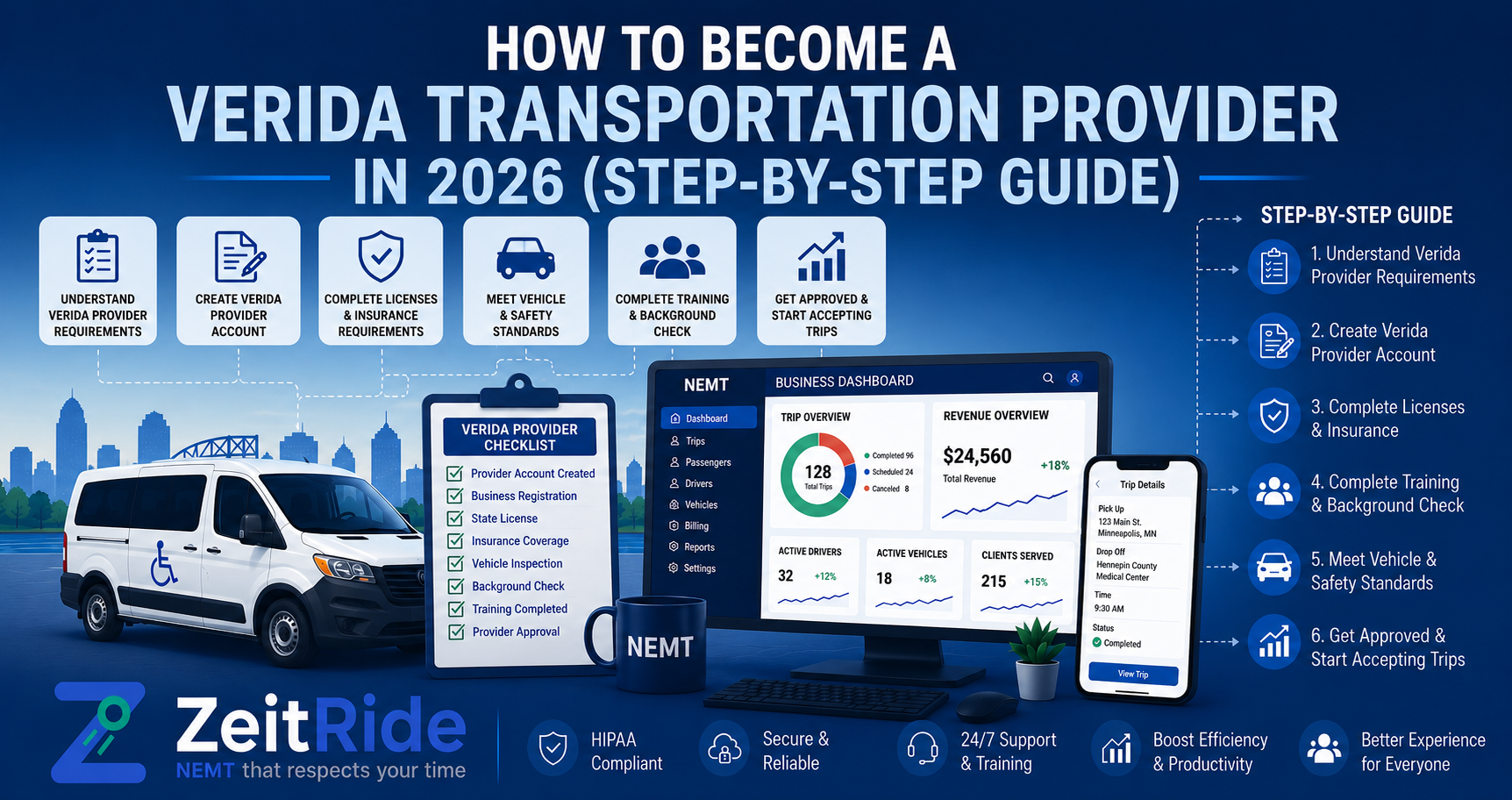
How to Become a Verida Transportation Provider in 2026 (Step-by-Step Guide)
Everything NEMT operators need to become a Verida transportation provider in 2026 — requirements, the 4-step credentialing process, trainings, and timelines.
Quick answer
To become a Verida transportation provider, submit a Request for Qualifications form with your driver and vehicle lists, pass Verida's business documentation review, complete vehicle inspections and all eight required driver trainings, then attend a provider orientation. Credentialing typically takes 30–45 days (estimated).
ZeitRide Team
NEMT Operations Expert
If you run — or plan to launch — an NEMT fleet in Georgia, Indiana, Tennessee, Arkansas, Louisiana, or Washington, DC, learning how to become a Verida transportation provider is one of the fastest routes to steady Medicaid trip volume. Verida manages non-emergency medical transportation for millions of Medicaid members across six states, and its network runs entirely on independent providers like you. The catch: Verida's own website scatters enrollment details across separate state pages, and none of them tell you how long credentialing takes, why applications get rejected, or what running Verida trips actually looks like. This guide pulls everything into one place. For other brokers active in your state, start with our NEMT brokers by state directory.
The short answer: To become a Verida transportation provider, you complete a four-step credentialing process — submit a Request for Qualifications (RFQ) form with driver and vehicle lists, pass a business documentation review, complete vehicle inspections and required driver trainings, and attend a provider orientation. Based on provider reports, the process typically takes 30–45 days (estimated), assuming Verida has demand in your area.
What Is Verida? (Formerly Southeastrans)
Verida is a minority-owned NEMT broker headquartered in Villa Rica, Georgia, about 30 miles west of Atlanta. Founded in 2000 as Southeastrans, the company rebranded to Verida in 2022 — so if you've heard operators talk about becoming a Southeastrans transportation provider, it's the same organization. Verida contracts with state Medicaid agencies and managed care organizations, then subcontracts the actual trips to a network of independent transportation companies.
The company reports contracting with over 900 NEMT providers, credentialing more than 5,300 vehicles and drivers, and managing over 5 million trips annually for roughly 3 million covered individuals. As a Passenger Assistance Safety and Sensitivity (PASS) certified broker, Verida holds its providers to specific training standards — which is exactly what the credentialing process below verifies.
Where Verida Operates: States and Programs
Unlike ModivCare or MTM, Verida is a regional NEMT broker. It currently manages programs in six markets, and requirements — especially insurance minimums — can differ slightly by state. Here's the current footprint:
| State/Market | Program Verida Serves | Notes for Providers |
|---|---|---|
| Georgia | Georgia Medicaid NET (regional model) | Verida's home state and largest market; regional Provider Relations Managers |
| Indiana | FSSA Medicaid (traditional Medicaid) | One of the major brokers operating in Indiana |
| Tennessee | BlueCare & TennCareSelect members | Managed-care based; strong demand in rural counties |
| Arkansas | Arkansas Medicaid NET | State-contracted regions |
| Louisiana | Louisiana Medicaid (select health plans) | Verida is one of several brokers, depending on the plan |
| Washington, DC | HSCSN members | Smaller, specialized program |
If you operate in Georgia or Indiana, remember that broker enrollment is only half the equation — you'll also want dispatch and billing set up before trips start landing. ZeitRide supports fleets in both states; see our NEMT software for Georgia and NEMT software for Indiana pages.
Verida Provider Requirements: The Checklist
Before you touch the application, make sure you can produce every item below. Verida's documentation review (Step 2) is where most delays happen, and missing paperwork is the easiest way to stall for weeks. The core Verida provider requirements include:
- Current business license for your transportation company
- Verification of commercial liability insurance coverage (minimums vary by state — some providers report combined single limit requirements around $1.5M; confirm exact figures with your local Provider Relations Manager)
- Driver credentials and valid licenses for every listed driver
- Current criminal background checks for all drivers
- Current drug screens for all owners and drivers
- Current motor vehicle records (MVR) for all drivers
- A complete vehicle list with vehicles that can pass a comprehensive safety inspection
- Willingness to complete Verida's full driver training program (detailed below)
Insurance is usually the biggest cost line here. If you're still shopping coverage or want to understand what drives premiums, our guide to NEMT insurance costs in 2026 breaks down realistic per-vehicle numbers before you commit to a policy.
The Verida Credentialing Process: 4 Steps
The Verida credentialing process is deliberately strict — it's how the broker maintains its PASS certification and its contracts with state Medicaid agencies. Here's each step from the operator's side.
Step 1 — Submit the Request for Qualifications (RFQ) Form
Everything starts with Verida's online Request for Qualifications form, submitted along with your driver list and vehicle list on Verida's official interested providers page. This is not a formality: Verida reviews every application against regional demand and only moves forward if it needs new providers where you're located. If demand exists, you'll be contacted for an interview. If not, your application sits — which is why checking which brokers actually assign trips in your county should come before you spend money on vehicles or insurance riders.
Step 2 — Documentation Review
After a successful interview, Verida requests the full documentation package from the checklist above: business license, insurance verification, driver credentials, background checks, drug screens, and MVRs. Treat this like a Medicaid audit — because functionally, it is one. Providers who keep organized, audit-ready files move through in days; providers who scramble lose weeks. Our NEMT documentation requirements checklist covers how to build that file system once and reuse it for every broker you enroll with.
Step 3 — Vehicle Inspections and Driver Training
Once your documents clear, Verida schedules a comprehensive safety inspection for every vehicle you intend to run in the network. In parallel, every driver must complete Verida's required training program. The full list:
- First Aid
- CPR
- Defensive Driving
- Passenger Sensitivity and Customer Service Training
- Spill Kit Training
- Proper Lifting Techniques
- Wheelchair Securement
- Driver Orientation
Budget both time and money for this step — certifications like CPR and First Aid carry real per-driver costs, and scheduling eight trainings across a roster is its own logistics problem. Fleets that track training expiration dates in their operations software avoid the nasty surprise of a driver being pulled from Verida trips mid-contract.
Step 4 — Owner Orientation and Contracting
The final step: the company owner attends an NEMT provider orientation conducted by Verida staff, covering contracting requirements, trip standards, and how trip assignment works. After orientation, you sign the contract and officially join the network. From this point, your performance record starts — and it determines how much volume you actually receive.
How Long Does Verida Credentialing Take?
Verida doesn't publish an official timeline. Based on provider reports across the industry, expect roughly 30–45 days from RFQ submission to signed contract (estimated) — if your region has demand and your paperwork is clean on the first pass. The full journey from starting an NEMT business to running Verida trips is longer, because broker credentialing sits on top of state Medicaid enrollment, insurance procurement, and vehicle acquisition. If you're at that earlier stage, start with our guide on how to get NEMT contracts, which maps the whole landscape — brokers, facilities, and private pay.
Why Verida Applications Get Rejected
Three failure points come up again and again. First, no regional need: Verida openly gates applications on whether it needs providers in your area — apply where the demand is, not just where you live. Second, insurance mismatches: policies missing required coverage limits or endorsements trigger back-and-forth that can take weeks, since policy changes require your insurer's cooperation. Third, incomplete driver files: one expired MVR or missing drug screen holds the entire application. The fix for all three is the same — verify requirements with your state's Provider Relations Manager before submitting, and build your documentation file to audit standard from day one.
After You're Approved: Running Verida Trips Profitably
Approval is where the real work starts. Verida assigns trips through its own systems and mobile technology, tracks provider performance, and manages claims — which means your on-time percentage, documentation quality, and claim cleanliness now directly control how much volume you get. Most Verida providers also run trips for other brokers, since ModivCare and MTM overlap Verida's states, so the practical challenge becomes running multiple broker feeds through one dispatch board without double-booking drivers. To understand how brokers score you once you're live, read our breakdowns of NEMT KPIs and broker scorecard metrics and how to get more NEMT trips from brokers.
That multi-broker problem is exactly what ZeitRide's NEMT software was built for: broker trip imports, AI-sequenced routing, EVV-ready documentation, and clean claims in one platform at $49/vehicle/month — so staying in good standing with Verida doesn't become a second job.
Verida vs. Other NEMT Brokers
Verida has a reputation as a provider-friendly regional broker with fair negotiations — but it's rarely your only option. In Georgia and Indiana, ModivCare operates alongside Verida; in Tennessee, MTM serves other plan populations. Smart operators credential with every broker active in their region, since each application reuses most of the same documentation. If Verida is your first, your second should probably be one of these: see our step-by-step guides on how to become a ModivCare provider and how to become an MTM Health transportation provider.
Ready before the trips arrive? Knowing how to become a Verida transportation provider gets you into the network — keeping your scorecard clean is what gets you volume. Book a 15-minute demo, bring a sample route, and we'll show you exactly how Verida trips run alongside your other brokers: imports, dispatch, EVV documentation, and clean claims on one board. No setup fees, no contracts, $49/vehicle/month.
Frequently Asked Questions
Q: Is Verida the same as Southeastrans?
Yes. Verida is the new name of Southeastrans, which rebranded in 2022. The company, founded in 2000 and headquartered in Villa Rica, Georgia, kept the same leadership, contracts, and provider network — only the brand changed.
Q: What states does Verida operate in?
Verida currently manages NEMT programs in six markets: Georgia, Indiana, Tennessee, Arkansas, Louisiana, and Washington, DC. Requirements and insurance minimums can vary by state, so confirm details with your local Provider Relations Manager.
Q: How long does Verida credentialing take?
Verida doesn't publish an official timeline, but providers commonly report around 30–45 days (estimated) from RFQ submission to signed contract, assuming regional demand exists and documentation is complete on the first pass.
Q: What driver trainings does Verida require?
Eight trainings: First Aid, CPR, Defensive Driving, Passenger Sensitivity and Customer Service, Spill Kit Training, Proper Lifting Techniques, Wheelchair Securement, and Driver Orientation. Every driver must complete all of them before running Verida trips.
Q: What insurance do you need to be a Verida provider?
Verida requires verified commercial liability coverage, with minimums that vary by state. Some providers report combined single limit requirements around $1.5M. Always confirm exact limits and endorsements with your state's Provider Relations Manager before binding a policy.
Q: Can I work with Verida and ModivCare at the same time?
Yes. Most NEMT operators in Verida's states credential with multiple brokers to keep vehicles full. Each broker credentials you separately, but the documentation largely overlaps, so subsequent applications go faster.
Q: Why would Verida reject my application?
The most common reasons: no current need for providers in your region, insurance that doesn't meet state-specific requirements, or incomplete driver files such as expired background checks, drug screens, or motor vehicle records.
Rather see it than read about it?
Bring a real route, a couple of drivers, and your current process. 15 minutes, zero pitch.