How to Bill Medicaid for NEMT: Codes, Modifiers & Claims Process
A step-by-step provider guide to Medicaid NEMT billing: HCPCS codes, origin/destination modifiers, documentation, claims, and broker vs. direct billing.
Quick answer
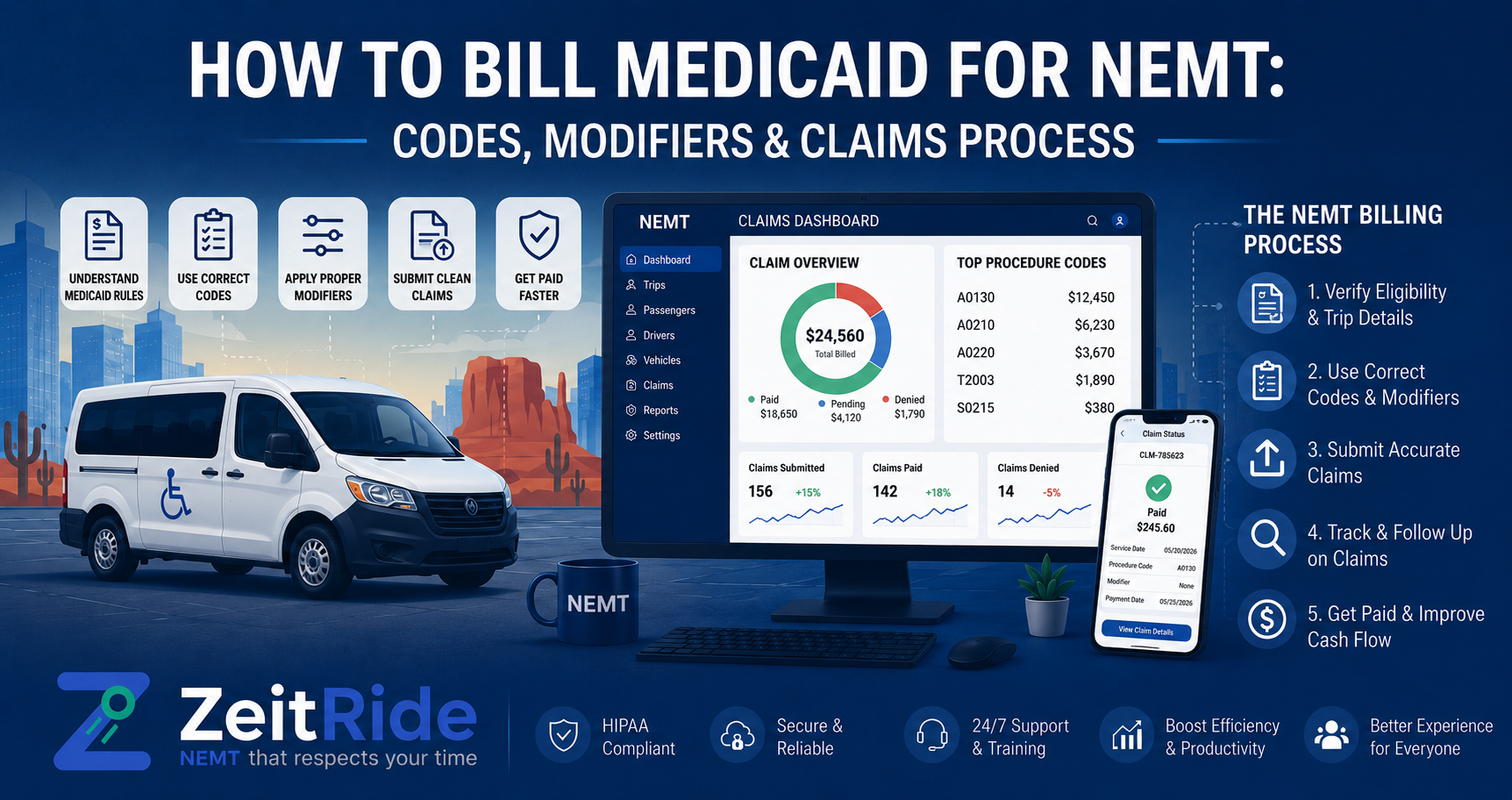
Verify member eligibility before the trip, document GPS mileage, times, and signatures, assign the correct HCPCS code with origin/destination modifiers, scrub the claim, submit via EDI 837P or CMS-1500 within your state's filing deadline, then post payments and work any denials.
ZeitRide Team
NEMT Operations Expert
If you run a non-emergency medical transportation company, completing the trip is the easy half of the job — getting paid for it is where operations sink or swim. Learning how to bill Medicaid for NEMT correctly means understanding three things: the HCPCS codes that describe each trip, the modifiers that tell the payer where it started and ended, and the claims process that turns a completed ride into deposited revenue. Get any one of them wrong and the claim denies, no matter how well the trip went.
Here's the short version: to bill Medicaid for NEMT, you verify member eligibility before the trip, document GPS-verified mileage, timestamps, and signatures during it, assign the correct HCPCS code and origin/destination modifiers, scrub the claim for errors, submit it electronically (EDI 837P) or on a CMS-1500 form within your state's timely filing window, then post payments and appeal any denials. The rest of this guide walks through each step in detail — including the code tables most guides bury and the broker-vs-direct decision most guides skip entirely.
How Medicaid NEMT Billing Actually Works
Federal law requires every state Medicaid program to assure transportation to covered medical services, but each state chooses how to run its program. In practice, you'll bill in one of three environments: through a broker (most common — companies like ModivCare, MTM Health, or Verida manage the benefit and pay you a negotiated per-trip rate), through a managed care organization (MCO) that administers Medicaid benefits for its members, or directly to your state's fee-for-service Medicaid program as an enrolled transportation provider.
Which environment you're in determines everything downstream: who verifies eligibility, whose portal you submit to, which codes and rates apply, and how fast you get paid. Many fleets operate in all three at once — which is exactly where manual billing starts to break, because every payer has different rules and a claim built for one will deny at another. Providers running multiple payer relationships typically lean on broker integrations to keep trip data, cancellations, and billing details synced automatically instead of re-keying them between portals.
Can NEMT Providers Bill Medicaid Directly?
Yes — in most states, NEMT providers can enroll with the state Medicaid program and bill fee-for-service trips directly instead of (or alongside) working through a broker. Direct billing usually pays more per trip, because the broker's margin comes out of the rate you'd otherwise receive. The trade-off is that you take on the administrative work brokers handle for you: eligibility checks, prior authorizations, coding, claim submission, and denial management.
| Factor | Broker Billing vs. Direct Medicaid Billing | |
|---|---|---|
| Rate per trip | Negotiated broker rate (lower) | State fee schedule (typically higher) |
| Trip volume | Broker assigns trips to you | You build your own referral sources |
| Eligibility & authorization | Broker usually handles | Your responsibility, every trip |
| Claim submission | Broker portal / invoice | EDI 837P or CMS-1500 to the state |
| Payment speed | Per broker contract | Per state adjudication cycle |
| Admin burden | Lower | Higher — coding, scrubbing, denials |
| Best for | New fleets building volume | Established fleets protecting margin |
Most growing fleets end up doing both — broker trips for baseline volume, direct billing for margin. If you're still budgeting your launch, our breakdown of what it costs to start a NEMT business covers the enrollment and credentialing costs that come before your first claim.
NEMT Billing Codes: HCPCS Codes Explained
NEMT claims are coded using HCPCS Level II — the national code set maintained by CMS that translates the service you provided into the standardized language payers process. The correct code depends on the service level (ambulatory, wheelchair, stretcher), whether you're billing the trip itself or the mileage, and any add-on services. These are the HCPCS codes for NEMT you'll use most often:
| Common NEMT HCPCS Codes | What It Covers & Billing Unit | |
|---|---|---|
| A0120 | Non-emergency transport: mini-bus or other transportation systems (often ambulatory trips) | Per trip |
| T2003 | Non-emergency transportation: encounter/trip (common ambulatory code in many states) | Per one-way trip |
| A0130 | Non-emergency transportation: wheelchair van | Per trip |
| T2005 | Non-emergency transportation: stretcher van | Per trip |
| A0425 | Ground mileage | Per loaded mile |
| A0100 | Taxi transport | Per trip |
| T2001 | Patient attendant / escort | Per service |
| T2007 | Transportation wait time (non-emergency) | Per ½-hour increment |
| A0170 | Parking fees, tolls, other transportation costs | Per occurrence |
One critical caveat: states customize this list. Some states use T2003 as the workhorse ambulatory code; others use A0120; some have retired or replaced mileage codes with state-specific alternatives. Always confirm codes against your state's Medicaid transportation billing manual before submitting — Colorado's NEMT billing manual is a good example of how specific (and how frequently updated) these rules are. Reimbursement per code also varies widely by state and service level; our guide to NEMT rates by service type breaks down what trips actually pay.
NEMT Origin and Destination Modifiers
Every base transport code needs a two-character modifier that tells the payer where the trip started and where it ended. NEMT origin and destination modifiers are built by combining two single-letter values — first letter = origin, second letter = destination. Missing or invalid modifier pairs are one of the most common causes of automatic claim denials.
- R — Residence
- P — Physician's office
- H — Hospital
- D — Diagnostic or therapeutic site other than P or H
- G — Hospital-based dialysis (ESRD) facility
- J — Freestanding dialysis (ESRD) facility
- N — Skilled nursing facility
- E — Residential, domiciliary, or custodial facility
- S — Scene of accident or acute event
- I — Site of transfer between vehicles or modes
Worked examples: a trip from a member's home to their doctor's office is billed with modifier RP. Home to a freestanding dialysis clinic is RJ, and the return trip is JR. A discharge from hospital to a skilled nursing facility is HN. Some states add their own modifiers on top — such as codes for night service, extra passengers, or multi-member trips — so treat your state manual as the final word.
Documentation Medicaid Requires for Every Trip
A perfectly coded claim still denies if the trip record behind it is incomplete. Medicaid payers and their auditors expect proof of service captured at the time of the trip, not reconstructed afterward. At minimum, your trip record should include:
- Member name and Medicaid ID, matched to the eligibility check
- Date of service, plus pickup and drop-off timestamps
- Complete origin and destination addresses
- GPS-verified loaded mileage (odometer or breadcrumb trail)
- Driver identity and vehicle identification
- Member (or facility) signature or electronic attestation
- Prior authorization number, when the trip required one
Most states also apply Electronic Visit Verification (EVV) requirements to Medicaid-funded transportation and personal care trips — GPS-stamped, timestamped proof that the service happened where and when you claim it did. States like Texas publish specific EVV code tables, and mismatches between EVV data and claim data trigger automatic denials. This is why capture matters more than paperwork: if your driver app records GPS, times, signatures, and mileage during the trip, your claims are effectively pre-documented.
How to Bill Medicaid for NEMT: The Claims Process Step by Step
Whether you bill a broker, an MCO, or the state directly, the workflow follows the same six steps. This is also, in essence, how to bill Medicaid for transportation services of any non-emergency type:
- Verify eligibility before dispatch. Check the member's Medicaid status 24–48 hours before the trip (electronically via EDI 270/271 where available). Eligibility changes monthly — a member covered last week may not be covered today, and there's no appeal for transporting an ineligible member.
- Confirm prior authorization. Many trip types require payer or broker approval before the ride. Capture the authorization number on the trip record; a completed trip without a required PA is a guaranteed denial.
- Capture trip data during service. GPS mileage, timestamps, signatures, driver and vehicle IDs — collected in real time by the driver, not reconstructed at month-end.
- Code the claim. Assign the correct HCPCS base code for the service level, add mileage codes where applicable, and attach the right origin/destination modifier pair.
- Scrub and submit. Validate the claim against payer rules (member ID format, code/modifier combinations, PA presence), then submit via EDI 837P through your clearinghouse or portal — or on a CMS-1500 form where paper is still accepted. Submit within 24–48 hours of trip completion to protect cash flow and filing deadlines.
- Post payments and work denials. Reconcile electronic remittance advice (ERA/835) against submitted claims, correct and resubmit fixable denials quickly, and appeal within the payer's window. Denials left unworked are revenue you already earned and simply didn't collect.
Timely Filing Limits and State Variations
Every payer sets a deadline for claim submission, measured from the date of service — commonly anywhere from 90 to 365 days depending on the state and payer type, with brokers and MCOs often enforcing shorter windows than fee-for-service Medicaid. Miss the deadline and the denial is usually permanent. Two rules keep you safe: bill within days of service (never batch monthly), and keep proof of timely submission for every claim. And because rates, codes, and deadlines all vary by state, verify everything in this guide against your own state's Medicaid transportation manual before you build your billing workflow around it.
Common NEMT Billing Mistakes That Trigger Denials
- Wrong code for the service level — billing a stretcher code for a wheelchair trip (or vice versa), or using a code your state has retired
- Missing or invalid modifier pairs — no origin/destination modifier, or an impossible combination
- No prior authorization on file for a trip type that required one
- Eligibility not verified on the date of service — coverage lapsed between booking and trip
- Documentation gaps — missing signatures, mileage that doesn't match GPS data, EVV mismatches
- Duplicate submissions — multiple same-day trips billed without the time-of-day detail payers need to distinguish them
- Late filing — claims batched monthly instead of submitted within days
Notice the pattern: almost every denial traces back to something that happened (or didn't happen) before the claim was ever created. Billing problems are usually dispatch-data problems wearing a different hat.
Manual vs. Automated NEMT Billing
Manually, this process means a biller re-keying trip data from dispatch logs into a claim, looking up codes, checking modifiers by memory, and discovering denials 30–60 days later on a remittance report. At even modest trip volume, that's hours of daily labor and an error rate that compounds into denials.
Modern platforms close the gap by generating claims directly from completed trip data: the GPS mileage, timestamps, signatures, and service type your driver captured flow straight into a coded, scrubbed claim — no re-entry step where errors creep in. If you're evaluating options, our guide to the best billing software for non emergency medical transportation covers exactly what to look for, and our overview of what NEMT software is explains how billing fits into the wider dispatch-to-payment workflow. ZeitRide includes the full billing module — broker integrations, claim generation, and EVV capture — in one $49/vehicle plan with no add-ons.
See your own trips become clean claims. Bring one of your actual routes to a 15-minute ZeitRide demo and we'll run the workflow live — trip capture, code assignment, and claim generation — so you can see exactly where your current process is leaking revenue. Book a demo
Rather see it than read about it?
Bring a real route, a couple of drivers, and your current process. 15 minutes, zero pitch.