NEMT Driver Requirements 2026: Complete Compliance Guide
Learn the licensing, training, screening, and broker requirements NEMT operators should verify before assigning a driver to trips.
Quick answer
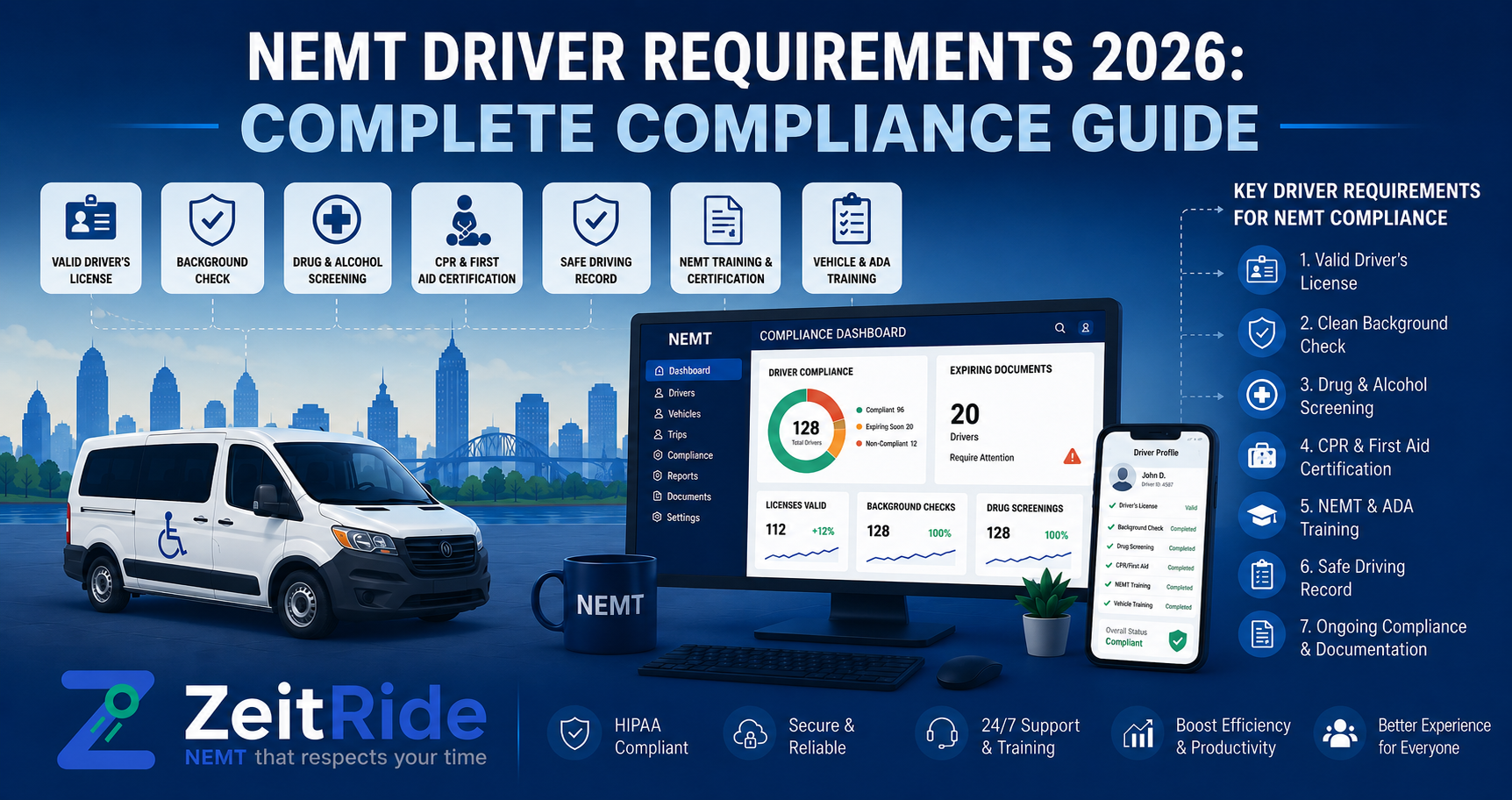
Most NEMT drivers need a valid license, an acceptable motor vehicle record, required background and exclusion checks, safety and passenger-assistance training, and current credentials. Exact rules vary by state, broker, insurer, vehicle, and service level.
ZeitRide Team
NEMT Operations Expert
NEMT driver requirements involve more than confirming that an applicant has a valid license. Transportation providers may also need to verify driving history, background screening, training, certifications, insurance eligibility, and broker approval before assigning trips. Exact requirements vary by state, Medicaid program, broker, insurer, vehicle, and service level. This guide explains the main areas U.S. operators should verify and document through an organized NEMT driver management system.
What Are the Basic NEMT Driver Requirements?
Most NEMT operators should confirm that every driver has a current license appropriate for the assigned vehicle, an acceptable motor vehicle record, required criminal and exclusion screening results, insurance eligibility, completed safety and passenger-assistance training, any required wheelchair or stretcher qualifications, current broker approval, and a complete credential file.
There is no single federal NEMT driver license that qualifies someone to work for every provider in every state. Operators must compare each driver against the most restrictive applicable state, Medicaid, broker, insurance, vehicle, and company requirements.
| Requirement | What to Verify | Record to Retain |
|---|---|---|
| Driver's license | Correct type, current status, and restrictions | License copy and expiration date |
| Motor vehicle record | Violations, suspensions, accidents, and points | Current MVR and review result |
| Background screening | Required criminal or registry checks | Screening result or clearance |
| Exclusion screening | Federal and state Medicaid exclusions | Search result and screening date |
| Training | Safety and passenger-assistance competency | Certificate or training log |
| Broker approval | Active approval for the applicable network | Approval status and effective date |
| Specialized service | Wheelchair or stretcher competency | Skills-validation record |
NEMT Driver Qualifications to Check Before Hiring
Valid and Appropriate Driver's License
A driver must have a current license that is appropriate for the vehicle being operated. A standard license may be sufficient for many sedans, minivans, and smaller wheelchair-accessible vehicles. However, some states or local authorities may require a chauffeur, for-hire, passenger, or similar endorsement. Verify the requirement using the current state manual rather than assuming the same rule applies nationwide.
Acceptable Motor Vehicle Record
The driver's motor vehicle record should be reviewed before hire and again at the interval required by the insurer, broker, state, or company policy. The review should identify license suspensions, reckless-driving offenses, DUI history, at-fault accidents, moving violations, excessive points, and restrictions that could affect the assigned vehicle.
A company policy should clearly define which violations automatically disqualify a driver and which require management or insurance review. Describing the standard only as a clean driving record can lead to inconsistent hiring decisions.
Ability to Perform the Assigned Service
NEMT driver qualifications should match the passengers and vehicles the person will serve. A driver may need to assist passengers at the curb or door, operate a wheelchair lift, secure mobility devices, document trip activity, and respond appropriately during an incident. A driver approved only for ambulatory transportation should not automatically be assigned wheelchair or stretcher trips.
NEMT Driver Background Check Requirements
NEMT driver background check requirements differ by state and transportation contract. Depending on the program, operators may need criminal-history screening, fingerprint-based checks, sex-offender or abuse-registry searches, motor vehicle record reviews, drug or alcohol screening, federal health care exclusion screening, and state Medicaid exclusion screening.
The HHS Office of Inspector General maintains the List of Excluded Individuals and Entities. Medicaid-facing providers should retain evidence showing when each required exclusion search was performed, which name was searched, who reviewed the result, and whether the driver was cleared. The company's broader NEMT documentation requirements should explain how these records are stored and produced during an audit.
Are Drug Tests Required?
Drug-testing requirements may come from federal transportation rules, a state program, broker contract, insurer, or employer policy. Not every NEMT drug test is a federal DOT test. Federal DOT drug and alcohol rules generally apply when a driver operates a commercial motor vehicle requiring a CDL. Non-CDL drivers may still be tested under other applicable policies.
NEMT Driver Training Requirements
NEMT driver training requirements should reflect the provider's actual vehicles, passengers, and contracts. Written training alone may not be sufficient when a driver must operate specialized equipment or physically assist passengers.
| Training Area | What It Should Cover |
|---|---|
| Defensive driving | Hazard recognition, safe following distance, and adverse-weather response |
| Passenger assistance | Boarding, exiting, respectful communication, and service animals |
| Wheelchair securement | Lift operation, four-point securement, and occupant restraints |
| Emergency response | Accidents, passenger illness, breakdowns, and dispatch notification |
| Privacy | Safe handling of passenger and trip information |
| Infection control | Cleaning, exposure response, and protective equipment |
| Documentation | Trip statuses, signatures, incidents, and inspection records |
| Fraud awareness | Accurate trip completion and reporting |
Wheelchair and Passenger-Assistance Training
Drivers assigned wheelchair trips should demonstrate that they can safely operate the vehicle's lift or ramp, position the mobility device, apply securement straps, and use occupant restraints. CTAA's Passenger Assistance, Safety and Sensitivity program is one recognized training option. Providers should still confirm whether their state, broker, or insurer requires PASS or accepts another program.
NEMT Driver Certification Requirements
NEMT driver certification requirements are frequently contract-specific. There is no universal national certification that replaces every state, broker, insurer, and service-level requirement.
- CTAA Passenger Assistance, Safety and Sensitivity training
- NEMTAC Certified Transport Specialist training
- Mobility-device securement training
- Stretcher-transport training
- CPR and first-aid certification
- Defensive-driving certification
- Broker-specific compliance training
The provider should confirm whether each credential is mandatory, recommended, or required only for a particular service. Current professional training pathways can be reviewed through NEMTAC's education resources.
Does an NEMT Driver Need a CDL?
Many drivers operating sedans, minivans, and smaller accessible vehicles do not need a commercial driver's license. A CDL may be required when the assigned vehicle meets applicable federal or state commercial-vehicle thresholds based on passenger capacity, weight, or operating conditions.
- Check the vehicle's designed passenger capacity
- Confirm the gross vehicle weight rating
- Review state passenger or chauffeur-license rules
- Determine whether interstate or intrastate rules apply
- Confirm insurance requirements
- Review broker requirements
The FMCSA provides additional passenger-carrier guidance for operators determining when federal commercial-driver requirements apply.
Broker Compliance Requirements
Hiring a driver and receiving broker approval are separate steps. A driver may be legally employable but still ineligible to perform trips for a particular transportation network. Major brokers may review licenses, MVRs, background checks, training certificates, vehicle assignments, insurance information, and recurring credential renewals.
- Identify the correct broker and state program
- Review the current provider manual
- Submit all required driver documents
- Confirm that the driver was approved
- Record the approval date and any restrictions
- Monitor expiration and recredentialing dates
- Prevent unapproved drivers from receiving affected trips
ZeitRide provides separate guidance for becoming a ModivCare provider, joining the MTM Health network, and becoming a Verida transportation provider.
NEMT Driver Qualification File Checklist
An NEMT driver qualification file checklist helps operators confirm that a driver was properly approved on the date a trip was performed. The file should include every record required by the applicable state, broker, insurer, service type, and company policy.
- Driver application and identity verification
- Current driver's license
- Motor vehicle record
- Insurance approval
- Criminal-background screening
- Federal and state exclusion searches
- Drug-screening result when applicable
- CPR and first-aid certificates
- Defensive-driving training
- Passenger-assistance training
- Wheelchair or stretcher competency
- Broker-specific training and approval
- Signed company policies
- Incident and retraining records
- Credential expiration dates
- Final dispatch authorization
Do not assume that submitting a document means the broker has approved it. Record the driver's current approval status separately and make sure dispatchers can see whether that driver is eligible for the assigned broker, vehicle, and service level.
How Often Should Driver Credentials Be Reviewed?
Credential reviews should follow the most demanding applicable rule. Operators may need to review records before hiring, before broker activation, before assigning a new vehicle or service level, at each credential expiration, at the broker's recredentialing interval, after a serious accident or violation, and whenever an insurer requests a new review.
Expiration alerts should begin early enough to complete training, screening, or broker processing before the current document expires. Thirty-, 60-, and 90-day reminders can help prevent a driver from becoming unexpectedly unavailable.
Manage Driver Compliance Before Dispatch
A spreadsheet can record expiration dates, but it may not stop a dispatcher from assigning a driver whose license, certification, or broker approval has expired. ZeitRide's compliance document tracking centralizes driver credentials, monitors renewal dates, and connects compliance status with scheduling.
The broader ZeitRide NEMT software platform connects driver records with dispatch, broker trips, electronic trip documentation, and billing. This helps operators verify driver eligibility before a trip is assigned rather than discovering a compliance issue during an audit.
Bring your current driver checklist to a 15-minute ZeitRide demo. See how to centralize credentials, receive expiration alerts, and keep drivers with missing or expired documents from reaching the dispatch board.
Compliance notice: This article provides general operational information for U.S. NEMT providers. It does not replace a current state manual, broker contract, insurance policy, or qualified legal advice.
Frequently Asked Questions
Q: What are the basic NEMT driver requirements?
Common requirements include a valid license, an acceptable motor vehicle record, required background and exclusion checks, insurance eligibility, safety and passenger-assistance training, and broker approval. Exact requirements vary by state, insurer, vehicle, and transportation contract.
Q: Does an NEMT driver need a CDL?
Not every NEMT driver needs a CDL. It may be required when the assigned vehicle meets federal or state commercial-vehicle thresholds based on passenger capacity, vehicle weight, or operating conditions.
Q: What training do NEMT drivers need?
Training commonly covers defensive driving, passenger assistance, incident response, documentation, privacy, and company procedures. Wheelchair and stretcher drivers may require additional equipment and securement training.
Q: Are background checks required for NEMT drivers?
Background screening is commonly required, but the type of check depends on the state, Medicaid program, broker, insurer, and employer. Criminal screening, MVR checks, exclusion searches, and registry checks may apply.
Q: Is CPR certification required for every NEMT driver?
CPR certification is not one universal federal requirement for every NEMT driver. It may be required by a state, broker, health plan, insurer, transportation contract, or company policy.
Q: What belongs in an NEMT driver qualification file?
The file may include the driver's license, MVR, background and exclusion checks, training records, certifications, insurance approval, broker approval, signed policies, incident records, and credential expiration dates.
Rather see it than read about it?
Bring a real route, a couple of drivers, and your current process. 15 minutes, zero pitch.