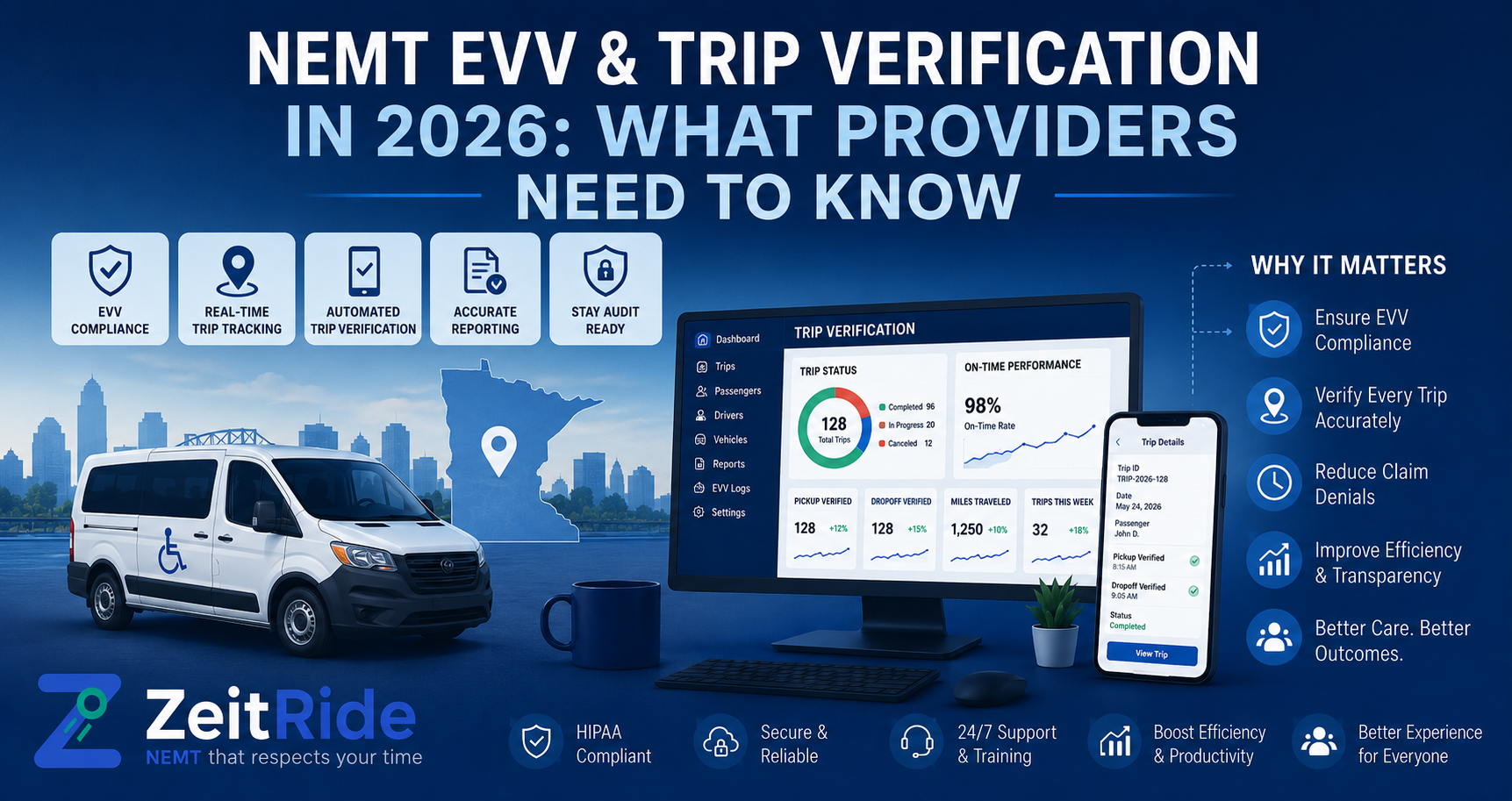
NEMT EVV & Trip Verification in 2026: What Providers Need to Know
Learn when federal EVV applies, how NEMT trip verification differs, and what GPS, timestamps, signatures, and trip records providers may need.
Quick answer
Federal EVV under the 21st Century Cures Act applies to Medicaid personal care and home health services requiring in-home visits—not automatically to NEMT. NEMT trip-verification rules may instead come from states, MCOs, brokers, or payer contracts.
ZeitRide Team
NEMT Operations Expert
NEMT EVV compliance is easy to misunderstand because "EVV," "GPS verification," "trip verification," and "proof of service" are often used as if they mean the same thing. They do not. The federal Electronic Visit Verification requirement created by the 21st Century Cures Act applies to certain Medicaid personal care services and home health services that require an in-home visit. It does not automatically make every non-emergency medical transportation trip a federally EVV-covered service.
That does not mean NEMT providers can ignore electronic verification. State Medicaid programs, managed-care organizations, transportation brokers, and payer contracts can establish their own requirements for documenting whether an authorized trip actually occurred. For NEMT operators, the practical question is not simply, "Do I have EVV?" It is: What evidence does my specific program require to verify each trip, and can my operation produce that evidence reliably?
This guide explains the difference between federal EVV and NEMT trip verification, the types of records providers may need, and how to verify your actual requirements before relying on any software or compliance claim.
Quick Answer: Is EVV Required for NEMT?
Federal EVV is not automatically required for every NEMT trip under the 21st Century Cures Act. The federal EVV provision applies to Medicaid-funded personal care services (PCS) and home health care services (HHCS) that require an in-home visit.
NEMT is a different Medicaid transportation function. However, an NEMT provider can still be required to capture electronic trip evidence under a state Medicaid program, managed-care organization, transportation broker agreement, payer policy, or other applicable contract.
That evidence might include GPS information, pickup and drop-off timestamps, driver and vehicle identification, proof of service, mileage, electronic signatures, or other fields. Because requirements differ, providers should verify their obligations with the authority that actually governs their trips rather than assuming that one national "NEMT EVV standard" applies everywhere. For the federal EVV scope, review the official Medicaid Electronic Visit Verification guidance.
What Does Federal Electronic Visit Verification Actually Cover?
Section 12006 of the 21st Century Cures Act requires states to implement EVV for Medicaid personal care services and home health care services that require an in-home visit. For services covered by that federal EVV requirement, the system verifies six core elements.
| Federal EVV Data Element | What It Identifies |
|---|---|
| Type of service performed | The covered service delivered |
| Individual receiving the service | The Medicaid member receiving the service |
| Date of service | When the covered service occurred |
| Location of service delivery | Where the service was delivered |
| Individual providing the service | The person delivering the service |
| Time service begins and ends | Start and end of the covered service |
Those six elements are important, but they should not be copied into an NEMT guide and described as six federally required fields for every transportation trip. That distinction matters because a transportation provider can otherwise believe it is "federally EVV compliant" while overlooking the actual documentation rules contained in its state program, broker manual, MCO agreement, or payer contract.
What Is NEMT Trip Verification?
NEMT trip verification is the process of creating evidence that an authorized transportation service was performed as recorded. A useful trip record connects what was scheduled and authorized with what actually happened on the road.
Depending on the program, relevant evidence may include:
- Member or rider identification
- Broker, payer, or authorization reference
- Scheduled pickup and appointment information
- Actual pickup and drop-off timestamps
- Pickup and destination locations
- Driver identification
- Vehicle identification
- Approved transportation or service level
- GPS or location history
- Loaded mileage where required
- Rider, facility, or other permitted proof of service
- Electronic signature or attestation where required
- No-show, cancellation, delay, or exception notes
- A billing or claim record matching the completed trip
Not every field in that list is universally required for every NEMT provider. The exact record depends on the applicable program. ZeitRide's broader NEMT documentation requirements guide explains how authorizations, trip records, driver files, vehicle documentation, proof of service, billing records, and change history fit together.
CMS also advises NEMT providers to understand the Medicaid rules applicable in the state where they operate and to maintain accurate documentation showing that billed services were actually furnished. Providers can review the CMS NEMT provider resources.
Federal EVV vs. NEMT Trip Verification
| Question | Federal EVV | NEMT Trip Verification |
|---|---|---|
| Primary purpose | Verify covered Medicaid PCS/HHCS visits | Verify that an authorized transportation service occurred |
| Federal Cures Act scope | PCS and HHCS requiring qualifying in-home visits | NEMT is not automatically included in that federal EVV mandate |
| Who may define requirements? | Federal statute plus state EVV implementation | State Medicaid program, MCO, broker, payer, or contract |
| Common data | Service, recipient, date, location, provider, start/end times | May include authorization, driver, vehicle, GPS, timestamps, mileage, signature, service level, and exceptions |
| Are requirements identical nationwide? | Federal core applies to covered EVV services, with state implementation differences | No. Transportation requirements can vary considerably |
| Does software alone create compliance? | No | No |
The safest approach is to treat EVV and trip verification as distinct concepts unless the governing authority for your transportation program explicitly connects them.
Why Do NEMT Providers Still Hear the Term EVV?
NEMT operations increasingly use technologies that look similar to EVV because both workflows are trying to establish reliable evidence about who, where, and when. A driver application can record an arrival status. GPS can associate that event with a location. A timestamp can show when the event occurred. A rider or facility confirmation can provide additional proof that the transportation was performed.
As these technologies have become common, EVV is sometimes used informally as shorthand for electronic NEMT trip verification. The terminology, however, should never replace the actual rule.
A provider should identify whether the requirement comes from:
- Federal EVV rules for a separate covered service
- State Medicaid transportation policy
- A managed-care organization
- A transportation broker
- A direct payer agreement
- A provider manual
- A contract or statement of work
- A state-specific NEMT program
Medicaid transportation itself can be structured differently from one state to another. The federal Medicaid transportation framework gives states flexibility in how transportation is administered, which is one reason providers should confirm requirements at the program level rather than assume a national workflow. The Medicaid Assurance of Transportation guidance is a useful federal starting point.
How Does NEMT GPS Verification Support a Trip Record?
NEMT GPS verification can strengthen a trip record by associating vehicle activity with a location and point in time. For example, a driver's arrival status can be connected with the pickup location, while later status events can help document trip progression and destination arrival.
But GPS should be treated as supporting evidence, not automatically as complete proof of every requirement.
GPS alone may not establish:
- Which rider was transported
- Whether the trip was authorized
- Whether the correct service level was delivered
- Whether a required signature or attestation was collected
- Whether billed mileage or units match the payer's rules
- Whether the driver and vehicle met applicable qualifications
The strongest workflow connects GPS activity with the underlying trip record instead of storing location history in a separate system. ZeitRide's NEMT fleet GPS monitoring connects driver location and trip activity with the same operational workflow used by dispatch.
Are Electronic Signatures Required for NEMT?
There is no single rule making an electronic rider signature universally mandatory for every U.S. NEMT trip. A state, broker, MCO, payer, or contract may require a particular form of proof of service. Depending on the program, an acceptable method could involve a rider signature, facility confirmation, driver attestation, electronic record, or another permitted verification method.
Providers should therefore avoid designing their workflow around the assumption that one signature format is accepted everywhere. Where electronic signatures are permitted or required, they become more useful when they stay connected to the trip's date, time, location, rider, driver, and authorization information.
ZeitRide's NEMT e-signature workflow captures signatures inside the driver workflow and connects them with the trip record.
How to Verify Your Actual NEMT EVV Requirements
1. Start With Your State Medicaid Transportation Program
Review the current provider manual, transportation policy, state plan materials, bulletins, and provider notices. Focus specifically on NEMT rather than general home-care EVV guidance.
2. Check Each Managed-Care or Broker Contract
If trips arrive through an MCO or transportation broker, review its provider handbook, billing rules, trip-verification policies, proof-of-service requirements, and technology specifications.
3. Identify Required Evidence Field by Field
Create a written list showing exactly what must be captured for an accepted trip: authorization, timestamps, GPS, mileage, signature, driver, vehicle, service level, exception notes, or other data. Do not substitute a generic software feature list for the actual requirement.
4. Determine What Happens When Information Is Missing
Find out whether missing information causes a warning, rejected invoice, denied claim, documentation request, broker dispute, corrective action, or another consequence. This helps your team distinguish essential fields from useful supporting evidence.
5. Keep the Requirement Source With the Workflow
Document where each rule came from and when it was last verified. If a broker or state changes its requirement, you can then update the workflow instead of relying on institutional memory.
Common NEMT Trip Verification Mistakes
- Treating federal PCS/HHCS EVV rules as a universal NEMT mandate
- Calling software EVV compliant without identifying the applicable program
- Capturing GPS but losing the connection to the authorized trip
- Recording timestamps manually after the route ends
- Keeping signatures separately from the trip record
- Using one verification process for every payer without checking differences
- Failing to document no-shows, cancellations, address changes, or other exceptions
- Allowing trip corrections to overwrite the original information
- Sending a claim that does not match the completed trip record
- Assuming a technology vendor is responsible for interpreting provider contracts
The underlying issue in most of these cases is fragmentation. A dispatch record says one thing, the driver app shows another, the paper signature has no trip identifier, and billing receives a fourth version. A connected record makes verification easier because the same trip can carry its operational evidence forward into reporting and billing.
How ZeitRide Supports NEMT Trip Verification Workflows
ZeitRide does not replace a provider's responsibility to understand state, payer, MCO, and broker requirements. What the platform can do is make the provider's approved process easier to execute consistently.
ZeitRide connects scheduling, dispatch, driver activity, GPS-aware trip events, electronic signatures, reporting, audit history, and billing-oriented records inside the same NEMT operating system.
Providers can use NEMT reporting software to retrieve operational records, while the NEMT audit trail helps preserve who changed trip information and when.
When the completed transportation record needs to move toward invoicing or claims preparation, NEMT billing software keeps the operational and billing workflows connected.
The goal is not to add another compliance module. It is to make accurate documentation part of how the trip is scheduled, dispatched, performed, reviewed, and billed.
NEMT Trip Verification Checklist for 2026
Before marking a trip ready for billing, providers should compare the completed record with the requirements that apply to that specific payer or program.
- Is the correct member connected to the trip?
- Is the authorization or broker reference present where required?
- Does the delivered service match what was authorized?
- Are actual pickup and drop-off times recorded?
- Is required location or GPS evidence available?
- Is the correct driver identified?
- Is the correct vehicle identified?
- Is required mileage documented?
- Is the required proof of service attached?
- Are no-shows, cancellations, delays, and changes explained?
- Does the billing record match the completed trip?
- Can your team identify who changed important trip information?
- Could you retrieve the complete record if a payer asked for it today?
That checklist is intentionally broader than federal EVV because NEMT trip verification is ultimately about proving the transportation service your organization actually performed under the rules that apply to that trip.
The Bottom Line on NEMT EVV Compliance
NEMT EVV compliance should not be reduced to a claim that every transportation provider must capture six federally mandated EVV fields on every ride.
The more accurate approach is: understand what federal EVV covers, identify the transportation-verification requirements that actually govern your trips, and then build a workflow that captures the required evidence while the service is happening.
For many NEMT providers, that means keeping authorizations, driver activity, GPS-aware events, timestamps, proof of service, exceptions, audit history, and billing information connected rather than reconstructing them later.
If your current operation still depends on separate spreadsheets, paper trip sheets, driver messages, and disconnected billing records, explore how ZeitRide's NEMT software connects the full trip lifecycle in one platform.
See Your Trip-Verification Workflow in One Place
Your compliance obligations depend on your program. Your operating system should make those requirements easier to follow—not harder to prove.
Bring one of your real trip workflows to a ZeitRide demo and see how scheduling, dispatch, driver activity, GPS-aware records, signatures, reporting, audit history, and billing stay connected from trip creation through completion.
Ready to see how your existing trip-verification workflow could work inside one connected platform? Book a ZeitRide demo and bring a real route or workflow.
Frequently Asked Questions
Q: Is EVV federally required for every NEMT trip?
No. The federal EVV mandate applies to Medicaid personal care services and home health care services requiring qualifying in-home visits. NEMT providers may separately face electronic trip-verification requirements from states, MCOs, brokers, payers, or contracts.
Q: What is NEMT trip verification?
NEMT trip verification documents evidence that an authorized transportation service occurred as recorded. Depending on the program, evidence may include GPS data, timestamps, driver and vehicle information, mileage, signatures, proof of service, and exception records.
Q: Is GPS tracking required for NEMT trips?
There is no single nationwide GPS rule for every NEMT trip. GPS or location evidence may be required by a specific state Medicaid program, MCO, broker, payer, or contract.
Q: Are electronic signatures required for Medicaid NEMT?
Not universally. The acceptable proof-of-service method depends on the applicable state Medicaid program, payer, managed-care organization, broker, or provider contract.
Q: How do NEMT providers verify their trip-documentation requirements?
Review the current state Medicaid transportation policy and every applicable MCO, broker, payer, and provider contract. Identify the exact required fields and keep a record of where each requirement came from and when it was last verified.
Rather see it than read about it?
Bring a real route, a couple of drivers, and your current process. 15 minutes, zero pitch.