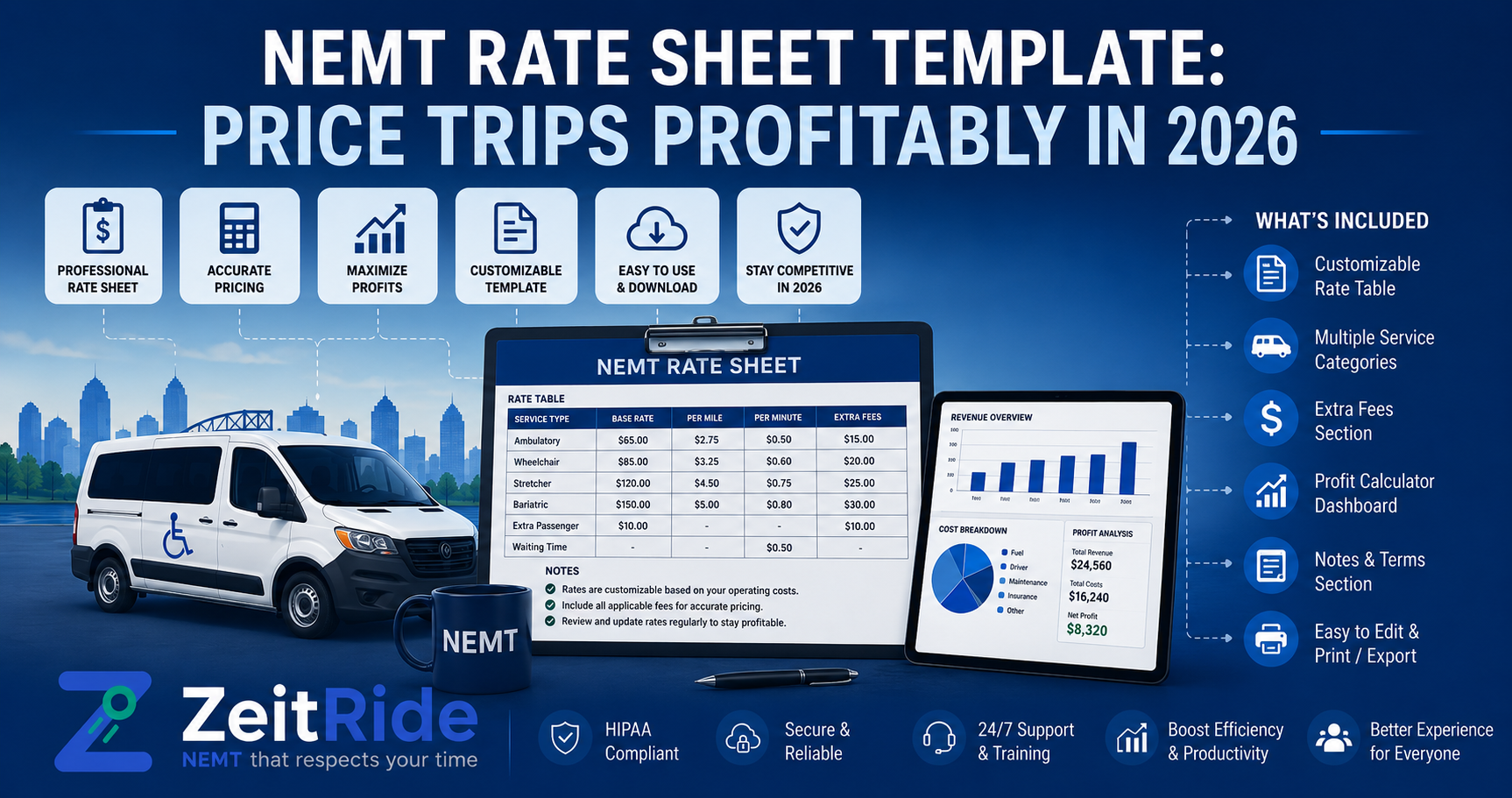
NEMT Rate Sheet Template: Price Trips Profitably in 2026
Use this NEMT rate sheet template to price private-pay and facility trips using real operating costs, service fees, and profit targets.
Quick answer
A profitable NEMT rate sheet starts with your true trip cost, then adds service-specific fees and a target margin. Include base charges, mileage, wait time, deadhead, cancellations, after-hours service, and clear payment terms.
ZeitRide Team
NEMT Operations Expert
An NEMT rate sheet template should do more than make your prices look professional. It should protect your margin by showing exactly how you charge for ambulatory, wheelchair, stretcher, mileage, waiting, cancellations, after-hours service, and other costs that can turn a busy schedule into an unprofitable one. The copy-ready template below is designed for U.S. NEMT operators quoting private-pay riders and healthcare facilities. Before entering any price, calculate what the trip actually costs your company and compare it with your existing non-emergency medical transportation costs.
What Is an NEMT Rate Sheet?
An NEMT rate sheet is a pricing document that lists the services a transportation provider offers, the charge for each service, and the terms that affect the final price. A complete sheet normally includes a base or pickup charge, included mileage, per-mile pricing, wait time, additional assistance, after-hours surcharges, cancellation rules, and payment terms.
The rate sheet is the client-facing result. The real pricing work happens before it: measuring driver time, total vehicle miles, insurance, maintenance, dispatch labor, billing work, deadhead travel, and the margin needed to keep the service sustainable.
Copy-Ready NEMT Rate Sheet Template
Copy this NEMT pricing template into Word, Google Docs, Excel, or your proposal software. Replace every blank with a rate calculated from your own costs and local market. Do not treat another provider's price list as your cost model.
| Rate Item | What It Covers | Your Rate |
|---|---|---|
| Ambulatory base charge | Pickup, dispatch handling, standard loading, and the included service radius | $_____ |
| Wheelchair base charge | Wheelchair vehicle, securement, loading time, and standard assistance | $_____ |
| Bariatric wheelchair charge | Higher-capacity equipment, additional handling, and staffing where required | $_____ |
| Stretcher or gurney charge | Specialized vehicle, equipment, and required crew where legally offered | $_____ |
| Included loaded miles | Passenger-carrying miles included in the base charge | _____ miles |
| Loaded mileage | Each passenger-carrying mile beyond the included distance | $_____ per mile |
| Out-of-area or deadhead fee | Unloaded travel outside the normal service area | $_____ or zone rate |
| Wait time | Driver and vehicle time after a stated grace period | $_____ per _____ minutes |
| Additional attendant | Second staff member or approved escort assistance | $_____ |
| Additional stop | Extra pickup, pharmacy stop, or destination added to the booked trip | $_____ |
| After-hours service | Trips outside standard operating hours | $_____ or _____% |
| Weekend or holiday service | Premium scheduling periods | $_____ or _____% |
| Late cancellation | Cancellation inside the stated notice window | $_____ |
| No-show | Driver dispatched but passenger unavailable | $_____ |
| Tolls and parking | Documented third-party trip expenses | At cost / included |
| Payment terms | Deposit, card authorization, Net-15 or Net-30, and late-payment terms | ________________ |
Your public medical transportation rate sheet should be simple enough for a patient, case manager, or facility administrator to understand without calling for an explanation. Complex calculations can stay in your internal worksheet; the client-facing sheet should show clear charges, when each charge applies, and what is included.
How to Charge for NEMT Services
To decide how to charge for NEMT services, calculate the complete cost of delivering a trip and then convert that cost into a pricing structure clients can understand. A base-plus-mileage model is common, but it only works when the base fee covers the time and expense that exist even on a very short trip.
- Calculate the cost of keeping one vehicle and qualified driver available for an hour.
- Calculate the operating cost of every loaded and unloaded mile.
- Allocate insurance, software, dispatch, billing, office, and compliance overhead.
- Add service-specific costs for wheelchair securement, extra attendants, or specialized equipment.
- Account for waiting, no-shows, cancellations, after-hours work, tolls, and parking.
- Apply a target profit margin, then test the final price against your market and client type.
1. Calculate Your Cost per Vehicle Hour
Start with all costs that increase when a vehicle is committed to a trip: driver wages, payroll taxes, workers' compensation, overtime exposure, and any second attendant. Then allocate fixed costs such as insurance, vehicle payments, licensing, dispatch, office staff, software, and compliance across the realistic number of billable vehicle hours you expect each month.
Use realistic billable hours rather than every hour the vehicle technically exists. A van may be available for ten hours but produce only six billable hours after gaps, cancellations, repositioning, cleaning, and driver breaks.
2. Calculate the True Cost per Mile
Vehicle cost per mile should include fuel, tires, routine maintenance, repairs, depreciation or lease cost, and mileage-sensitive insurance effects. As of July 1, 2026, the IRS business standard mileage rate is 76 cents per mile. That is an optional tax and reimbursement benchmark, not a recommended NEMT customer price. It does not replace your own calculation for commercial insurance, specialized vehicles, dispatch, assistance, waiting, or profit.
3. Price Deadhead and Waiting Time
Deadhead miles are miles driven without a paying passenger, including travel to the pickup, repositioning between trips, and the return from a distant drop-off. They still consume driver time, fuel, maintenance, and vehicle capacity. You may recover those costs through a defined service radius, an out-of-area zone fee, a minimum trip charge, or a higher loaded-mile rate. You should also reduce dead miles before passing avoidable inefficiency to the client.
Waiting should have a written grace period and a clear billing unit. For example, a facility may receive the first 15 minutes without charge, followed by a fee for each additional 15-minute block. Your exact policy should reflect driver cost, vehicle scarcity, local competition, and the facility's historical delay pattern.
4. Convert Cost Into a Target-Margin Price
Markup and profit margin are not the same. If a trip costs $120 and you add a 25% markup, the price is $150 but the resulting margin is only 20%. To price for a true target margin, use: Price = Total trip cost / (1 - target margin). At a 25% target margin, a $120 trip requires a $160 price.
NEMT Pricing Calculator Formula
A useful NEMT pricing calculator should calculate the full movement of the vehicle, not only the passenger-carrying segment. Use the following worksheet for each common trip type or contract.
| Calculator Input | Formula | Example Only |
|---|---|---|
| Driver and attendant labor | Total vehicle hours x loaded hourly labor cost | 2.25 hours x $24 = $54.00 |
| Vehicle operating cost | Loaded plus deadhead miles x actual cost per mile | 45 miles x $0.85 = $38.25 |
| Allocated overhead | Monthly overhead / realistic monthly billable trips | $18.00 |
| Service-specific cost | Securement, cleaning, supplies, or extra handling | $10.00 |
| Total trip cost | Labor + vehicle + overhead + service cost | $120.25 |
| Price at 25% margin | Total trip cost / 0.75 | $160.33 |
The figures above are fictional calculation examples, not recommended national rates. Round only after the full calculation. A quote of $160 or $165 may be practical in that example, but the correct price for your operation could be materially different.
Worked Example: Wheelchair Trip With Facility Wait Time
Assume a wheelchair vehicle is committed for three hours, drives 36 total miles, and includes securement plus a facility delay. At $24 per hour in loaded labor, $0.95 per total mile, $20 in allocated overhead, and $12 in service-specific cost, the trip costs $138.20. Dividing by 0.75 produces a price of about $184.27 at a 25% target margin. The operator could quote $185, provided that price fits the market and the service agreement clearly states how additional waiting will be charged.
NEMT Private Pay Rates vs. Facility and Broker Rates
NEMT private pay rates are controlled by the provider, but Medicaid broker rates are normally set or negotiated through a payer contract. Facility pricing sits between the two: the provider proposes rates, while the hospital, dialysis center, nursing facility, or adult day program may negotiate volume, service levels, cancellation rules, and payment terms.
| Payer Type | Who Controls the Rate? | Best Pricing Approach | Main Risk |
|---|---|---|---|
| Private pay | Provider | Transparent base, mileage, assistance, and cancellation charges | Price objections or unpaid reservations |
| Healthcare facility | Negotiated | Rate sheet plus service agreement, volume assumptions, and payment terms | Scope creep, waiting, and slow payment |
| Medicaid or broker | State, MCO, broker, or contract | Compare contracted reimbursement with actual cost per trip | Accepting volume that is unprofitable after deadhead and denials |
When preparing proposals, connect the rate sheet to the operational value the facility receives: dependable pickups, suitable vehicles, trained drivers, live trip visibility, documented exceptions, and accurate invoices. Our guide to getting NEMT contracts explains what facilities and brokers evaluate beyond price. For contracted Medicaid work, compare your cost model with the applicable Medicaid transportation reimbursement rather than assuming the payer's mileage figure is profitable. CMS's Medicaid transportation coverage guide explains the federal transportation assurance; state programs and contracts still determine local provider billing rules.
Fees Operators Often Leave Off the Rate Sheet
- A minimum trip charge for short rides that still consume dispatch and loading time
- An out-of-area or deadhead policy for pickups beyond the normal service radius
- Wait time after a clearly stated grace period
- Additional stops, pharmacy stops, or changes made after dispatch
- Late cancellations and no-shows, subject to the payer or client agreement
- After-hours, weekend, and holiday service
- Additional attendants, stairs, door-through-door assistance, or special handling
- Tolls, parking, cleaning, and documented third-party costs
- Late-payment terms for facilities and responsibility for disputed trip details
Every fee should correspond to a real cost or capacity loss. Avoid vague surcharges. State the trigger, grace period, billing unit, and any exceptions so the client understands the total price before the trip.
How to Present a Medical Transportation Rate Sheet to Facilities
A facility does not buy a rate sheet; it buys reliable transportation at an understandable total cost. Pair the document with a short service proposal that defines your service area, operating hours, mobility capabilities, booking process, cancellation policy, escalation contact, invoicing cycle, and documentation standards.
- Put your company name, contact details, service area, and effective date at the top.
- Separate ambulatory, wheelchair, bariatric, and stretcher services instead of using one blended price.
- Explain what the base charge includes and when mileage begins.
- Show the wait-time grace period and cancellation window in plain language.
- State whether tolls, parking, escorts, and additional stops are included.
- Add an expiration or review date so old pricing does not remain active indefinitely.
- Attach the rate sheet to a signed service agreement for recurring facility work.
When Should You Update Your NEMT Pricing Template?
Review the internal cost worksheet at least quarterly and update the public sheet whenever a material cost or service change makes the existing rates inaccurate. Common triggers include insurance renewal, wage increases, fuel changes, a new vehicle type, expanded service territory, new staffing requirements, repeated facility delays, or a change in payment processing and billing workload.
Track whether each service category actually reaches its intended margin. A business can show healthy total revenue while repeatedly losing money on one long-distance route, one facility with excessive waiting, or one service type that requires more driver time than the rate allows. Compare the results with your broader NEMT business revenue and profitability.
Connect the Rate Sheet to Dispatch and Billing
A rate sheet becomes difficult to enforce when dispatch, mileage, wait time, invoices, and payments live in separate spreadsheets. Your NEMT billing software should connect each booked service type with the correct payer, rate rules, trip record, mileage, approved additional fees, and invoice. That creates a repeatable process instead of asking staff to rebuild the price after every trip.
ZeitRide connects scheduling, dispatch, routing, trip execution, and billing workflows in one NEMT platform. Bring one real private-pay or facility route to a 15-minute ZeitRide demo and see how your rate structure can follow the trip from booking through invoicing.
Frequently Asked Questions
Q: What should an NEMT rate sheet include?
Include service types, base charges, included mileage, loaded-mile rates, wait time, out-of-area or deadhead rules, additional assistance, after-hours charges, cancellation and no-show policies, tolls, parking, payment terms, and the rate sheet's effective date.
Q: How do I determine how much to charge for NEMT services?
Calculate driver and attendant labor, all loaded and unloaded mileage, vehicle expense, allocated overhead, service-specific costs, and expected waiting. Add the target margin using Price = Total cost / (1 - target margin), then validate the result against local demand and client type.
Q: Should I use the IRS mileage rate as my NEMT mileage charge?
No. The IRS rate is an optional tax and reimbursement benchmark, not a complete NEMT selling price. Your customer rate may also need to recover commercial insurance, specialized vehicles, driver time, securement, dispatch, waiting, overhead, and profit.
Q: Should NEMT providers charge for deadhead miles?
For private-pay and negotiated facility work, providers can recover deadhead costs through a service radius, zone fee, minimum charge, or higher loaded-mile rate when the agreement permits it. Broker and Medicaid contracts control which mileage and fees are reimbursable.
Q: How should wait time appear on a rate sheet?
State the grace period, billing interval, amount, and when the clock starts. For example, the first 15 minutes may be included, followed by a stated charge for each additional 15-minute block.
Q: Can I use one rate sheet for private-pay clients and facilities?
Use the same cost model but create separate client-facing versions. A patient sheet should be simple and payment-focused, while a facility sheet should include negotiated rates, recurring-trip terms, wait-time rules, invoicing cycles, and service-level expectations.
Rather see it than read about it?
Bring a real route, a couple of drivers, and your current process. 15 minutes, zero pitch.