How to Start a NEMT Business in Indiana in 2026
Start an Indiana NEMT business in 2026 with IHCP enrollment, Verida, licensing, startup costs, and the steps needed before your first trip.
Quick answer
To start a NEMT business in Indiana, register the company, prepare vehicles, insurance and drivers, meet applicable operating requirements, enroll with IHCP as a Type 26 Transportation Provider, then contract with Verida or the appropriate managed-care transportation network.
ZeitRide Team
NEMT Operations Expert
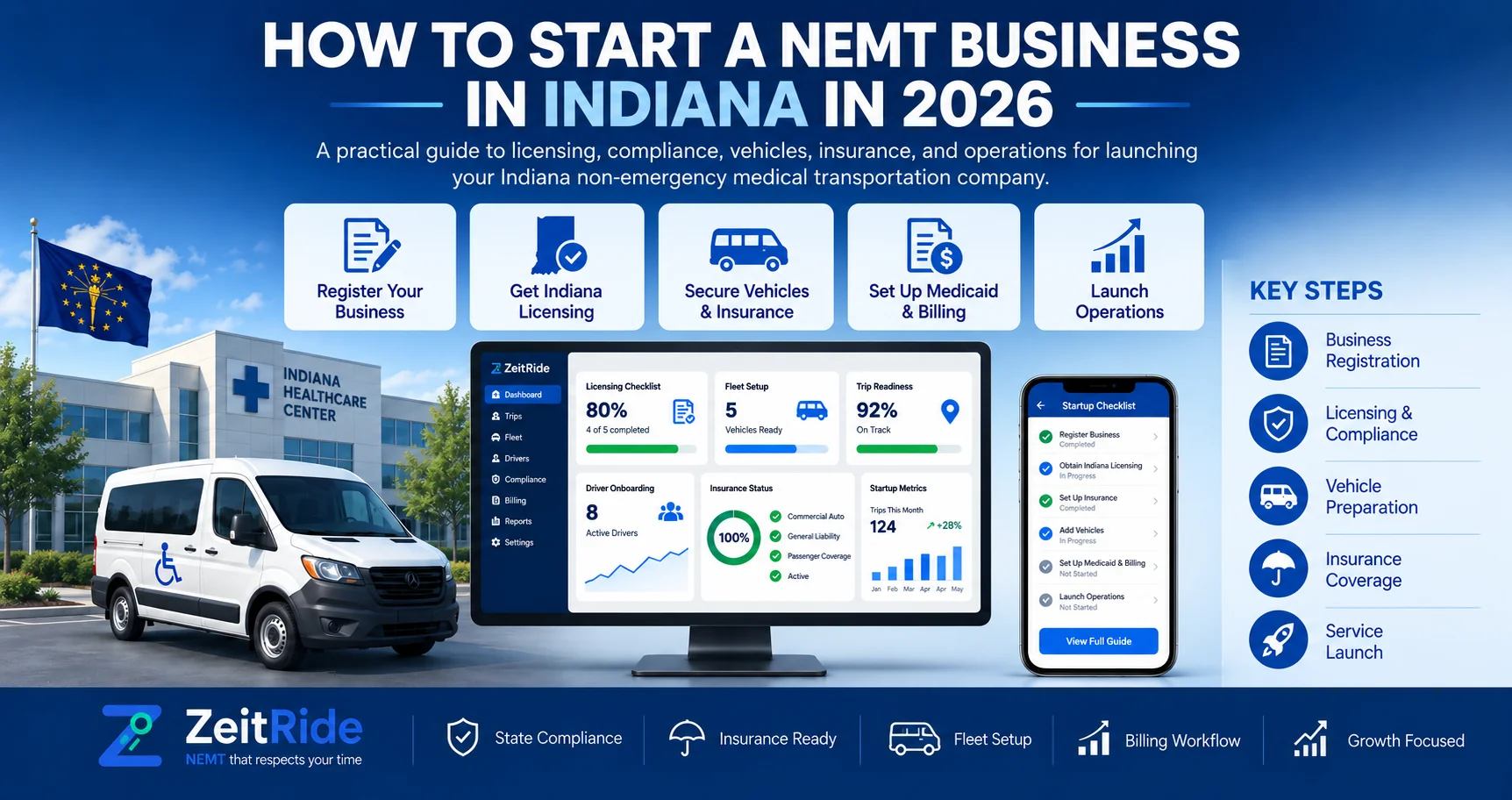
If you're researching how to start a NEMT business in Indiana, the process involves more than registering a transportation company and buying a vehicle. Operators planning to serve Medicaid members may also need Indiana Health Coverage Programs enrollment, the correct transportation-provider specialty, insurance and operating documentation, screening requirements, and contracts with the transportation network serving their target members. The easiest way to manage the process is to separate it into three stages: set up the business, become properly enrolled and credentialed, then build the operation that will handle live trips. If you are still shaping the business model, ZeitRide's NEMT business plan template can help you plan your service area, payer mix, fleet, staffing, and operating costs before launch.
How to Start a NEMT Business in Indiana: Quick Roadmap
- Register your business and complete applicable Indiana registrations.
- Decide which transportation services you will provide.
- Prepare vehicles, commercial insurance, and driver records.
- Identify the correct IHCP Type 26 transportation specialty.
- Complete applicable screening, fingerprinting, fee, and surety-bond requirements.
- Submit your IHCP transportation provider enrollment.
- Contract with Verida or the appropriate managed-care transportation network.
- Set up dispatch, scheduling, trip documentation, and billing.
- Test the full workflow before accepting live trips.
The exact path depends on the type of transportation you provide, your service area, and whether you plan to serve Medicaid, facilities, private-pay clients, or a mix of payers.
What Are the Indiana NEMT Requirements?
Indiana Medicaid enrolls transportation providers through IHCP Provider Type 26 — Transportation Provider. The correct specialty matters because supporting documents, screening requirements, and enrollment obligations can differ by transportation type. Current Indiana Medicaid guidance should always be checked before filing because provider requirements can change.
| IHCP Specialty | Transportation Type | Typical Relevance |
|---|---|---|
| 263 | Taxi | Taxi transportation businesses |
| 264 | Common Carrier — Ambulatory | Passengers who can walk or transfer into and out of the vehicle |
| 265 | Common Carrier — Non-Ambulatory | Passengers who remain in a wheelchair during transport |
| 267 | Transportation Network Company | Operations that meet Indiana's TNC classification |
| 269 | Broker Fleet | Broker fleet enrollment; preapproval is required |
Indiana currently treats several transportation specialties as higher-risk enrollment categories, which can trigger additional screening such as a pre-enrollment site visit and fingerprint-based background checks for qualifying owners or controlling interests. Certain transportation specialties are also subject to Indiana Medicaid's provider enrollment application fee and surety-bond requirements. For applications received in 2026, the applicable enrollment fee is $750 per service location when the specialty is subject to the fee.
Before submitting an application, verify the latest rules on Indiana Medicaid's Type 26 Transportation Provider page and the state's Nonemergency Medical Transportation guidance. These official sources should take priority if requirements change after this guide is published.
Do You Need an NEMT License in Indiana?
There is not one universal document called an Indiana NEMT license that automatically covers every transportation business. Requirements depend on the service you provide and may include business registration, applicable motor-carrier or operating credentials, commercial insurance, vehicle and driver documentation, IHCP enrollment, screening, a surety bond, and broker or managed-care network credentialing.
For Medicaid common-carrier transportation, the important distinction is that business registration, IHCP approval, and transportation-network contracting are separate steps. Approval at one level does not automatically satisfy the others. This is also why new operators should confirm the exact requirements for their chosen Type 26 specialty before purchasing vehicles or promising a launch date.
How Does IHCP Transportation Provider Enrollment Work?
IHCP transportation provider enrollment is the central Medicaid enrollment step for Indiana companies that want to provide covered Medicaid transportation. Before applying, choose the correct Type 26 specialty and gather the supporting documents required for that specialty. Depending on the enrollment, these may include insurance records, operating credentials, ownership disclosures, screening, fingerprinting, and the applicable application fee.
Indiana also requires providers enrolling under transportation specialties 263, 264, 265, 267, and 269 to obtain a Medicaid surety bond unless an applicable exemption applies. The bond must generally provide at least $50,000 in coverage and remain continuously effective for at least three years. The $50,000 amount is the required bond coverage, not necessarily the premium the provider pays to obtain the bond. For broader Medicaid enrollment context, use ZeitRide's Medicaid transportation provider guide.
IHCP Enrollment Sequence
- Select the correct Type 26 transportation specialty.
- Review the current documentation and risk requirements for that specialty.
- Complete fingerprinting first if your enrollment requires it.
- Obtain the required Indiana Medicaid surety bond if applicable.
- Pay the provider enrollment application fee if your specialty is subject to it.
- Submit the IHCP enrollment application with all supporting records.
- Respond promptly to requests for missing or corrected information.
- Receive the IHCP enrollment decision, then move to transportation-network contracting.
Indiana currently tells applicants to allow at least 15 business days before checking the status of an enrollment submission. That is not a guaranteed approval timeline. Screening, site visits, fingerprinting, missing documents, or corrections can extend the process.
Where Does Verida Fit Into Indiana NEMT?
IHCP enrollment establishes your Medicaid provider status, but it does not automatically put broker trips on your schedule. For most brokered NEMT serving Traditional Medicaid members in Indiana's fee-for-service system, Verida is the transportation broker. A provider that wants to serve those members generally needs to complete IHCP enrollment first and then complete the applicable Verida contracting and credentialing process.
ZeitRide already has a detailed guide on how to become a Verida transportation provider, so this Indiana startup guide does not duplicate the entire broker application process.
Managed-care transportation follows a different path. Transportation for members in programs such as the Healthy Indiana Plan, Hoosier Healthwise, Hoosier Care Connect, and Indiana PathWays for Aging is handled through the member's managed-care organization and its designated transportation arrangement. In other words, Verida should not be treated as the transportation pathway for every Indiana Medicaid member.
How Much Does It Cost to Start a NEMT Business in Indiana?
The cost to start a NEMT business in Indiana depends mainly on the vehicle, accessibility level, insurance, staffing, and the transportation services you plan to provide. Some costs are fixed or regulatory; others require individual quotes. Avoid relying on one generic statewide startup figure because a one-vehicle ambulatory operation and a wheelchair-accessible fleet have very different capital needs.
| Cost Area | 2026 Planning Guidance |
|---|---|
| Business formation | Depends on entity type and filing method |
| IHCP application fee | $750 when the enrollment is subject to the fee |
| Indiana Medicaid surety bond | At least $50,000 coverage for affected specialties; actual premium varies |
| Vehicle | Depends on ambulatory vs. wheelchair-accessible service |
| Commercial insurance | Quote based on vehicles, drivers, service area, and coverage |
| Driver onboarding | Screening, training, and credentialing costs vary |
| Dispatch software | ZeitRide starts at $49 per vehicle/month |
| Working capital | Plan for payroll, fuel, maintenance, and payment timing |
For a broader breakdown of vehicles, insurance, staffing, and working capital, see ZeitRide's guide on how much it costs to start a NEMT business.
Prepare the Operation Before Your First Trip
Credentialing gets the business approved. Operations determine whether it can deliver trips reliably. Before accepting broker, Medicaid, facility, or private-pay volume, define how your team will handle trip intake, scheduling, driver and vehicle assignment, route planning, pickup and drop-off statuses, GPS and time documentation, cancellations, no-shows, completed-trip records, billing, and credential monitoring.
This is also where the startup journey connects naturally to software. ZeitRide's NEMT software for Indiana brings scheduling, dispatch, routing, driver workflows, trip documentation, and billing into one system without turning this startup guide into another software-focused article.
Indiana NEMT Startup Checklist
- Register the business and define your Indiana service area.
- Choose the transportation services you plan to provide.
- Confirm applicable operating and insurance requirements.
- Prepare compliant vehicles and driver records.
- Select the correct IHCP Type 26 specialty.
- Complete required screening or fingerprinting.
- Obtain a Medicaid surety bond if applicable.
- Pay the IHCP application fee if applicable.
- Complete IHCP enrollment.
- Join Verida or the appropriate managed-care transportation network.
- Set up dispatch, scheduling, trip documentation, and billing.
- Test the complete workflow before your first live trip.
Build the Business for What Happens After Approval
Learning how to start a NEMT business in Indiana gets you through the launch process. The next challenge is running trips consistently while keeping drivers, vehicles, documentation, recurring schedules, exceptions, and billing organized. The strongest setup is one where compliance and operations work together instead of being managed in separate spreadsheets and portals.
If you're preparing to launch or scale an Indiana transportation operation, explore ZeitRide's Indiana NEMT software to see how scheduling, dispatch, routing, driver activity, trip documentation, and billing can move through one workflow.
Ready to prepare your Indiana NEMT operation for real trips? See how ZeitRide works with your own workflow.
Frequently Asked Questions
Q: How do I start a NEMT business in Indiana?
Register your transportation business, prepare the appropriate vehicles, insurance, and drivers, determine the correct IHCP Type 26 specialty, complete applicable enrollment requirements, and then contract with Verida or the appropriate managed-care transportation network if you plan to provide Medicaid NEMT.
Q: Do I need an NEMT license in Indiana?
Indiana does not use one universal NEMT license for every transportation provider. Requirements depend on the service type and can include business registration, operating credentials, insurance, IHCP enrollment, screening, and transportation-network credentialing.
Q: What is IHCP Provider Type 26?
Provider Type 26 is the Indiana Health Coverage Programs classification for transportation providers. It includes specialties for taxi, ambulatory and non-ambulatory common carriers, transportation network companies, broker fleets, and other transportation types.
Q: Is Verida the NEMT broker for all Indiana Medicaid members?
No. Verida handles most brokered NEMT for Traditional Medicaid fee-for-service members. Transportation for Indiana managed-care programs is handled through the member's managed-care organization and its designated transportation arrangement.
Q: How much is the IHCP enrollment application fee in 2026?
The IHCP provider enrollment application fee is $750 for applications received in 2026 when the provider specialty is subject to the fee. Applicable exemptions and prior qualifying payments should be verified before submission.
Q: Do Indiana NEMT providers need a surety bond?
Indiana currently requires providers enrolling under transportation specialties 263, 264, 265, 267, and 269 to obtain a Medicaid surety bond unless an applicable exemption applies. Required coverage is at least $50,000 and generally must remain effective for at least three years.
Rather see it than read about it?
Bring a real route, a couple of drivers, and your current process. 15 minutes, zero pitch.