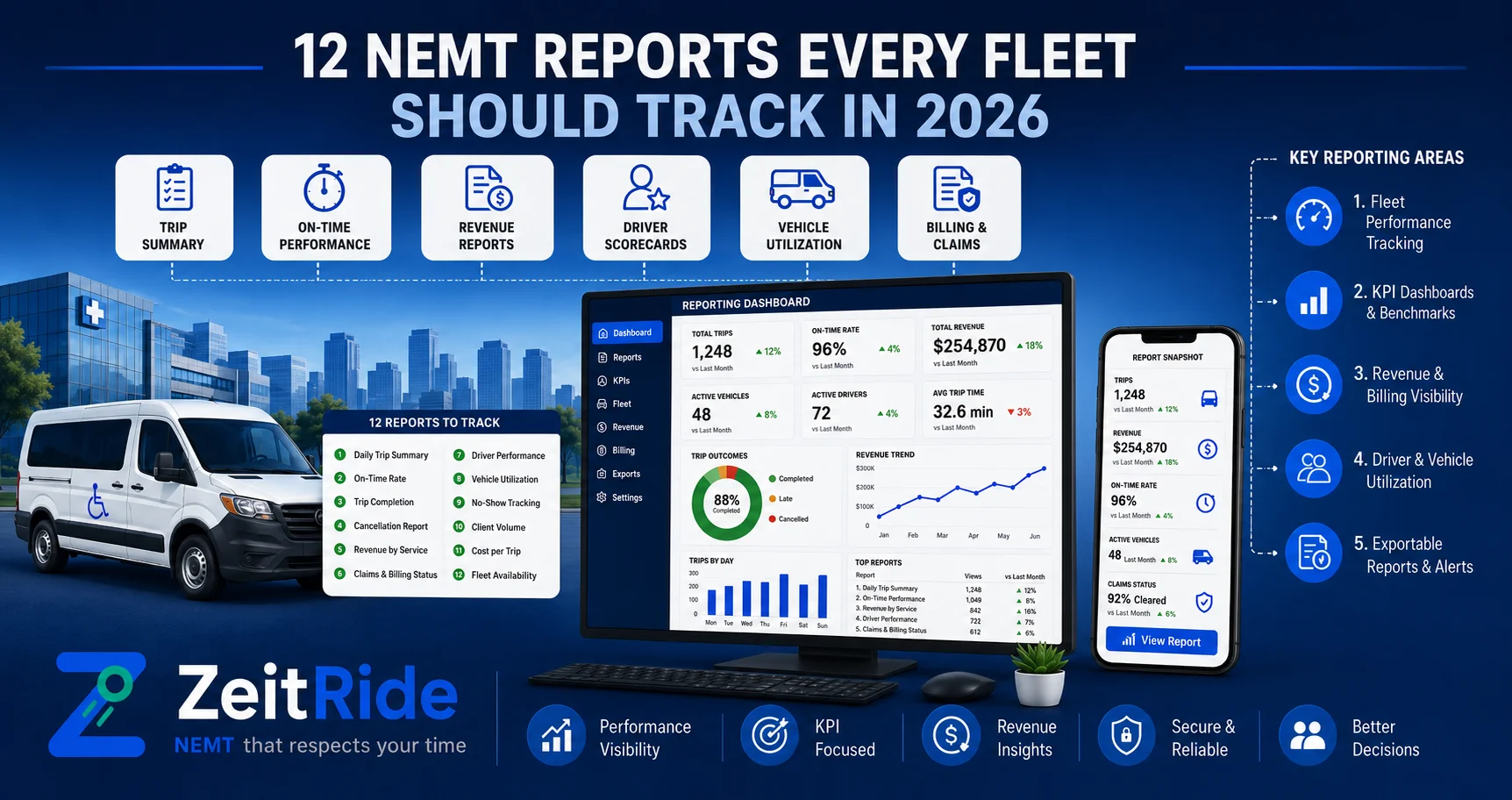
12 NEMT Reports Every Fleet Should Track in 2026
Learn the NEMT reports every fleet should track, from on-time performance and utilization to no-shows, billing, revenue, and compliance.
Quick answer
NEMT fleets should track reports for trip volume, on-time performance, no-shows, fleet utilization, deadhead mileage, driver performance, broker and facility results, billing, revenue, remittance, EVV, and audit documentation.
ZeitRide Team
NEMT Operations Expert
An NEMT fleet can complete hundreds of trips and still have unanswered questions about the health of the operation. Which routes are consistently late? Which vehicles spend too much time driving empty? Are passenger no-shows rising at one facility? Which completed trips have not reached billing? Which broker or contract is actually producing useful revenue?
The right NEMT reports turn daily trip activity into answers. Instead of treating reporting as a month-end spreadsheet exercise, providers can use operational, fleet, financial, and compliance reports to identify problems while there is still time to act on them.
The key is not tracking every number available. It is building a reporting system where each report answers a management question and connects back to the trips, drivers, vehicles, routes, billing records, or exceptions responsible for the result.
For operators who want those reports generated directly from their operating system, NEMT reporting software can connect scheduling, dispatch, driver, fleet, billing, and compliance data instead of requiring staff to assemble the same information manually.
Which NEMT Reports Should Every Fleet Track?
A practical NEMT reporting stack should cover four areas: service performance, fleet efficiency, financial performance, and documentation or compliance. The exact definitions and targets depend on your brokers, payers, facilities, state programs, and contracts, so there is no single national threshold that every provider should apply to every report.
A strong starting point is the following 12-report framework.
| Report | What It Answers | Typical Review Frequency |
|---|---|---|
| Trip Volume & Completion | How much transportation did we schedule, accept, and complete? | Daily / Weekly |
| On-Time Performance | Which trips, routes, drivers, or facilities are creating delays? | Daily / Weekly |
| No-Show & Cancellation | Where are failed or canceled trips occurring and why? | Daily / Weekly |
| Fleet Utilization | Are we using the vehicles we already have efficiently? | Weekly / Monthly |
| Deadhead & Route Efficiency | How much mileage is productive versus empty movement? | Weekly / Monthly |
| Driver Performance | How are drivers performing across trips, timeliness, activity, and exceptions? | Weekly / Monthly |
| Broker & Facility Performance | Which trip sources create volume, service issues, or operational complexity? | Monthly |
| Billing Readiness | Which completed trips are ready to bill and which still have missing information? | Daily / Weekly |
| Revenue Analytics | Which trips, vehicles, contracts, or trip sources contribute revenue? | Weekly / Monthly |
| Remittance & Payment | Did completed and billed trips produce the expected payment? | Weekly / Monthly |
| EVV & Compliance | Do completed trips have the verification and documentation required for review? | Daily / Monthly |
| Audit & Exception History | Can we reconstruct what happened when a trip or record is questioned later? | As Needed / Monthly |
1. Trip Volume and Completion Report
Trip volume is the simplest report, but total scheduled trips alone can be misleading. A useful report separates what was requested, accepted, scheduled, canceled, missed, and actually completed.
Look at volume by day, broker, facility, service type, route, and geographic area rather than relying only on one fleet-wide monthly total.
- Are accepted trips actually being completed?
- Is one facility producing rapid growth?
- Is demand concentrated on specific weekdays?
- Are recurring trips growing faster than one-time requests?
- Are same-day requests increasing?
- Is one service type consuming disproportionate capacity?
Volume becomes especially useful when paired with other NEMT reports. More trips are not automatically better if on-time performance falls, deadhead mileage rises, or billing does not keep pace.
2. On-Time Performance Report
An on-time performance report should compare scheduled or contract-defined service windows with what actually happened during transportation. At minimum, the underlying trip record should make it possible to investigate scheduled time, actual arrival, pickup, appointment arrival where applicable, and the operational reason for a delay.
Do not impose one universal definition across every contract. Broker, payer, facility, and state rules can define timeliness differently. The reporting system should preserve enough detail to measure performance according to the rules that actually apply to each trip.
When the number moves in the wrong direction, use real-time NEMT dispatch data to investigate the affected trips rather than stopping at a fleet-wide percentage.
- Driver
- Vehicle
- Route
- Broker
- Facility
- Service area
- Time of day
- Day of week
- Mobility or service level
- Delay reason
3. No-Show and Cancellation Report
A combined failed-trips number hides too much information. Passenger no-shows, passenger cancellations, facility cancellations, provider cancellations, invalid trip information, and operational failures should be separated whenever the applicable workflow permits it.
A good report answers both how often the event happened and why it happened. Review no-shows and cancellations by rider, facility, route, weekday, broker, driver, and reason code. A repeated pattern at one dialysis center may require a very different response from repeated provider-caused cancellations on one route.
ZeitRide's guide on reducing NEMT no-shows and dry runs covers prevention, documentation, and capacity recovery in more detail.
4. Fleet Utilization Report
A vehicle being on the road all day does not necessarily mean it is being used efficiently. Fleet utilization reporting should help operators distinguish productive activity from idle capacity and understand whether another vehicle is actually necessary.
Useful views may include active service time, available time, trips per vehicle, productive mileage, idle periods, and utilization by vehicle type.
The most useful analysis is vehicle-level rather than one blended fleet average. If five vehicles are highly utilized and three are lightly used, an average can hide both the capacity shortage and the unused capacity.
Operators who need deeper vehicle-level analysis can use NEMT fleet utilization analytics to examine utilization by vehicle, driver, shift, and operating pattern.
5. Deadhead Mileage and Route Efficiency Report
Deadhead mileage is vehicle movement that does not carry a passenger or otherwise generate productive service under the provider's operating definition. Some deadhead movement is unavoidable. Rural geography, specialized wheelchair vehicles, return trips, facility schedules, and uneven demand can all create empty travel.
The objective is not to chase a mathematically impossible zero. The objective is to identify avoidable patterns.
- Long empty repositioning between trips
- Vehicles crossing unnecessarily
- Poor trip grouping
- Routes with repeated backtracking
- Excessive distance between a final drop-off and the next pickup
- Too many vehicles covering demand that a better schedule could consolidate
Compare planned mileage with what vehicles actually drove whenever possible. That turns a generic mileage report into evidence for better route and scheduling decisions.
6. Driver Performance Report
NEMT performance reporting should evaluate drivers using operational context, not one simplistic leaderboard. Useful measures may include completed trips, pickup timeliness, trip-status accuracy, documentation completeness, miles per trip, exceptions, assigned work, and schedule adherence where relevant.
A driver handling a rural wheelchair route should not automatically be compared with a driver completing short urban ambulatory trips without accounting for the operating differences.
Driver reports are most useful when they lead to a specific action: coaching, schedule changes, workload balancing, training, documentation review, or investigation of a repeated exception.
7. Broker and Facility Performance Report
NEMT providers often measure their own performance without separately measuring the trip sources creating the workload. A broker or facility report can show transportation volume, service types, cancellations, no-shows, miles, timing patterns, billing status, and other relevant operational information by account.
- Which relationships generate the most completed trips?
- Which facilities create repeated waiting or schedule problems?
- Which brokers produce the most operational exceptions?
- Which trip sources are growing?
- Where is specialized vehicle demand concentrated?
- Which accounts require unusually high administrative effort?
Do not confuse volume with value. A large contract can create substantial activity while also producing high deadhead mileage, long wait times, or significant billing complexity.
8. Billing Readiness Report
A completed trip should not disappear between dispatch and billing. A billing-readiness report identifies completed transportation that is ready for billing and flags trips with incomplete information that still need attention.
Depending on the payer or workflow, missing items might include timestamps, mileage, service codes, signatures, statuses, authorization details, or other required documentation.
Connected NEMT billing software can make this report more useful because finance is reviewing the same underlying trip record that dispatch and the driver used during service.
The management question is simple: what transportation did we perform that has not yet become a clean billing record?
9. NEMT Revenue Analytics Report
Trip count measures activity. Revenue reporting measures what that activity produced financially. Useful NEMT revenue analytics can examine revenue by broker, facility, service type, vehicle, route, region, or another meaningful business segment.
Revenue alone still does not equal profit. Operators should pair revenue with operating information such as driver labor, mileage, tolls, vehicle costs, waiting time, deadhead movement, and other direct expenses where those data are available.
If you are evaluating the broader financial effect of fleet automation, ZeitRide's NEMT ROI calculator provides a separate framework for comparing software cost with labor, mileage, trip-capacity, and billing changes.
10. Remittance and Payment Report
A billed trip is not necessarily a correctly paid trip. Payment reporting should help finance identify whether completed and billed transportation can be matched to expected payments, and where an exception requires investigation.
- Completed trips with no matching payment
- Short-paid trips
- Missing return legs
- Unmatched remittance lines
- Mileage discrepancies
- Payment differences requiring review
ZeitRide's NEMT remittance reconciliation workflow goes deeper into connecting completed trip records, billing data, and broker payment information.
This report protects against an easy mistake: assuming the monthly deposit total proves every individual trip was paid correctly.
11. EVV and Compliance Report
Where electronic visit verification, broker trip verification, signatures, GPS evidence, timestamps, or other documentation applies, providers need to know whether the required evidence is actually present before someone requests it.
An EVV or compliance report may include the completion status of required trip elements, documentation exceptions, signatures, GPS-supported events, or other program-specific data.
Requirements vary by state, payer, broker, service type, and contract, so software should not substitute one universal checklist for the rules governing the provider's actual trips.
12. Audit and Exception History Report
Some reports answer how the operation is performing. Audit history answers a different question: what exactly happened to this record?
When a trip is disputed weeks later, the operator may need to know who changed an assignment, when a status was updated, what the original schedule showed, or why a cancellation was recorded.
A useful audit or exception view keeps changes connected to the trip instead of forcing staff to reconstruct events from messages, emails, spreadsheets, and memory.
NEMT Reporting vs. Analytics vs. Dashboards
The terms reporting, analytics, and dashboard are related, but they are not identical.
| Term | Primary Purpose | Example |
|---|---|---|
| Reporting | Organize and present what happened | Weekly on-time performance report |
| Analytics | Find patterns and understand why results changed | Comparing late trips by route, driver, facility, and time of day |
| Dashboard | Give users a visual view of current or summarized information | Fleet KPI dashboard showing trips, utilization, billing, and exceptions |
A strong NEMT reporting dashboard should let managers move from the summary back to the underlying operating data. If the dashboard shows late pickups but cannot identify the trips responsible for them, the fleet still has to investigate somewhere else.
That is why useful NEMT reporting and analytics begins with connected records rather than prettier charts.
What Should an NEMT Reporting Dashboard Include?
The dashboard should be designed around decisions, not around displaying the maximum number of charts.
- Current trip volume and completion
- On-time performance
- Open operational exceptions
- Cancellations and no-shows
- Fleet utilization
- Deadhead or productive mileage
- Driver-level performance
- Completed but unbilled trips
- Revenue or billing status
- Compliance or documentation exceptions
- Filters for broker, facility, driver, vehicle, route, date, and service area
ZeitRide already has a dedicated guide to NEMT KPIs and broker scorecard metrics for operators who need formulas, benchmark-setting guidance, and a deeper KPI framework. This article focuses on the reports management teams should build around those metrics rather than duplicating the KPI guide.
How Often Should NEMT Reports Be Reviewed?
Not every report belongs in the same meeting. Operational exceptions can require attention during the service day. Weekly reviews are better for identifying emerging trends. Financial, broker, fleet, and compliance reporting often benefits from a monthly review in addition to shorter operational checks.
| Cadence | Review Focus |
|---|---|
| Daily | Active exceptions, late trips, no-shows, cancellations, incomplete records, and billing blockers |
| Weekly | On-time trends, route performance, driver performance, utilization, deadhead mileage, and unbilled trips |
| Monthly | Broker and facility performance, revenue, remittance, fleet trends, compliance, and recurring problem areas |
| Quarterly | Capacity decisions, contract performance, long-term trends, reporting definitions, and management targets |
The exact cadence should reflect the risk. A red operational metric that affects today's riders should not wait until a monthly review.
Build Reports From the Same Data That Runs the Fleet
Manual reporting usually becomes difficult for one reason: the data needed for the report lives in different places. The schedule may be in one application. GPS data may be in another. Drivers may communicate through texts or phone calls. Billing may live in a separate workflow. Compliance records may be stored in folders or spreadsheets.
That creates reconciliation work before analysis can even begin. The stronger model is schedule to dispatch to driver activity to GPS and trip evidence to completion to billing to payment to reporting.
When those stages reference the same transportation record, a report becomes a view of the work the fleet already performed rather than a new administrative project created afterward.
Industry NEMT Reporting Is Becoming More Structured
NEMT reporting is not only an internal management issue. Industry and public-program reporting frameworks increasingly define specific service, quality, and operational measures that transportation programs may need to monitor.
The National Emergency Medical Transportation Accreditation Commission has published a proposed Trip Performance Metrics and KPIs framework addressing performance areas such as service quality, reliability, trip denials, cancellations, and related measures.
Oregon's official NEMT Quality Assurance reporting specifications provide a state-level example of structured reporting categories that include no-shows, cancellations, same-day rides, late rides, utilization, and other transportation measures.
The practical lesson is not to copy another program's thresholds. It is to make sure your system preserves enough structured trip data to report according to the definitions that actually apply to your contracts, brokers, payers, and market.
How to Evaluate NEMT Reporting Software
Do not judge reporting software from a polished dashboard screenshot. Bring a real management question to the demo and ask the vendor to trace the answer back to the underlying trips.
For example, ask the vendor to show all completed trips from last month that were late, group them by facility, and then open the trips responsible for the result.
- Can reports filter by broker, facility, driver, vehicle, route, and date?
- Can managers move from a summary metric to underlying trips?
- Can reports separate provider cancellations from rider or facility cancellations?
- Can the system compare operational and financial information?
- Can completed but unbilled trips be identified?
- Can reports be exported?
- Can reports be scheduled automatically?
- Is GPS and driver activity connected to the same trip?
- Can permissions restrict who sees financial or sensitive information?
- Can historical changes be investigated?
- Does reporting cost extra?
- What happens to your reporting data if you leave the platform?
The best demonstration is your own operating question, not the vendor's easiest chart.
Turn NEMT Reports Into Better Fleet Decisions
Reports do not improve an NEMT operation simply because they exist. An on-time report should lead to the trips creating delays. A utilization report should reveal the vehicles or schedules creating unused capacity. A no-show report should identify repeat patterns. A revenue report should help management understand which work contributes financial value. A billing report should expose completed transportation that has not reached payment.
That is where connected NEMT performance reporting becomes useful: the result points back to the workflow that produced it.
ZeitRide connects scheduling, dispatch, routing, driver activity, billing workflows, reporting, and supporting trip records in one NEMT platform. Instead of rebuilding reports from disconnected systems, operators can use the same operational data that ran the transportation day.
Bring a report you currently build by hand, or a fleet question your current software cannot answer easily. See how ZeitRide works and walk through the underlying trip, fleet, billing, and reporting workflow using a real operating scenario.
Frequently Asked Questions
Q: What NEMT reports should providers track?
NEMT providers should track reports covering trip volume and completion, on-time performance, no-shows and cancellations, fleet utilization, deadhead mileage, driver performance, broker and facility results, billing readiness, revenue, payment reconciliation, compliance, and audit history. Exact definitions should follow applicable contracts and program requirements.
Q: What is the difference between NEMT reporting and analytics?
NEMT reporting organizes and presents operational or financial results, while analytics examines those results to identify patterns, causes, and opportunities for action.
Q: What should an NEMT reporting dashboard include?
An NEMT reporting dashboard should surface key operational and financial information such as trip volume, on-time performance, no-shows, cancellations, utilization, mileage, driver performance, billing status, revenue, and documentation exceptions.
Q: How often should NEMT reports be reviewed?
Operational exceptions should be reviewed daily, performance and efficiency trends generally benefit from weekly review, and broker, financial, fleet, and compliance results should receive regular monthly review based on the provider's contracts and operating risks.
Q: Can NEMT software automate reports?
Yes. NEMT software can automate reports when scheduling, dispatch, GPS, driver activity, billing, and documentation data are connected. Providers should verify that report definitions match applicable broker, payer, state, and contract requirements.
Q: Which NEMT reports help track revenue?
Useful financial reports include revenue by trip source, broker, facility, vehicle, route, or service type; completed-but-unbilled trips; billed-versus-paid information; and remittance exceptions.
Rather see it than read about it?
Bring a real route, a couple of drivers, and your current process. 15 minutes, zero pitch.