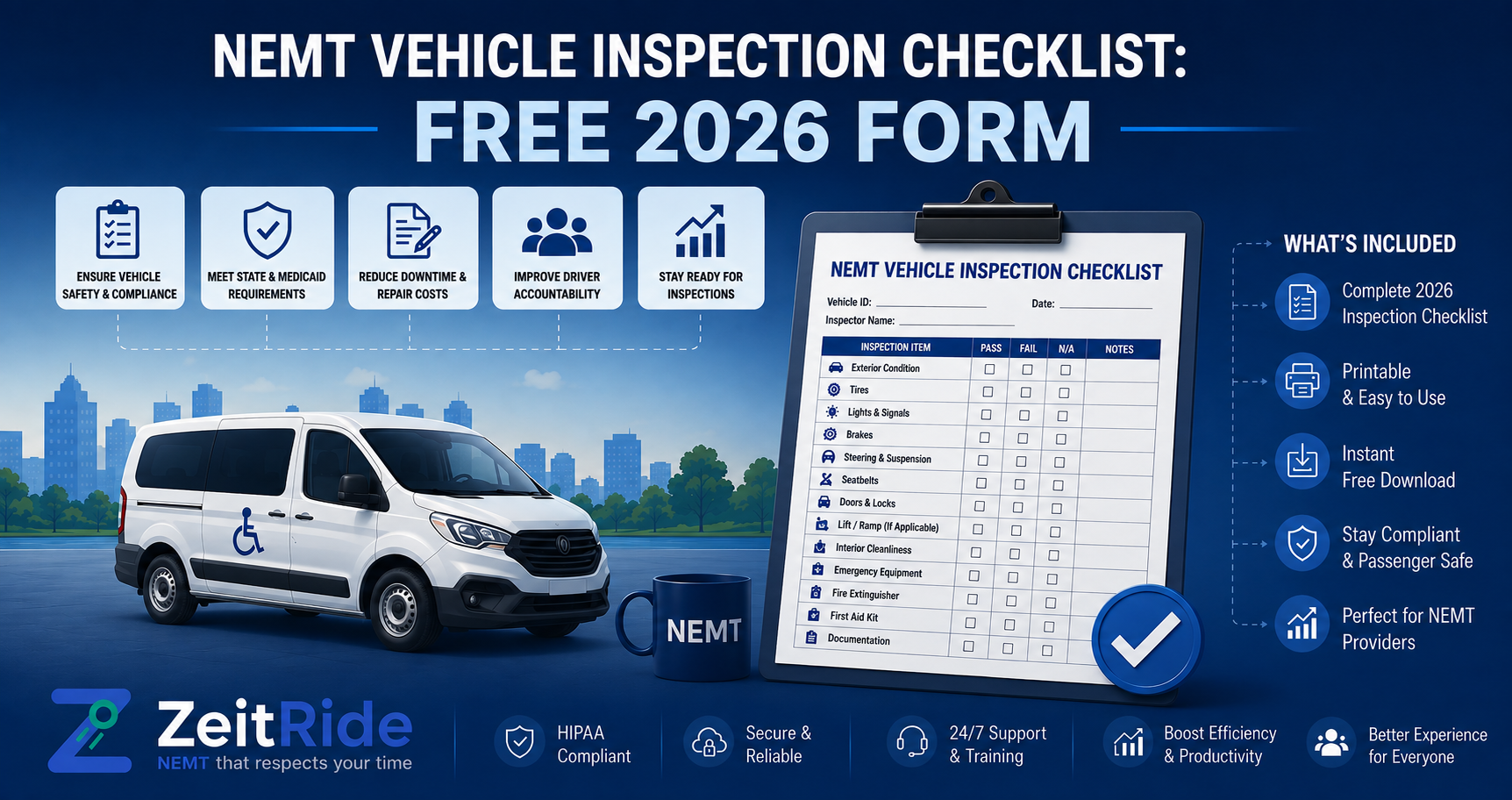
NEMT Vehicle Inspection Checklist: Free 2026 Form
Use this free NEMT vehicle inspection checklist to complete daily pre-trip checks, document defects, and keep unsafe vehicles out of service.
Quick answer
An NEMT vehicle inspection checklist should cover vehicle condition, passenger safety, wheelchair equipment, emergency supplies, required documents, and communication tools. Drivers should document defects and keep unsafe vehicles out of service until cleared.
ZeitRide Team
NEMT Operations Expert
A consistent vehicle inspection helps NEMT providers identify safety, accessibility, and maintenance problems before passengers are transported. It also gives drivers, dispatchers, and fleet managers a clear record of what was checked, which defects were found, and whether the vehicle is ready for service. This free NEMT vehicle inspection checklist can be printed, saved as a PDF, or adapted into a digital NEMT fleet inspection workflow. Inspection requirements can vary by state, transportation broker, payer, insurer, contract, vehicle type, and operating authority, so customize this checklist for the requirements that apply to your fleet.
What Should an NEMT Vehicle Inspection Checklist Include?
An NEMT vehicle inspection checklist should cover vehicle identification, previous defects, tires, brakes, lights, visibility, passenger seating and restraints, wheelchair-accessibility equipment, emergency supplies, required documents, communication tools, and the final release-to-service decision. The inspection should be completed before the vehicle begins service. Any defect that could affect safety, accessibility, or required operation should be documented and reported immediately.
Free NEMT Daily Vehicle Inspection Checklist
Before starting the inspection, record the date, time, driver name, vehicle number, starting mileage, route or shift, and any unresolved defect from the previous inspection. Complete the following NEMT daily vehicle inspection checklist before the vehicle's first passenger trip or at the beginning of the applicable shift.
| Inspection Area | Item to Check | Pass | Fail | N/A | Notes |
|---|---|---|---|---|---|
| Tires and wheels | Check inflation, tread, sidewalls, rims, and visible wheel condition | ☐ | ☐ | ☐ | |
| Fluid leaks | Check for visible fuel, oil, coolant, or other concerning leaks | ☐ | ☐ | ☐ | |
| Exterior lights | Test headlights, taillights, brake lights, and marker lights | ☐ | ☐ | ☐ | |
| Signals | Test turn signals and hazard lights | ☐ | ☐ | ☐ | |
| Visibility | Check windshield, windows, mirrors, wipers, washers, and defroster | ☐ | ☐ | ☐ | |
| Doors | Confirm driver and passenger doors open, close, and latch securely | ☐ | ☐ | ☐ | |
| Brakes | Check service brake response and parking brake operation | ☐ | ☐ | ☐ | |
| Steering and horn | Confirm steering responds normally and the horn works | ☐ | ☐ | ☐ | |
| Dashboard | Check for unresolved critical warning indicators | ☐ | ☐ | ☐ | |
| Passenger seats | Confirm seats are secure and free from obvious damage | ☐ | ☐ | ☐ | |
| Seat belts | Confirm required passenger restraints latch and retract correctly | ☐ | ☐ | ☐ | |
| Flooring and handholds | Check that floors are clear and handrails are secure | ☐ | ☐ | ☐ | |
| HVAC and cleanliness | Confirm the passenger area is clean and temperature controls work | ☐ | ☐ | ☐ | |
| Emergency equipment | Check required first-aid, fire, warning, and spill equipment | ☐ | ☐ | ☐ | |
| Communication | Test phone, radio, charging equipment, GPS, or approved communication tools | ☐ | ☐ | ☐ | |
| Documents | Confirm registration, insurance, permits, and inspection records are current | ☐ | ☐ | ☐ |
To create an NEMT vehicle inspection checklist PDF, open this page in your browser, select Print, and choose Save as PDF. Store the completed form according to your company's approved record-retention policy.
NEMT Wheelchair Van Inspection Checklist
Wheelchair-accessible vehicles require additional checks beyond a standard vehicle walk-around. Drivers should operate and inspect the equipment rather than confirming only that it is present. Follow the equipment manufacturer's instructions and any applicable state, broker, payer, insurance, or contract requirements.
| Accessibility Item | Inspection Check | Pass | Fail | N/A |
|---|---|---|---|---|
| Lift or ramp | Completes a full operating cycle without visible damage or unusual movement | ☐ | ☐ | ☐ |
| Safety interlocks | Required door, brake, and lift interlocks function correctly | ☐ | ☐ | ☐ |
| Platform barriers | Roll stops, barriers, and bridge plates operate as designed | ☐ | ☐ | ☐ |
| Manual backup | Backup operating method is present and ready for use | ☐ | ☐ | ☐ |
| Securement equipment | Required straps, hooks, retractors, and fittings are available | ☐ | ☐ | ☐ |
| Floor anchors | Tracks and anchor points are clean, accessible, and undamaged | ☐ | ☐ | ☐ |
| Occupant restraints | Passenger lap and shoulder restraints are present and serviceable | ☐ | ☐ | ☐ |
| Boarding area | Lift, ramp, entry, and securement areas are clear of stored items | ☐ | ☐ | ☐ |
For transportation services covered by federal accessibility rules, applicable accessibility features must be maintained in operative condition. Relevant provisions include 49 CFR §37.161 and 49 CFR §37.163. Federal requirements do not apply identically to every NEMT fleet, so review whether NEMT vehicles need DOT inspections and verify the rules governing your operation.
How to Complete an NEMT Pre-Trip Inspection Checklist
- Review the previous inspection and confirm whether reported defects were corrected.
- Record the driver, vehicle, date, time, shift, and starting mileage.
- Complete an exterior walk-around covering tires, wheels, leaks, lights, signals, glass, mirrors, wipers, and doors.
- Test the brakes, steering, horn, dashboard indicators, seats, restraints, flooring, handholds, and climate controls.
- Operate wheelchair lifts, ramps, interlocks, securement equipment, and occupant restraints where applicable.
- Confirm required emergency supplies, communication tools, registration, insurance, permits, and inspection records are available.
- Document every defect and notify the responsible dispatcher, supervisor, or fleet manager.
- Mark the vehicle as passed, monitored, or failed according to company policy.
A daily inspection does not replace preventive maintenance, an annual certification, or a qualified mechanic's inspection. Repeated or unresolved defects should be added to your NEMT fleet maintenance process so they become accountable repair tasks instead of recurring driver notes.
What Should Happen When an NEMT Vehicle Fails Inspection?
A failed inspection item should result in a documented decision. Record the defect, identify who was notified, classify its severity, and determine whether the vehicle can safely enter service. A safety-critical or accessibility-related failure should not disappear into a paper folder or text-message thread.
| Status | Meaning | Required Action |
|---|---|---|
| Pass | No unresolved issue affects service readiness | Release the vehicle for service |
| Monitor | A noncritical concern has been documented | Schedule follow-up and monitor according to policy |
| Fail | A defect may affect safety, accessibility, or required operation | Hold the vehicle and arrange corrective action |
| Return to service | The defect was corrected and rechecked | Record the approval, date, time, and responsible person |
Possible out-of-service conditions may include an apparent brake problem, unsafe tire condition, serious fluid leak, required lighting failure, unsafe door or passenger restraint, inoperative wheelchair lift or ramp, damaged securement equipment, or a critical dashboard warning. The final decision must follow your written procedures and applicable state, broker, payer, insurance, manufacturer, and contract requirements.
When a vehicle becomes unavailable, NEMT dispatch software can help your team identify affected trips and reassign them to another suitable vehicle before service is disrupted.
What Should the Final Inspection Record Include?
- Overall inspection result
- Description of each defect
- Whether the vehicle was held out of service
- Name of the dispatcher, supervisor, or fleet manager notified
- Notification date and time
- Corrective action or repair reference
- Reinspection result
- Return-to-service date and time
- Driver or inspector signature
- Supervisor approval where required
Store completed records so your company can retrieve inspections by vehicle and date. Retention periods vary, so follow the longest applicable requirement established by your state, payer, broker, insurer, contract, and internal policy. Review the broader NEMT documentation requirements and use NEMT compliance tracking to monitor permits, insurance documents, certifications, and recurring inspection deadlines.
Paper Checklist vs. Digital NEMT Vehicle Inspections
A paper or printable NEMT vehicle inspection form helps drivers check the same items consistently. The weakness appears after a defect is reported: someone must notify dispatch, change the vehicle's availability, move scheduled trips, open a maintenance task, and preserve the inspection record. With the ZeitRide Driver App, drivers can complete pre-trip inspections from their mobile workflow while inspection results remain connected to vehicle status, dispatch, and maintenance records.
Turn This Checklist Into a Connected Inspection Workflow
A checklist records what the driver inspected. A connected workflow also ensures that a failed result reaches dispatch, changes vehicle availability, creates an accountable maintenance record, and supports the return-to-service process. ZeitRide's NEMT software connects driver inspections, fleet maintenance, live dispatch, and vehicle records in one operating platform.
See how ZeitRide can turn your current inspection form into a connected driver and dispatch workflow — book a 15-minute demo and bring the checklist your fleet already uses.
Frequently Asked Questions
Q: What should be included in an NEMT vehicle inspection checklist?
An NEMT vehicle inspection checklist should cover vehicle identification, tires, brakes, lights, passenger restraints, wheelchair equipment, emergency supplies, communication tools, required documents, reported defects, and the final release-to-service decision.
Q: How often should an NEMT pre-trip inspection checklist be completed?
Complete the checklist before the vehicle's first service period or according to the schedule required by your company, state, payer, broker, insurer, or contract.
Q: What happens when an NEMT vehicle fails inspection?
Document the defect, notify the responsible person, hold the vehicle out of service when required, complete the corrective action, and record the reinspection and return-to-service approval.
Q: What should an NEMT wheelchair van inspection checklist include?
It should include the lift or ramp, safety interlocks, platform barriers, manual backup system, floor anchors, wheelchair securement equipment, occupant restraints, and a clear boarding area.
Q: Can an NEMT vehicle inspection form be completed electronically?
Yes. A digital inspection form can also notify dispatch, update vehicle availability, organize records, and connect reported defects to maintenance follow-up.
Q: Is a daily NEMT checklist the same as a DOT or annual vehicle inspection?
No. A daily checklist verifies immediate operating readiness. DOT, annual, state, broker, or certified inspections are separate processes that may require an authorized or qualified inspector.
Rather see it than read about it?
Bring a real route, a couple of drivers, and your current process. 15 minutes, zero pitch.