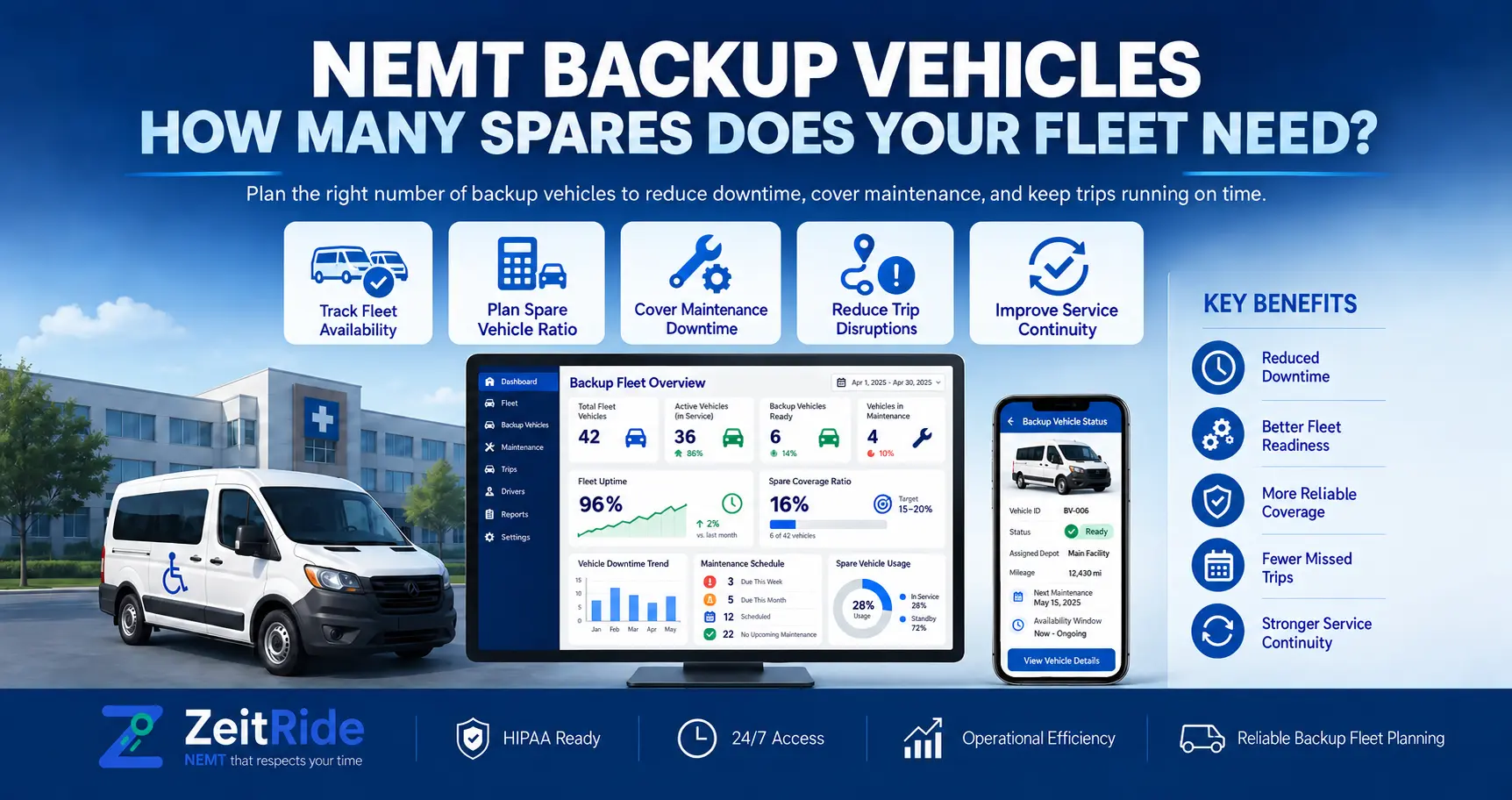
NEMT Backup Vehicles: How Many Spares Does Your Fleet Need?
Learn how to size NEMT backup vehicles using peak demand, downtime, vehicle type, maintenance history, and contract requirements.
Quick answer
There is no universal backup-vehicle percentage for every NEMT fleet. Size reserve capacity from peak active vehicle needs, concurrent downtime, repair time, vehicle type, and applicable broker or program requirements, then confirm each spare is road-ready.
ZeitRide Team
NEMT Operations Expert
Owning ten vehicles does not necessarily mean an NEMT company has ten vehicles available for tomorrow's schedule. One may be in preventive maintenance, another may have failed an inspection, and a wheelchair-accessible van may be waiting for lift repairs.
That is why NEMT backup vehicles should be planned as operational capacity rather than simply vehicles that happen to be unused. The important question is not only how many vehicles you own. It is: how many road-ready, compatible vehicles can your operation lose before scheduled transportation begins to break?
How Many Backup Vehicles Does an NEMT Fleet Need?
There is no single backup-vehicle percentage that is correct for every NEMT company. The right reserve depends on peak vehicles required at the same time, historical simultaneous downtime, average repair duration, preventive maintenance workload, fleet age and reliability, wheelchair and specialty vehicle requirements, service commitments, geography, and applicable broker, payer, state, or contract requirements.
A useful target is the smallest road-ready reserve fleet that can cover realistic downtime without creating excessive idle cost. That requires fleet data, not a copied percentage.
What Are NEMT Backup Vehicles?
NEMT backup vehicles are road-ready units held outside the normal peak requirement so they can replace active capacity when another vehicle becomes unavailable.
- Scheduled maintenance
- An inspection failure
- An unscheduled repair
- Wheelchair-lift or ramp problems
- An accident
- A mechanical breakdown
- Temporary vehicle restrictions
- Another condition that removes an active unit from service
A vehicle should only count as backup capacity if it can actually be dispatched. A van waiting for parts is not a spare. A vehicle with an unresolved safety defect is not a spare. And an ambulatory sedan is not necessarily replacement capacity for an unavailable wheelchair-accessible van.
Is There a Standard NEMT Spare Vehicle Ratio?
No universal NEMT spare vehicle ratio applies to every U.S. provider. Transit and paratransit systems often measure spare capacity against the number of vehicles required at peak service, but actual ratios vary significantly between systems.
Research from the National Academies shows that paratransit fleets use different spare ratios depending on their operating conditions. Those examples can help explain the measurement, but they should not be copied directly into an independent NEMT operation.
A simple measurement is: NEMT spare vehicle ratio = Ready backup vehicles ÷ Peak required active vehicles × 100.
For example, if a fleet normally needs eight vehicles simultaneously during its busiest period and has two additional road-ready compatible units, the calculation is 2 ÷ 8 × 100 = 25%. That means the current measured spare ratio is 25%. It does not mean 25% is the correct target for every NEMT fleet.
The calculation describes what you currently have. Your actual operating risk determines whether that capacity is enough.
Step 1: Calculate Your Peak Active Vehicle Requirement
Start with how many vehicles the operation actually needs at its busiest recurring point. Do not use total vehicles owned. Instead, review the schedule and determine the highest number normally required at the same time.
| Fleet Measure | Example |
|---|---|
| Vehicles owned | 12 |
| Peak vehicles required | 9 |
| Vehicles not required at peak | 3 |
At first glance, the operation appears to have three spare vehicles. But that conclusion is premature. The next questions are whether those three vehicles are road-ready and whether their capabilities match the vehicles most likely to become unavailable.
If you need to understand how much productive work your active vehicles can handle, use the existing NEMT vehicle capacity guide. That article owns active trip capacity; this guide focuses only on reserve capacity.
Step 2: Measure Concurrent Vehicle Downtime
One maintenance event does not tell you how much backup capacity you need. What matters is how many vehicles are unavailable at the same time.
- Scheduled preventive maintenance
- Unexpected repairs
- Inspection failures
- Accident-related downtime
- Wheelchair-lift or ramp repairs
- Parts delays
- Repeat mechanical issues
- Unusually long service events
Then identify the normal and high end of simultaneous downtime. For example, a 15-vehicle fleet may average one unavailable vehicle but regularly experience two units out together when planned maintenance overlaps with an unexpected repair. Sizing the reserve around an average of one could leave the operation exposed.
Your NEMT preventive maintenance schedule should reduce avoidable downtime and make planned service easier to anticipate. It should not be duplicated inside the backup-fleet calculation.
Step 3: Separate Backup Capacity by Vehicle Capability
This is where simple fleet percentages can become misleading. An operation may appear to have adequate reserve capacity overall while still having no replacement for a specific service class.
Imagine an operation has seven ambulatory vehicles, three wheelchair-accessible vehicles, and two ready ambulatory backups. Overall, the fleet appears to have spare capacity. But if one wheelchair van becomes unavailable during a period when all three are required, neither spare sedan solves the problem.
| Service Need | Peak Active Need | Ready Compatible Backup | Planning Question |
|---|---|---|---|
| Ambulatory | 7 | 2 | Can normal downtime be absorbed? |
| Wheelchair | 3 | 0 | What happens if one WAV becomes unavailable? |
| Specialized service | 1 | 0 | Is equivalent approved replacement capacity available? |
For NEMT reserve fleet capacity, count backup vehicles by what they can replace, not only by the number of vehicles parked in the fleet.
Step 4: Confirm Every Spare Is Actually Road-Ready
A vehicle should not appear in your reserve calculation simply because nobody is currently driving it. Before counting a unit toward NEMT fleet redundancy, confirm that it meets the readiness rules that apply to your operation.
- Current registration
- Required insurance
- Required inspections
- No unresolved safety defect
- Functioning required equipment
- Functioning wheelchair equipment where applicable
- Current maintenance status
- Usable passenger capacity
- Correct service classification
- Availability for assignment
Use a consistent NEMT vehicle inspection checklist to identify immediate defects before treating a vehicle as dispatch-ready. A spare vehicle that cannot legally, safely, or operationally leave the yard should not increase your calculated reserve.
Step 5: Test Your Reserve Against Real Failure Scenarios
Once the fleet inventory is classified, test it against realistic operating scenarios based on the problems your fleet has actually experienced.
What if one ambulatory vehicle enters maintenance?
Determine whether an equivalent road-ready spare can cover the work without changing the operating plan.
What if a wheelchair van fails inspection?
Check whether another wheelchair-capable unit is genuinely available rather than assuming any unused vehicle can replace it.
What if planned maintenance overlaps with an unexpected repair?
Test whether the fleet can still cover its peak active requirement when two units are simultaneously unavailable.
What if a specialized vehicle remains unavailable for several days?
Determine whether equivalent internal capacity, an approved rental option, subcontracted capacity where permitted, or another valid contingency is available.
The purpose is not to model every imaginable disruption. It is to test the repeatable problems your operation is most likely to face.
Worked Example: Is a 12-Vehicle Fleet Properly Covered?
Consider a hypothetical 12-vehicle operation. This example illustrates the method only; it is not an industry benchmark.
The fleet normally needs nine vehicles during peak service. Three vehicles therefore sit outside the peak requirement. That produces a measured spare vehicle ratio of 3 ÷ 9 × 100 = 33.3%.
Looking only at that percentage, reserve capacity appears strong. But the fleet mix is eight ambulatory vehicles and four wheelchair-accessible vehicles. At peak, six ambulatory vehicles and three wheelchair vehicles are required.
Of the three vehicles outside peak demand, two are ambulatory and one is wheelchair-accessible. Now assume historical records show that one vehicle is commonly in scheduled maintenance and a second vehicle is occasionally unavailable at the same time.
The overall reserve may still appear reasonable. But if the operation's only spare WAV is already in maintenance when another WAV fails inspection, the total fleet percentage no longer tells the full story. That is why backup planning should always be evaluated both fleet-wide and by critical vehicle capability.
What Are NEMT Backup Vehicle Requirements?
NEMT backup vehicle requirements are not identical nationwide. Requirements may come from state Medicaid programs, transportation brokers, managed-care contracts, local operating authorities, insurers, facility contracts, or internal policies.
For example, Virginia NEMT contract documentation includes backup-vehicle and trip-recovery expectations. That is a useful example of a program-specific requirement, but it should not be treated as a nationwide NEMT standard.
- Specific reserve or backup requirements
- Replacement-time expectations
- Trip-recovery procedures
- Required vehicle types
- Documentation requirements
- Notification rules after a service disruption
Review the requirements that actually govern your company. Your internal target may need to be higher than a minimum contractual requirement if your real downtime history creates greater operating risk.
When Should You Add Another Backup Vehicle?
A provider should investigate additional reserve capacity when operating data repeatedly shows that the existing backup fleet is inadequate.
- Peak schedules regularly require every road-ready vehicle
- Preventive maintenance is postponed because no replacement vehicle exists
- Two simultaneous outages repeatedly exhaust reserve capacity
- Wheelchair trips become uncovered when one WAV is unavailable
- The company frequently rents or borrows replacement vehicles
- Trips are routinely declined because an appropriate vehicle is unavailable
- Vehicle failures repeatedly create widespread schedule changes
- New contracts increase the number of vehicles required at peak
One isolated breakdown does not automatically justify purchasing another vehicle. Look for a recurring capacity problem.
If a failure has already happened, follow the separate NEMT vehicle breakdown policy for passenger recovery, trip reassignment, documentation, and return-to-service procedures. Reserve-fleet planning should happen before that emergency response is needed.
Can an NEMT Fleet Have Too Many Backup Vehicles?
Yes. Backup capacity reduces operational risk, but unused vehicles still cost money.
- Lease or financing payments
- Insurance
- Registration
- Scheduled inspections
- Maintenance
- Tires and batteries
- Wheelchair equipment maintenance
- Depreciation
- Parking or facility space
NEMT fleet redundancy has a cost on both sides. Too little reserve capacity can lead to disrupted transportation and lost productive capacity. Too much can tie capital up in vehicles that rarely contribute useful service.
The objective is not maximum redundancy. It is enough compatible, road-ready redundancy to protect realistic operating needs at an acceptable cost.
Review Reserve Capacity as the Fleet Changes
Your backup requirement should not be calculated once and forgotten. Review it whenever the operating conditions that determine peak demand or vehicle reliability materially change.
- Fleet size changes
- A major contract starts or ends
- Peak trip volume changes
- Wheelchair demand changes
- Older vehicles begin creating more downtime
- Repair turnaround becomes longer
- Maintenance performance improves
- Service areas expand
- New vehicle types are introduced
Also review the calculation periodically using actual utilization and downtime records. NEMT fleet management software can help operators distinguish vehicles that are owned from vehicles that are actually ready, available, and appropriate for upcoming transportation.
How Software Supports NEMT Backup Vehicle Planning
The hardest part of backup-fleet planning is often not the formula. It is knowing which vehicles should actually count.
If maintenance status lives in one spreadsheet, inspection failures in paper forms, vehicle capabilities in another file, and trip assignments on a separate dispatch board, management can overestimate available capacity.
ZeitRide connects vehicles, maintenance, inspections, assignments, scheduling, and live dispatch within the same NEMT operating platform. That helps fleet and operations teams distinguish active, available, under-maintenance, restricted, and genuinely ready reserve capacity.
The value is not an automatic universal spare percentage. It is better operational data for deciding how much capacity the fleet truly has. See how ZeitRide NEMT software connects fleet readiness with scheduling and dispatch.
NEMT Backup Vehicle Planning Checklist
- Count vehicles required during normal peak service
- Separate total owned vehicles from road-ready vehicles
- Review historical simultaneous downtime
- Measure how long major repairs normally keep units unavailable
- Separate ambulatory and wheelchair reserve capacity
- Identify other specialized vehicle requirements
- Confirm every spare passes your readiness rules
- Review applicable broker, payer, state, insurer, and contract requirements
- Calculate the current NEMT spare vehicle ratio
- Test reserve capacity against realistic simultaneous outages
- Compare the cost of additional reserve units with the risk of uncovered work
- Review the calculation when fleet demand or reliability changes
A good reserve plan should be explainable from operating data, not from habit.
Frequently Asked Questions
Q: How many backup vehicles does an NEMT fleet need?
There is no universal number. Base your reserve on peak active vehicle requirements, historical simultaneous downtime, repair duration, vehicle capabilities, service commitments, and applicable program or contract requirements.
Q: What is an NEMT spare vehicle ratio?
An NEMT spare vehicle ratio measures ready backup vehicles relative to vehicles required during peak operation. A simple formula is: Ready backup vehicles ÷ Peak required active vehicles × 100. The resulting percentage measures your current reserve; it is not a universal recommended target.
Q: Does every NEMT provider need a backup vehicle?
Requirements vary by contract, state, broker, payer, operating model, and fleet size. Even where a specific ratio is not mandated, providers should understand how transportation will be protected when an assigned vehicle becomes unavailable.
Q: Should wheelchair vehicles have separate backup capacity?
Wheelchair-accessible capacity should be evaluated separately when those vehicles cannot be replaced by standard ambulatory vehicles. An overall fleet spare count can hide a shortage in a specialized service class.
Q: What should count as a ready backup vehicle?
Count a vehicle only when it meets the readiness requirements that apply to your operation and can realistically be dispatched. Units awaiting repair, failing required inspections, missing required equipment, or otherwise unavailable should not be treated as usable reserve capacity.
Size the Reserve Fleet From Your Own Operating Risk
The right number of NEMT backup vehicles is not whatever percentage another fleet uses. Start with the number of vehicles your schedule truly requires at peak. Measure how many units are typically unavailable at the same time. Separate reserve capacity by vehicle capability and remove any supposed spare that is not actually road-ready.
The most important principle is simple: one backup vehicle only counts if it can replace the work that may actually become uncovered.
ZeitRide connects fleet records, maintenance, inspections, scheduling, and dispatch so operators can see which vehicles are truly available rather than relying on separate spreadsheets. Bring your fleet roster, vehicle types, maintenance status, and one busy operating day to a 15-minute ZeitRide demo and see how your actual fleet readiness can stay connected to the work those vehicles need to cover.
Rather see it than read about it?
Bring a real route, a couple of drivers, and your current process. 15 minutes, zero pitch.