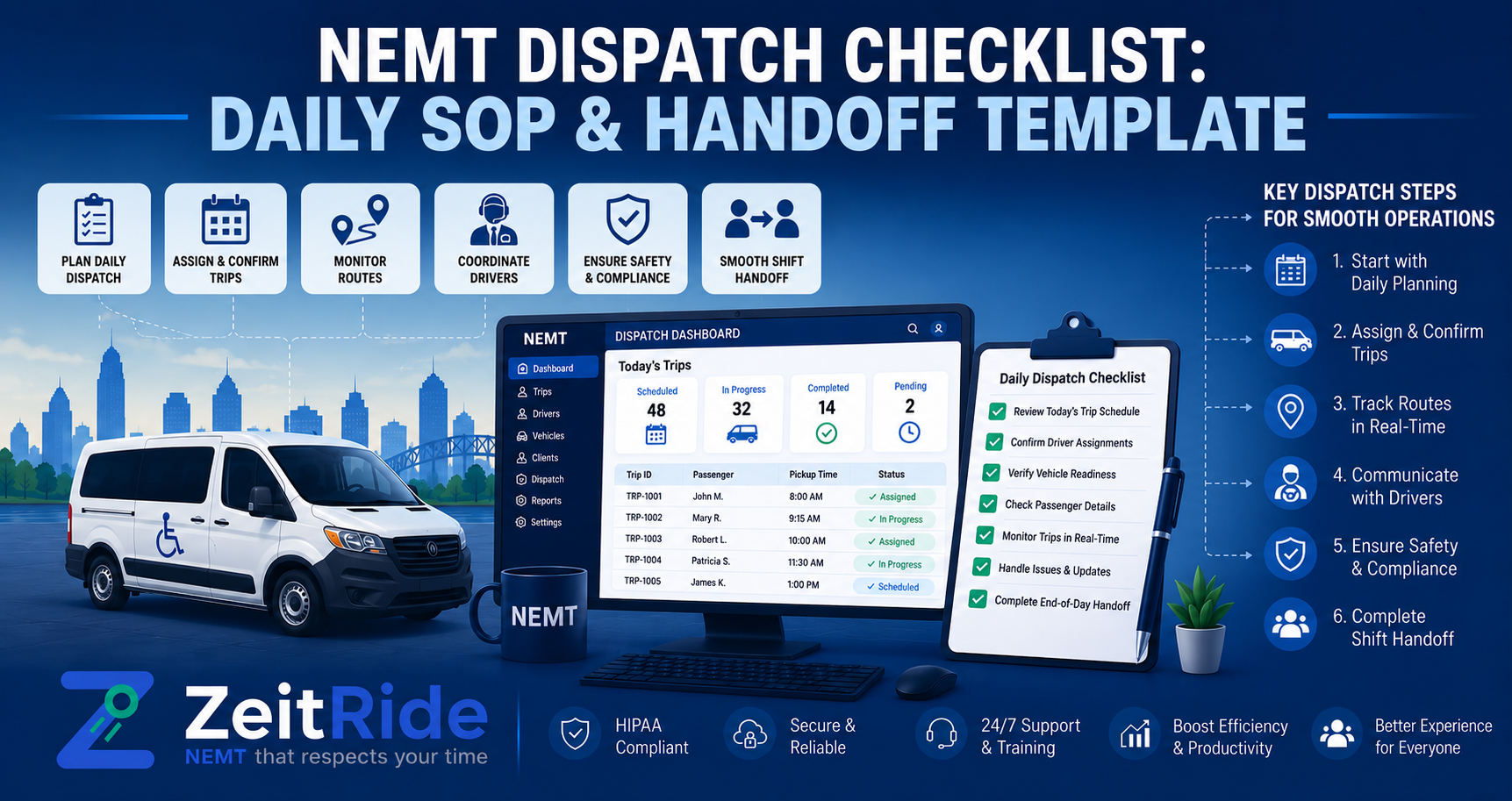
NEMT Dispatch Checklist: Daily SOP & Handoff Template
Use this NEMT dispatch checklist to standardize trip validation, live exception handling, shift handoffs, and billing-ready closeout.
Quick answer
An NEMT dispatch checklist should cover trip validation, driver and vehicle assignments, live monitoring, exception handling, shift handoffs, and end-of-day closeout. Each task should identify the responsible person, required documentation, and escalation trigger.
ZeitRide Team
NEMT Operations Expert
An NEMT schedule can change before the first vehicle leaves the yard. A driver may call out, a wheelchair van may fail inspection, a facility may delay a discharge, or a broker may add a same-day trip. Without a consistent process, dispatchers are forced to manage these changes through phone calls, text messages, spreadsheets, and memory. That increases the risk of missed pickups, incomplete records, poor handoffs, and billing delays.
A practical NEMT dispatch checklist gives the team one repeatable process for preparing the shift, releasing assignments, monitoring active trips, responding to problems, transferring open work, and closing completed trips. Requirements can differ by state, payer, broker, contract, and service level, so compare this checklist with applicable company policies, official CMS NEMT resources, and relevant NEMTAC standards.
What Should an NEMT Dispatch Checklist Include?
An NEMT dispatch checklist should cover six core stages: pre-shift preparation, trip validation and assignment, schedule release, live trip monitoring, exception handling and shift handoff, and end-of-day closeout.
- Pre-shift preparation
- Trip validation and assignment
- Schedule release
- Live trip monitoring
- Exception handling and shift handoff
- End-of-day closeout
Every checklist item should state who owns the task, what action is required, what information must be documented, and when the issue should be escalated. A written NEMT policies and procedures manual defines the company's overall rules. The daily NEMT dispatch SOP converts those rules into actions dispatchers can follow during a live shift.
Daily NEMT Dispatch Workflow
| Stage | Main Dispatcher Action | Required Record |
|---|---|---|
| Pre-shift review | Check open issues, driver availability, vehicle readiness, weather, and facility notices | Readiness and handoff notes |
| Trip validation | Confirm locations, times, authorization, service level, mobility needs, and return status | Complete trip record |
| Assignment | Match each trip with a qualified driver and suitable vehicle | Driver and vehicle assignment |
| Live monitoring | Watch trip status, ETAs, delays, and unacknowledged assignments | Status and communication history |
| Exception response | Recover affected trips and notify required parties | Reason code, notes, and action taken |
| Shift handoff | Transfer unresolved work to the next dispatcher | Accepted handoff record |
| Closeout | Reconcile trip outcomes and required documentation | Billing-ready or correction status |
Pre-Shift NEMT Scheduling Checklist
The pre-shift review should happen before routes are released. Reliable NEMT scheduling software can organize assignments, but the dispatcher must still confirm that the plan is workable with the drivers and vehicles available that day.
Review Driver and Vehicle Readiness
- Confirm driver attendance and availability
- Review credential, qualification, or duty restrictions
- Confirm each assigned vehicle is available for service
- Check wheelchair lift, securement, capacity, and accessibility requirements
- Review unresolved inspection or maintenance issues
- Confirm drivers can access the approved communication system
- Identify backup coverage for high-risk trips where practical
If daily vehicle checks are part of company or contractual requirements, use a documented NEMT vehicle inspection checklist before the vehicle is released.
Validate Every Trip
- Correct service date
- Pickup and destination addresses
- Appointment and pickup times
- Rider and facility contact information
- Authorization or broker reference where required
- Ambulatory, wheelchair, stretcher, or other service level
- Mobility device and assistance requirements
- Escort or attendant information
- One-way, scheduled return, or will-call status
- Required signature, mileage, GPS, or proof-of-service fields
- Special instructions the driver must receive
Do not release an incomplete trip simply because it appears on the schedule. Assign someone to resolve the missing information and set a deadline for the decision.
Clear Unassigned or Unworkable Trips
- Find trips without a driver or vehicle
- Review overlapping pickup windows
- Check for incorrect vehicle or service-level assignments
- Identify excessive deadhead or unrealistic route timing
- Confirm return coverage
- Assign an owner to every unresolved trip
- Escalate trips that cannot be covered safely or on time
Live NEMT Dispatch Checklist
After service begins, the dispatcher moves from planning to active control. Connected NEMT dispatch software can show driver statuses, vehicle locations, assignment changes, and trip progress in one place.
- Confirm drivers have acknowledged their assignments
- Monitor late, stalled, or unacknowledged trips
- Compare live ETAs with pickup and appointment windows
- Watch open returns and will-call requests
- Respond to driver, rider, caregiver, broker, and facility messages
- Update routes when trips are added, canceled, delayed, or reassigned
- Confirm replacement drivers and vehicles meet service requirements
- Record important calls, decisions, status changes, and reason codes
- Escalate accidents, safety concerns, medical emergencies, and serious service failures immediately
- Keep billing-related information current as events occur
The ZeitRide Driver App helps connect driver manifests, live status updates, trip details, signatures, and GPS-supported activity with the dispatch team.
NEMT Exception Handling Playbook
NEMT exception handling should follow the same basic process: protect passenger safety, identify affected trips, choose the best available recovery action, notify the appropriate parties, document the decision, and escalate when necessary.
| Exception | Immediate Action | What to Document |
|---|---|---|
| Driver callout | Mark the driver unavailable and review qualified replacement coverage | Callout time, affected trips, reassignment, and notifications |
| Vehicle breakdown | Confirm safety, block the vehicle, and arrange suitable replacement service | Location, time, affected passengers, failure details, and recovery action |
| Late pickup | Confirm the cause and driver location, then provide a realistic ETA | Delay reason, updated ETA, notifications, and route changes |
| Rider no-show | Follow required arrival, wait-time, contact, and notification procedures | Arrival time, GPS, contact attempts, waiting time, and reason code |
| Facility delay | Confirm the expected release time and decide whether the vehicle should wait or be reassigned | Facility contact, estimated delay, affected trips, and decision |
| Will-call return | Confirm the rider is ready and assign a qualified driver and vehicle | Ready time, request source, assignment time, and pickup status |
| Service-level mismatch | Stop the assignment until a suitable driver and vehicle are available | Required service level, mismatch, correction, and notifications |
| Missing authorization | Hold the trip in a documented pending status while contacting the responsible party | Missing information, contact attempts, response, and final decision |
A failed pickup should not automatically be recorded as a rider no-show. The final classification may depend on whether the driver reached the correct location, arrived within the required window, waited for the required period, and completed the necessary contact attempts. The guide to reducing NEMT no-shows and dry runs explains this process in more detail.
NEMT Shift Handoff Checklist
An NEMT shift handoff checklist transfers responsibility from the outgoing dispatcher to the incoming dispatcher. It should cover every active trip, unresolved exception, pending communication, and issue that may affect the next part of the schedule.
- Active trips and their current statuses
- Late or at-risk pickups
- Open returns and will-call requests
- Unresolved driver or passenger communication
- Driver callouts, delays, or restrictions
- Vehicle breakdowns, inspection failures, or maintenance holds
- Pending broker or facility responses
- Missing trip documentation
- Accidents, incidents, or complaints requiring follow-up
- The next action, responsible person, and deadline
Each handoff item should include the current situation, responsible person, required next action, and deadline or escalation trigger. The handoff is complete only when the incoming dispatcher has reviewed and accepted the open items.
End-of-Day Dispatch Closeout
End-of-day closeout connects dispatch with documentation and billing. A trip should not be treated as billing-ready merely because the vehicle returned.
- Reconcile completed, canceled, no-show, and failed trips
- Confirm actual pickup and drop-off information
- Review unexplained time, mileage, location, or status differences
- Verify the correct driver and vehicle
- Confirm required signatures, attestations, and proof of service
- Review delay, no-show, cancellation, and incident notes
- Identify incomplete records and assign correction owners
- Separate billing-ready trips from trips requiring review
- Transfer unresolved issues to the next shift
Use the NEMT documentation requirements checklist to review required trip records. The NEMT trip log template can also help define the information that should follow a trip from scheduling through billing.
Turn the Checklist Into a Connected Workflow
A paper checklist can improve consistency, but dispatch information still needs to reach drivers, fleet managers, and billing teams. When assignments, status changes, GPS activity, exception notes, and trip records are stored in separate places, staff must repeatedly communicate and re-enter the same information.
ZeitRide connects scheduling, live dispatch, driver activity, trip documentation, vehicle records, and billing workflows in one NEMT platform.
Bring one real route and a recent dispatch problem to a 15-minute ZeitRide workflow review. See how your current NEMT dispatch checklist can operate as a live, connected process.
Frequently Asked Questions
Q: What is an NEMT dispatch checklist?
An NEMT dispatch checklist is a structured list of tasks used to prepare, monitor, document, and close non-emergency medical transportation trips. It normally covers trip validation, assignments, live monitoring, exceptions, handoffs, and closeout.
Q: What should an NEMT dispatcher check before the first pickup?
Dispatch should verify trip details, pickup windows, service levels, mobility requirements, authorizations, driver availability, vehicle readiness, open returns, and unresolved issues from the previous shift.
Q: How should NEMT dispatchers handle exceptions?
Dispatchers should protect passenger safety, identify affected trips, select a recovery action, notify required parties, document timestamps and decisions, and escalate situations outside their authority or available capacity.
Q: What belongs in an NEMT shift handoff checklist?
The handoff should include active trips, at-risk pickups, open returns, unresolved exceptions, driver and vehicle issues, pending communications, missing documentation, next actions, responsible people, and deadlines.
Q: How does dispatch close an NEMT trip for billing?
Dispatch or the designated reviewer should confirm the trip outcome, service times, driver, vehicle, required mileage, proof of service, signatures, and exception notes. Incomplete records should be corrected before billing.
Rather see it than read about it?
Bring a real route, a couple of drivers, and your current process. 15 minutes, zero pitch.