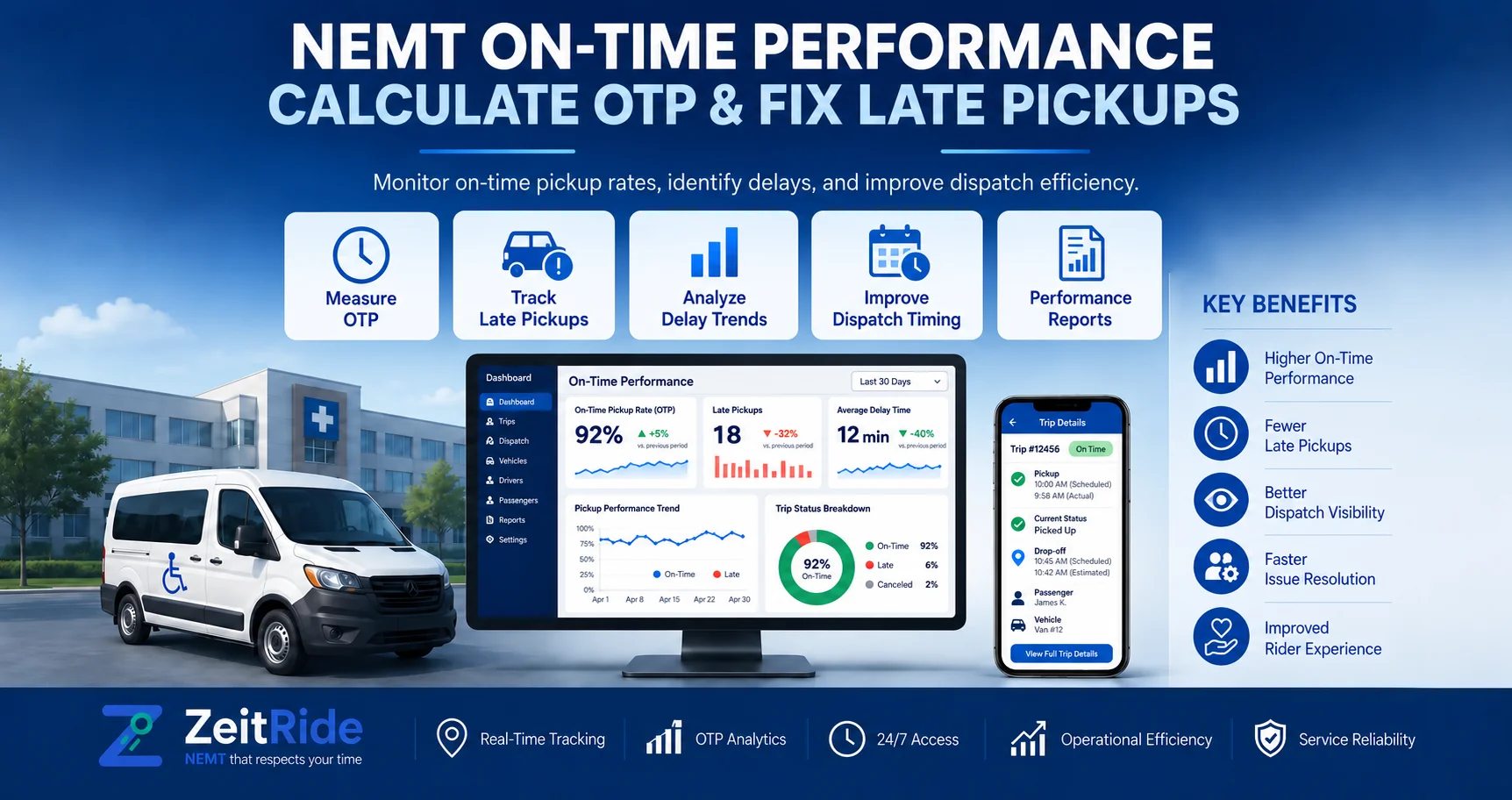
NEMT On-Time Performance: Calculate OTP & Fix Late Pickups
Learn how to calculate NEMT on-time performance, diagnose late pickups, recover at-risk trips, and improve dispatch reliability.
Quick answer
NEMT on-time performance measures the percentage of eligible trips that meet required pickup or arrival windows. Providers can improve OTP by tracking accurate timestamps, identifying delay causes, monitoring at-risk trips, and intervening before service windows are missed.
ZeitRide Team
NEMT Operations Expert
A late NEMT trip rarely begins when a rider notices the vehicle has not arrived. The problem usually starts earlier: a previous stop takes longer than expected, the driver falls behind schedule, travel time was underestimated, or a same-day change creates a conflict dispatch does not catch quickly enough. NEMT on-time performance, often called OTP, helps providers measure whether trips are meeting the pickup and arrival standards required by their brokers, payers, or transportation programs. The percentage is useful, but the bigger opportunity is understanding why trips become late and what dispatch can do before a service window is missed.
What Is NEMT On-Time Performance?
NEMT on-time performance is the percentage of eligible trips that meet the pickup, drop-off, appointment-arrival, or response-time requirement defined for those trips. There is no single nationwide definition of "on time" that applies to every NEMT trip. One broker may define a scheduled pickup using an early-and-late arrival window, while another may use different rules for standing orders, appointment arrivals, same-day trips, or will-call returns.
That is why operators should calculate OTP using the rules that actually apply to each contract or program rather than applying one universal number across the fleet. For example, SafeRide Health publishes a 95% on-time performance standard for providers in its network. That is a network-specific requirement, not a universal U.S. benchmark.
How to Calculate NEMT On-Time Performance
The basic NEMT on-time performance calculation is: OTP % = On-Time Eligible Trips ÷ Total Eligible Trips × 100. For example, if a fleet completed 380 eligible trips and 355 met their required service window, the calculation would be 355 ÷ 380 × 100 = 93.4% OTP.
The formula is simple. The harder part is determining which trips belong in the calculation. Before reporting OTP, providers should confirm how the applicable broker, payer, or transportation program treats exceptions.
- Passenger no-shows
- Passenger or facility cancellations
- Provider-caused cancellations
- Same-day or urgent trips
- Will-call return trips
- Facility-caused delays
- Missing or incomplete arrival timestamps
- Weather, traffic, or road closures
Use the same inclusion and exclusion rules every reporting period. Otherwise, changes in the calculation method can make performance look better or worse without reflecting an actual operational improvement.
NEMT On-Time Pickup Rate vs. Appointment Arrival
A strong NEMT on-time pickup rate does not automatically mean passengers are reaching medical appointments on time. A driver may arrive within the permitted pickup window but still reach the destination late because of long boarding time, unrealistic travel assumptions, inefficient stop sequencing, traffic, or an overloaded route.
| Metric | What It Measures | What It Can Reveal |
|---|---|---|
| Pickup OTP | Whether the vehicle reached the pickup location within the required window | Driver, dispatch, or previous-stop delays |
| Appointment Arrival | Whether the passenger reached the destination within the applicable arrival requirement | Travel-time, routing, boarding, or scheduling problems |
If pickup OTP is healthy but appointment arrivals are weak, the underlying issue may be scheduling or routing rather than driver punctuality. For broader operational measurements beyond OTP, ZeitRide's NEMT KPI framework covers additional broker scorecard and fleet-performance metrics.
Why NEMT Late Pickups Happen
NEMT late pickups are usually the visible result of an earlier operational problem. Recording every delay simply as "driver late" hides the information needed to prevent the same issue from happening again. A better approach is to classify each late trip by its true root cause.
| Cause | Examples | What to Review |
|---|---|---|
| Scheduling | Too little travel time or insufficient buffer | Original schedule assumptions |
| Routing | Poor stop sequence or excessive backtracking | Route design and stop order |
| Dispatch | Late intervention or slow reassignment | When the risk first became visible |
| Driver | Late start or missing status updates | Driver activity timeline |
| Rider or Facility | Passenger not ready or discharge delay | Dwell and waiting time |
| Vehicle | Breakdown or incorrect vehicle type | Vehicle availability and assignment |
| External | Traffic, weather, or road closure | Whether dispatch adapted to the event |
This classification turns OTP from a reporting number into an operational tool. If 40 late trips were caused by five different problems, one generic solution will not fix all 40.
How to Identify an At-Risk Trip Before It Becomes Late
The most valuable late trip is the one dispatch catches before it actually becomes late. A real-time NEMT dispatch workflow should allow dispatchers to compare upcoming pickups against what is actually happening in the field rather than relying only on the original schedule.
- The previous stop remains open longer than expected
- Live ETA is moving toward the edge of the next pickup window
- An expected arrival, pickup, or drop-off status is missing
- Traffic is materially affecting the driver's next stop
- A same-day trip or will-call return is inserted into a tight route
- The assigned vehicle becomes unavailable
- One developing delay begins threatening several later pickups
The goal is not simply to display vehicle locations. The more useful question is: which upcoming trip is likely to miss its service window if nothing changes? That gives dispatch time to act while recovery is still possible.
How to Recover an At-Risk NEMT Trip
When a trip becomes at risk, dispatch should use a repeatable recovery process rather than automatically moving the trip to the closest driver.
- Confirm the pickup or arrival window that applies to the trip
- Check the assigned driver's live location and current stop status
- Estimate whether the existing driver can still protect the service window
- Identify another qualified driver or vehicle if recovery is unlikely
- Check mobility requirements, capacity, availability, and the replacement driver's remaining trips
- Reassign only when the change improves the overall outcome
- Send the updated assignment to the receiving driver immediately
- Notify the appropriate passenger, facility, or coordination party when required
- Record the delay cause and intervention for later analysis
ZeitRide's Driver app helps keep field activity connected to dispatch through trip assignments, navigation, GPS-aware activity, and driver status updates. A recovery decision only works when the updated trip reaches the receiving driver quickly and accurately.
Prevent One Late Trip From Creating Multiple NEMT Trip Delays
A single delay can quickly affect the rest of a driver's day. A 10-minute facility delay may seem small, but if the next passenger has a narrow pickup window and the following trip requires additional boarding time, that delay can cascade into several missed windows.
When the same routes repeatedly fall behind, the problem may not be dispatch at all. The original schedule or route may be unrealistic. That is where NEMT routing software and a stronger NEMT scheduling workflow become important. Scheduling should create realistic time expectations, routing should organize trips efficiently, and dispatch should manage exceptions when the real world no longer matches the plan.
How to Improve NEMT On-Time Performance
The most effective way to improve NEMT on-time performance is to find the most common preventable cause behind late trips and fix that problem first. Do not begin by chasing the fleet-wide percentage without understanding what is producing it.
1. Define the Measurement Rules
Document the pickup and arrival standards for each major broker or contract. Confirm which timestamp proves vehicle arrival, which trips are eligible, and how exceptions are treated.
2. Classify Late Trips
Separate scheduling, routing, dispatch, driver, facility, vehicle, and external causes instead of using one generic late-trip reason.
3. Find the Pattern
Break late trips down by driver, vehicle, broker, facility, route, time of day, trip type, mobility requirement, and delay reason. Patterns that disappear inside one fleet-wide average often become obvious at this level.
4. Fix the Highest-Frequency Preventable Cause
If the issue is unrealistic drive time, fix scheduling assumptions. If routes repeatedly backtrack, improve sequencing. If dispatch sees risk but responds too late, establish stronger early-warning and reassignment workflows.
5. Measure Again
Use the same OTP definition and calculation method when measuring the result. The goal is not to manufacture a better percentage. It is to create a more reliable transportation operation.
Example: Catching a Late Pickup Before the Window Is Missed
Consider an illustrative example. A passenger has an 8:00 AM scheduled pickup. Assume the applicable broker allows the vehicle to arrive no later than 8:15 AM. At 7:35 AM, the assigned driver is still completing the previous stop, and live route progress now shows an estimated arrival of 8:18 AM.
The trip is not technically late yet, but it is already at risk. Instead of waiting until 8:15 AM, dispatch can check whether another qualified nearby driver can protect the pickup window without creating a larger problem elsewhere.
If a suitable vehicle is available, the trip can be reassigned and sent to the new driver. If no feasible recovery option exists, dispatch can communicate the developing delay early and document what caused it. Reactive dispatch responds after a service failure. Proactive dispatch identifies the trip while there is still time to influence the outcome.
How NEMT Software Supports Better On-Time Performance
Software cannot make an impossible schedule realistic by itself. What it can do is make developing problems visible earlier and connect the information dispatch needs to make better decisions.
| Capability | How It Supports OTP |
|---|---|
| Scheduling | Creates realistic trip plans and time assumptions |
| Routing | Improves stop sequencing and reduces unnecessary travel |
| Live GPS | Shows whether actual vehicle movement matches the plan |
| Driver Status | Confirms arrival, pickup, drop-off, and exceptions |
| Dispatch | Helps identify and respond to developing delays |
| Reassignment | Moves trips when another qualified resource can protect service |
| Reporting | Reveals recurring causes behind late trips |
ZeitRide connects scheduling, routing, live vehicle visibility, driver workflows, dispatch, and reporting in one NEMT platform. The goal is to move from asking "What was our OTP last month?" to asking "Which trips are at risk right now, why are they at risk, and what can dispatch still do about them?"
For operators who want to review OTP alongside utilization, no-shows, revenue, billing, driver performance, and other fleet measurements, ZeitRide's NEMT reports and fleet KPIs provides the broader reporting framework.
Frequently Asked Questions
Q: What is NEMT on-time performance?
NEMT on-time performance is the percentage of eligible trips that meet the pickup, arrival, or response-time requirement defined by the applicable broker, payer, facility, program, or contract.
Q: How do you calculate NEMT on-time performance?
Divide the number of eligible trips completed within their applicable service window by the total number of eligible trips, then multiply by 100.
Q: What is a good NEMT on-time performance rate?
There is no single nationwide OTP target that applies to every NEMT provider. Providers should follow the standard required by their specific broker, payer, Medicaid program, facility agreement, or contract.
Q: What causes NEMT late pickups?
Common causes include unrealistic scheduling, inefficient route sequencing, facility delays, driver availability, missing status updates, vehicle problems, traffic, and delayed dispatch intervention.
Q: How can NEMT providers reduce late pickups?
Providers can reduce late pickups by identifying recurring delay causes, improving scheduling and route design, monitoring live trip progress, maintaining accurate driver status data, and intervening before service windows are missed.
Q: Can NEMT dispatch software improve on-time performance?
NEMT dispatch software can support better on-time performance by connecting vehicle location, driver status, trip progress, route changes, and reassignment decisions in real time.
Catch Late Trips Earlier With ZeitRide
If your team only reviews late trips after the day is over, OTP reporting explains what happened but does not help protect the next pickup. ZeitRide connects scheduling, routing, live dispatch, driver updates, and trip reassignment so operators can see developing problems earlier and respond from one connected workflow.
Bring a real route and see how ZeitRide can help your team identify at-risk trips earlier and manage daily NEMT operations more efficiently — book a ZeitRide demo.
Rather see it than read about it?
Bring a real route, a couple of drivers, and your current process. 15 minutes, zero pitch.