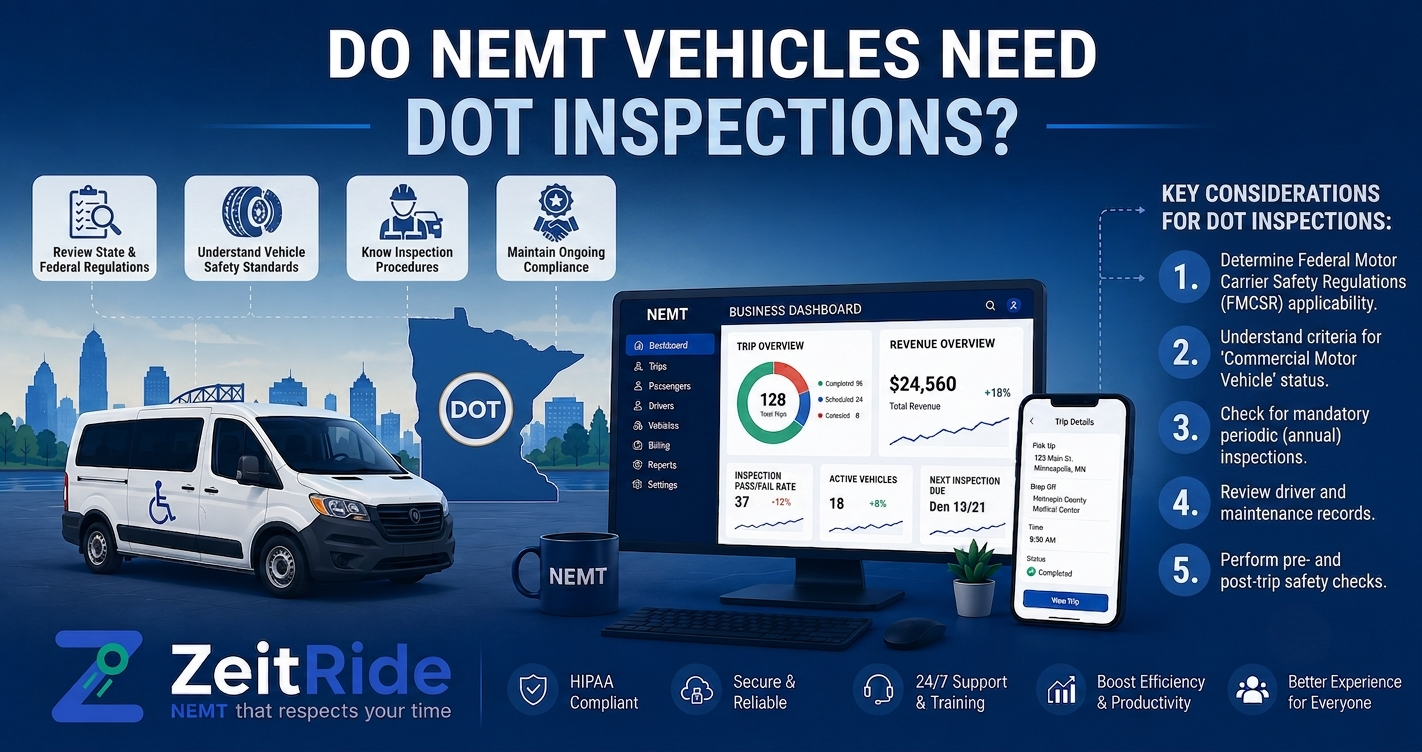
Do NEMT Vehicles Need DOT Inspections?
Most NEMT vehicles are federally exempt from DOT inspections but state DOT rules and broker contracts can still apply. Here's exactly where the exemption ends.
Quick answer
Most NEMT vehicles — sedans, wheelchair minivans, stretcher vans — fall under all federal Commercial Motor Vehicle thresholds in 49 CFR § 390.5, so they're exempt from mandatory federal DOT inspections.
ZeitRide Team
NEMT Operations Expert
Do NEMT vehicles need DOT inspections? For most fleets, the honest answer is no at the federal level but that's not the whole story, and operators who stop reading there usually get caught by a state rule or a broker credentialing check instead. ZeitRide tracks vehicle and driver documents in one place so a lapsed inspection never turns into a missed route. Providers running on ZeitRide are typically live within 30 minutes of signup, documents included.
What Triggers Federal DOT Inspection Rules for NEMT Vehicles
Federal DOT inspection rules only apply once a vehicle meets the legal definition of a Commercial Motor Vehicle (CMV). Under 49 CFR § 390.5, a vehicle crosses into CMV territory if it hits any one of three thresholds: a gross vehicle weight rating of 10,001 pounds or more, a design capacity of 9 or more occupants (driver included) when passengers are transported for compensation, or 16 or more occupants regardless of payment.
Sedans, wheelchair-accessible minivans, and most stretcher vans stay under all three thresholds. That means no annual federal inspection, no hours-of-service logging, and no federal drug-testing mandate tied to CMV status for a typical NEMT vehicle. Where it changes: a larger paratransit-style bus or cutaway van built for 9+ paying riders. That vehicle is a CMV the moment it rolls off the lot, no matter what it weighs.
Fleet owners running mixed inventory — sedans and minivans alongside a few larger buses — end up managing two compliance tracks inside the same NEMT software. That split is exactly where a spreadsheet stops working and dispatch software with document tracking starts earning its keep.
It's worth being precise about what "exempt" actually means here. A vehicle that stays under all three CMV thresholds is exempt from the federal inspection and hours-of-service framework specifically — it isn't exempt from state safety inspection laws, vehicle registration rules, or the kind of routine maintenance checks any responsible fleet already runs. Some operators read "exempt" and stop thinking about inspections altogether, which is a different mistake than misunderstanding the weight threshold, but it causes the same problem: a vehicle on the road with paperwork nobody's tracking.
If a vehicle does cross into CMV territory — a 12-passenger cutaway van running Medicaid trips, for example — the obligations that follow are not minor. Annual federal inspections become mandatory, drivers need to maintain hours-of-service logs, an Electronic Logging Device requirement generally applies (with a short-haul exemption for drivers who stay within 150 air miles of base and return within 14 hours), and the vehicle needs a USDOT number displayed on both sides in letters legible from 50 feet. None of that is optional once the threshold is crossed, and retrofitting a fleet's paperwork after the fact is far more painful than tracking it from day one.
How ZeitRide Keeps NEMT Vehicles Compliant
Knowing you're federally exempt doesn't mean you're compliant — state inspection cycles, broker credentialing, and insurance renewals still run on their own clocks. ZeitRide gives fleet managers one place to see every deadline before it becomes a problem.
- Vehicle document storage tied to each unit in your fleet, including inspection certificates, registration, and insurance cards
- Automated renewal reminders so a semi-annual PennDOT inspection or a Florida CPCN renewal doesn't slip past a dispatcher's radar
- Driver-side document tracking for CPR certification, background checks, and any state-mandated PASS-style training alongside vehicle records
- Broker-ready reporting, since MTM Health, Provide A Ride, ProCare, and DD Med Trans all expect current documentation before they'll route trips your way
- Dispatch and routing tools that sit on top of that same $49/vehicle/month plan — no separate compliance module, no add-on fee
Operators tell us this is where the time actually gets saved. Marcus Johnson, who owns Skyline Medical Transport, has said the platform saves him roughly a full day's worth of admin work compared to how he used to track fleet paperwork by hand.
State Rules vs. Federal Exemptions — What NEMT Operators Get Wrong
The most common mistake in NEMT vehicle inspections isn't misreading the federal rule — it's assuming the federal exemption is the end of the conversation. It isn't. Federal thresholds set a floor, and states build their own inspection and licensing systems on top of it, sometimes regardless of vehicle weight or seating.
New York runs one of the most layered frameworks in the country: NYSDOT operating authority plus semi-annual vehicle inspections covering hundreds of individual safety points, with Article 19-A rules governing drivers on top of that. California requires a CPUC Transportation Charter Party permit for every for-hire NEMT vehicle no matter its size, with statewide drug and alcohol testing that applies even to vehicles well under federal CMV thresholds. Minnesota goes further still, requiring a USDOT number for every vehicle enrolled in its Special Transportation Service program, federal exemption or not.
Then there's the broker layer. MTM, ModivCare, and similar brokers routinely write inspection, drug-testing, and insurance requirements into contracts that mirror or exceed federal CMV standards — and they apply those terms to every vehicle in your network, big or small. A fleet can be 100% federally exempt and still lose a broker contract over a missed inspection deadline, because the broker's rulebook, not the DOT's, is the one that actually governs the relationship.
None of this means chasing three separate compliance calendars by hand. It means knowing which rulebook applies to which vehicle in your fleet — federal, state, broker, sometimes all three at once — and having a system that flags the earliest deadline rather than the one you happened to remember. Operators who get burned here usually aren't ignoring the rules; they're tracking them in three different places and one of those places falls out of date.
Who This Matters For
- Fleet owners deciding how to spec new vehicle purchases — a 9-passenger cutaway van carries a different compliance load than a 5-passenger minivan, and that decision affects staffing and paperwork for years
- Operations directors setting internal renewal calendars across a mixed fleet operating in more than one stat
- Dispatch coordinators who need to know instantly if a vehicle's documentation has lapsed before it gets assigned to a Medicaid trip
- Drivers who need their own certifications current, since a state or broker can pull a driver from the schedule just as fast as a vehicle
Each of these roles is looking at the same underlying question from a different angle, and that's usually where compliance breaks down in practice. A fleet owner tracks purchase decisions in one spreadsheet, an operations director tracks renewal dates in another, and a dispatcher is working off whatever's taped to the visor — until one of those three sources goes stale and a vehicle gets sent out on a trip it shouldn't be running. Centralizing vehicle and driver records in one system that dispatch already touches every day removes that gap, because the person assigning the trip is looking at the same record as the person who filed the paperwork.
Bottom Line
So, do NEMT vehicles need DOT inspections? Federally, most don't — but the state and broker layers on top of that exemption are where fleets actually get tripped up. ZeitRide keeps vehicle and driver documentation, renewal reminders, and broker-ready reporting in the same $49/vehicle/month platform your dispatchers already use every day.
So, do NEMT vehicles need DOT inspections? Federally, most don't — but the state and broker layers on top of that exemption are where fleets actually get tripped up. ZeitRide keeps vehicle and driver documentation, renewal reminders, and broker-ready reporting in the same $49/vehicle/month platform your dispatchers already use every day.
Frequently Asked Questions
Q: Do NEMT vehicles need DOT inspections at the federal level?
Most don't. A typical NEMT sedan, wheelchair minivan, or stretcher van stays under all three federal CMV thresholds in 49 CFR § 390.5, so it's exempt from mandatory annual federal DOT inspections. Larger vehicles built for 9 or more paying riders don't get that exemption.
Q: What vehicle weight requires a DOT inspection?
Federal rules kick in at a gross vehicle weight rating of 10,001 pounds or more, but weight is only one of three triggers — occupant count for compensation and total occupant capacity can also push a vehicle into CMV status even under that weight.
Q: Do state DOT rules apply even if a vehicle is federally exempt?
Yes. States including New York, California, and Minnesota impose their own inspection, licensing, or USDOT number requirements on NEMT vehicles that have nothing to do with federal CMV thresholds. Always confirm requirements with your state DOT and Medicaid agency directly.
Q: Can a broker require inspections beyond what DOT or the state requires?
Brokers like MTM and ModivCare routinely write vehicle inspection, drug-testing, and insurance terms into their contracts that match or exceed federal CMV standards, and those terms apply regardless of what federal or state rules say.
Q: How does NEMT software help with DOT and state inspection compliance?
NEMT software like ZeitRide stores inspection certificates, registration, and insurance documents against each vehicle and sends renewal reminders before deadlines pass, so dispatchers can see compliance status before assigning a trip rather than finding out after.
Rather see it than read about it?
Bring a real route, a couple of drivers, and your current process. 15 minutes, zero pitch.