NEMT Trip Turnbacks: When to Return Accepted Broker Trips
Learn when to return accepted NEMT broker trips, what notice and penalty rules to check, and how to document a safe, accountable handoff.
Quick answer
Return an accepted broker trip when qualified coverage is unavailable and the agreement allows reassignment. Check safe replacement capacity, notify the broker through its required channel, document the reason and response, and confirm responsibility. Deadlines and penalties vary by contract.
ZeitRide Team
NEMT Operations Expert
An accepted broker trip is scheduled for tomorrow morning. Then the driver calls out, and your only backup wheelchair van is already committed. Keeping the booking on your dispatch board will not get the rider to their appointment—but returning it incorrectly could create another problem.
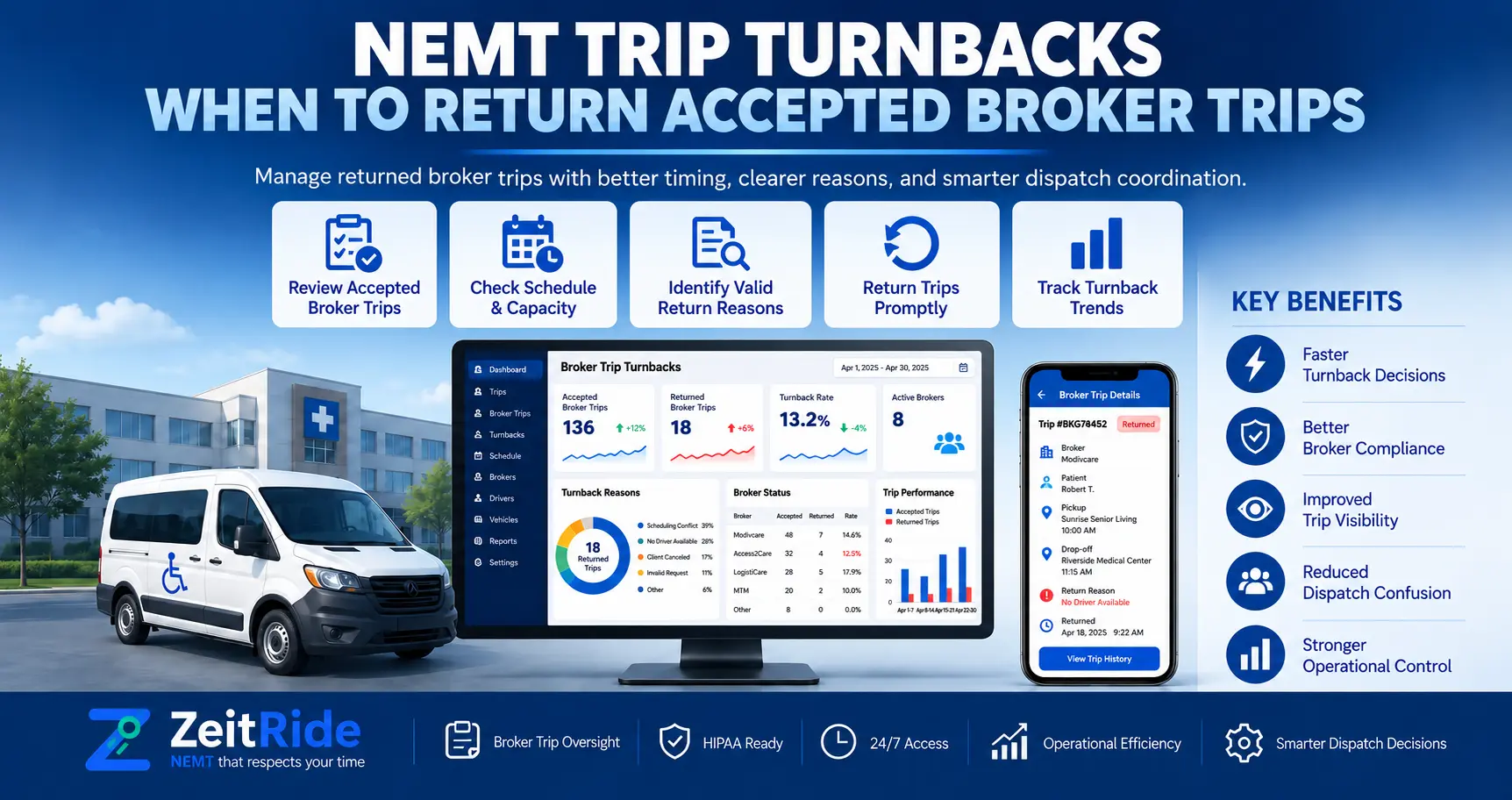
NEMT trip turnbacks happen when a transportation provider returns a previously accepted broker-assigned ride because it cannot complete the service. The broker may then arrange replacement transportation. Timing, permitted reasons, and financial consequences depend on the specific program and provider agreement.
Quick answer: Check whether qualified replacement coverage is possible, review the broker’s return rules, notify the broker promptly through its required channel, and retain proof of the response. Do not assume that submitting a return guarantees a replacement or removes your obligations.
What Are NEMT Trip Turnbacks?
A trip turnback, sometimes called a handback or provider-requested reassignment, concerns an assignment after the provider has accepted it. That is the key difference from declining an offer before acceptance. The article on evaluating broker trips before accepting them covers the earlier decision; this guide addresses an existing commitment that is now at risk.
| Event | Meaning | Correct operational response |
|---|---|---|
| Decline | Provider rejects an offer before accepting | Use the broker’s offer-response procedure |
| Turnback | Provider returns an accepted broker trip | Follow return rules and confirm responsibility |
| Cancellation | The trip is cancelled by an authorized party | Record the actual cancellation reason |
| Internal reassignment | Same provider changes the driver or vehicle | Check safety, fit, and required approvals |
| Provider no-show | Provider fails to deliver the assigned pickup | Escalate as a service failure |
For NEMT trip turnbacks, use the right status. An internal driver change does not automatically require giving the trip back to the broker; conversely, marking a trip cancelled is not necessarily a valid broker turnback.
NEMT Turnback Policy: Which Reasons Are Acceptable?
There is no single nationwide NEMT turnback policy. Your current broker agreement, service area, trip type, and program instructions determine whether a return is permitted. A useful published reference is CareOregon’s February 2024 Transportation Provider Manual, which presents guidance for NEMT brokerages and providers rather than a binding national rule.
The manual identifies examples of potentially acceptable NEMT trip turnback reasons: assignments outside a provider’s stated area or hours, unavailable required vehicle types, driver or vehicle capacity limits, adverse weather, and safety concerns. It cautions against discriminatory refusals, selecting only higher-paying work, repeated last-minute returns, and abandoning certain previously accepted urgent trips.
A driver call-out may justify requesting reassignment where the agreement permits it. But first check whether another qualified driver and suitable vehicle can meet the pickup window. Never replace an accessible vehicle with an incompatible one simply to keep the assignment.
When the problem is a broken-down van, follow your vehicle breakdown response procedure for passenger safety and internal recovery. Use the broker return process only if the affected accepted trip truly cannot be served.
NEMT Broker Turnback Deadlines and Penalties
NEMT broker turnback deadlines vary. Review the contract’s notice window, required channel, handling of urgent or recurring trips, and whether the broker must acknowledge the request. If a deadline has passed, immediately use the specified urgent escalation method. A return request should never be mistaken for confirmed replacement coverage.
NEMT turnback penalties can also differ. For one concrete example, the Wingz driver sendback policy, updated May 2025, published these fees per round trip:
| When the driver sends the trip back | Published Wingz fee |
|---|---|
| More than 48 hours before pickup | $0 |
| More than 24 but less than 48 hours | $10 |
| Less than 24 hours | $25 |
Those are Wingz driver-platform rules, not standard Medicaid broker fees. Check the current market-specific terms before relying on the amounts. Other programs may use corrective action or performance consequences rather than this structure. CareOregon’s 2024 guidance, for instance, discusses investigating assignment and capacity issues before considering remedies for patterns of unacceptable reassignment.
With NEMT trip turnbacks, the safest habit is to act as soon as service becomes doubtful. Early notice gives the broker more time to protect the member’s appointment and gives your team a clear record of its response.
Recover or Return? A Six-Step Dispatch Decision
Use one consistent sequence when an accepted ride becomes at risk. The goal is safe transportation first, with a documented broker handoff if recovery is not possible.
- Confirm the risk. Check pickup and appointment times, mobility assistance, vehicle requirements, and the consequence of delay.
- Test replacement capacity. Look for an available qualified driver and compatible vehicle without creating a conflict with another committed rider.
- Check the applicable rule. Identify the broker, program, approved return reason, notice deadline, and required reporting channel.
- Notify the broker. Supply the trip reference, truthful reason, time at risk, and any immediate member-service concern.
- Record acknowledgment. Save the submission timestamp, broker response, reference number, and any instructions. Keep unresolved coverage visible.
- Confirm responsibility. Establish whether the broker has accepted the return or requested additional action. Do not tell the member a replacement is confirmed unless it is.
If the trip remains assigned while confirmation is pending, follow the broker’s escalation procedure. Do not silently delete the booking or report transportation as completed. For broader staffing controls, see driver scheduling and trip coverage; this turnback process begins only after an accepted commitment is at risk.
Worked Example: A Driver Calls Out Before Pickup
At 10:30 a.m., a driver reports illness before a 2:00 p.m. wheelchair pickup. Dispatch checks the only other accessible vehicle, but its current run will not finish until 2:45 p.m. No qualified replacement can reach the rider on time.
The dispatcher checks the specific broker’s return policy, sends the required notification immediately, and records the trip ID, capacity issue, timestamp, and broker response. If the broker confirms the return, the dispatcher records the handoff. If confirmation remains pending, the team follows escalation instructions and continues watching the service risk.
What changed the outcome? Dispatch checked recovery first, preserved the actual reason, and did not confuse a submitted return request with a confirmed replacement. The example times are illustrative not a universal deadline.
What to Document and How to Measure Turnbacks
A broker may later ask why the ride was returned and what was done to protect service. Preserve the minimum evidence needed for a defensible record:
| Record | Purpose |
|---|---|
| Broker, trip ID, pickup window | Identifies the commitment |
| Driver/vehicle and service level | Shows original and required coverage |
| Issue discovered and return submitted times | Establishes the timeline |
| Reason and alternative coverage checked | Explains the decision |
| Broker acknowledgment and final status | Clarifies responsibility |
ZeitRide’s trip-history documentation describes a timeline of status and assignment changes, including turned-back events. Use access controls and avoid putting unnecessary protected health information into informal messages.
How to Calculate the NEMT Turnback Rate
An internal NEMT turnback rate helps identify recurring capacity problems. One simple formula is: (accepted trips returned ÷ accepted trips scheduled) × 100. If a fleet accepted 400 broker trips and returned 8, the illustrative rate is 2%. The denominator, exclusions, and acceptable threshold in an official broker scorecard may differ; use the broker’s definition for contractual reporting.
Review the measure alongside the reasons and notice timing. An out-of-area assignment is not the same as repeated last-minute returns caused by an inaccurate driver schedule. The broader NEMT broker KPI guide covers other scorecard measures.
How to Reduce Avoidable Turnbacks
Preventing avoidable NEMT trip turnbacks starts with an accurate capacity profile, not a promise that every accepted trip can be rescued. Confirm broker-facing service areas, operating hours, wheelchair availability, and driver coverage; flag tomorrow’s tight commitments before the morning rush; and ensure dispatch knows whom to contact for urgent exceptions.
Review returned trips by root cause. If a broker repeatedly assigns rides outside your declared territory, correct the profile. If driver call-outs repeatedly leave wheelchair work uncovered, evaluate backup coverage. Keep this section focused on accepted-trip exceptions rather than repeating a full fleet-management guide.
How ZeitRide Supports Accepted-Trip Returns
ZeitRide connects live NEMT dispatch with broker-fed trips, driver assignments, status changes, and trip history. Its Cancelling and Turning Back Trips help article confirms that eligible broker-originated trips can be returned electronically only when that broker supports the feature. The Turn Back action is separate from Cancel and cannot be undone once completed.
This gives dispatchers a clearer operational process. However, using the button does not waive contract terms, confirm that another provider has accepted the ride, or make an otherwise unacceptable return permissible.
Before every turnback, confirm four things: safe recovery was considered; the current broker rule was checked; the notice and reason were documented; and responsibility for the trip is clear.
Want to see this workflow with your broker assignments? Explore a ZeitRide demo and ask to review the integrations your fleet actually uses.
Editorial note: CareOregon and Wingz examples refer to identified published policies and their dates. They do not establish universal NEMT requirements. Verify the current agreement for every market and program.
Frequently Asked Questions
Q: What are NEMT trip turnbacks?
A turnback is a request to return a broker-assigned trip after the transportation provider has accepted it and can no longer perform the service. The broker may arrange replacement coverage under its program rules.
Q: What reasons can justify a broker trip turnback?
Depending on the agreement, examples include unavailable qualified drivers, incompatible or out-of-service vehicles, assignments outside agreed operating hours or territory, severe weather, and safety risks. Discriminatory refusals and cherry-picking are not valid reasons.
Q: How far in advance must an NEMT provider turn back a trip?
There is no universal notice deadline. The responsible broker or program sets its own timing, approved channel, emergency process, and confirmation requirements. Always check the current contract and notify the broker as early as possible.
Q: Can NEMT providers be penalized for returning accepted trips?
Potentially. Some agreements specify fees, while others use performance reviews or corrective action for repeated unacceptable returns. Consequences depend on the governing policy, timing, reason, and circumstances.
Q: How is an NEMT turnback rate calculated?
A useful internal calculation is accepted trips returned divided by accepted trips scheduled in the same period, multiplied by 100. Eight returns out of 400 accepted trips equals 2%. Broker scorecards may define the measure differently.
Q: Can ZeitRide return every broker trip automatically?
No. ZeitRide supports electronic Turn Back only for eligible broker-originated trips when the connected broker permits it. Dispatch must follow the broker’s separate process when the option is unavailable.
Rather see it than read about it?
Bring a real route, a couple of drivers, and your current process. 15 minutes, zero pitch.