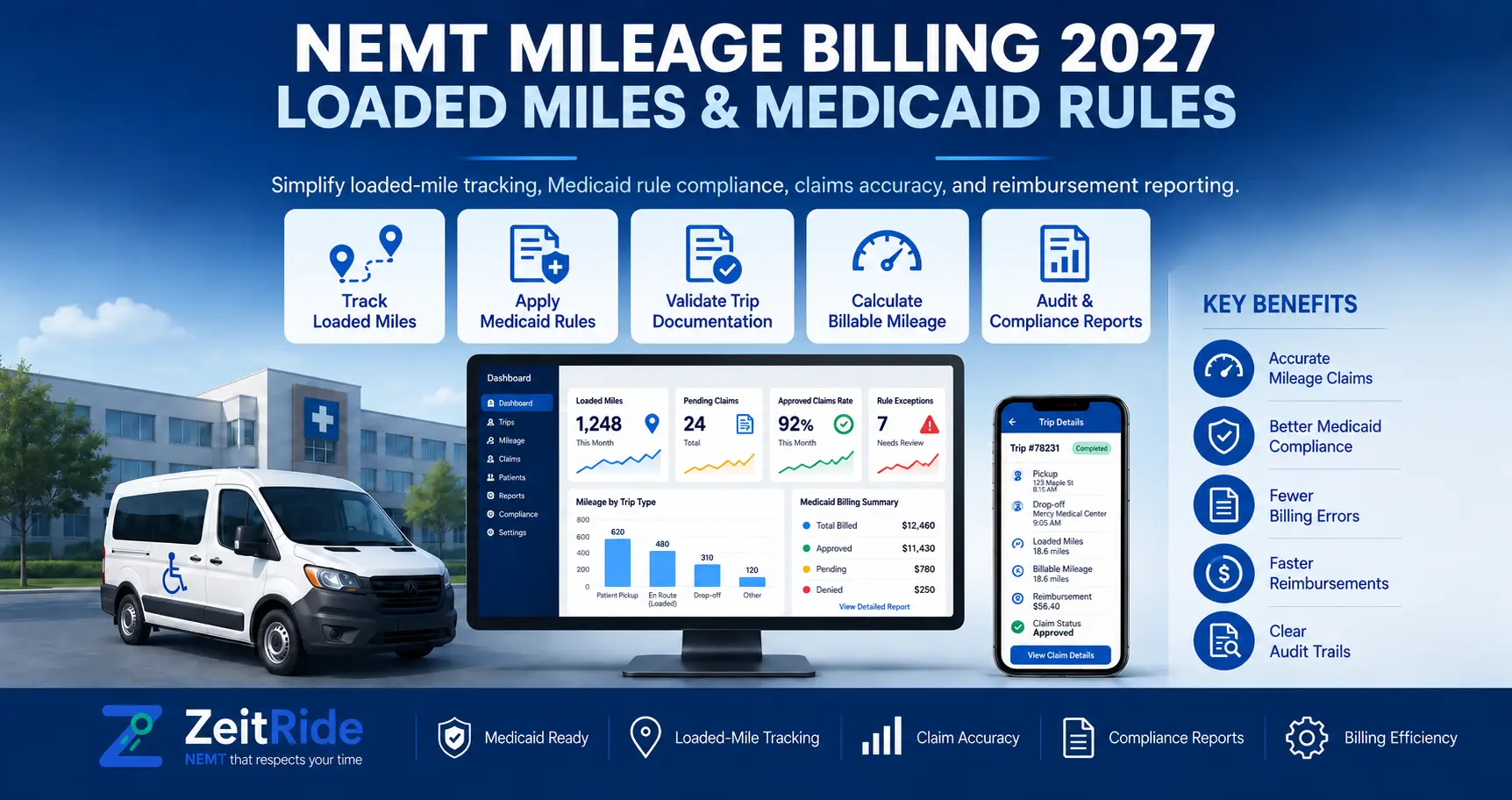
NEMT Mileage Billing 2027: Loaded Miles & Medicaid Rules
Learn how NEMT mileage billing works, including loaded miles, HCPCS codes, Medicaid rules, documentation, and common mileage billing errors.
Quick answer
NEMT mileage billing converts qualifying transportation distance into claim units under the applicable payer's rules. Many programs focus on loaded miles while the member is onboard, but codes, mileage measurement, rounding, documentation, and reimbursement rules vary by state and payer.
ZeitRide Team
NEMT Operations Expert
Your vehicle may drive 40 miles during a transportation assignment, but that does not automatically mean 40 miles belong on the claim. NEMT mileage billing depends on the distance a payer considers billable, the transportation service provided, the applicable HCPCS code, how mileage must be measured, and the documentation supporting the trip.
In many Medicaid transportation programs, the key distinction is between loaded miles, when the member is onboard, and empty or deadhead miles before pickup or after drop-off. Providers should not assume that every payer uses the same mileage definition, rounding method, claim structure, or code. This guide explains how to move from miles driven to miles properly documented and billed.
2027 planning note: This guide was prepared using information available as of October 7, 2026. CMS had published the October 2026 HCPCS update at the time of review, while the January 2027 update had not yet been released. Always verify the code set, Medicaid manual, fee schedule, broker agreement, and payer rules effective on the actual date of service through the CMS HCPCS Quarterly Update and the applicable payer source.
What Is NEMT Mileage Billing?
NEMT mileage billing is the process of reporting qualifying transportation distance as billing units according to a Medicaid program, broker, managed-care plan, or other payer's requirements. Mileage is usually one component of the overall transportation claim rather than a standalone payment.
Depending on the program, a claim may contain a base transportation service, qualifying mileage, required modifiers, approved waiting time, or other permitted charges. The important point is that total vehicle mileage and billable mileage are not automatically the same thing.
Providers should determine which distance the payer recognizes before converting recorded miles into billing units. For the broader claims workflow, ZeitRide's guide to the Medicaid NEMT billing process explains how codes, modifiers, documentation, and claim preparation fit together.
What Are NEMT Loaded Miles?
NEMT loaded miles are generally the miles traveled while the member or passenger is inside the vehicle, typically from the qualifying pickup point to the destination. These miles should be distinguished from empty travel before pickup or after drop-off.
Consider a route that runs from the vehicle's starting point to the member pickup, then to a medical facility, followed by travel to the next assignment. The vehicle moves during every segment, but a payer may recognize only the portion where the member is onboard as reimbursable mileage.
- Total vehicle mileage
- Loaded mileage while the member is onboard
- Deadhead or unloaded mileage
- Route deviations or detours
- Repositioning mileage after drop-off
Empty mileage can still affect profitability even when it is not separately reimbursable. ZeitRide's guide on how to reduce NEMT dead miles covers that operational problem without mixing route optimization with mileage billing rules.
Which NEMT Miles Are Billable?
There is no single nationwide answer that applies to every Medicaid program, managed-care plan, or broker. A payer may determine billable mileage using member-onboard distance, actual odometer readings, GPS-supported mileage, the most direct route, authorized distance, or another contract-defined method.
The correct question is therefore not simply how many miles the vehicle drove. It is how many miles the payer allows the provider to report for that specific transportation service.
Arizona AHCCCS guidance, for example, distinguishes loaded mileage from travel used to reach the member and instructs providers to report actual mileage rather than automatically rounding it. That illustrates why billing staff should follow the rule attached to the specific claim rather than applying a universal mileage formula.
NEMT Mileage Codes Explained
NEMT mileage codes identify different transportation mileage services. The national code description helps identify the service, but the payer determines whether that code is accepted, which transportation mode qualifies, what modifiers are required, how units are calculated, and what rate applies.
| Code | General Description | Billing Context |
|---|---|---|
| S0209 | Wheelchair van mileage, per mile | Used by certain programs for wheelchair transportation mileage |
| S0215 | Non-emergency transportation mileage, per mile | Used by certain Medicaid transportation programs |
| T2049 | Non-emergency stretcher-van mileage, per mile | Used by some programs for stretcher transportation |
| A0425 | Ground mileage, per statute mile | May apply in ambulance or program-specific transportation billing |
A national HCPCS description does not guarantee reimbursement. Providers should verify the current payer instructions instead of copying NEMT mileage codes from another fleet's claims.
What Is the S0209 Billing Code?
The S0209 billing code represents wheelchair-van mileage on a per-mile basis. It is an important NEMT billing entity, but it should not be treated as a universal wheelchair-mileage rule.
A provider must still verify whether the applicable Medicaid program, managed-care organization, or broker recognizes S0209 for the trip. The payer may also specify what counts as mileage, whether only loaded miles qualify, whether a separate base transportation code is required, which modifiers apply, and what supporting documentation is necessary.
The safer sequence is simple: identify the transportation service, verify the payer's rules, select the permitted code, and then calculate the units.
How Does Medicaid NEMT Mileage Billing Vary by Program?
Medicaid NEMT mileage billing varies because state programs and contracted transportation arrangements do not all measure or submit mileage the same way. A method that works for one Medicaid program should not automatically be copied into another state's claims.
| Program Example | Mileage Approach |
|---|---|
| Arizona AHCCCS | Guidance focuses on loaded mileage while the Medicaid member is in the vehicle and instructs providers to report actual mileage rather than simply rounding it |
| Minnesota MHCP | Transportation mileage may be billed as units under the applicable service rules; for a per-mile code such as S0215, each eligible mile is reported as a mileage unit |
These examples demonstrate two core principles: a per-mile code may use one unit for each eligible mile, but the payer still decides which miles qualify; and mileage calculation rules should be verified for the specific program and date of service.
How to Bill NEMT Mileage Step by Step
If you are determining how to bill NEMT mileage, use a consistent process that begins with the payer rule rather than the vehicle's total odometer movement.
1. Identify the Payer and Transportation Program
Confirm whether the trip is Medicaid fee-for-service, managed care, broker-assigned, facility-funded, private pay, or another arrangement. The payer responsible for the trip determines which billing rules apply.
2. Verify the Billable Mileage Definition
Determine whether the payer uses loaded mileage, actual mileage, direct-route mileage, authorized mileage, or another measurement method.
3. Confirm the Mileage Code
Verify the HCPCS code permitted for the transportation mode and payer. Do not select S0209, S0215, T2049, or another code solely because its national description appears to match the trip.
4. Capture Mileage During the Trip
- Pickup and drop-off locations
- Driver and vehicle
- Pickup and drop-off timestamps
- Starting and ending odometer readings where required
- GPS route history where applicable
- Member-onboard status
- Transportation service level
- Authorization information
- Route deviations or trip exceptions
5. Apply Unit and Rounding Rules
If one unit represents one mile, submit only the eligible mileage units allowed under the program's measurement rules. Do not automatically round the driver's mileage unless the payer explicitly permits that method.
6. Review Exceptions Before Submission
Road closures, destination changes, shared rides, incorrect addresses, approved detours, or other route deviations can cause actual mileage to differ from the expected route. Document the reason while the trip is still easy to verify.
7. Reconcile the Result
After billing, NEMT trip reconciliation can help compare the completed trip, billed mileage, expected payment, and actual payment so mileage discrepancies do not disappear inside the revenue cycle.
Example: 42 Miles Driven vs. Billable Mileage
Assume a vehicle records 42 total miles during one transportation assignment. The vehicle's total movement does not automatically equal the claim mileage.
| Trip Segment | Miles |
|---|---|
| Base to member pickup | 8 |
| Member onboard to medical facility | 21 |
| Documented route deviation while member remains onboard | 5 |
| Facility to next positioning point | 8 |
| Total vehicle miles | 42 |
Before billing, the provider must determine whether pre-pickup mileage is payable, whether the payer recognizes actual loaded mileage or another approved distance, whether the five-mile deviation is supported, whether post-drop-off positioning is reimbursable, which code applies, and how the payer expects units to be reported.
This is the core mileage-billing sequence: miles driven → miles eligible → miles documented → miles billed.
What Documentation Should Support NEMT Mileage?
Mileage should connect directly to the transportation actually provided. The billing record should make it possible to understand who was transported, where the trip occurred, which vehicle performed it, and how the reported mileage was determined.
- Trip ID
- Member information
- Payer or broker
- Authorization when applicable
- Pickup and destination
- Driver and vehicle
- Transportation service level
- Pickup and drop-off timestamps
- Loaded-mile record
- Odometer readings where required
- GPS route information where applicable
- Route or destination changes
- Reason for unusual mileage
- Mileage code
- Mileage units billed
Exact requirements vary by payer. GPS information may support the record, but it does not automatically make every mile billable. For the broader evidence framework, review ZeitRide's NEMT documentation requirements.
Why NEMT Mileage Claims Get Reduced or Denied
Mileage-related claim problems frequently begin with a mismatch between the transportation that occurred and the mileage submitted.
- Reporting unloaded mileage when the payer only recognizes loaded miles
- Using the wrong mileage code
- Submitting incorrect mileage units
- Applying unsupported rounding
- Mileage that does not reasonably match the pickup and destination
- An unexplained detour
- GPS, odometer, and billed mileage that conflict
- Missing authorization
- Using the wrong transportation service level
- Duplicate mileage on shared transportation
If a claim is reduced or rejected, investigate the trip before simply resubmitting it. ZeitRide's NEMT claim denials guide explains how to separate documentation, authorization, coding, and payer-related causes.
GPS Mileage vs. Billable Mileage
GPS can provide useful evidence, but GPS distance and payable mileage are not automatically identical. GPS may establish where the vehicle traveled, route history, pickup and drop-off context, and unexpected deviations, while the payer may still require mileage to be calculated using a specific methodology.
That is why NEMT GPS tracking should support the billing record rather than replace the applicable payer rule. The strongest workflow keeps GPS information, driver activity, trip status, and billing records connected so discrepancies can be reviewed before submission.
How NEMT Software Supports Mileage Billing
Mileage discrepancies become harder to investigate when dispatch, driver records, GPS history, billing, and payment information are stored in separate systems.
A connected workflow can preserve the relationship between trip assignment, driver and vehicle, pickup, loaded movement, drop-off, mileage records, billing review, claim submission, and payment reconciliation.
ZeitRide's NEMT billing software keeps completed operational trip information connected with billing workflows so finance teams have better context when reviewing mileage and other claim-supporting information. Software does not decide what a payer legally permits a provider to bill; its role is to preserve accurate operational information and reduce manual reconstruction.
NEMT Mileage Billing Checklist
- Confirm the correct payer or broker
- Verify the payer's mileage definition
- Document the correct transportation mode
- Use the permitted mileage code
- Confirm required base codes or modifiers
- Verify pickup and destination
- Support loaded mileage with trip records
- Review GPS or odometer information where applicable
- Explain route deviations
- Apply the payer's unit and rounding rules
- Confirm authorization requirements
- Make sure the billing record matches the completed trip
The Bottom Line on NEMT Mileage Billing
NEMT mileage billing is not about copying the vehicle's total mileage into a claim. Loaded mileage, deadhead mileage, GPS distance, odometer distance, and billable mileage can all be different numbers.
The correct process is to identify the payer, determine eligible mileage, verify the code, document the trip, calculate units according to the payer's rules, review exceptions, and then reconcile payment. Keeping those steps connected helps providers create more defensible billing records and investigate mileage discrepancies faster.
See Your Mileage-to-Billing Workflow in ZeitRide
If your team has to compare driver notes, GPS history, spreadsheets, and billing records every time mileage does not match, bring one real trip to a ZeitRide demo. See how ZeitRide's NEMT software keeps scheduling, dispatch, driver activity, GPS-aware trip records, documentation, billing, and reconciliation connected around the same transportation record.
Bring one real trip where actual, billed, or paid mileage did not match and book a 15-minute ZeitRide demo to review the workflow using your own operation.
Frequently Asked Questions
Q: What are NEMT loaded miles?
NEMT loaded miles are generally the miles traveled while the member is onboard, typically from pickup to drop-off. Whether those miles are billable and how they must be measured depends on the Medicaid program, broker, or other payer.
Q: Does Medicaid pay for deadhead miles?
Providers should not assume deadhead miles are separately reimbursable. Many programs distinguish member-onboard mileage from empty travel, but exact rules vary by state, payer, transportation mode, and contract.
Q: What is the S0209 billing code?
S0209 is an HCPCS Level II code for wheelchair-van mileage billed per mile. Whether a provider should use S0209 depends on the applicable Medicaid program, payer, transportation service, modifiers, and billing rules.
Q: How do you bill NEMT mileage?
Identify the payer, verify its billable-mileage definition, confirm the permitted mileage code, capture the required trip evidence, apply unit and rounding rules, document exceptions, and make sure the mileage claim matches the completed trip.
Q: Can GPS mileage be used for NEMT billing?
GPS data can support mileage documentation and route verification, but GPS distance is not automatically the billable amount. Providers must still follow the mileage measurement and documentation method required by the applicable payer.
Q: Is one NEMT mileage unit equal to one mile?
Per-mile HCPCS codes are commonly billed with one unit representing one eligible mile, but providers must verify the payer's specific code, mileage definition, rounding, modifiers, and claim requirements before submission.
Rather see it than read about it?
Bring a real route, a couple of drivers, and your current process. 15 minutes, zero pitch.