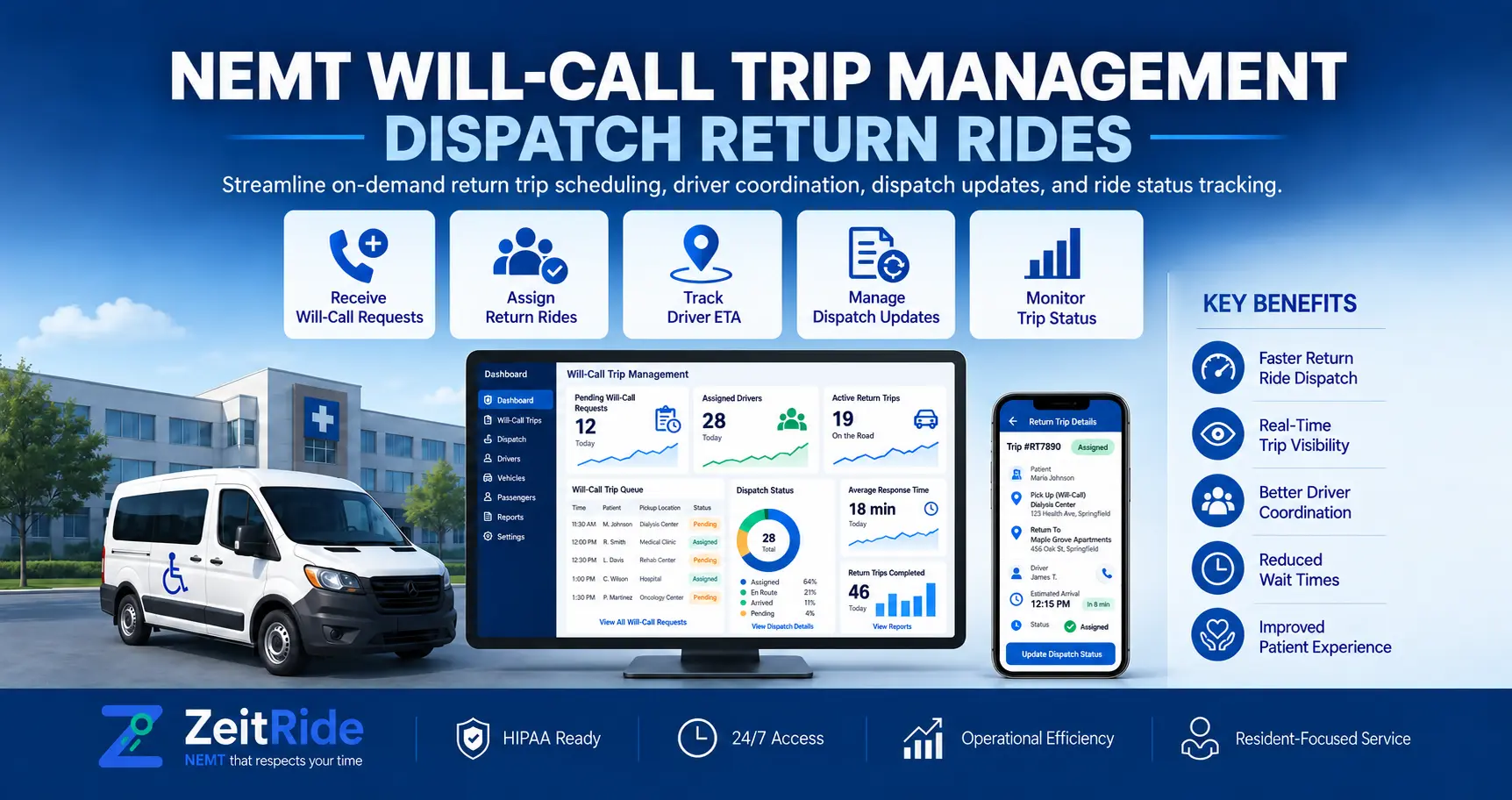
NEMT Will-Call Trip Management: Dispatch Return Rides
Learn how NEMT providers keep will-call returns visible, handle readiness calls, and assign suitable drivers using the ZeitRide Will Call Queue.
Quick answer
NEMT will-call trip management keeps a pre-booked return without a fixed pickup time visible until the rider or facility reports readiness. In ZeitRide, dispatchers select the trip from the Will Call Queue, choose an available driver, set a pickup time, and confirm dispatch.
ZeitRide Team
NEMT Operations Expert
An outpatient appointment is running late. The driver who handled the morning trip has moved on, and the clinic cannot say when the patient will be ready. Dispatch still needs to protect the ride home without placing an unreliable pickup time on a driver's schedule.
NEMT will-call trip management solves this planning problem by keeping a pre-booked return visible until the rider or facility confirms readiness. ZeitRide uses a dedicated Will Call Queue so dispatch can turn that return into a scheduled pickup when the time is known.
What Is NEMT Will-Call Trip Management?
A will-call is a trip booked without a confirmed pickup time, usually the return leg after a medical appointment. The outbound trip has a scheduled pickup, while the return waits for a readiness notification. NEMT will-call return trips are common when appointment lengths vary, such as dialysis, procedures, and specialist visits.
A will-call is not the same as a new same-day booking. The return already exists; only its pickup timing and operational assignment need to be confirmed. For separate new-trip requests, see the same-day NEMT trip management guide.
Will-Call Returns vs. Scheduled Returns
| Dispatch Detail | Scheduled Return | Will-Call Return |
|---|---|---|
| Pickup time at booking | Confirmed | Unknown |
| What starts dispatch | Planned schedule | Rider or facility readiness notice |
| Driver planning | Can be sequenced in advance | Capacity must remain flexible |
| Key record | Scheduled pickup and status | Readiness notice, dispatch time, pickup |
Neither option is automatically better. Use the return type permitted by the broker or payer and appropriate for how predictable the appointment is.
How to Book a Will-Call Return in ZeitRide
When creating or editing a trip, open the return leg, usually Leg B, and select Will Call instead of entering a fixed pickup time. ZeitRide clears the scheduled pickup and appointment times for that leg. You may enter an estimated pickup for planning, but the estimate does not commit a driver to an exact time.
After saving, the return appears in the Will Call Queue. Broker-supplied trips marked as will-call can enter this workflow too. The return remains visible within NEMT scheduling software until dispatch is ready to activate it.
How Does the NEMT Will-Call Dispatch Workflow Work?
When someone reports that the passenger is ready, the dispatcher should follow a consistent process:
- Confirm readiness: Verify the rider, pickup entrance, destination, service level, and who made the readiness call.
- Record the notification: Document the readiness time in the required broker or office record and check the applicable response window.
- Find the return: Locate it in the Will Call Queue on the Trip List or Dispatch Board.
- Choose a suitable driver: Select Dispatch, choose an available driver, and set the scheduled pickup time. Check vehicle suitability and existing commitments before confirming.
- Confirm and monitor: Select Confirm dispatch, communicate the pickup plan through the appropriate channel, and monitor completion.
In ZeitRide, the confirmed trip moves to the chosen driver's normal run and appears in the Driver app. The system records who dispatched it and when. This is a dispatcher-confirmed step, not an automatic assignment to the nearest vehicle.
For exact interface instructions, use the ZeitRide will-call trip guide.
What Are NEMT Will-Call Pickup Windows?
NEMT will-call pickup windows depend on the Medicaid program, broker, health plan, or facility contract. There is no universal national response time. Some requirements begin when the rider reports readiness to the broker rather than when the provider later receives the assignment.
For example, Modivcare's West Virginia facility guidance says that the member or facility calls Modivcare when ready and the transportation provider should arrive within one hour. That is a West Virginia program example, not a standard for every NEMT trip.
Record the readiness time and compare actual arrival with the applicable rule. Broader measures of punctuality belong in your NEMT on-time performance review; this article focuses on activating and covering the individual return.
How Does the NEMT Will-Call Queue Help Dispatch?
A central NEMT will-call queue prevents a known return from depending on someone's sticky note or memory. ZeitRide shows waiting trips in a band above the Trip List and at the top of the Dispatch Board. Cards identify the rider, leg, contact number, and pickup address.
The dispatcher can confirm readiness, assign a driver, and set a pickup time from that card. Once confirmed, the trip joins the driver's upcoming work in the ZeitRide Driver app.
Visibility helps the team manage the exception; it does not guarantee a vehicle will be available.
How Should Fleets Protect Capacity for Will-Calls?
Consider an illustrative case: a wheelchair rider is ready at 11:20 a.m., but the closest vehicle is already committed to another pickup. The best response is not automatically to send the nearest driver. Dispatch must check wheelchair capacity, drive time, other passengers, and the deadline defined by the relevant contract.
A workable policy includes:
- Review open returns before busy clinic discharge periods.
- Know which drivers and vehicles can handle each mobility requirement.
- Leave realistic room for uncertain returns in active assignments.
- Give riders and facilities the correct broker or dispatch contact instructions.
- Escalate likely missed windows early and document the communication.
If a patient never calls, do not silently close the return or mark it a no-show. Verify the trip's status and follow the broker's cancellation or escalation procedure. The NEMT call center guide addresses routing readiness calls to the right staff.
What Should NEMT Will-Call Scheduling Software Provide?
Useful software should retain the original return leg, show pending will-calls alongside active operations, support driver assignment when the rider is ready, and preserve the resulting dispatch record.
ZeitRide's documented workflow connects those steps to its NEMT dispatch software and driver app without requiring the dispatcher to rebuild the return as a new trip.
See Will-Call Dispatch in ZeitRide
If your team still tracks open returns in messages or spreadsheets, see how NEMT will-call trip management connects the waiting queue, dispatcher decisions, and the driver's active schedule.
Book a ZeitRide demo to walk through one realistic return pickup with your team.
Frequently Asked Questions
Q: What Is a Will-Call Return Trip in NEMT?
It is a pre-booked return ride with no fixed pickup time. The rider or facility reports readiness, then dispatch confirms the pickup.
Q: Is a Will-Call the Same as a Same-Day NEMT Trip?
No. A will-call return is generally booked in advance, while a same-day trip is a new request received on the service day.
Q: When Does a Will-Call Pickup Window Start?
It depends on the program or broker agreement. Often the readiness notification starts the clock, but the exact triggering event and deadline must be verified.
Q: Can ZeitRide Assign a Driver After the Rider Calls?
Yes. Dispatchers select the waiting trip, choose an available driver, set a pickup time, and confirm dispatch to the driver's run.
Q: What If the Rider Never Calls for the Return?
Dispatch should verify readiness and follow the relevant broker or facility escalation and cancellation policy instead of assuming the ride is no longer needed.
Rather see it than read about it?
Bring a real route, a couple of drivers, and your current process. 15 minutes, zero pitch.