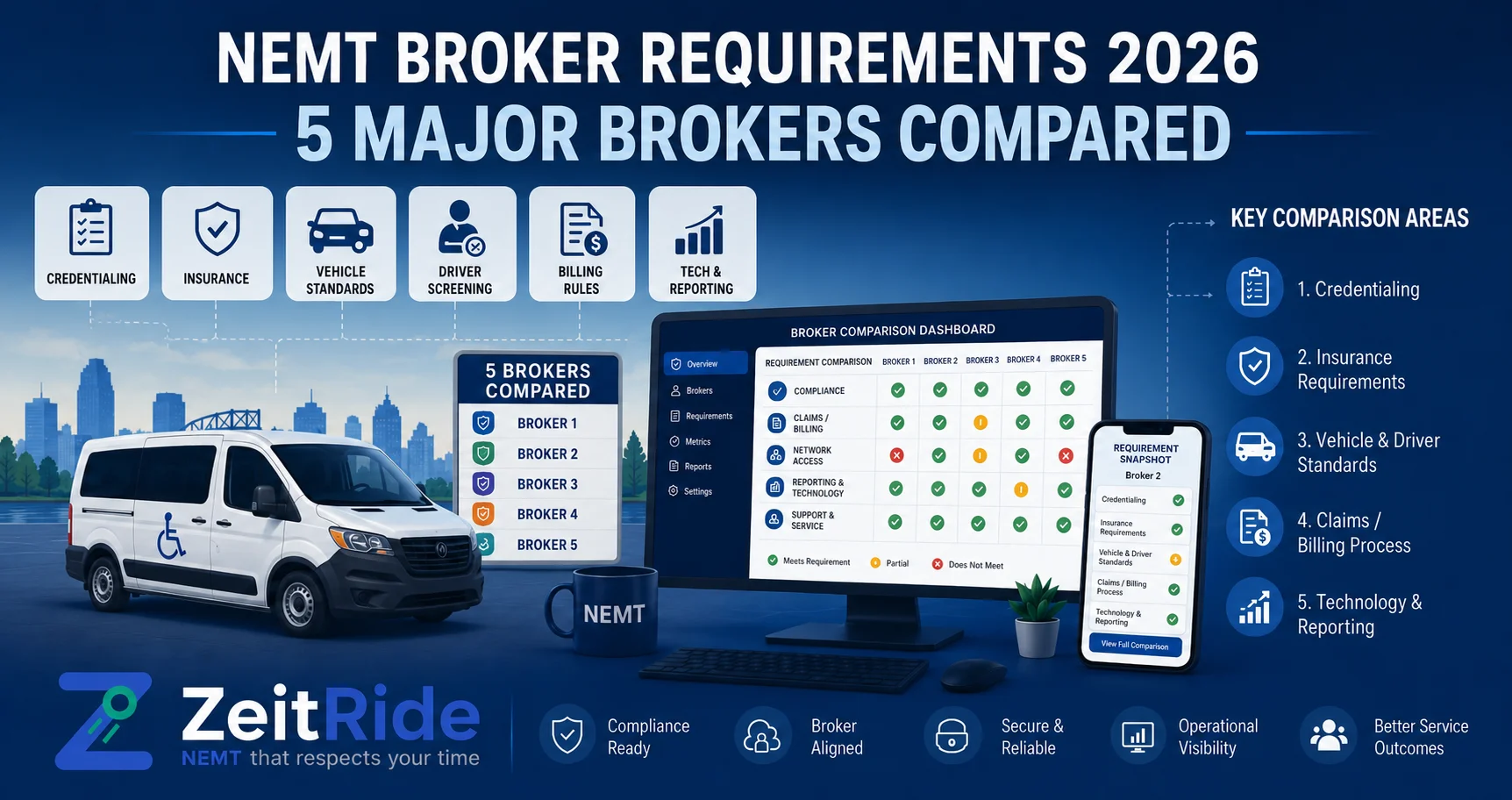
NEMT Broker Requirements 2026: 5 Major Brokers Compared
Compare 2026 requirements for ModivCare, MTM, SafeRide, Verida and MAS, including credentialing, GPS, trip verification, performance and billing.
Quick answer
NEMT brokers generally require compliant business and insurance records, qualified drivers and vehicles, accurate trip documentation, and billing evidence. GPS, credentialing, performance and trip-verification rules vary by broker, state, health plan and contract.
ZeitRide Team
NEMT Operations Expert
NEMT broker requirements are not one universal national checklist. In 2026, transportation providers may need to satisfy state Medicaid rules, broker credentialing requirements, health-plan requirements, and their individual provider contract at the same time. Most major brokers evaluate the same core areas — business credentials, insurance, drivers, vehicles, trip documentation, performance, and billing — but the exact requirements can differ significantly.
That distinction is important for providers working across multiple markets. A ModivCare requirement in one state should not automatically be treated as an MTM Health, SafeRide Health, Verida, or MAS requirement somewhere else. Before changing your workflow, first identify which network actually manages transportation in your market using ZeitRide's NEMT brokers by state directory, then verify the latest requirements in your broker agreement and applicable Medicaid program.
What Are NEMT Broker Requirements?
NEMT broker requirements are the credentialing and operating standards transportation providers must meet to join and remain in a broker's network. They commonly cover company qualifications, insurance, driver and vehicle compliance, trip verification, operating performance, and the documentation needed to support payment.
- Business registration and applicable Medicaid enrollment
- Commercial insurance
- Driver licenses and screening
- Driver training and certifications
- Vehicle registration and insurance
- Vehicle inspections
- Trip timestamps and status updates
- GPS or location evidence where required
- Passenger or facility signatures where applicable
- No-show and cancellation documentation
- Performance monitoring
- Billing and trip reconciliation
- Credential renewals and expiration tracking
The important point is that not every requirement applies to every broker or every state. NEMT transportation may be administered through statewide brokers, regional networks, managed-care organizations, or other arrangements. Providers should always verify a requirement against the actual program and contract governing their trips.
ModivCare vs MTM vs SafeRide vs Verida vs MAS: Requirements Compared
| Requirement | ModivCare | MTM Health | SafeRide Health | Verida | MAS |
|---|---|---|---|---|---|
| Company credentialing | Yes | Yes | Yes | Yes | Yes |
| Driver credentialing | Yes | Yes | Yes | Yes | Yes |
| Vehicle documentation | Yes | Yes | Yes | Yes | Yes |
| Insurance verification | Yes | Yes | Yes | Yes | Yes |
| Driver training / screening | Applicable network requirements | Monitored by program | Detailed published requirements | Published training requirements | New York program requirements |
| GPS / trip data | Program-specific | Program-specific | Operational trip data | Contract-specific | Important for trip attestation |
| Performance monitoring | Yes | Yes | Published performance standards | Provider scorecards | Trip and payment compliance |
| Billing validation | Yes | Yes | Yes | Yes | GPS may affect attestation and payment |
This table is a comparison framework rather than a replacement for your transportation-provider agreement. The differences become more important as a fleet works with multiple brokers. A provider may have drivers and vehicles that satisfy one network while still needing additional documentation, training, or technology workflows for another.
ModivCare Provider Requirements
ModivCare publicly identifies driver, vehicle, insurance, and compliance requirements for transportation providers. Driver preparation can include background screening, motor vehicle records, drug screening, First Aid/CPR, defensive-driving training, and passenger-assistance training where applicable.
Vehicles generally need current registration, required inspections, and valid insurance. Providers must also maintain applicable company insurance and keep credentials current. For fleets considering this network, ZeitRide's how to become a ModivCare provider guide covers the application process in more detail.
Provider takeaway: do not treat credentialing as a one-time application task. Track expiration dates for drivers, vehicles, insurance, and training before those records affect trip eligibility. Review the latest requirements directly through ModivCare's transportation provider information.
MTM Health Provider Requirements
MTM Health evaluates transportation-provider credentials on an ongoing basis. Its provider oversight can include licensure, background checks, driver certifications, insurance, vehicle inspections, timeliness, and passenger satisfaction.
A critical operational consideration is keeping credentials current. Expired driver, vehicle, or company records can create assignment problems even if the transportation company itself remains enrolled in the network. Requirements may also vary by individual MTM program or state, so providers should verify the standards for the actual contract they intend to serve.
ZeitRide's MTM Health transportation provider guide covers the broader onboarding process. Provider takeaway: build credential monitoring into dispatch readiness rather than maintaining compliance records separately from daily operations. Current network information is available through MTM Health's transportation provider resources.
SafeRide Health Provider Requirements
SafeRide Health is especially useful for understanding how NEMT broker requirements extend beyond basic credentialing. Its published provider requirements include company insurance, driver screening, driver training, vehicle information, and continuing performance standards.
Driver credentialing can include background screening, motor vehicle records, drug screening, First Aid/CPR/AED training, defensive driving, and wheelchair-securement training. SafeRide also publishes operational performance expectations covering areas such as ride response, acceptance, on-time performance, complaints, and provider kickbacks.
That means passing credentialing is only the beginning. A provider can maintain valid documents and still create network risk through poor dispatch performance. For additional network context, see ZeitRide's SafeRide Health NEMT broker guide. Provider takeaway: treat broker scorecards as operational requirements, not simply reporting metrics. Verify current standards on SafeRide Health's provider requirements page.
Verida Provider Requirements
Verida's provider-network materials describe onboarding as a combination of business credentialing, driver and vehicle verification, provider orientation, and training. Providers may need to submit business credentials, driver information, vehicle information, insurance, service-area details, and required training documentation.
Published materials also describe driver training related to NEMT operations, passenger assistance, defensive driving, and First Aid/CPR. After onboarding, performance monitoring can include areas such as on-time performance, complaints, no-shows, and reroutes.
ZeitRide's Verida transportation provider guide explains the onboarding process separately. Provider takeaway: prepare for both initial credentialing and ongoing quality monitoring. Current company and provider information can be verified through Verida.
MAS Requirements for New York NEMT Providers
Medical Answering Services, commonly known as MAS, requires special attention because it operates within the New York Medicaid transportation environment. Providers should not apply MAS requirements to NEMT operations outside the applicable New York program.
One of the most important areas is GPS data. MAS guidance connects required GPS information with trip attestation. If required GPS information is incomplete, the affected trip may not be attestable, which can interfere with the provider's ability to submit the trip for payment.
This demonstrates why NEMT GPS requirements are not simply a fleet-tracking issue. In some programs, location data becomes part of the evidence supporting reimbursement. For more New York-specific information, see ZeitRide's MAS NEMT broker guide. Provider takeaway: design your GPS workflow around the broker's trip-validation requirements, not just vehicle location. Review MAS GPS requirements for attestation for official guidance.
NEMT GPS and Trip Verification Requirements
One of the most common compliance mistakes is treating GPS tracking, electronic visit verification, trip verification, and proof of service as if they were identical. They can overlap, but they are not automatically the same requirement.
- Driver and vehicle assignment
- Pickup timestamp
- Arrival timestamp
- Drop-off timestamp
- GPS coordinates
- Location history where required
- Authorized pickup and destination
- Passenger or facility signature
- Mileage
- Service level
- Cancellation or no-show reason
- Driver notes
- Proof that the authorized trip occurred
The safest operational approach is to capture required trip evidence while the trip is happening rather than attempting to reconstruct it later. ZeitRide's NEMT EVV compliance guide explains the distinction between EVV and transportation trip verification in greater detail.
What Documents Should an NEMT Provider Maintain?
A transportation company working with multiple brokers should maintain one master credential system and then map broker-specific requirements on top of it. This reduces duplicate administrative work while helping dispatchers determine whether a driver or vehicle is actually eligible for an assignment.
- Business and tax information
- Medicaid identifiers where applicable
- Operating authority
- Commercial auto insurance
- General liability insurance
- Workers' compensation where required
- Driver licenses
- Background-screening records
- Motor vehicle reports
- Drug-screening records
- Driver training certificates
- Vehicle registrations
- Vehicle insurance
- Vehicle inspections
- Credential issue and expiration dates
- Broker approval and renewal records
For a deeper records checklist, use ZeitRide's NEMT documentation requirements guide.
Broker Performance Requirements Matter After Credentialing
Credentialing gets a provider into the network. Operational performance helps keep the provider there. Depending on the broker or contract, monitored KPIs may include on-time pickups, appointment arrival, trip acceptance, provider cancellations, missed trips, complaints, no-shows, reroutes, documentation completeness, and driver or vehicle compliance.
That creates an important distinction for growing NEMT companies: compliance is not only about paperwork. Dispatch performance is part of compliance too. A provider can have perfect insurance and credential files while still losing trip volume because of repeated late pickups, rejected rides, or weak documentation.
ZeitRide's NEMT KPI and broker scorecard guide explains which operational metrics fleets should monitor.
NEMT Broker Billing Requirements
NEMT broker billing requirements generally come down to one question: can the provider prove that the trip being billed matches the trip that was authorized and delivered?
- Correct member and trip information
- Correct date of service
- Authorized pickup and destination
- Correct service level
- Assigned driver and vehicle
- Required timestamps
- Required GPS information
- Required signatures
- Correct mileage
- No-show or cancellation status
- Broker-specific billing fields
The cleaner the connection between dispatch and billing, the easier it becomes to identify incomplete trips before they turn into denials, corrections, or unpaid claims. This is also why trip reconciliation should not happen only at the end of the billing process.
How to Manage Multiple Broker Requirements in One Workflow
A growing fleet should not operate five completely separate internal systems for five different brokers. The better model is one core workflow with broker-specific rules applied where necessary.
- Identify the broker and payer: confirm the member, market, health plan, and trip authorization.
- Validate the driver and vehicle: make sure required credentials are active before dispatch.
- Import or enter the trip once: keep authorization, appointment, and passenger information attached to one record.
- Capture trip evidence during service: record statuses, timestamps, GPS, mileage, signatures, and exceptions as required.
- Validate before billing: check the completed trip against broker requirements.
- Reconcile payment: connect claims, corrections, and payments back to the original trip.
- Monitor credentials and performance: track document expirations and broker KPIs continuously.
This is where NEMT software for broker integrations becomes important. A provider should look beyond a software vendor's list of supported broker names and ask what actually flows through the integration: assignments, changes, cancellations, driver statuses, GPS information, trip completion, billing, and reconciliation.
ZeitRide brings scheduling, dispatch, routing, driver workflows, broker integrations, billing, reporting, and document tracking together in one NEMT software platform.
NEMT Broker Readiness Checklist
- Confirm the broker serves your specific market
- Verify state Medicaid enrollment requirements
- Obtain the latest provider agreement
- Verify insurance limits
- Review driver-screening requirements
- Review required driver training
- Verify vehicle documentation
- Track credential expiration dates
- Confirm GPS requirements
- Confirm trip-status requirements
- Confirm signature and mileage requirements
- Understand no-show and cancellation procedures
- Review broker performance standards
- Map the billing or attestation process
- Test how incomplete trips are corrected
- Reconcile completed trips with payment
Recheck these requirements whenever the broker, Medicaid program, health-plan relationship, or provider agreement changes.
The Most Important Compliance Rule
Do not treat another transportation provider's contract, an online forum, or even a general industry guide as the final authority for your operation. Use resources like this guide to understand what needs to be investigated, then confirm the exact requirement against the current broker handbook, Medicaid program, health plan, and provider agreement governing your trips.
That prevents costly situations where a trip is already completed before the provider discovers that a credential expired, required GPS data is missing, the vehicle was not eligible, or the trip cannot be billed.
Manage Broker Trips From Assignment to Payment
Managing several brokers becomes difficult when your team has to move the same trip between broker portals, spreadsheets, dispatch tools, driver messages, and billing systems. ZeitRide connects the operational workflow from trip intake through scheduling, dispatch, routing, driver activity, documentation, billing, and reconciliation.
Bring one real broker trip to a 15-minute ZeitRide demo and see how it moves through the complete workflow. See how ZeitRide works with your own operation instead of a generic software walkthrough.
Ready to simplify broker trip intake, compliance, dispatch, and billing? Book a 15-minute ZeitRide demo and bring a real trip from your current workflow.
Frequently Asked Questions
Q: What are the basic NEMT broker requirements?
Most NEMT brokers require appropriate business credentials, commercial insurance, qualified drivers, compliant vehicles, complete trip documentation, and billing evidence. Exact requirements vary by broker, Medicaid program, health plan, state, and provider contract.
Q: Is Medicaid enrollment the same as NEMT broker credentialing?
No. Medicaid enrollment and broker credentialing are separate processes. A provider may be enrolled in Medicaid but still need approval from an individual transportation broker before receiving trips.
Q: Do all NEMT brokers require GPS tracking?
No single GPS rule applies to every NEMT broker. Requirements vary by program and contract. Some systems use GPS as part of trip verification, attestation, or reimbursement documentation.
Q: Can expired driver or vehicle credentials affect trip assignments?
Yes. Brokers may monitor driver, vehicle, and company credentials continuously. Expired licenses, insurance, inspections, or required certifications can affect whether a driver or vehicle is eligible for assignments.
Q: Can missing GPS data prevent an NEMT provider from getting paid?
It can where GPS is required for trip validation. MAS, for example, connects complete GPS data with trip attestation, so missing required information may prevent a trip from being submitted for payment.
Q: Can one NEMT software platform manage multiple brokers?
Yes, but providers should evaluate what each integration actually supports. Useful broker workflows may include trip imports, changes, cancellations, driver statuses, GPS data, trip completion, billing, and reconciliation.
Rather see it than read about it?
Bring a real route, a couple of drivers, and your current process. 15 minutes, zero pitch.