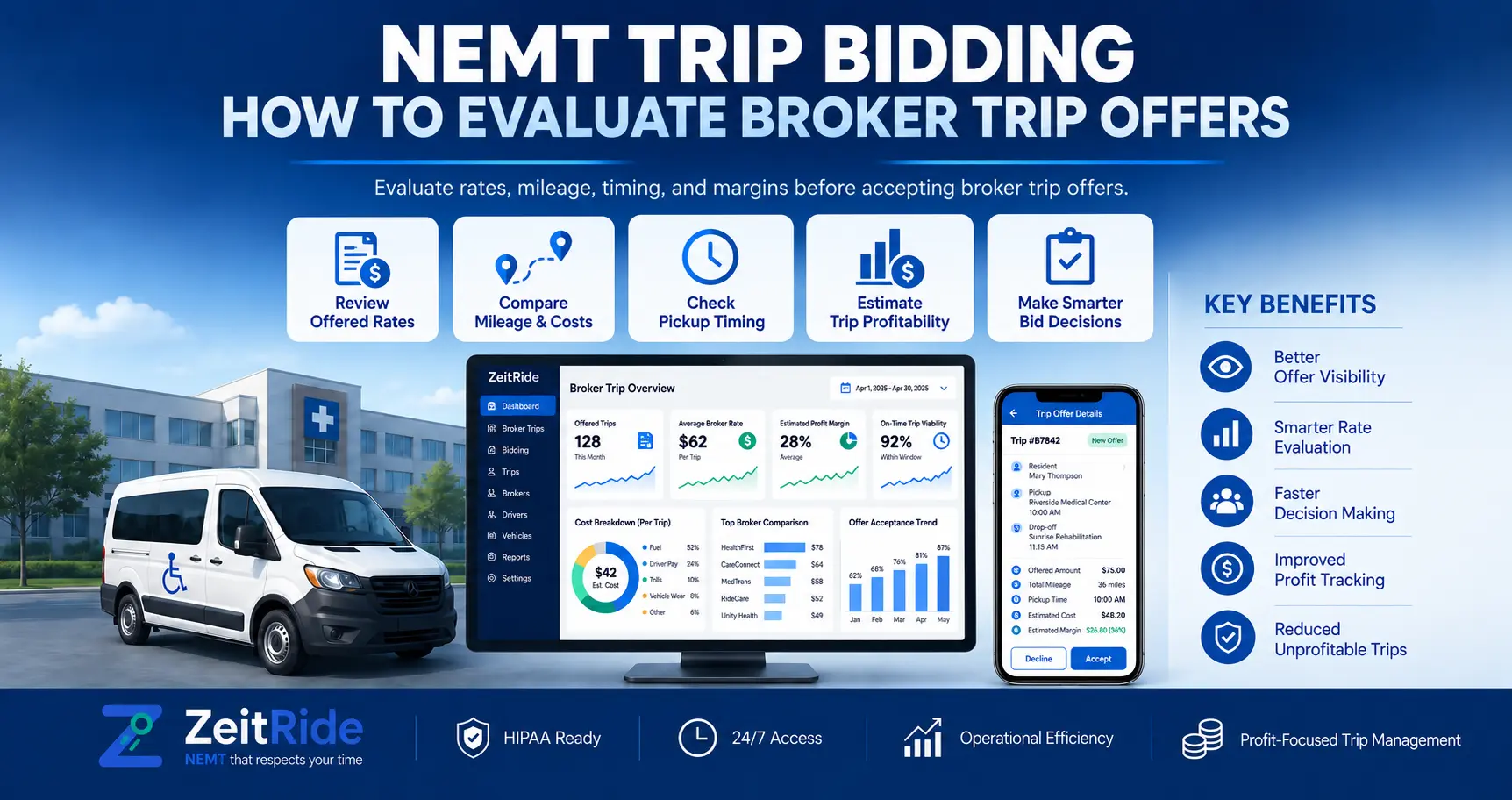
NEMT Trip Bidding: How to Evaluate Broker Trip Offers
Learn how to evaluate NEMT broker trip offers using rate, deadhead, vehicle capacity, schedule fit, and full-cycle economics before accepting.
Quick answer
Evaluate each offer using expected revenue, deadhead, loaded trip time, post-drop position, driver and vehicle capacity, schedule conflicts, and trip-chaining potential. Accept when it fits your capacity and internal profit threshold without putting committed service at risk.
ZeitRide Team
NEMT Operations Expert
A broker trip can look profitable on the offer screen and still create a poor operating decision. The displayed rate is only one part of the movement. Your vehicle may need to travel empty to the pickup, wait at a facility, complete the loaded trip, reposition afterward, and still protect every trip already committed to that driver.
That is why NEMT trip bidding should be treated as an operating decision, not simply a race to accept more work. The right question is not, "How many broker trips can we accept?" It is, "Which broker trips fit our current fleet well enough to complete reliably and produce acceptable economics?"
What Is NEMT Trip Bidding?
NEMT trip bidding is the process of reviewing broker trip opportunities and deciding which work a transportation provider should accept based on schedule fit, driver and vehicle capacity, geography, reimbursement, and operating cost.
The exact workflow varies by broker and portal. In some systems, a provider receives an assigned trip at established contract terms and accepts or declines it. Other workflows may expose available trips or offers that providers can respond to.
For example, official WellTrans provider documentation documents an assigned-trip accept/decline workflow. Whatever the portal calls the process, the operational question is the same: can your company complete this trip reliably and economically?
How Do You Evaluate NEMT Trip Offers?
A practical framework for how to evaluate NEMT trip offers is: Revenue → Position → Capacity → Conflict → Chain → Margin → Decision.
Each step answers a different part of the trip-acceptance question. A good-looking rate should not override a bad vehicle position. Available capacity should not override a serious schedule conflict. And a technically possible trip should not automatically be accepted if its full-cycle economics do not make sense.
Step 1: Review the Offered Revenue
Start with the revenue you reasonably expect to collect for the trip. Review the transportation level, base reimbursement, loaded mileage, applicable wait-time terms, additional approved charges, payment adjustments that may apply, and the broker contract governing the trip.
Do not use this step to renegotiate the entire contract. ZeitRide already has a dedicated guide to NEMT broker rates for evaluating reimbursement and contract-level economics. For trip bidding, the purpose is narrower: what revenue does this particular offer contribute to the decision?
Step 2: Calculate the Whole Vehicle Movement
The passenger leg is only part of the work. Evaluate the full movement as: Deadhead to pickup + Loaded trip + Expected wait + Post-drop repositioning.
For example, a trip may include only 12 loaded miles but require a vehicle to travel 18 empty miles before the pickup. After drop-off, the vehicle may also be left far from its next scheduled trip. That changes the economics considerably.
- Vehicle location before pickup
- Empty miles to pickup
- Expected loaded miles
- Likely waiting time
- Destination
- Next scheduled assignment
- Repositioning after drop-off
When evaluating NEMT broker trip offers, consider the entire vehicle movement rather than only the loaded passenger leg. For deeper analysis of empty mileage and stop sequencing, use the existing NEMT route optimization guide instead of duplicating that topic here.
Step 3: Check Driver and Vehicle Capacity
A profitable-looking trip is not useful if the right vehicle or driver is unavailable. Before NEMT trip acceptance, confirm that the offer fits the actual resources available during the required time window.
- Compatible vehicle type
- Available seating or mobility capacity
- Qualified driver
- Driver shift availability
- Existing recurring assignments
- Pickup and appointment windows
- Expected return-trip obligations
Vehicle class matters. Using scarce wheelchair capacity for work that could have been handled by another vehicle may reduce your ability to accept a stronger wheelchair trip later in the same time block. Review NEMT vehicle capacity separately when you need to understand how much work one vehicle can reasonably handle across the day.
Step 4: Check the Offer Against Existing Commitments
Do not evaluate a trip in isolation. Place it against the schedule that already exists.
- Does it overlap another pickup?
- Could a facility wait make the next trip late?
- Does the destination pull the vehicle too far from its next assignment?
- Is a return leg expected during the same period?
- Does the added work extend the driver beyond the planned shift?
- Does accepting the trip put a recurring or high-priority trip at risk?
A new trip should add useful work without destabilizing better work already on the board. That is why schedule fit can matter just as much as the displayed rate.
Step 5: Look for Trip-Chaining Potential
A trip that looks only moderately attractive by itself can become much stronger when it fits naturally with work already scheduled.
- A pickup near another drop-off
- Trips moving in the same direction
- Compatible pickup windows
- Nearby return work
- Matching vehicle requirements
- Multi-load opportunities where operationally appropriate
Trip chaining can reduce empty repositioning and make existing vehicle time more productive. The opposite is also true: a high-rate trip that forces a vehicle away from a dense sequence of existing work may be less valuable than it first appears.
Step 6: Compare Revenue With Incremental Cost
Once schedule and capacity fit are understood, compare the expected revenue with the additional cost created by accepting the trip. A practical planning equation is: Expected trip contribution = Expected collected revenue − Incremental cost of accepting the trip.
- Additional driver time
- Fuel
- Empty mileage
- Loaded mileage
- Waiting time
- Tolls or parking
- Overtime exposure
- Incremental vehicle expense
This is not the same as calculating your company's entire average cost structure. For a full operating-cost model, use the NEMT cost per trip calculator and guide. The bidding decision should use the cost information relevant to the additional offer.
NEMT Trip Offer Decision Table
A simple decision table can make broker trip bidding more consistent across dispatchers and operations staff.
| Factor | Accept | Review | Decline |
|---|---|---|---|
| Vehicle capacity | Clearly available | Tight | Not available |
| Driver coverage | Fits shift | May extend shift | Cannot cover |
| Schedule fit | Clean | Possible conflict | Breaks commitment |
| Deadhead | Fits internal standard | Borderline | Excessive |
| Economics | Clears internal threshold | Uncertain | Below acceptable contribution |
| Vehicle type | Appropriate | Uses scarce capacity | Incompatible |
| Trip chaining | Strong fit | Standalone | Disrupts better sequence |
| Execution confidence | High | Requires adjustment | Low |
Do not copy another provider's numerical thresholds. A rural fleet, urban operator, wheelchair-heavy provider, and high-density dialysis operation may each have very different acceptable economics. Use your own costs and operating standards.
When Should You Decline NEMT Trips?
Knowing when to decline NEMT trips is part of disciplined capacity management. More accepted work is not automatically better work.
- No compatible vehicle is available
- No qualified driver can cover the trip
- The pickup conflicts with an existing commitment
- Full-cycle deadhead is excessive
- The trip creates unacceptable overtime exposure
- The reimbursement does not support the incremental cost
- Accepting it would put already-scheduled riders at risk
Declining should be based on clear operating rules rather than instinct. Broker rules vary, so providers should also follow the response requirements, service obligations, and decline procedures contained in their actual broker agreements and portals.
Do Not Judge Performance by Acceptance Rate Alone
A high acceptance rate can look impressive while hiding poor operational choices. If your team accepts work that later creates late pickups, excessive deadhead, vehicle conflicts, or unreliable execution, higher accepted volume may not produce better operating results.
Track the full progression instead: Offered → Accepted or Declined → Scheduled → Completed → Collected → Operational Result.
This gives management better information than simply counting accepted trips. It also separates two different growth goals: getting more opportunities and selecting the right opportunities. If the problem is that too few opportunities are arriving in the first place, review how to get more NEMT trips from brokers.
Track Why Trips Are Accepted or Declined
Over time, trip-offer decisions become useful operating data. Tracking the reason behind each decision can show where capacity, geography, scheduling, or economics are limiting growth.
- Broker
- Service area
- Offer type
- Transportation level
- Expected revenue
- Accepted or declined
- Decline reason
- Vehicle assigned
- Estimated deadhead
- Completed or not completed
- Collected revenue
- Operational exceptions
Patterns can reveal important issues. A large number of declines in one area may indicate poor vehicle positioning. Frequent declines for wheelchair trips may indicate limited specialty capacity. Offers that repeatedly look attractive but create schedule problems may expose a timing issue rather than a rate problem. The goal is to improve decision rules with evidence.
How Software Supports Better Broker Trip Decisions
The hardest trip-offer decisions happen when the information needed to evaluate them lives in separate systems. One portal shows the trip, another screen shows the driver schedule, a spreadsheet tracks vehicles, a map shows location, and billing data lives somewhere else.
ZeitRide brings broker-fed transportation into the same operational environment used for scheduling, routing, drivers, vehicles, dispatch, billing, and reporting. When supported broker trips arrive, ZeitRide can automatically place broker-assigned trips into the Trip List so they are available within the scheduling workflow.
That does not mean software should automatically decide whether every offer is profitable. The value is having the relevant operating context closer together when your team makes the decision. See how ZeitRide NEMT software connects broker trips with the rest of the daily operation.
NEMT Trip Bidding Checklist
- Check expected collected revenue
- Confirm the required service level
- Verify vehicle compatibility
- Confirm an available qualified driver
- Check the vehicle's current position
- Estimate deadhead to pickup
- Review loaded travel
- Estimate likely wait exposure
- Check post-drop vehicle position
- Review the next scheduled assignment
- Check return-trip obligations
- Look for trip-chaining potential
- Identify schedule conflicts
- Estimate incremental operating cost
- Confirm the trip can be completed reliably
If several of those questions are still unanswered, the offer probably needs review before acceptance.
Frequently Asked Questions
Q: What is NEMT trip bidding?
NEMT trip bidding is the process of reviewing broker trip opportunities and deciding whether the provider should accept or decline them based on revenue, capacity, geography, schedule fit, and operating economics. Exact broker workflows vary.
Q: Should I accept every broker trip offered to my fleet?
No. Accept trips that your fleet can complete reliably and that meet your company's operating and economic requirements. Accepting work without adequate driver, vehicle, or schedule capacity can create problems elsewhere in the operation.
Q: How do I know if an NEMT broker trip is profitable?
Evaluate expected collected revenue against the incremental cost of the whole movement, including deadhead, loaded travel, driver time, waiting, repositioning, and other trip-specific costs.
Q: How does deadhead affect a broker trip offer?
Deadhead adds vehicle mileage and driver time without carrying the passenger for the offered trip. Heavy deadhead before pickup or after drop-off can reduce the value of an otherwise attractive offer.
Q: When should an NEMT provider decline a trip?
Consider declining when the required vehicle or driver is unavailable, the trip conflicts with existing commitments, the full-cycle economics fall below your internal threshold, or accepting the trip creates an unacceptable service risk.
Accept Work That Strengthens the Schedule
The purpose of NEMT trip bidding is not to accept the largest possible number of offers. It is to accept the work your fleet can execute reliably and economically.
Evaluate the revenue. Check the vehicle's starting and ending position. Confirm driver and vehicle capacity. Protect existing commitments. Look for trip-chaining opportunities. Then compare the expected revenue with the incremental cost of taking the work.
More broker trips can help a fleet grow. Better broker-trip decisions help make that growth sustainable. Bring a recent broker trip batch and your current driver and vehicle schedule to a 15-minute ZeitRide demo and see how broker-fed transportation can stay connected to scheduling, routing, dispatch, and daily fleet operations.
Rather see it than read about it?
Bring a real route, a couple of drivers, and your current process. 15 minutes, zero pitch.