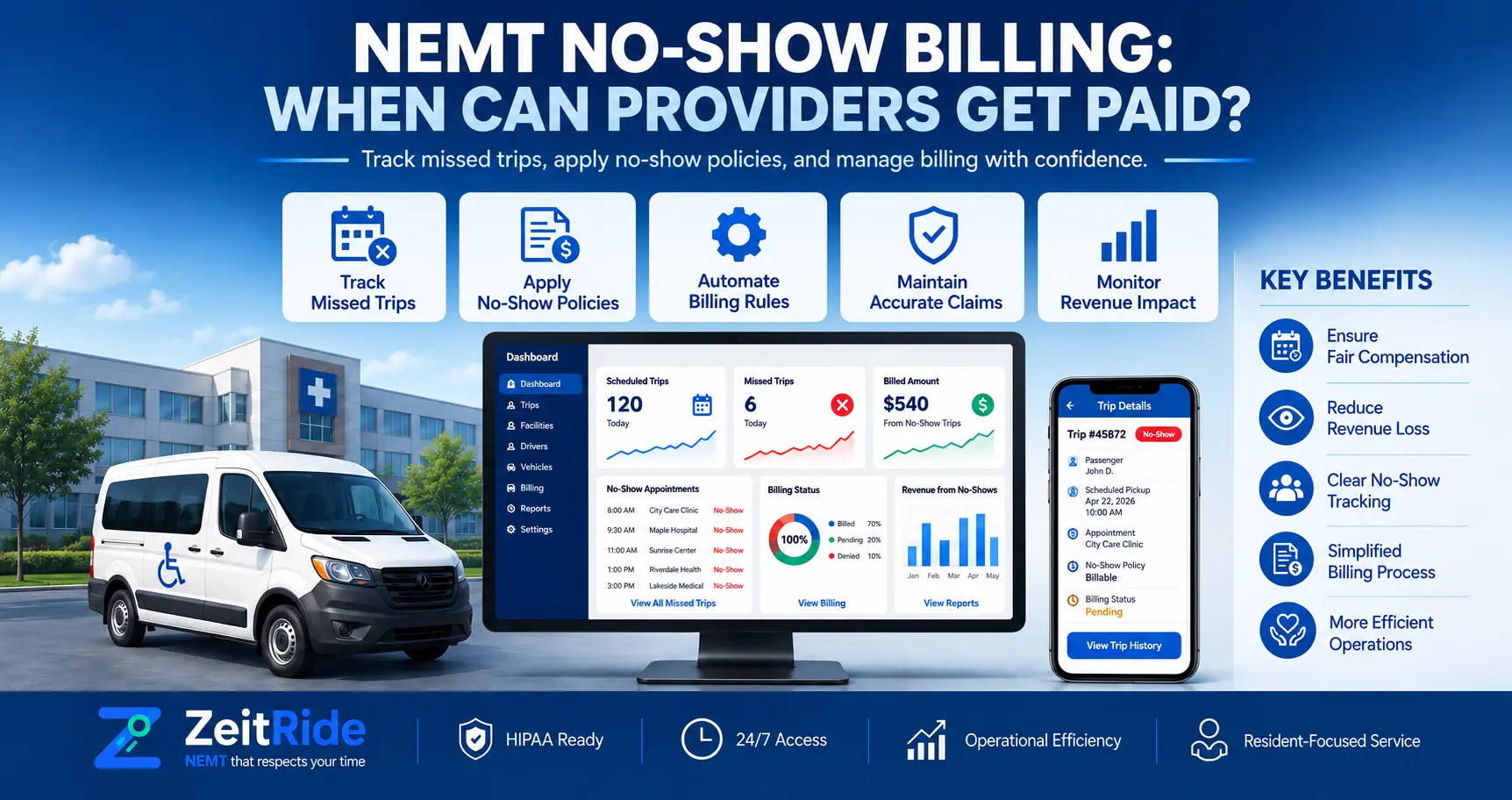
NEMT No-Show Billing: When Can Providers Get Paid?
A driver arrives, but the rider does not. Learn when NEMT no-shows or dry runs may be paid, which Medicaid rules apply, and what proof to keep.
Quick answer
Usually, providers cannot bill Medicaid for a ride that never occurred or charge a Medicaid member a no-show fee. Specific programs may authorize separate dry-run or broker payments under defined conditions. Verify the current payer rule and document the event before billing.
ZeitRide Team
NEMT Operations Expert
A scheduled pickup looks routine until the driver arrives and nobody comes out. The vehicle is at the correct address. The driver calls the rider, waits, updates dispatch, and eventually leaves without a passenger.
The transportation never happened, but the business still incurred driver time, fuel costs, and vehicle wear. Can the provider recover any of that expense?
NEMT no-show billing is more complicated than proving a vehicle reached the pickup location. Medicaid restrictions, broker contracts, state-specific payment methods, and documentation requirements all determine what happens next. The essential distinction is simple: recording a no-show is not the same as establishing that it is payable.
This guide explains when payment may be permitted, how the rules differ, what evidence to preserve, and how to keep an unsuccessful pickup from becoming an unsupported transportation claim.
Can NEMT Providers Get Paid for a No-Show?
Quick answer: Generally, federal Medicaid funding does not cover the transportation cost of a beneficiary who never appears, and a Medicaid beneficiary cannot be charged a no-show fee. However, certain programs establish specific broker-payment or qualifying dry-run arrangements. Providers must verify the applicable rule before submitting any charge.
The CMS Medicaid Transportation Coverage Guide explains that federal financial participation is unavailable for transportation to a beneficiary who does not appear for the ride. It also allows states to account for certain no-load-mile and no-show costs in transportation payment methodologies, subject to federal requirements.
That does not mean every transportation program has an identical payment arrangement. Some programs use separately defined response or broker payments, while private transportation agreements may include lawful cancellation provisions. Identify what happened, who would pay, and which current rule applies before billing.
What Is the Difference Between a No-Show and a Dry Run?
A rider no-show generally occurs when a scheduled passenger does not appear or is unavailable after the driver follows the applicable pickup procedure. A dry run describes a transportation response that does not result in the passenger being transported. These terms can overlap, but payers and brokers may classify or reimburse them differently.
| Event | What happened | Billing consideration |
|---|---|---|
| Rider no-show | Driver reaches the pickup location, but the rider does not board | Do not record a completed ride; check for a separately authorized exception |
| Dry run | Vehicle responds, but no passenger is transported | A distinct payment is possible only under applicable program rules |
| Late cancellation | Trip is cancelled after a specified notice window | Treatment depends on the responsible payer and contract |
| Provider no-show | Transportation company fails to arrive | No completed transportation; potential contractual consequences |
| Completed trip | Passenger receives the authorized transportation | Ordinary payable-service rules still require eligibility and proof |
A passenger who never answers the door is not the same as a driver who goes to the wrong address. Correct event classification comes before any reimbursement decision. For help preventing missed pickups rather than evaluating payment, see ZeitRide's guide to reducing NEMT no-shows and dry runs.
Medicaid NEMT No-Show Billing: What Federal Rules Say
Medicaid NEMT programs operate under federal requirements alongside state-administered payment and service arrangements. Medicaid NEMT no-show billing must therefore begin with official policy, not assumptions based on a different operator or state.
A missed ride is not automatically a payable transportation service
CMS states that federal matching funds are not available for the cost of transportation to a beneficiary who does not appear. A driver may incur real expenses by reaching the pickup address, but the unsuccessful response cannot be falsely reported as a completed passenger transport. A separately permitted response payment must follow its own lawful program authority and instructions.
Medicaid beneficiaries cannot be charged no-show penalties
The same CMS guide states that states and providers may not impose a no-show charge on Medicaid beneficiaries. It also states that transportation cannot be denied solely because of repeated beneficiary no-shows or lateness. Programs may use appropriate confirmation and scheduling procedures, but providers should not create their own penalty against the member.
Key takeaway: A signed authorization, GPS timestamp, or completed waiting period does not override the payer's payment restrictions. Documentation may prove that a response occurred; it does not by itself prove reimbursement eligibility.
When Can a No-Show or Dry Run Be Reimbursed?
Real payment practices differ. The examples below come from identifiable published program sources and illustrate why it is unsafe to apply one national no-show policy to every contract.
| Program | Published payment treatment | Important condition |
|---|---|---|
| MTM Health — Missouri | MTM says transportation providers are not reimbursed for no-shows | Report or cancel the event as instructed; recording arrival does not create payment eligibility |
| Georgia Medicaid NEMT | October 2026 manual instructs the broker to pay the provider for the A leg in qualifying member no-shows | The provider must arrive on time and the broker must follow its DCH-approved methodology |
| California Medi-Cal fee-for-service ground transportation | The medical ground transportation manual describes certain qualifying dry-run responses | Use the applicable service, authorization and billing rules; do not transfer these codes to unrelated NEMT contracts |
Missouri: MTM Health does not reimburse no-shows
The MTM Health Missouri transportation-provider FAQ expressly states that MTM does not reimburse providers for no-shows. It advises providers to confirm the transport and pickup time beforehand and cancel when the participant says the appointment will not occur. Arrival documentation is still operationally useful, but it does not create a payable no-show under that published policy.
Georgia: a conditional broker A-leg payment
Georgia's October 2026 NEMT Policies and Procedures Manual, Sections 702.7 and 1110, directs the broker to pay the provider for the A leg when a member fails to board within the applicable pickup standards and the provider arrived on time. The broker's member no-show payment methodology requires Georgia Department of Community Health approval.
This is a broker-level arrangement, not permission to submit an ordinary completed-ride Medicaid claim for a passenger who was never transported. Providers need the active broker procedure and must retain required proof of on-time arrival.
California: limited, program-specific dry-run billing
The Medi-Cal Medical Transportation — Ground manual describes qualifying medical ground transportation dry-run responses. Its August 2020 dry-run instructions specify modifier DS followed by QN for certain applicable claims, along with other service-specific requirements. These instructions are not a universal code set for every wheelchair-van, NEMT broker, or managed-care arrangement.
Because the cited manual pages were last revised in August 2020, providers should confirm current rules, applicable authorizations, vehicle/service categories, and any later program updates before using a code. Never copy a dry-run billing method from one payer into another.
NEMT Broker No-Show Reimbursement: What to Check
NEMT broker no-show reimbursement depends on the current provider agreement and operating instructions, not merely on whether the broker pays for completed rides. Before expecting payment, verify these points:
- Eligibility: Does the agreement authorize a member no-show, dry-run response, A-leg payment, or another defined category?
- Arrival rules: Was the driver at the authorized location and within the required window?
- Waiting and contact: Were the prescribed wait, contact attempts, and dispatcher notifications completed?
- Authorization: Does the payment category require additional broker or payer approval?
- Submission method: Must the event be entered through a broker portal, specialized invoice, or specific claim instructions?
- Amount and timing: Which rate applies, and what reporting or submission deadline controls?
Verify the effective date. Rules from an expired broker contract may not survive a service-area transition or new agreement. Where terms are unclear, request written guidance instead of submitting a speculative charge.
Private-pay and facility-sponsored trips are different
Private-pay or facility contracts may contain lawful cancellation fees agreed to by the responsible paying party. Define the fee, cancellation deadline, arrival standard, and dispute process in advance. Do not assume a fee in a private-pay agreement can be charged to a Medicaid beneficiary for a Medicaid-covered transportation no-show.
NEMT Dry Run Reimbursement: Six-Step Eligibility Framework
The most reliable reimbursement workflow separates the trip event from the financial decision. These six checks make it easier to recognize a permitted payment without treating an unsuccessful pickup as completed transportation.
Step 1: Classify what actually happened
Record whether it was a rider no-show, cancellation, facility issue, incorrect address, or provider failure. Preserve the actual outcome and do not change trip status solely to obtain payment.
Step 2: Identify the payer and program
Determine whether the responsible entity is Medicaid fee-for-service, a managed-care plan, an NEMT broker, a facility, or a private customer. That identity decides which documents control.
Step 3: Confirm payment authority
Review the current provider manual, agreement, rate schedule, or written payer instruction. Note the version, effective date, and payment category. If the charge cannot be supported, keep it out of the billing queue while seeking clarification.
Step 4: Test the event against every condition
Verify arrival, wait time, contact requirements, approved service level, original authorization, and required notice. Satisfying only one condition, such as arriving on time, does not necessarily satisfy the entire payment rule.
Step 5: Preserve the supporting evidence
Store the assignment, GPS and timestamps, contact history, reason code, dispatcher notes, and broker communications. Evidence supports a determination but cannot replace the legal or contractual payment basis.
Step 6: Separate review, submission, and payment
Mark the event as non-billable, pending clarification, potentially payable, or approved for the particular authorized method. Treat claim acceptance and actual payment as distinct later outcomes. The operational record must continue to show that no passenger was transported.
NEMT No-Show Billing Documentation: Evidence Checklist
NEMT no-show billing documentation should explain the scheduled transportation, the vehicle response, why nobody was transported, and what happened before the driver departed. Capture details during the incident rather than rebuilding a story days later.
| Evidence | What it helps establish |
|---|---|
| Trip ID and authorization reference | The scheduled service, payer and approved transportation request |
| Arrival and departure timestamps | Whether the response took place within the required window |
| GPS or mapped location | Where the vehicle was when the event was recorded |
| Driver and vehicle identification | Who responded and with which vehicle |
| Contact attempts and waiting period | Whether required procedures were followed |
| Reason code and dispatch notes | Why the transport did not occur |
| Broker notification or written approval | Whether necessary reporting or payment authorization exists |
GPS shows location, not automatic payment eligibility. It cannot by itself prove the rider was absent, that the correct entrance was used, or that the payer authorizes a charge. For wider recordkeeping standards, use ZeitRide's NEMT documentation requirements and audit checklist.
Example: One Missed Pickup, Three Different Billing Outcomes
Consider an illustrative assignment with a 9:00 a.m. pickup. The driver arrives at 8:58, tries to reach the rider at 9:02 and again at 9:07, and informs dispatch. At 9:12, the rider still has not appeared. No passenger boards, and the trip is recorded as a missed pickup. These timestamps are illustrative, not a universal waiting requirement.
| Payer scenario | Potential outcome | What the provider should do |
|---|---|---|
| MTM Health, Missouri | No-show not reimbursed under published MTM policy | Retain event record and follow cancellation/reporting requirements |
| Georgia Medicaid broker | May qualify for approved A-leg payment if requirements are met | Confirm on-time arrival, pickup standard and broker payment method |
| California Medi-Cal fee-for-service medical ground transport | Specific dry-run payment may be possible | Confirm vehicle category, authorization, current billing instructions and modifiers |
The operating facts are the same, but the possible financial outcome differs by program. That is why the trip event, payment-eligibility decision, submitted transaction, and remittance should never be collapsed into a single status.
Can Waiting Time or Empty Mileage Be Billed Instead?
A failed pickup does not automatically become a covered waiting-time service. HCPCS T2007 represents transportation waiting time, but the code's existence alone does not make a specific wait eligible. ZeitRide's NEMT wait-time billing guide explains the separate coverage and documentation considerations.
Likewise, empty miles cannot simply be submitted as loaded passenger mileage. CMS explains that unloaded-mile and beneficiary no-show costs generally cannot be reimbursed as standalone direct services or administrative activities, although states may account for them in authorized payment methodologies and limited flexibilities. Verify the actual program terms before entering any amount.
Common NEMT No-Show Billing Mistakes
- Marking an unsuccessful pickup as completed transportation
- Billing a Medicaid member after a payer declines reimbursement
- Assuming GPS arrival alone establishes a payable service
- Using another state's dry-run modifiers or reimbursement codes
- Submitting unloaded mileage as if a passenger rode in the vehicle
- Applying outdated broker terms without checking current instructions
- Skipping required authorization, reporting, or approval steps
- Confusing an accepted claim with an approved or received payment
If a legitimate authorized payment is submitted, NEMT trip reconciliation helps connect the operational record to expected reimbursement and actual remittance. It does not convert a non-payable event into a payable one.
How ZeitRide Supports No-Show Records Before Billing Review
The practical difficulty is often not recording that a pickup failed, but finding reliable evidence when dispatch, finance, or a broker asks what happened. ZeitRide's no-show and cancellation logs connect driver-reported events to timestamps, GPS location, and reason codes. Its NEMT billing workflows help teams work from connected transportation records.
A sensible process is straightforward: the driver records the true outcome; dispatch checks the incident details; billing identifies the responsible payer; a reviewer confirms whether a specific payment category is authorized; and only an eligible transaction moves into the appropriate submission process.
ZeitRide can help keep the event history accessible. No software, however, can independently make an otherwise non-payable no-show reimbursable or replace the transportation provider's obligation to follow the payer agreement.
Final No-Show Billing Review Checklist
- Record the incident accurately as a rider no-show, dry run, or cancellation.
- Identify the responsible payer and the contract effective on the service date.
- Verify a specific, lawful payment provision before treating the event as billable.
- Check required arrival, waiting, contact and notification standards.
- Preserve GPS, timestamps, authorization, notes and broker instructions.
- Confirm that any code, modifier, invoice category and amount are permitted.
- Do not charge a Medicaid beneficiary a prohibited no-show fee.
- Keep the event status, billing authorization, submission and payment history separate.
If an essential eligibility condition is unknown, pause submission and obtain clarification from the payer or broker.
Final Takeaway: Document First, Decide Billing Second
NEMT no-show billing should never depend on assuming that a dispatched vehicle deserves the same payment as a completed ride. Federal Medicaid rules establish important boundaries, while some programs provide separate, clearly defined arrangements. Current payer rules and actual event evidence determine the next step.
For transportation operators, the goal is to preserve an accurate record, recognize legitimate payment opportunities when authorized, and avoid unsupported claims. Doing all three protects the integrity of both dispatch and billing.
See How ZeitRide Documents No-Shows Before Billing Review
Bring a real missed-pickup scenario and your broker's documentation requirements. See how ZeitRide captures driver-reported trip events, GPS timestamps, reason codes, and connected transportation records. Book a 15-minute ZeitRide workflow demo and review your process with the team.
Editorial note: This guide provides general operational and reimbursement information as of October 12, 2026, not payer-specific legal or billing advice. State rules, covered services, contractual terms and authorization requirements can change. Confirm the rules applicable to the actual service date before submitting a charge.
Frequently Asked Questions
Q: Can NEMT providers bill for no-shows?
Generally, federal Medicaid funding does not cover passenger transportation that never occurred, and Medicaid beneficiaries cannot be charged a no-show fee. Some programs authorize distinct dry-run responses or broker payments under defined conditions. Verify the payer policy and documentation requirements before submission.
Q: Can a Medicaid beneficiary be charged a no-show fee?
No. CMS states that states and providers may not impose a no-show charge on a Medicaid beneficiary. A provider should not recover a missed Medicaid transportation payment by billing the member directly.
Q: Do NEMT brokers reimburse providers for dry runs?
Rules vary. MTM Health says its Missouri transportation providers are not reimbursed for no-shows. Georgia's October 2026 NEMT manual describes conditional broker payment for the A leg when the member does not board and the provider arrived on time.
Q: Does GPS arrival proof make an NEMT no-show billable?
No. GPS can help document where a vehicle was and when it arrived, but payment requires an applicable payer or contract rule plus any mandated authorization, waiting, reporting and documentation conditions.
Q: What documentation supports NEMT dry run reimbursement?
Requirements depend on the payer. They may include the trip authorization, driver and vehicle identifiers, GPS arrival/departure data, contact attempts, waiting time, reason code, dispatch notes and written broker notification or approval.
Q: Can providers bill waiting time or mileage when the rider never boards?
Not automatically. Waiting time and unloaded mileage have separate coverage rules, and an unsuccessful pickup must not be billed as completed passenger transportation. Verify any independently allowed response, waiting-time or mileage payment with the responsible payer.
Rather see it than read about it?
Bring a real route, a couple of drivers, and your current process. 15 minutes, zero pitch.