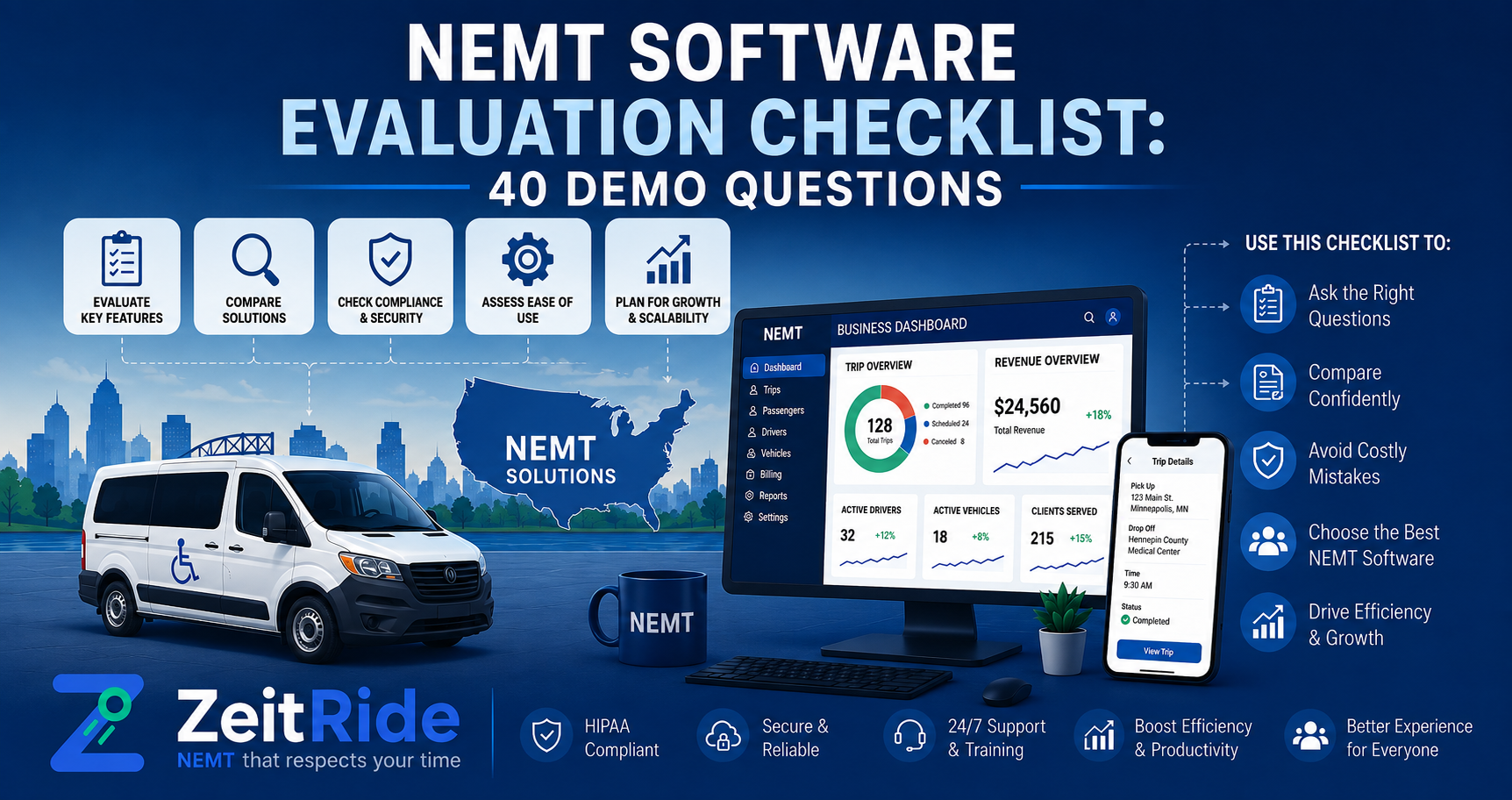
NEMT Software Evaluation Checklist: 40 Demo Questions
Compare NEMT software using 40 practical demo questions, a 100-point framework, key red flags, and a free vendor scorecard.
Quick answer
Evaluate NEMT software by giving every vendor the same requirements, real-world trip scenarios, pricing questions, and operational tests. Score each platform on scheduling, dispatch, integrations, driver workflows, billing, security, implementation, support, and total cost.
ZeitRide Team
NEMT Operations Expert
Most software demonstrations are built around perfect data and simple workflows. The vendor controls the presentation, chooses the trips, and avoids the difficult situations your dispatchers handle every day. A practical NEMT software evaluation checklist changes that process: you define the requirements, ask every vendor the same questions, and score only what can be demonstrated or confirmed in writing.
Before shortlisting vendors, review the complete guide to choosing NEMT software. Then use this checklist to test and compare the final candidates.
What Should an NEMT Software Evaluation Checklist Include?
An NEMT software evaluation checklist should cover scheduling, dispatch, routing, driver workflows, broker integrations, billing, documentation, reporting, security, implementation, support, pricing, and data ownership. Every vendor should complete the same real-world tests, and important capabilities should be demonstrated rather than accepted as marketing claims.
What to Prepare Before the Software Demo
Create an NEMT software requirements checklist before contacting vendors. Your requirements should reflect the way your company actually operates rather than a generic feature list.
- Number and type of vehicles in your fleet
- Average daily and monthly trip volume
- Ambulatory, wheelchair, stretcher, and other service types
- Broker, payer, facility, and private-pay relationships
- Driver shifts, credentials, and mobile devices
- Recurring-trip and standing-order requirements
- Common cancellations, no-shows, will-calls, and same-day trips
- Current billing and documentation workflow
- Required operational, broker, and compliance reports
- Current software, integration, support, and staffing costs
Document how trips move from NEMT scheduling software into dispatch, the driver workflow, and billing. Pay close attention to every place where employees must re-enter information, switch between systems, or manually reconcile records.
NEMT Software Evaluation Criteria: 100-Point Framework
Use the following NEMT software evaluation criteria to compare vendors consistently. The highest weight is assigned to the workflows that directly affect trip delivery, documentation, billing, and daily operations.
| Evaluation Category | Maximum Points |
|---|---|
| Operational fit and trip intake | 10 |
| Scheduling, dispatch, and routing | 20 |
| Driver app and field workflows | 10 |
| Broker and payer integrations | 15 |
| Billing, documentation, and reporting | 15 |
| Security, privacy, and data ownership | 10 |
| Implementation, migration, and support | 10 |
| Pricing, contracts, and scalability | 10 |
| Total | 100 |
Score each category from one to five, then calculate the category result using this formula: category weight multiplied by rating, divided by five.
- 1 — The requirement is missing or unacceptable
- 2 — A major workaround or additional product is required
- 3 — The core requirement is supported with manageable limitations
- 4 — The workflow is strong and clearly demonstrated
- 5 — The workflow is complete, intuitive, documented, and well supported
A vendor that fails a mandatory broker, billing, security, documentation, or operational requirement should be removed regardless of its overall score.
Give Every Vendor the Same Live Test
Ask every shortlisted vendor to run the same representative service day. Use anonymized test data that reflects your actual trip mix, operating constraints, and common dispatch exceptions.
- A recurring dialysis trip
- A wheelchair trip requiring the correct vehicle
- A same-day trip added after routes are published
- A will-call return without a confirmed pickup time
- A passenger cancellation
- A rider no-show
- A driver callout
- A vehicle breakdown
- A trip completed with signatures and timestamps
- A completed trip moved into billing and reporting
Ask the vendor to show how every change moves through live NEMT dispatch software, route planning, the driver's device, trip documentation, and billing. Do not allow the demonstration to stop after the schedule looks correct.
40 NEMT Software Demo Questions
Use these NEMT software demo questions with every vendor. Record whether each answer was demonstrated live, confirmed in documentation, described verbally, or not confirmed.
Operational Fit and Trip Intake
| # | Question | What to Verify |
|---|---|---|
| 1 | Which NEMT service types are supported without custom development? | Your ambulatory, wheelchair, stretcher, facility, and private-pay workflows |
| 2 | Can you import one of our sample trip files? | Field mapping, duplicate prevention, validation, and error reporting |
| 3 | How are incomplete or conflicting trips handled? | Invalid records are identified before they reach dispatch |
| 4 | Can the system enforce vehicle, mobility, and driver restrictions? | Incompatible assignments are prevented automatically |
| 5 | How are trip changes and cancellations recorded? | Original and updated values remain visible with timestamps |
Scheduling, Dispatch, and Routing
| # | Question | What to Verify |
|---|---|---|
| 6 | Can you create and edit recurring trips? | One occurrence can change without affecting the full series |
| 7 | How is a same-day trip added after routes are published? | The system finds feasible placement without rebuilding every route |
| 8 | How are trips reassigned after a driver callout? | Trips move without losing requirements, history, or documentation |
| 9 | What happens when a vehicle becomes unavailable? | Every affected trip is identified immediately |
| 10 | Can routes handle mixed mobility needs and appointment windows? | Capacity, vehicle, service, and time constraints are respected |
Ask what assumptions the NEMT routing software uses and whether dispatchers can safely override route recommendations when real operating conditions change.
Driver App and Field Workflows
| # | Question | What to Verify |
|---|---|---|
| 11 | Which phones, tablets, and operating systems are supported? | Compatibility with the devices your drivers already use |
| 12 | What works when cellular service is unavailable? | Trips, statuses, forms, and documentation can sync later |
| 13 | How do drivers update pickup and drop-off statuses? | A clear workflow requiring minimal driver interaction |
| 14 | How are signatures, notes, forms, and photos stored? | Every item remains connected to the correct trip record |
| 15 | How are drivers trained before launch? | Role-based training and access to a test environment |
Test the NEMT driver app on the same type of phone or tablet your drivers use. A polished desktop presentation does not prove that the field workflow will remain practical during a busy shift.
Broker and Payer Integrations
| # | Question | What to Verify |
|---|---|---|
| 16 | Is each broker connection direct, file-based, or manual? | The exact connection method for each required broker |
| 17 | Which trip fields move automatically? | Which information still requires manual entry |
| 18 | Do cancellations and trip changes update automatically? | Whether information moves in one direction or both directions |
| 19 | What happens when an integration fails? | Alerts, error details, ownership, and resolution procedures |
| 20 | Are setup, maintenance, or transaction fees charged? | Every initial and ongoing integration fee |
A broker logo does not prove that your required workflow is supported. Review the vendor's NEMT broker integration details and require a clear explanation of the data connection, supported fields, update direction, error process, and billing workflow.
Billing, Documentation, and Reporting
| # | Question | What to Verify |
|---|---|---|
| 21 | How does a completed trip become ready for billing? | Operational and billing records remain connected |
| 22 | What information is validated before billing or export? | Missing or inconsistent fields are identified before submission |
| 23 | How are cancellations, no-shows, and wait time documented? | Standardized and timestamped records are created |
| 24 | Can we view every important trip change? | The user, time, previous value, and new value are visible |
| 25 | Which billing, invoice, and reporting files can be exported? | Compatibility with your broker, payer, and internal workflows |
The NEMT billing workflow should begin with the completed operational trip rather than a separately recreated billing record. For general federal context, review the official CMS Medicaid transportation guidance, then confirm the specific requirements of your state, brokers, payers, and contracts.
Security, Privacy, and Data Ownership
| # | Question | What to Verify |
|---|---|---|
| 26 | Will the vendor sign a Business Associate Agreement when required? | A defined legal and contracting review process |
| 27 | How is access to member and trip data controlled? | Role-based permissions and authentication controls |
| 28 | How are backups and disaster recovery handled? | Documented recovery procedures and responsibilities |
| 29 | Who owns our data? | Contract language confirming your ownership |
| 30 | How can we export our data when leaving? | A usable format without unreasonable fees or restrictions |
The official HHS HIPAA Security Rule resource provides a useful starting point for reviewing administrative, physical, and technical safeguards. Your legal, privacy, and security advisers should review the requirements that apply to your organization.
Implementation, Migration, and Support
| # | Question | What to Verify |
|---|---|---|
| 31 | Which records will be migrated? | Members, trips, drivers, vehicles, rates, and required history |
| 32 | What is the implementation plan? | Owners, milestones, testing, training, and launch criteria |
| 33 | How will each team be trained? | Separate training for dispatch, drivers, billing, and administrators |
| 34 | What support is available during operating hours? | Channels, coverage, escalation, and response expectations |
| 35 | Can we run parallel testing before launch? | A validation process and rollback plan |
Review the vendor's complete implementation process rather than accepting a target launch date. ZeitRide's implementation overview shows the type of onboarding detail that should be discussed before a final decision.
Pricing, Contracts, and Scalability
| # | Question | What to Verify |
|---|---|---|
| 36 | What is our complete first-year cost? | Subscription, setup, training, support, integrations, and transaction fees |
| 37 | Which capabilities shown in the demo cost extra? | Every add-on, usage limit, and optional module |
| 38 | What are the renewal and cancellation terms? | Contract length, notice periods, and possible price increases |
| 39 | How does pricing change as our company grows? | Costs for additional vehicles, trips, users, locations, or brokers |
| 40 | Can you provide references from similar fleets? | Customers with comparable operations, trip volume, and broker requirements |
Use the NEMT software pricing guide to compare the advertised subscription with the complete cost of implementation, integrations, support, add-ons, and growth.
NEMT Software Red Flags
The following NEMT software red flags indicate operational, financial, or implementation risk. One concern may require clarification, but several together should disqualify the vendor.
- The vendor refuses to test your sample trips or realistic scenarios
- Important features shown during the demo cost extra
- Broker integrations cannot be explained clearly
- Offline driver-app functionality cannot be demonstrated
- Billing information must be recreated manually
- Data ownership is not addressed in the contract
- Pricing excludes implementation, integration, or support charges
- Support response expectations are undocumented
- The implementation plan does not include testing
- A mandatory feature depends on future development
- Data exports use an unusable or proprietary format
- Customer references do not resemble your operation
Free NEMT Software Vendor Scorecard
Complete this NEMT software vendor scorecard immediately after every demonstration. Record both the score and the evidence supporting it before attending another vendor presentation.
| Category | Weight | Vendor A | Vendor B | Vendor C |
|---|---|---|---|---|
| Operational fit and trip intake | 10 | |||
| Scheduling, dispatch, and routing | 20 | |||
| Driver app and field workflows | 10 | |||
| Broker and payer integrations | 15 | |||
| Billing, documentation, and reporting | 15 | |||
| Security, privacy, and data ownership | 10 | |||
| Implementation, migration, and support | 10 | |||
| Pricing, contracts, and scalability | 10 | |||
| Total | 100 |
- 85–100 points: Strong candidate, subject to contract and reference validation
- 70–84 points: Potential fit, but material gaps must be resolved
- Below 70 points: Significant operational or commercial risk
- Mandatory requirement failed: Disqualify regardless of total score
Record whether each important answer was demonstrated live, confirmed in documentation, confirmed in the proposal or contract, described verbally, or not confirmed. A live demonstration should receive more weight than a verbal promise.
How to Make the Final Decision
- Remove vendors that fail mandatory requirements
- Compare weighted scores rather than raw feature counts
- Calculate complete first-year and three-year costs
- Confirm integration, migration, and support responsibilities
- Review data ownership, renewal, cancellation, and export terms
- Speak with customers operating similar fleets
- Request written answers for every unresolved question
- Run one final end-to-end workflow demonstration
The strongest platform is not necessarily the one with the longest feature list. It is the one that supports the complete trip lifecycle with the least unnecessary manual work, risk, and uncertainty.
Test ZeitRide Using the Same Checklist
ZeitRide should be evaluated using the same criteria as every other platform. Bring one representative service day, your broker requirements, a difficult dispatch exception, the devices your drivers use, and an example of the documentation your billing team needs.
Review the ZeitRide NEMT software platform, compare its capabilities with your mandatory requirements, and ask the team to demonstrate the workflows that matter to your operation.
Bring a real service day and score the workflow yourself. Book a ZeitRide demo using your trips, operating constraints, broker requirements, and billing questions.
Frequently Asked Questions
Q: What should an NEMT software evaluation checklist include?
An NEMT software evaluation checklist should cover scheduling, dispatch, routing, driver workflows, broker integrations, billing, documentation, reporting, security, implementation, support, pricing, contracts, scalability, and data ownership.
Q: What questions should I ask during an NEMT software demo?
Ask the vendor to import sample trips, manage recurring and same-day work, process cancellations and no-shows, reassign drivers, demonstrate offline workflows, show broker data movement, prepare a completed trip for billing, export reports, and explain all costs.
Q: Should an NEMT software vendor demonstrate our actual workflows?
Yes. Use anonymized or test data based on a representative service day. Generic demonstrations may not reveal whether the platform can handle your mobility requirements, broker formats, operating exceptions, documentation, and billing process.
Q: How do I score NEMT software vendors fairly?
Give every vendor the same requirements, questions, data, and live scenarios. Use a weighted scoring framework and record whether each answer was demonstrated, documented, described verbally, or not confirmed.
Q: What are the biggest NEMT software red flags?
Major red flags include unclear pricing, unverified integrations, manual billing re-entry, weak data-export rights, no offline driver workflow, vague support terms, missing implementation details, and promises that depend on future development.
Q: How many NEMT software vendors should I compare?
A shortlist of three serious candidates is usually manageable. Eliminate vendors that fail mandatory requirements before scheduling detailed demonstrations.
Rather see it than read about it?
Bring a real route, a couple of drivers, and your current process. 15 minutes, zero pitch.