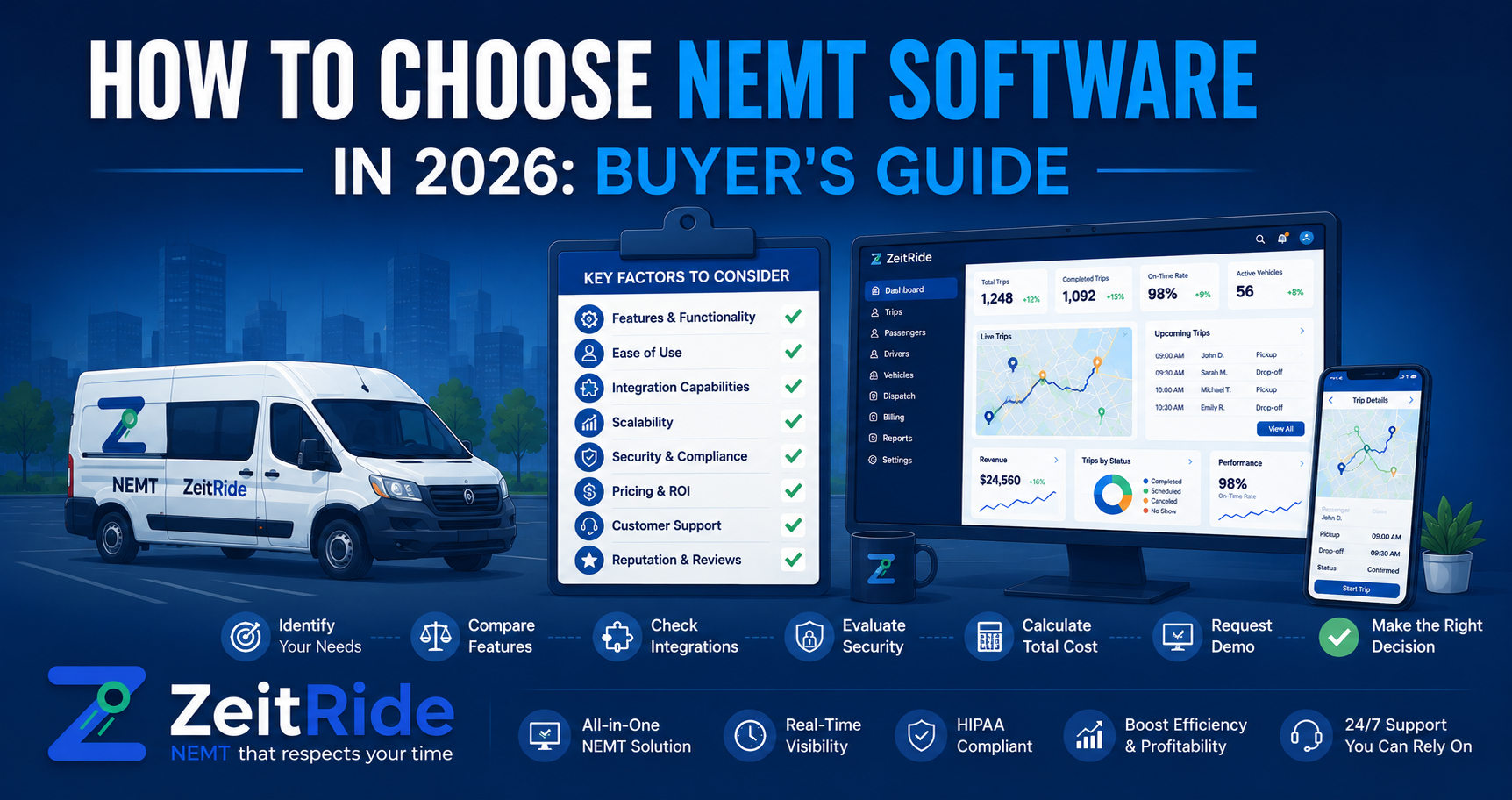
How to Choose NEMT Software in 2026: Buyer's Guide
A practical framework for evaluating NEMT software: dispatch, scheduling, routing, billing, driver apps, broker fit, pricing models, and implementation risk.
Quick answer
To choose NEMT software, define your operational needs (dispatch, scheduling, routing, billing), validate broker and payer integrations for your region, compare total cost per vehicle including all modules, test driver and dispatcher UX in a live demo, and evaluate implementation timeline and support quality.
ZeitRide Team
NEMT Operations Expert
Knowing how to choose NEMT software in 2026 is the single most important operational decision a non-emergency medical transportation provider can make this year. The landscape has changed dramatically: brokers demand faster reporting, Medicaid compliance requirements are tighter than ever, and providers still relying on manual workflows are losing both revenue and contracts. This buyer's guide written by the team at ZeitRide gives you a clear, step-by-step framework to evaluate, compare, and confidently select the right platform for your fleet.
Whether you run a 5-vehicle startup or a 50-vehicle operation, this guide covers the core criteria, must-have features, red flags to avoid, and the questions you must ask every vendor before you sign.
Step 1: Understand What You Actually Need
Audit Your Current Operations First
Before you evaluate a single platform, you need an honest picture of where your workflow is breaking down. Most providers who struggle with non emergency medical transportation software selection skip this step entirely — and end up buying features they don't need while missing the ones they do. Ask yourself: • How many trips per day does your team currently process? • How long does daily scheduling take your dispatcher? • What is your current claim denial rate — and what is causing it? • Which brokers are you contracted with, and how are trips currently imported? • Are drivers still using paper manifests or a basic navigation app?
Step 2: Know Which Features Are Non-Negotiable
In 2026, the gap between essential and optional features has narrowed. These capabilities are now standard requirements for any competitive provider:
Automated Non Emergency Medical Transportation Scheduling
Manual scheduling is no longer viable at scale. Your NEMT scheduling software must auto-assign trips based on vehicle type, driver availability, patient mobility needs, and appointment windows — building daily manifests in minutes, not hours. Look for platforms that offer non emergency medical transportation scheduling automation tied directly to your broker trip feed, so incoming requests populate the schedule without dispatcher re-entry.
Intelligent Route Optimization
The NEMT routing software layer is where operators recover real money. A proper routing engine accounts for multi-stop manifests, multi-load trips, appointment deadlines, and real-time traffic — then recalculates dynamically when cancellations or add-on trips hit the schedule. Providers using intelligent routing typically reduce fuel costs by 15–30% monthly.
Integrated Dispatch Management
Your NEMT dispatch software should connect scheduling, GPS tracking, and billing in a single live dashboard. When a trip is completed, the data — including GPS timestamps and electronic signatures — flows directly into the billing module. This is what eliminates re-entry errors and dropped documentation that cause claim denials.
NEMT Billing Software with Medicaid Automation
Billing is where providers either protect or lose revenue. Your NEMT billing software must handle HCPCS coding, origin and destination modifiers, EDI 837P claim submission, and denial management automatically. Disconnected billing modules — or worse, manual claim entry — are responsible for the 15–20% average denial rates that still plague many providers in 2026.
Driver Mobile App
The ZeitRide driver app replaces paper manifests with digital workflows: turn-by-turn navigation, trip status updates, electronic signature capture at pickup and drop-off, and real-time dispatcher communication. Driver adoption rate is often the difference between a software rollout that works and one that fails.
Step 3: Evaluate Broker Integration Depth
This is the step most buyer's guides underplay — and the one that matters most to your bottom line. When you're learning how to choose NEMT software in 2026, broker integration depth is the deciding factor for any provider doing Medicaid or managed care work. What to verify with every vendor: • Direct API connections: Does the platform directly connect with Modivcare, MTM, OneCall, Alivi, and your state-specific brokers — or does it use a generic API layer that requires manual configuration? • Auto-import functionality: Do broker trips automatically populate your schedule, or does someone manually enter them? • Trip status updates: Are completed trip confirmations sent back to the broker automatically, or manually? • Audit documentation: Does the system generate the GPS-verified, signature-confirmed documentation brokers require for trip validation?
ZeitRide's features page outlines direct broker integrations — verify the specific brokers you work with before making a decision. You can also compare ZeitRide to competitors to see integration depth side by side.
Step 4: Assess Implementation Timeline and Support Quality
Quality One of the most overlooked factors when learning how to choose NEMT software in 2026 is what happens after you sign the contract. A platform is only as good as the onboarding and ongoing support behind it. Ask every vendor: • What is the realistic go-live timeline for a fleet my size? • Who is my dedicated point of contact during implementation? • What does data migration from my current system look like? • Is training included, and in what format? • What does support look like after go-live — phone, chat, or ticket queue?
Most providers go live within 2–4 weeks on modern platforms like ZeitRide. If a vendor quotes 6–8 weeks for a standard deployment, factor that downtime cost into your evaluation. Read more on how to choose NEMT software in 2026 in ZeitRide's detailed blog resource.
Step 5: Watch for These Red Flags
After analyzing the competitive landscape, here are the warning signs that a non emergency medical transportation scheduling platform isn't ready for serious operators: • No published broker integration list: If a vendor can't tell you exactly which brokers they connect with, it's a red flag. • Per-trip billing model: This structure punishes volume growth. As you scale, costs compound without adding value. • Disconnected billing: Dispatch and billing in separate systems means manual data handoff, re-entry errors, and preventable claim denials. • No driver mobile app: Paper manifests in 2026 create compliance gaps and documentation problems during broker audits. • No demo environment: Any reputable platform will let you test a real environment before committing. Reluctance to demo is a transparency problem.
Final Thought
Knowing how to choose NEMT software in 2026 comes down to six things: matching features to your real operational gaps, verifying broker integration depth, demanding integrated billing, stress-testing support quality, building a real ROI projection, and insisting on a live demo before any commitment. At ZeitRide, we built our platform around the exact pain points that cost U.S. NEMT providers revenue every single day: manual scheduling, disconnected billing, opaque routing, and unreliable broker workflows. Our non emergency medical transportation software is purpose-built for U.S. operators — not retrofitted from a generic fleet tool.
Providers in Pennsylvania and Florida are already using ZeitRide to automate scheduling, cut claim denials, and dispatch smarter. If you want to see how it works in your actual workflow, explore our full features or contact us to request a free demo today.
Rather see it than read about it?
Bring a real route, a couple of drivers, and your current process. 15 minutes, zero pitch.