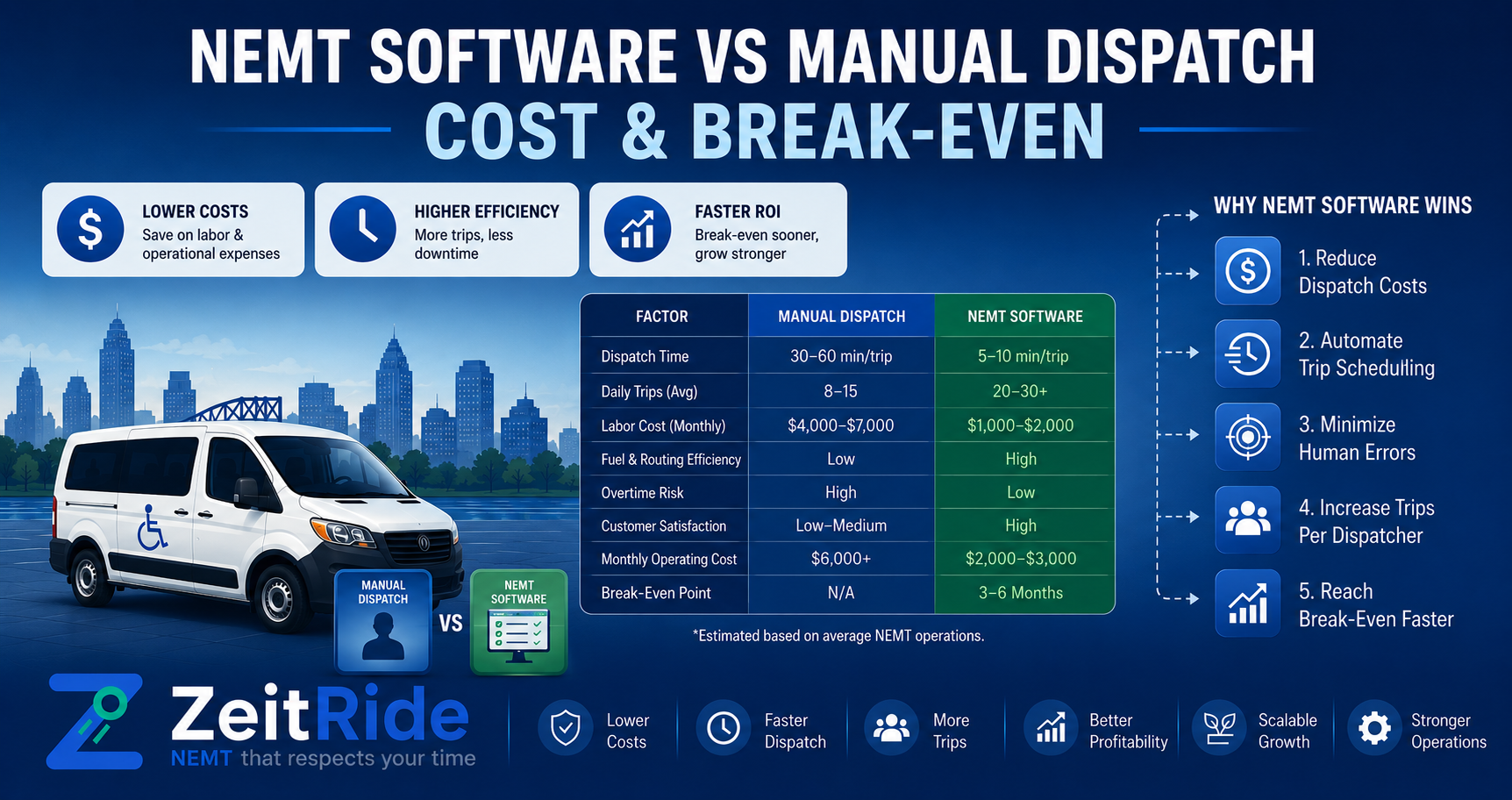
NEMT Software vs Manual Dispatch: Cost & Break-Even
Compare manual NEMT dispatch with dedicated software, calculate break-even by fleet size, and determine when automation may justify its cost.
Quick answer
NEMT software may be worth the cost when manual scheduling, driver communication, avoidable mileage, billing rework, and missed trip capacity cost more than the complete software subscription. The true break-even point depends on trip volume and workflow complexity, not fleet size alone.
ZeitRide Team
NEMT Operations Expert
Choosing between NEMT software vs manual dispatch is not simply about paying for software or avoiding another subscription. The real comparison is between the complete cost of your current workflow and the cost of replacing repetitive work with a connected operating system. Manual dispatch can work for a small, predictable operation, but its real cost may include dispatcher hours, owner time, duplicate trip entry, avoidable mileage, driver calls, billing corrections, and missed trip capacity. This guide explains how to compare those costs and determine when software may reach break-even for your fleet.
Is NEMT Software Worth It?
NEMT software is worth considering when the measurable value of reduced administrative work, better route coordination, cleaner trip records, and additional capacity exceeds the complete monthly software cost. Fleet size matters, but it is not the only factor. A three-vehicle fleet handling frequent schedule changes and broker trips may benefit sooner than a larger fleet operating a small number of predictable routes.
The better question is: What does our current dispatch process cost each month, and which parts of that cost could software realistically reduce?
NEMT Software vs Manual Dispatch
| Area | Manual Dispatch | NEMT Software |
|---|---|---|
| Trip entry | Information is copied from calls, emails, or broker portals | Trips are stored in a centralized system |
| Scheduling | Routes and assignments are created manually | Scheduling tools assist with assignments and sequencing |
| Driver communication | Calls, texts, and group chats | Driver app and centralized status updates |
| Route changes | Dispatcher manually rebuilds the schedule | Live schedule and route adjustments |
| Vehicle visibility | Dispatcher asks drivers for updates | GPS and trip-status visibility |
| Billing preparation | Staff reconstruct completed-trip information | Trip records move into connected billing workflows |
| Record history | Spread across paper, texts, and files | Centralized trip and status history |
| Scalability | More trips usually create more coordination work | Automation can absorb part of the additional workload |
Dedicated NEMT dispatch software becomes most valuable when dispatchers and drivers need one reliable source for trip details, assignments, updates, and completed-trip information.
What Counts as Manual NEMT Dispatch?
Manual dispatch does not always mean paper manifests and a whiteboard. Many providers use digital tools but still operate through a manual process.
- Trips are copied from broker portals into spreadsheets.
- Routes are built in consumer mapping applications.
- Drivers receive assignments through calls or text messages.
- Cancellations and will-calls are tracked in separate notes.
- Trip details are entered again for billing.
- Only one person fully understands the daily schedule.
The problem is not the spreadsheet or group chat by itself. The problem is that the schedule, driver, route, vehicle, and billing record are not automatically connected.
How Much Does Manual NEMT Dispatch Cost?
A complete manual NEMT dispatch cost calculation should include more than dispatcher payroll. The subscription price of software is easy to see, while manual operating costs are often spread across labor, mileage, billing, and lost capacity.
| Cost Area | What to Measure |
|---|---|
| Dispatch labor | Hours spent entering trips, scheduling, calling drivers, and managing changes |
| Owner time | Unpaid hours the owner spends coordinating daily operations |
| Duplicate entry | Time spent copying the same trip information between systems |
| Avoidable mileage | Empty or inefficient miles caused by weak assignments and route changes |
| Billing rework | Hours spent locating missing timestamps, mileage, signatures, or trip records |
| Missed capacity | Profitable trips the fleet could not accept because the schedule was overloaded |
| Existing tools | Mapping, messaging, storage, or other subscriptions used to support dispatch |
Use a representative operating period, such as the previous four weeks. Avoid calculating costs from only your busiest or easiest day because that can distort the result. ZeitRide's NEMT cost-per-trip calculator can help establish a more complete operating-cost baseline.
What Does NEMT Software Cost?
The software side of the comparison should include the complete investment, not only the advertised monthly subscription.
- Monthly or annual subscription
- Required modules and add-ons
- Implementation or onboarding fees
- Training costs
- Broker and billing integrations
- Driver application charges
- Per-trip or usage fees
- Hardware requirements
- Internal data-migration time
- Contract and cancellation terms
The NEMT software pricing guide explains how per-vehicle, per-trip, tiered, and flat-rate pricing models affect the final cost. Always use the current amount shown on the ZeitRide pricing page when calculating the software side of your comparison.
How to Calculate the NEMT Software Break-Even Point
The NEMT software break-even point is reached when the measurable monthly value recovered through improved workflows equals the complete monthly software cost.
Monthly recoverable value = labor recovered + mileage reduced + billing rework reduced + additional trip contribution + replaced tool costs
Monthly net benefit = monthly recoverable value - monthly software cost
NEMT software payback period = one-time transition cost divided by monthly net benefit
Only include improvements that can reasonably occur. Do not count every dispatcher hour as cash savings unless payroll, overtime, or hiring requirements will actually change. Use the NEMT ROI calculator to model labor, mileage, billing, trip capacity, ROI, and payback using your own fleet data.
Break-Even by Fleet Size
| Fleet Size | Main Cost Considerations | Key Break-Even Question |
|---|---|---|
| 1-3 vehicles | Owner time, duplicate entry, billing preparation, and documentation | Is the recovered time and operational control worth more than the subscription? |
| 4-7 vehicles | Driver communication, scheduling, route changes, and administrative hiring | Can software reduce overtime or delay the need for another employee? |
| 8-15 vehicles | Dispatcher capacity, deadhead mileage, billing handoffs, and vehicle visibility | Can the current team manage more trips without equal growth in administrative work? |
| 16+ vehicles | Multiple dispatchers, permissions, reporting, billing controls, and fleet utilization | Can one connected system reduce coordination costs across the operation? |
Small fleets should not assume software is unnecessary. The deciding factor is operational complexity, not vehicle count alone. Review the NEMT software for small fleets guide for additional small-fleet considerations.
NEMT Software vs Spreadsheets
Spreadsheets are inexpensive, flexible, and familiar. They may remain suitable for low-volume operations with predictable routes and limited daily changes. However, a spreadsheet does not automatically connect the live schedule with drivers, vehicles, routes, trip status, and billing records.
- A spreadsheet does not automatically notify a driver when an assignment changes.
- It does not show which vehicle is closest to a new trip.
- It does not automatically update routes after a cancellation.
- It does not connect completed trips with billing records.
- It does not place driver status, timestamps, and documentation into one workflow.
The strongest reason to replace spreadsheets is not convenience. It is the increasing cost of keeping disconnected information accurate as trip volume and operational complexity grow.
Example NEMT Software Payback Calculation
Consider a hypothetical five-vehicle fleet. The figures below are examples only and should be replaced with actual fleet data.
| Example Input | Monthly Value |
|---|---|
| Administrative time recovered | $150 |
| Avoidable mileage reduced | $75 |
| Billing rework reduced | $100 |
| Total monthly recoverable value | $325 |
| Complete monthly software cost | $245 |
| Monthly net benefit | $80 |
| One-time transition cost | $300 |
| Estimated payback period | 3.75 months |
This result is only valid if the fleet actually achieves the estimated improvements. After implementation, compare the forecast with real results after 30, 60, and 90 days.
When Manual Dispatch May Still Make Sense
- Trip volume is low and highly predictable.
- Routes rarely change during the day.
- One person can manage dispatch without overtime.
- Billing records are complete and easy to locate.
- The fleet produces little avoidable mileage.
- Growth is not currently a priority.
- The measured manual cost remains below the total software cost.
Manual dispatch should be a deliberate operating decision supported by numbers, not simply the default because its costs are difficult to see.
Signs It May Be Time to Switch
- Staff repeatedly enter the same trip information.
- Drivers regularly call for addresses, changes, or rider status.
- The dispatcher spends significant time rebuilding routes.
- Multiple versions of the daily schedule exist.
- Completed trips require frequent billing follow-up.
- The owner cannot step away from dispatch.
- Growth would require another dispatcher before another revenue-producing role.
- Staff cannot quickly reconstruct a disputed trip.
One occasional problem may not justify a platform. Several recurring problems usually indicate that the business should calculate the break-even point formally.
How to Move From Manual Dispatch
- Document the current workflow from trip intake through billing.
- Clean driver, vehicle, member, and recurring-trip data.
- Select a representative group of routes for testing.
- Train dispatchers and drivers on their daily tasks.
- Validate schedules before moving the full operation.
- Compare labor, mileage, billing, and capacity results after implementation.
ZeitRide's implementation process explains how trips, drivers, vehicles, dispatch, and billing can be connected in stages instead of changed all at once.
Frequently Asked Questions
Q: Is NEMT software worth it for a small fleet?
It may be worth it when owner time, duplicate trip entry, billing rework, avoidable mileage, or missed capacity exceeds the software cost. A small fleet with complex operations may benefit before a larger fleet with simple routes.
Q: At what fleet size does NEMT software pay for itself?
There is no universal fleet-size threshold. Break-even depends on trip volume, scheduling complexity, staffing costs, mileage, billing work, and the complete software investment.
Q: Is NEMT software better than spreadsheets?
Software is generally more suitable when the operation needs live driver updates, route changes, centralized trip records, and connected billing workflows. Spreadsheets may still work for a low-volume and predictable operation.
Q: How is the NEMT software payback period calculated?
Divide one-time implementation and transition costs by the expected monthly net benefit. Monthly net benefit equals measurable monthly value recovered minus the complete monthly software cost.
Calculate Your Fleet's Break-Even Point
Start with one representative month. Calculate dispatch labor, owner time, duplicate entry, avoidable mileage, billing rework, missed trip capacity, and existing tool costs. Then compare that amount with the complete software investment.
Use ZeitRide's NEMT ROI calculator to create your financial estimate. When the numbers support a change, contact ZeitRide and bring a de-identified route to your demonstration.
The correct NEMT software vs manual dispatch decision should be based on measurable operating costs, not assumptions about fleet size or guaranteed savings.
Rather see it than read about it?
Bring a real route, a couple of drivers, and your current process. 15 minutes, zero pitch.