How to Become a Medicare Advantage NEMT Provider in 2026
Learn how to become a Medicare Advantage NEMT provider in 2026 — networks, credentialing, contracts, trip documentation, and billing.
Quick answer
To become a Medicare Advantage NEMT provider, identify plans offering transportation in your service area, find the organization managing their transportation network, and complete its credentialing, contracting, onboarding, documentation, and billing requirements.
ZeitRide Team
NEMT Operations Expert
If you operate a non-emergency medical transportation company, becoming a Medicare Advantage NEMT provider can create another source of contracted trip volume. But there is an important distinction: there is no single universal Medicare Advantage transportation application that gives an NEMT company access to every plan. Medicare Advantage plans are offered by private companies that contract with Medicare, and their transportation benefits and provider networks can vary by plan and location.
For an NEMT operator, the practical process is to identify plans offering transportation where you operate, find out who actually manages those rides, complete the appropriate credentialing process, review the contract, and build a reliable documentation and billing workflow. If you first need to understand the coverage side, read ZeitRide's guide to Medicare transportation coverage. If your goal is broader contract acquisition, see the complete guide to NEMT contracts.
How Do You Become a Medicare Advantage NEMT Provider?
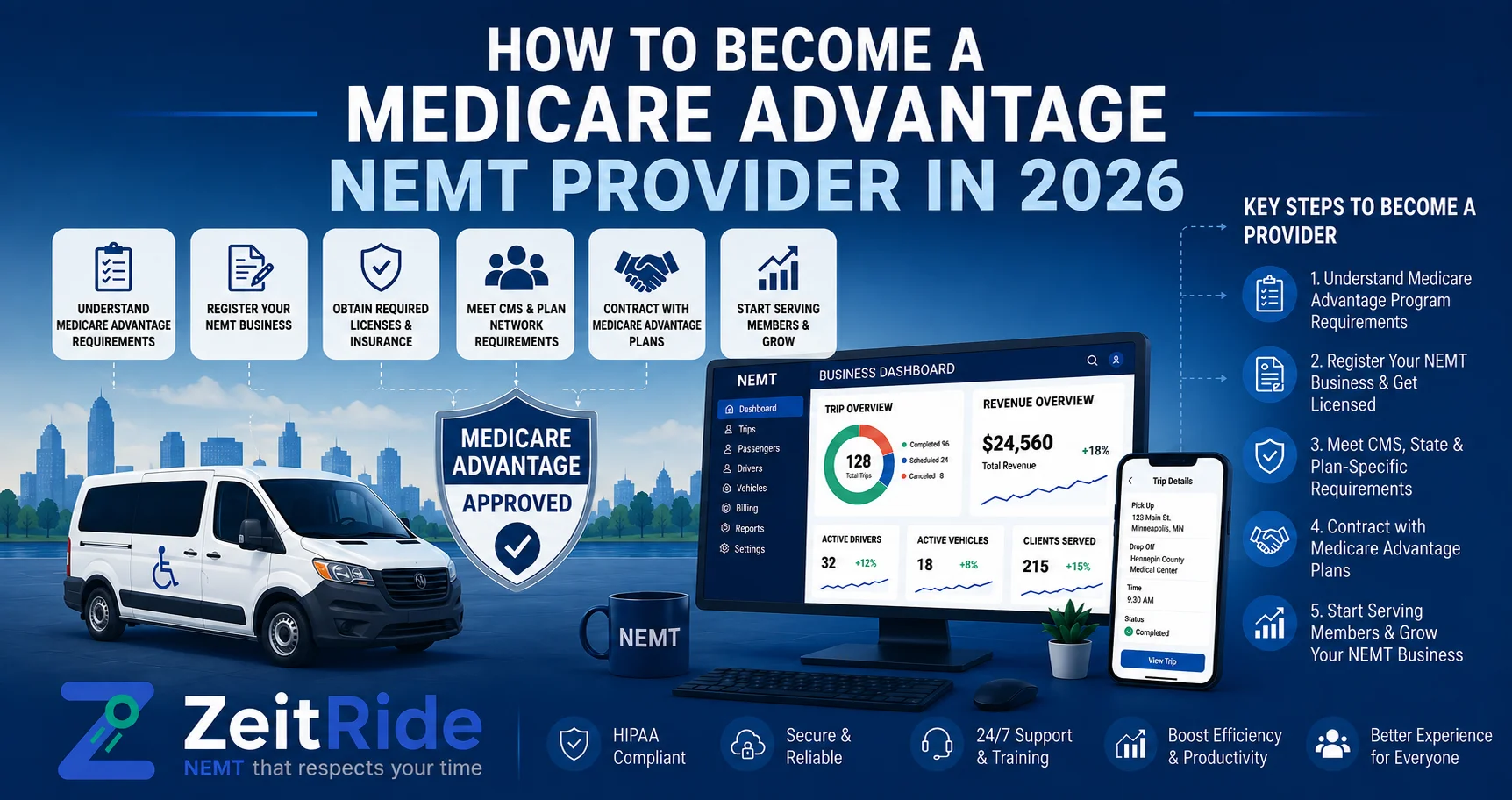
To become a Medicare Advantage NEMT provider, start with the plans available in the counties your fleet can actually serve. Determine which plans offer a transportation benefit, identify whether the plan manages transportation directly or through a transportation administrator or broker, and then apply through the correct provider-relations process.
- Define the counties and ZIP codes your fleet can serve reliably.
- Identify Medicare Advantage plans available in those markets.
- Verify which plans include a transportation benefit.
- Determine who manages transportation providers for each relevant plan.
- Contact provider or network relations and confirm whether the network is accepting providers.
- Submit the required business, insurance, driver, vehicle, and compliance documents.
- Review rates, service requirements, documentation rules, and payment terms.
- Complete onboarding before accepting live trips.
The company assigning your trips may not be the same company whose name appears on the member's insurance card. That is why identifying the actual transportation network should come before sending provider applications.
Medicare Advantage vs. Original Medicare Transportation
Original Medicare and Medicare Advantage should not be treated as the same transportation program. Original Medicare Part B can cover ambulance transportation when Medicare's medical-necessity requirements are met, including certain non-emergency ambulance situations. Routine NEMT should not automatically be treated as an Original Medicare covered service. Medicare explains its ambulance coverage rules on the official Medicare website.
Medicare Advantage plans can include additional benefits beyond Original Medicare, and some plans offer transportation. For an NEMT provider, the exact benefit, transportation administrator, service area, trip rules, and provider requirements must be verified for the individual plan.
| Program | What NEMT Providers Should Know |
|---|---|
| Original Medicare | Transportation coverage follows specific Medicare rules and should not be assumed for routine NEMT. |
| Medicare Advantage | Individual plans may offer transportation benefits through their own provider networks or transportation administrators. |
| Medicaid NEMT | Usually follows state, managed care organization, or broker-specific transportation requirements. |
| Dual-eligible members | Verify the authorized trip and responsible payer or network instead of assuming Medicare or Medicaid automatically pays. |
Find the Medicare Advantage Transportation Network
One of the most important steps is determining who actually contracts with transportation providers in your market. Start by identifying Medicare Advantage plans available in the counties you serve. The official Medicare Plan Compare tool can help identify plans available in a specific area.
Once you identify relevant plans, verify whether transportation is included and determine who manages the provider network. Do not assume an insurer uses the same transportation company nationwide because network relationships can vary by geography, product, and contract year.
| Information to Track | Why It Matters |
|---|---|
| Plan name and county | Confirms the exact market you are researching. |
| Transportation benefit | Shows whether the plan offers a relevant transportation benefit. |
| Transportation administrator | Identifies who may recruit, credential, and dispatch local providers. |
| Provider-relations contact | Gives you the correct application path. |
| Transportation modes needed | Helps determine whether your fleet matches network demand. |
| Contract year verified | Reduces the risk of relying on outdated network information. |
Once the administrator is identified, check whether its network is accepting providers in your service area. ZeitRide already maintains provider-focused guides for networks such as MTM Health and ModivCare, because individual transportation networks can have different enrollment and operating requirements.
Medicare Advantage NEMT Credentialing Requirements
Medicare Advantage NEMT credentialing is the process a transportation network uses to verify that your company, drivers, vehicles, insurance, and operating controls meet its standards. There is no reliable universal checklist because exact requirements can vary by payer, administrator, transportation mode, state, and contract.
However, preparing a master credentialing folder before you apply can make the process much easier.
- Business registration and tax documents
- Required transportation licenses and permits
- Commercial auto insurance
- General liability insurance
- Driver licenses and motor vehicle records
- Background or screening records where required
- Vehicle registrations and inspections
- Driver training records
- Wheelchair securement documentation when applicable
- Company safety and incident policies
- Service-area and fleet-capacity information
- NPI or other provider identifiers when required
- Banking or EFT information for payments
Credentialing does not end when the contract is signed. Insurance policies, driver records, licenses, vehicle documents, and training credentials can expire. Using centralized NEMT driver management helps operators keep driver and credential records connected to day-to-day fleet operations.
Is There One Medicare-Approved NEMT Provider Application?
No single application should be assumed to make an NEMT company approved for every Medicare Advantage transportation network. The phrase "Medicare-approved NEMT provider" can be confusing because Original Medicare provider enrollment and participation in a Medicare Advantage transportation network are separate questions.
Before applying, ask the health plan or transportation administrator exactly which registrations and provider identifiers are required for your contract.
- Is an organizational NPI required?
- Is Medicare enrollment required for the services covered by this contract?
- Which state or local transportation registrations are required?
- Which driver and vehicle credentials must be maintained?
- Is network-specific training required?
- How often does recredentialing occur?
The safest approach is to follow the written requirements supplied by the network you want to join instead of relying on a generic Medicare provider checklist.
Review Medicare Advantage NEMT Contracts Before Signing
Getting accepted into a network is only valuable if the contract works operationally and financially for your fleet. Before signing Medicare Advantage NEMT contracts, review the rates and the rules that determine what actually gets paid.
| Contract Item | What to Verify |
|---|---|
| Base rate | What is included in the basic trip payment? |
| Mileage | When does paid mileage begin and end? |
| Transportation mode | Are ambulatory, wheelchair, or other modes priced differently? |
| Wait time | When, if ever, is waiting compensated? |
| Cancellations and no-shows | What documentation is required for payment? |
| Authorization | Which trips require a reference or authorization number? |
| Documentation | Which timestamps, signatures, mileage, or GPS records are mandatory? |
| Billing | How are completed trips submitted? |
| Payment terms | When should a clean submission be paid? |
| Service area | Which counties, ZIP codes, and transportation modes are included? |
A contract with high trip volume is not automatically profitable. Account for deadhead mileage, driver time, wait time, wheelchair loading, vehicle operating costs, and return-trip requirements before committing capacity.
Document Every Medicare Advantage NEMT Trip Correctly
Credentialing gets your company into the network. Documentation helps make completed trips billable and defensible. Build the required trip fields into your operating workflow before the first live ride instead of asking office staff to reconstruct missing information afterward.
- Member and trip identifiers
- Authorization or reference number
- Assigned driver and vehicle
- Level of service
- Pickup arrival time
- Passenger onboard time
- Drop-off time
- Mileage
- GPS records when required
- Passenger or facility signature when required
- Completed, cancelled, or no-show status
- Required reason codes
ZeitRide's NEMT broker integrations help connect broker trip intake, dispatch activity, trip status, and operational records so contracted trips do not have to be managed through disconnected manual workflows.
How Do NEMT Providers Bill Medicare Advantage?
How do NEMT providers bill Medicare Advantage? The billing process follows the individual payer or transportation-network contract. There is no single billing method that should be assumed for every Medicare Advantage NEMT trip.
Depending on the arrangement, a provider may submit completed trips through a transportation administrator's portal, a payer workflow, an EDI or claim process, trip files, invoices, or another approved channel.
Confirm These Billing Rules Before Your First Trip
- Required member and trip identifiers
- Authorization requirements
- Transportation or service codes when applicable
- Mileage rules
- Required timestamps
- GPS or electronic trip verification requirements
- Signature requirements
- Timely-filing deadline
- Correction and resubmission process
- Remittance format
- Denial or dispute process
The strongest workflow connects billing back to the original trip record. ZeitRide's NEMT billing software keeps scheduling, dispatch activity, driver records, trip documentation, and billing workflows connected so staff do not have to rebuild a completed ride from separate systems.
What Makes a Strong Medicare Advantage NEMT Provider?
Transportation networks need more than vehicles. They need providers that can clearly define where they operate, maintain current credentials, communicate reliably, document trips correctly, and reconcile completed work.
- Clearly defined service areas
- Current driver and vehicle credentials
- Reliable dispatch communication
- Accurate electronic trip records
- GPS-backed documentation where required
- Clear cancellation and no-show procedures
- Reliable wheelchair transportation when offered
- Credential-expiration monitoring
- Defined billing responsibilities
- Regular reconciliation of completed and paid trips
The goal is not to accept every trip offered. The goal is to accept trip volume your operation can perform reliably, document correctly, and operate profitably.
Manage Medicare Advantage Trips Without Creating Another Workflow
Winning a new transportation contract creates an operational challenge: Medicare Advantage trips still have to fit alongside Medicaid broker trips, facility contracts, recurring rides, and private-pay work. Adding another payer should not mean adding another spreadsheet or disconnected dispatch process.
ZeitRide's NEMT software brings scheduling, dispatch, routing, driver workflows, broker integrations, trip records, billing, and reporting together in one operating system. The objective is to keep the operational history of each ride connected from scheduling through completion and billing while still following the individual network's contract requirements.
Planning to add Medicare Advantage or other contracted trip volume? Book a ZeitRide demo and see how your real scheduling, dispatch, documentation, and billing workflow can run in one platform.
Frequently Asked Questions
Q: How do I become a Medicare Advantage transportation provider?
Identify Medicare Advantage plans serving your market, verify which plans offer transportation, determine who manages each transportation network, and apply through that organization's provider-relations process. Complete all required credentialing, contracting, and onboarding before accepting trips.
Q: Is there one Medicare-approved NEMT provider application?
No. Medicare Advantage transportation requirements can differ by health plan, transportation administrator, provider type, service area, and transportation mode. Providers should verify the correct application process with each network they want to join.
Q: Do I need an NPI for Medicare Advantage NEMT contracts?
Some transportation networks or payers may require an organizational NPI, while requirements can differ by contract and provider type. Confirm the requirement directly with provider relations before applying.
Q: How long does Medicare Advantage NEMT credentialing take?
There is no universal credentialing timeline. Processing depends on the network, local provider needs, application completeness, insurance and document verification, and whether corrections are required.
Q: How do NEMT providers bill Medicare Advantage?
Billing follows the individual transportation contract. Providers may submit through a transportation administrator, payer portal, claim or EDI workflow, trip file, invoice process, or another approved method.
Q: Can a small NEMT company get Medicare Advantage contracts?
Potentially. Network acceptance depends on local transportation needs and credentialing requirements rather than fleet size alone. A smaller provider may be valuable when it reliably covers an underserved area, transportation mode, or schedule.
Rather see it than read about it?
Bring a real route, a couple of drivers, and your current process. 15 minutes, zero pitch.