NEMT Software Pricing Complete Guide
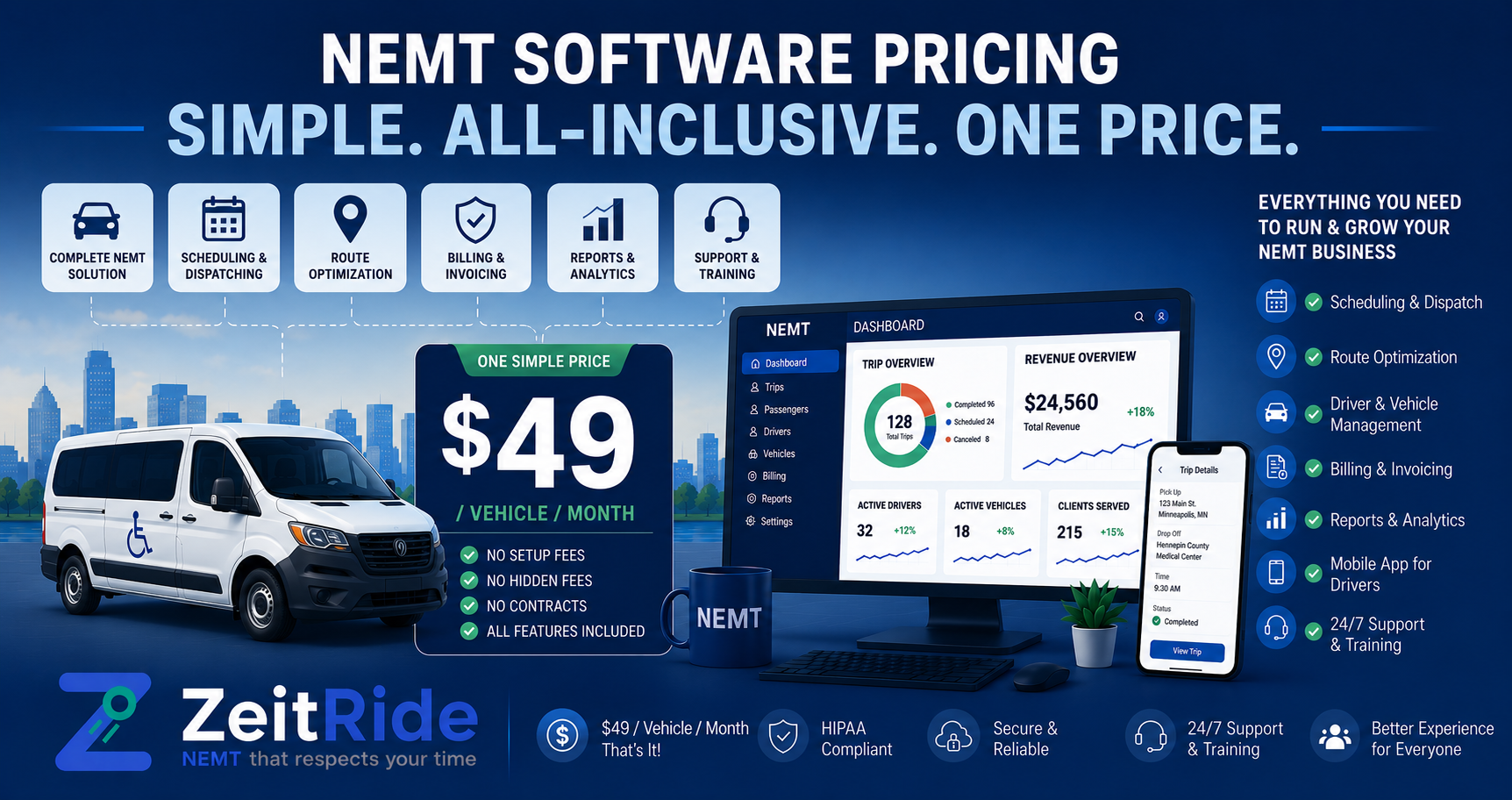
NEMT software pricing starts at $49 per vehicle per month in 2026. This guide compares every pricing model per-vehicle, per-trip, flat-rate tiered, and enterprise.
Quick answer
NEMT software costs $49–$250 per vehicle per month in 2026. ZeitRide charges $49/vehicle with dispatch, billing, routing, and broker integrations included. RouteGenie starts at $50/vehicle but bills billing and broker integrations separately.
ZeitRide Team
NEMT Operations Expert
Most NEMT operators who reach out to us have already been burned once they picked a platform based on the headline price, then watched the actual bill climb 30–60% higher by month three. How much does non-emergency medical transport cost to run on software? The honest answer is: it depends on which pricing model you're buying, what's bundled in, and what you'll pay in add-ons the vendor never mentioned in the demo.
This article breaks all of that down, platform by platform, with a full comparison table and first-year cost estimates by fleet size so you can budget accurately before you sign anything.
How Much Does Non-Emergency Medical Transport Software Cost?
NEMT dispatch software typically costs between $49 and $250 per vehicle per month, depending on the platform and what's included.
That range looks wide because it is. Here's why it spans so far: A flat-fee platform like ZeitRide bundles dispatch, scheduling, routing, billing, broker integrations, and the driver app into one number — $49 per vehicle per month, no add-ons, no setup fees, no contracts. A legacy system or enterprise platform may quote you $50 per vehicle but bill broker integrations, auto-dispatch, and billing as separate line items — and you're suddenly at $150+ before you've touched advanced features.
5 NEMT Software Pricing Models You'll Encounter
Understanding the model matters more than the sticker price. These five structures cover the entire NEMT software market.
1. Per-Vehicle Pricing
You pay a fixed monthly fee for every active vehicle on your account, regardless of trip volume. This is the most common transparent model — and the easiest to forecast when your fleet size is stable. Best for: Fleets of 5–50 vehicles with predictable growth. Watch for: Whether broker integrations, auto-dispatch, and billing are included in the per-vehicle rate or sold separately. RouteGenie Growth charges $50/vehicle but adds broker integrations at $100 each. ZeitRide charges $49/vehicle with everything bundled — no add-ons.
2. Per-Trip or Usage-Based Pricing
You pay a small fee — typically $0.25–$1.50 — per completed trip, either as the only pricing model or stacked on top of a base subscription. Best for: Very low-volume operations completing fewer than 100 trips per month. Watch for: Per-trip pricing compounds fast. At $0.50/trip and 400 trips/month, that's $200/month — more than a flat per-vehicle plan for a 4-vehicle fleet, with none of the predictability.
3. Flat-Rate Tiered Pricing
A monthly base fee covers a defined number of vehicles and a fixed feature set. Exceeding that ceiling triggers upgrade costs or per-unit overages. Best for: Mid-size fleets (10–30 vehicles) that want predictable billing with a full feature set from day one. Watch for: The ceiling. NEMT Cloud Dispatch's $149.99 tier covers 1–5 vehicles. At vehicle 6, pricing jumps. Map your fleet size for the next 12 months, not just today.
4. Subscription + Add-On Module Pricing
A low base rate covers the core platform. Every capability beyond basic scheduling — auto-dispatch, broker EDI, billing engine, passenger app, white-label portal — costs extra. Best for: Operators who genuinely only need dispatch with no broker integrations and no billing. Watch for: This is where the most budget surprises happen. RouteGenie's add-on list includes broker integrations ($100/each), communication suites, auto-dispatching, and passenger apps — all priced separately. A fully equipped RouteGenie setup for a 10-vehicle fleet can run $150–$200/vehicle/month once you account for the modules you actually need.
5. Custom Enterprise Pricing
Quote-based. Priced around custom integrations, state-specific Medicaid workflows, PACE programs, and MCO contracts. Think $1,000–$5,000/month and up, with implementation costs often in the $5,000–$25,000 range. Best for: Large managed care organizations, multi-state operations, or providers with unique compliance requirements.
Watch for: Implementation timelines. Enterprise deployments routinely take 60–180 days. If you need to be live within a week, this tier isn't for you.
2026 NEMT Software Pricing: Hidden Costs That Inflate Your Bill
The monthly subscription is almost never the whole number. Here are the costs that operators consistently underestimate — and that vendors rarely lead with in demo calls.
Broker integration fees. Many platforms charge $100 per broker integration, one-time or annually. If you work with four brokers, that's $400 before you take your first trip. ZeitRide includes integrations with MTM Health, CTS Transit, Provide A Ride, ProCare, DD Med Trans, and Tennessee Carriers at no additional cost.
EDI clearinghouse connections. Submitting Medicaid claims electronically requires a clearinghouse connection. Some platforms charge $100 per payer for this. Budget $200–$400/year if it's not bundled.
Training and onboarding. Standard onboarding is usually included. White-glove training, custom workflow setup, and after-hours support can run $500–$2,000+. NEMT Cloud Dispatch charges $65/hour for custom training beyond the base package. ZeitRide gets most operators live within 30 minutes — that's not a marketing line, it's how the platform is built.
White-label passenger apps. If your brokerage contract or MCO relationship requires a branded rider app, expect $1,500–$3,000 for setup.
Custom development. State-specific Medicaid integrations or custom reporting typically bills at $150–$250/hour. If a vendor says "we'll build that for you," ask for a scoped estimate before you commit.
Per-seat or per-dispatcher fees. Some platforms charge per administrative user. A five-dispatcher operation can absorb $50–$150/month in seat fees without realizing it. ZeitRide doesn't charge per dispatcher or per driver — the per-vehicle rate covers your whole team.
Quick rule: Assume your real monthly cost is 20–40% higher than the quoted per-vehicle rate until you've read every line of the contract and verified what's included versus billed separately.
Which Pricing Model Is Right for Your Fleet?
The right model depends on three things: your current fleet size, your growth plan for the next 12 months, and whether billing is a core requirement right now.
If you run 1–10 vehicles and bill Medicaid directly: You need billing included. A platform that separates dispatch from billing will cost you more in both money and time. ZeitRide, Tobi Cloud Bronze, and NEMT Cloud Dispatch all include billing at the base tier. RouteGenie and Bambi do not — or charge separately.
If you run 10–30 vehicles and manage multiple broker contracts: Per-vehicle pricing with included broker integrations is the most cost-effective model. Flat-rate tiered platforms can work if the ceiling doesn't force you into a higher tier prematurely. ZeitRide's per-vehicle model scales linearly — you only pay for active vehicles.
If you run 30+ vehicles or manage MCO contracts: You'll likely need a custom quote regardless of platform. The variable to control is implementation cost. Legacy enterprise platforms routinely charge $5,000–$25,000 to go live. ZeitRide's setup is included and most providers are running live routes within one day.
If you're just starting out (1–3 vehicles): Don't overbuy. You need dispatch, routing, a driver app, and Medicaid billing. You don't need a white-label passenger portal or custom state Medicaid workflow on day one. ZeitRide's $49/vehicle plan covers everything a new operator actually needs — including EVV support and HIPAA-aware data handling — without locking you into a contract.
One fleet manager, Sandra Mills at SafeTrip NEMT, cut her active vehicle count from running 3 extra vehicles per shift after switching to ZeitRide — route optimization averaged a 20% reduction in miles driven, which meant the same member volume with a smaller fleet footprint. That's the real NEMT cost calculation: not just what you pay the software vendor, but what the software saves you in fuel, driver hours, and vehicle wear.
Bottom Line on NEMT Software Pricing
How much does non-emergency medical transport software cost? For most small and mid-size fleets, the real number is $49–$150 per vehicle per month — but that range only makes sense when you know what's inside it. The smartest way to evaluate cost isn't to compare per-vehicle rates. It's to map out your actual required features, calculate add-on costs for each platform, and then compare the true monthly total.
ZeitRide operates in 10+ states and holds a 5.0 rating on Capterra, GetApp, Software Advice, and SourceForge. At $49 per vehicle per month with dispatch, scheduling, routing, billing, named broker integrations, and the driver app all included — no setup fees, no contracts, no per-trip charges — it's built for NEMT operators who want a complete platform at a predictable cost.
Start your first live route within a day. $49/vehicle. No contracts. Book your demo at ZeitRide.
Frequently Asked Questions
Q: How much does NEMT software cost per month?
NEMT software costs between $49 and $250 per vehicle per month in 2026, depending on the platform and what features are bundled in. ZeitRide charges $49 per vehicle per month with dispatch, scheduling, routing, billing, broker integrations, and the driver app all included — no add-ons, no setup fees. Platforms that unbundle billing and broker integrations can run significantly higher once you add those modules.
Q: What is the cheapest NEMT software in 2026?
ZeitRide is the most cost-effective full-featured NEMT software at $49 per vehicle per month with everything included. Platforms that advertise lower base rates like some per-trip models typically add up to more once trip volume grows and add-on costs are factored in. The cheapest software is the one with the lowest real monthly cost, not the lowest headline rate.
Q: Does NEMT software pricing include billing?
It depends on the platform. ZeitRide, Tobi Cloud Bronze, and NEMT Cloud Dispatch include billing at their standard subscription tiers. RouteGenie separates billing as an add-on module. Bambi describes billing as included but operators should confirm that full claims management HCPCS coding, EDI submission, denial management is covered at the $69/vehicle base rate. If billing is a core requirement for your Medicaid operations, verify explicitly before committing.
Q: Is there free NEMT software?
There is no genuinely free NEMT software that covers dispatch, Medicaid billing, broker integrations, and HIPAA compliance. Free tools like basic spreadsheets or general scheduling apps lack EVV support, broker EDI connections, and the compliance infrastructure Medicaid billing requires. Some platforms offer 14–30 day free trials. ZeitRide offers a live demo where operators can run a real route on the platform before making any commitment.
Q: What hidden costs should I budget for when buying NEMT software?
The most common hidden costs in NEMT software are broker integration fees ($100 per integration on some platforms), EDI clearinghouse connections ($100–$200 per payer), training beyond the base package ($500–$2,000), white-label passenger apps ($1,500–$3,000), and per-dispatcher seat fees ($25–$50/user/month on some platforms). ZeitRide includes named broker integrations, unlimited dispatcher access, and setup at no additional cost the $49/vehicle rate is the total rate.
Q: Can I switch NEMT software without losing my data?
Yes. Most NEMT platforms export trip records, member profiles, and billing history in standard formats typically CSV or Excel. The switch itself is less about data loss and more about timing. ZeitRide imports existing member and vehicle data during onboarding and gets most providers live within 30 minutes. The practical question isn't whether you can switch it's whether you can run both systems in parallel for a few days during the transition. ZeitRide supports that.
Q: What is the average ROI of NEMT software?
ROI on NEMT software comes from three places: reduced dispatcher hours, route optimization savings, and billing accuracy improvements. ZeitRide's route optimization averages a 20% reduction in miles driven for a 10-vehicle fleet running 200 miles per vehicle per day, that's 2,000 fewer miles daily, which translates to meaningful fuel and maintenance savings every month. On the billing side, automated claim scrubbing and electronic submission typically cut denial rates versus manual billing. The $49/vehicle/month cost of ZeitRide is usually recovered within the first 30–45 days of improved routing alone.
Related reading:
How Much Does NEMT Cost? The Complete 2026 Breakdown
Best NEMT Software in 2026: Top Platforms Compared
Best Billing Software for Non-Emergency Medical Transportation
Rather see it than read about it?
Bring a real route, a couple of drivers, and your current process. 15 minutes, zero pitch.