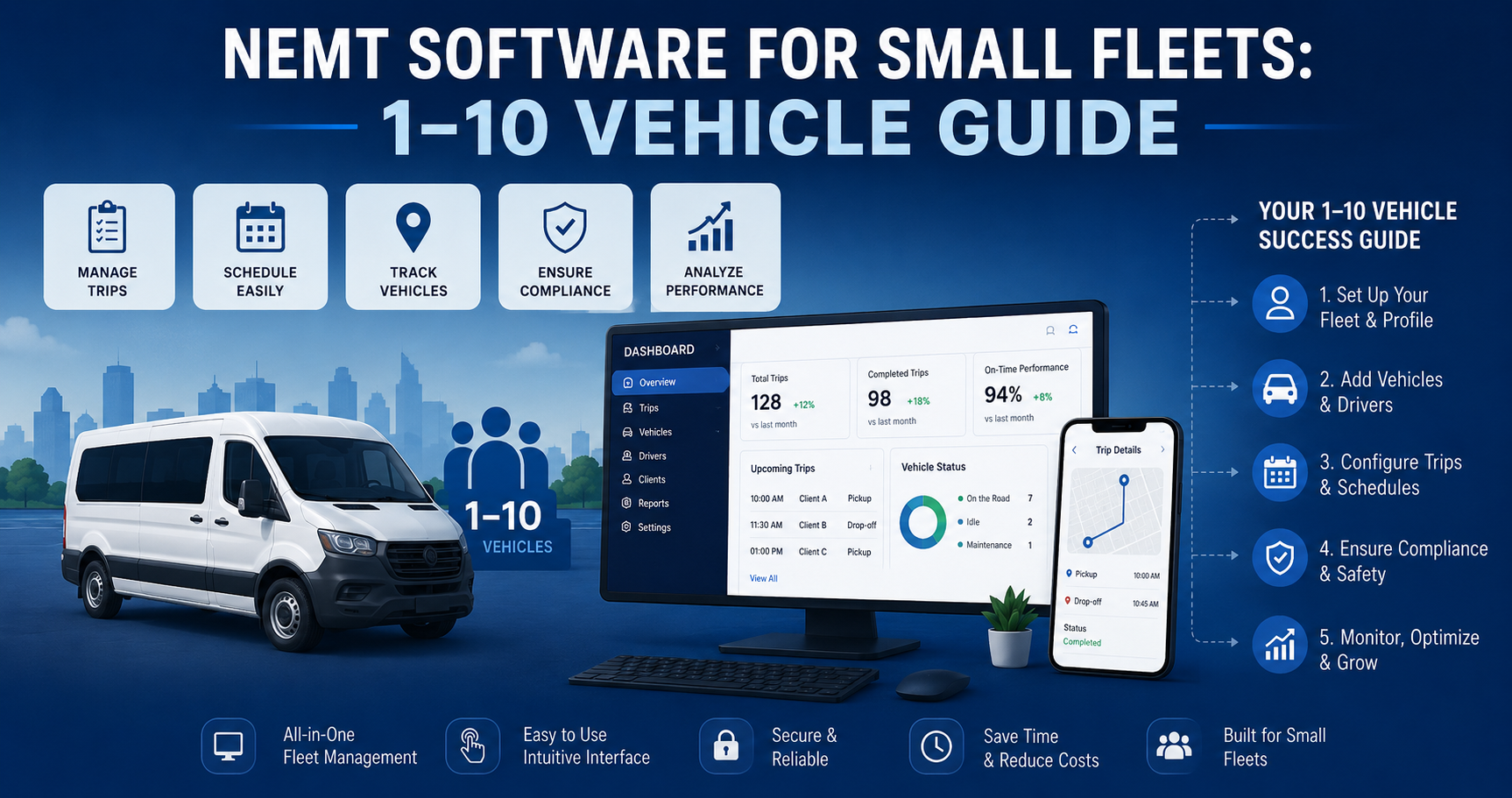
NEMT Software for Small Fleets: 1–10 Vehicle Guide
Compare NEMT software costs, essential features, and buying criteria for small fleets with 1–10 vehicles.
Quick answer
The best NEMT software for small fleets combines scheduling, live dispatch, route optimization, a driver app, trip documentation, broker workflows, and billing in one affordable system. Fleets with 1–10 vehicles should prioritize transparent pricing, fast setup, reliable support, and room to grow.
ZeitRide Team
NEMT Operations Expert
Choosing NEMT software for a small fleet is not simply a smaller version of an enterprise software decision. A provider with 1–10 vehicles still has to manage recurring medical trips, last-minute changes, driver communication, broker requirements, trip documentation, and billing—usually with fewer employees covering more responsibilities.
The right system should reduce that workload without forcing the company into enterprise pricing, complicated implementation, or several disconnected tools. This guide explains the essential features, realistic costs, buying criteria, and growth-stage requirements small U.S. NEMT providers should evaluate.
What Is the Best NEMT Software for Small Fleets?
The best NEMT software for small fleets connects scheduling, live dispatch, route planning, driver updates, trip verification, broker workflows, and billing in one system. For a 1–10 vehicle operation, transparent pricing, straightforward onboarding, mobile usability, dependable support, and the ability to grow are generally more valuable than complex enterprise customization.
A small provider should be able to manage the entire trip lifecycle in one place: receive or create a ride, assign the correct driver and vehicle, update the route, capture completion details, and move the verified trip toward billing. If staff must re-enter the same ride in several systems, the software is relocating administrative work instead of eliminating it.
When Does a Small NEMT Fleet Need Software?
For this guide, a small NEMT fleet means an operation with 1–10 active vehicles. The right time to adopt specialized software is not determined by vehicle count alone. It is the point when manual coordination creates repeated delays, missing information, billing problems, or preventable service risk.
- The same trip is entered into a broker portal, spreadsheet, driver message, and billing system.
- Recurring rides are copied manually and individual changes are easy to miss.
- Drivers rely on calls or text messages for addresses, cancellations, and schedule updates.
- The owner cannot see current vehicle and trip status without contacting drivers.
- Completed trips reach billing with missing signatures, mileage, timestamps, or status details.
- Adding another vehicle creates more administrative work instead of more operating capacity.
If another vehicle would require another spreadsheet, another group chat, or more duplicate entry, the operation is ready for connected NEMT scheduling software and dispatch workflows.
Essential Features for Fleets With 1–10 Vehicles
The goal is not to purchase the platform with the longest feature list. It is to cover the workflows that create the most operational and financial risk for a small provider.
| Capability | Why It Matters | What to Verify |
|---|---|---|
| Trip scheduling | Keeps one-time and recurring rides in one shared system. | Recurring-trip rules, bulk entry, edits, cancellations, and conflict alerts. |
| Live dispatch | Allows staff to assign and reassign trips as the service day changes. | Real-time statuses, vehicle visibility, alerts, and rapid reassignment. |
| Route optimization | Reduces unnecessary mileage and helps sequence time-sensitive stops. | Pickup windows, mobility needs, capacity, return trips, and dispatcher control. |
| Driver mobile app | Replaces calls and texts with current manifests and status updates. | iOS and Android support, navigation, offline behavior, signatures, and forms. |
| Trip documentation | Creates consistent records for billing, broker review, and audits. | Timestamps, GPS context, notes, signatures, forms, and edit history. |
| Broker workflows | Reduces duplicate entry and mismatched trip information. | Support for the actual brokers and file formats used in the service area. |
| Billing workflow | Moves completed trips toward claims or invoices without rebuilding the record. | Required fields, payer formats, exceptions, reconciliation, and exports. |
| Support and onboarding | Small teams cannot absorb long delays during operating hours. | Response channels, migration help, training, ownership, and extra fees. |
Scheduling and Live Dispatch
Recurring dialysis, therapy, behavioral health, and adult day service trips require more than a basic calendar. Scheduling should allow one occurrence to change without disrupting the entire series. Effective NEMT dispatch software should then give the office and drivers the same current information, reducing repeated calls and missed updates.
Routing and Driver Operations
Generic route planners may optimize addresses but overlook pickup windows, wheelchair capacity, shared rides, driver availability, and uncertain return trips. Purpose-built NEMT route optimization software should recommend efficient trip sequences while allowing dispatchers to apply local knowledge and member-specific requirements.
Trip Documentation and Billing
The pickup time, drop-off time, mileage, driver, vehicle, trip status, and required documentation should remain attached to the same ride record. Connected NEMT billing software makes missing information visible before a claim or invoice is submitted, reducing re-entry and avoidable billing delays.
Data Security and Access Controls
NEMT operations can involve member names, addresses, appointment details, billing records, and other sensitive information. Providers should review the HHS HIPAA Privacy Rule and ask vendors about user permissions, encryption, audit history, data retention, secure backups, and business associate agreements where applicable.
NEMT Software Cost for Small Fleets
NEMT software cost for small fleets should be evaluated as a complete first-year expense, not only the advertised subscription. Vendors may charge per vehicle, trip, user, driver, module, or feature tier. Setup, onboarding, broker connections, billing tools, support, and contract terms can materially change the real cost.
As of July 23, 2026, ZeitRide's core platform is priced at $49 per active vehicle per month. Scheduling, dispatch, routing, the driver app, billing workflows, broker connections, and other core capabilities are included, with no core-platform setup fee, per-trip software charge, or long-term software contract. Confirm current details on the ZeitRide pricing page.
| Active Vehicles | Monthly Cost | Annual Cost | Core Setup Fee |
|---|---|---|---|
| 1 | $49 | $588 | $0 |
| 3 | $147 | $1,764 | $0 |
| 5 | $245 | $2,940 | $0 |
| 10 | $490 | $5,880 | $0 |
These figures show ZeitRide's core software cost, not a market-wide average, and exclude optional hardware or add-ons. For a broader explanation of pricing structures and hidden charges, review the NEMT software pricing guide.
How to Calculate the True Software Cost
- Is pricing based on vehicles, trips, users, drivers, or feature tiers?
- Are scheduling, dispatch, routing, billing, and the driver app included?
- Do broker connections or billing formats cost extra?
- Are onboarding, training, migration, or support billed separately?
- Is there a minimum fleet size, annual commitment, or cancellation penalty?
- Will the price increase when trip volume grows but vehicle count stays the same?
Affordable NEMT software for small fleets should make the total operating cost predictable. A low base price is not a strong value if the provider must pay separately for the driver app, billing module, broker connection, support, or implementation services required to reproduce the workflow shown during the demo.
What Small Fleets Need at Each Growth Stage
| Fleet Stage | Main Priority | Most Important Capabilities | Common Mistake |
|---|---|---|---|
| 1–2 vehicles | Create a reliable process without adding unnecessary overhead. | Simple scheduling, driver app, trip documentation, billing continuity, and predictable pricing. | Buying several inexpensive tools that create duplicate work. |
| 3–5 vehicles | Coordinate multiple drivers and recurring trips consistently. | Live dispatch, route optimization, broker imports, alerts, and credential records. | Managing daily schedule changes through calls and group messages. |
| 6–10 vehicles | Standardize operations so growth does not depend on one person. | Permissions, live dashboards, reporting, audit history, and billing reconciliation. | Choosing software that works only while the owner personally knows every trip. |
A one-vehicle company does not need a temporary system that must be replaced after winning its first major contract. It needs a simple version of a scalable workflow. New operators can pair this guide with the practical steps in starting a NEMT business with one van.
How to Compare Small Business NEMT Software
A polished sales demo can make every platform look easy. A more reliable test is to use one realistic operating day. Bring a sample manifest containing recurring rides, a wheelchair trip, a cancellation, a same-day request, a will-call return, and the broker or payer fields your team uses.
- Import or create the sample trips using the same source your staff receives today.
- Assign vehicles and drivers while checking capacity, mobility, and timing constraints.
- Optimize the route, then manually change one assignment to test dispatcher control.
- Send the manifest to a driver and confirm how quickly the update appears.
- Complete a pickup and drop-off with the required documentation.
- Move the verified trip into the billing workflow.
- Find the record and edit history as if a broker questioned the ride.
This exercise shows whether the platform is genuinely connected. It also prevents a provider from choosing software based on impressive isolated features that do not reduce the actual daily workload. Use the broader NEMT software selection guide for additional vendor-evaluation criteria.
Red Flags Small NEMT Providers Should Avoid
- Core functions shown in the demo require separately priced modules.
- The vendor cannot provide a complete monthly and first-year cost.
- The team cannot demonstrate the provider's actual broker or payer workflow.
- Drivers need several applications to complete one ride.
- Trip information must be re-entered before billing.
- A long contract is required before real workflows can be tested.
- Support ownership, migration help, and data-export terms are unclear.
Why ZeitRide Fits Fleets With 1–10 Vehicles
ZeitRide's NEMT software is designed to keep the main transportation workflow in one platform: scheduling, live dispatch, AI-assisted routing, driver operations, trip documentation, billing workflows, broker connections, reporting, and fleet records. Small providers do not have to assemble a separate tool for each department.
- $49 per active vehicle per month for the core platform
- No core-platform setup fee or per-trip software charge
- Month-to-month software pricing rather than a long-term contract
- Scheduling, dispatch, routing, billing workflows, and the driver app in one system
- Predictable cost as the fleet grows from one vehicle to ten
- A live demonstration using the provider's own routes and operating scenarios
The best way to evaluate fit is to test the system against your real operation. Bring one day of trips and ask the ZeitRide team to show how the manifest is scheduled, dispatched, updated, completed, documented, and prepared for billing.
Small-Fleet NEMT Software Buying Checklist
- Current vehicle count and expected fleet size in 12 months
- Average daily and monthly trip volume
- Recurring, will-call, wheelchair, and private-pay trip mix
- Brokers, payers, facilities, and file formats used
- Required trip-verification and billing documentation
- Number of dispatchers, administrators, drivers, and operating locations
- Current duplicate-entry points and manual handoffs
- Total monthly and first-year software budget
- Implementation deadline, training time, and support expectations
- Data export, renewal, contract, and cancellation terms
The best NEMT software for small fleets should lower the cost and risk of operating, not merely carry a low subscription price. The strongest value comes from eliminating duplicate entry, giving dispatchers and drivers one current plan, and connecting completed trips to billing-ready records.
See Your Small-Fleet Workflow in ZeitRide
Bring one day's trip manifest to a 15-minute workflow review. ZeitRide will show how your rides can move from scheduling and dispatch through driver completion and billing preparation, then calculate the exact core software cost for your active vehicles.
Ready to see how your small fleet would operate inside one connected system? Book a ZeitRide demo and evaluate the platform using your real routes instead of a generic sales scenario.
Rather see it than read about it?
Bring a real route, a couple of drivers, and your current process. 15 minutes, zero pitch.