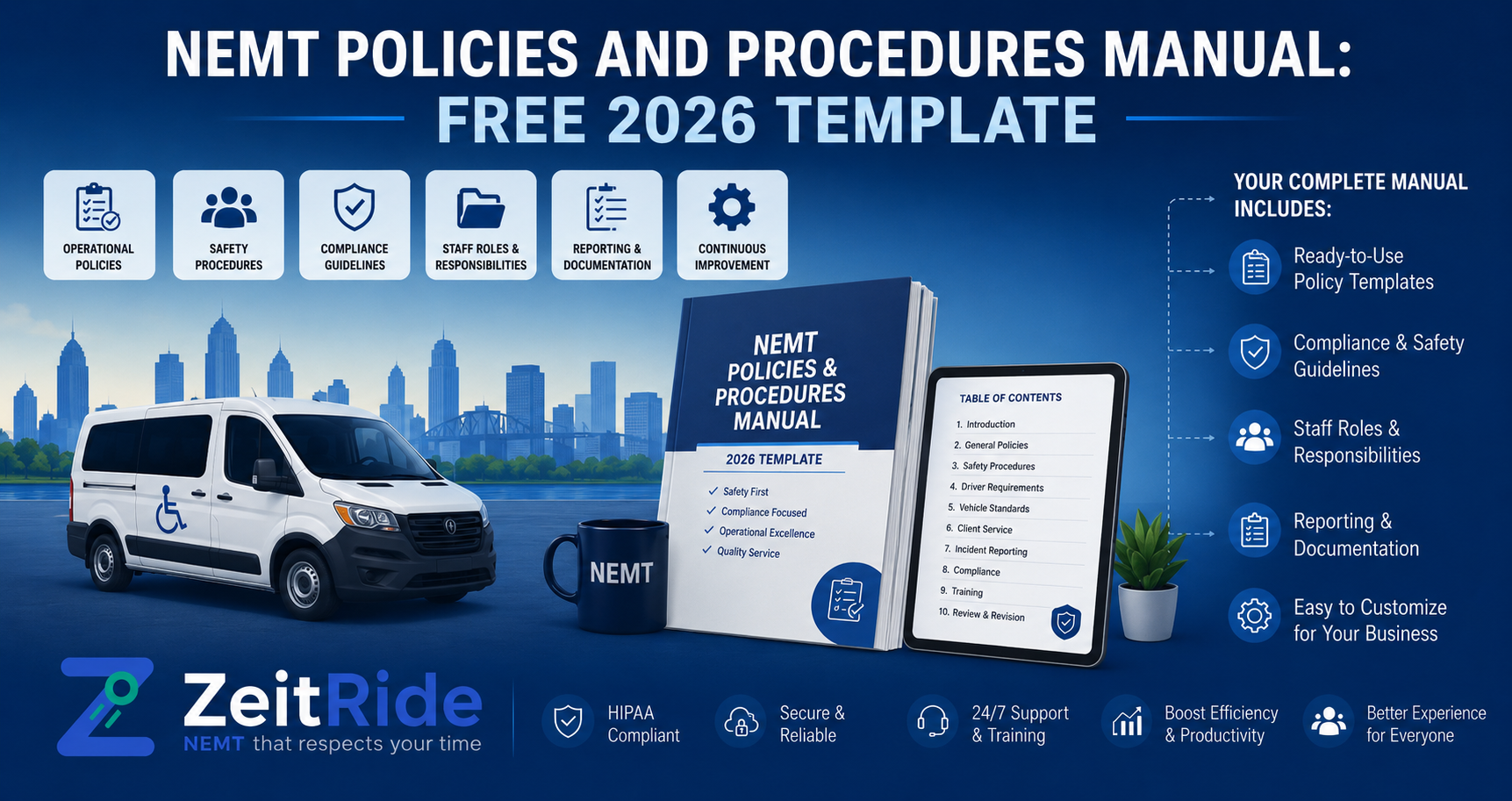
NEMT Policies and Procedures Manual: Free 2026 Template
Create an effective NEMT policies and procedures manual with a free editable framework, compliance checklist, sample policy, and practical guidance.
Quick answer
An NEMT company generally needs policies for passenger rights, driver qualifications, vehicle safety, dispatch, trip documentation, privacy, billing, incidents, complaints, and quality assurance. Each policy should reflect applicable state, payer, broker, and contract requirements.
ZeitRide Team
NEMT Operations Expert
An NEMT policies and procedures manual explains how a transportation company handles passengers, drivers, vehicles, trips, records, billing, incidents, and compliance responsibilities. It should not be a generic document that sits unused after enrollment. It should give employees clear instructions and identify the records that prove each procedure was followed.
This free NEMT policies and procedures template can be copied into Microsoft Word or Google Docs and customized for your business. Use it with ZeitRide's NEMT documentation requirements guide to connect your written policies with the records your company needs to create and retain.
Important: This template provides general operational guidance. It is not legal advice and does not guarantee compliance with every state, Medicaid program, transportation broker, payer, insurer, or contract. Review all applicable requirements before adopting it.
What Policies and Procedures Does an NEMT Company Need?
An NEMT company generally needs written policies covering passenger rights, driver qualifications, vehicle safety, scheduling and dispatch, mobility assistance, privacy, trip documentation, billing, incidents, complaints, quality assurance, corrective action, and records retention.
- Company governance, ethics, and compliance responsibilities
- Passenger rights, nondiscrimination, and accessibility
- Trip intake, eligibility verification, scheduling, and dispatch
- Driver qualifications, screening, credentialing, and training
- Vehicle inspections, maintenance, defects, and return-to-service approval
- Wheelchair, mobility-device, and passenger-assistance procedures
- Privacy, confidentiality, and information-security practices
- Trip documentation, proof of service, and record corrections
- Billing, claims, overpayments, and payment-integrity controls
- Accident, incident, emergency, and complaint procedures
- Quality assurance, corrective action, and policy review
- Record retention, document control, and revision history
The exact policies depend on the states in which the company operates, the transportation services it provides, and the requirements of its Medicaid programs, managed-care plans, brokers, payers, insurers, and contracts.
What Is an NEMT Policies and Procedures Manual?
A non emergency medical transportation policies and procedures manual is a controlled document that defines how an NEMT company operates. It establishes the company's rules, assigns responsibilities, explains required procedures, and identifies the records that demonstrate compliance.
| Element | Purpose | NEMT Example |
|---|---|---|
| Policy | States the company rule | Drivers must maintain current qualifications |
| Procedure | Explains how the rule is followed | Compliance staff verify credentials before dispatch |
| SOP | Provides detailed task instructions | Steps for reviewing and approving a renewed license |
| Record | Proves the task occurred | Credential file, verification date, and approval history |
A policy without a procedure is difficult to implement. A procedure without a record is difficult to prove. For every section in the manual, ask: What should happen, who is responsible, and what evidence will show that it happened?
Is an NEMT Policy Manual Required?
There is no single federal policy manual that every U.S. NEMT company can use without changes. Written requirements may come from state Medicaid agencies, managed-care organizations, transportation brokers, state or local licensing authorities, insurance companies, facility agreements, and commercial payer contracts.
CMS requires state Medicaid programs to assure necessary transportation and establish minimum provider and driver requirements. However, the detailed rules and documentation standards can differ by state and program. Review the official CMS Medicaid Assurance of Transportation information, then confirm the specific requirements that apply to your company.
Do not describe a generic NEMT policy manual template as state approved, fully Medicaid compliant, or audit guaranteed unless the appropriate authority has reviewed the customized document.
Free Editable NEMT Policies and Procedures Template
Copy the following framework into Word or Google Docs and use it for each policy in your manual. Replace every placeholder, remove sections that do not apply, and add state-, payer-, broker-, and contract-specific requirements.
| Policy Field | Information to Add |
|---|---|
| Policy title | A clear and specific name for the policy |
| Policy number | A unique internal reference number |
| Effective date | The date the policy becomes active |
| Review date | The date the policy must be reassessed |
| Approved by | The authorized owner, manager, or compliance lead |
| Responsible role | The person accountable for implementation |
| Applicable services | Ambulatory, wheelchair, stretcher, or other service levels |
| Applicable locations | States, counties, or service areas covered |
| Policy Section | What to Include |
|---|---|
| Purpose | Why the policy exists and which risk or requirement it addresses |
| Scope | The people, trips, vehicles, locations, or services covered |
| Definitions | Important terms employees must understand consistently |
| Policy statement | The company's mandatory rule or expectation |
| Responsibilities | Who performs, reviews, monitors, and approves the work |
| Procedure | Numbered steps employees must follow |
| Training | Who must be trained and how completion is recorded |
| Required records | Forms, logs, signatures, photos, or system records |
| Monitoring | How management checks whether the policy is followed |
| Corrective action | What happens when the policy is not followed |
| References | Applicable state, payer, broker, contract, or official sources |
| Revision history | What changed, when it changed, and who approved it |
Essential Sections for an NEMT Policy Manual
Driver Qualification and Training
Driver policies should explain how the company verifies licenses, motor vehicle records, background checks, required exclusion screening, training, service-level qualifications, credential renewals, fitness for duty, and expiration dates.
The policy should also explain what happens when a required credential expires. Using NEMT driver management software can help connect driver qualification records with dispatch eligibility. A credential stored in a folder is not useful if dispatchers cannot see that it has expired.
Vehicle Safety and Maintenance
Vehicle policies should cover pre-trip and post-trip inspections, preventive maintenance, defect reporting, out-of-service decisions, repairs, return-to-service approval, wheelchair equipment, cleaning procedures, emergency equipment, registration, insurance, and inspection expirations.
ZeitRide's NEMT vehicle inspection checklist provides a useful supporting form. The written policy should explain what happens after a failed inspection, including who blocks the vehicle, who reviews the defect, and who approves its return to service.
Scheduling and Dispatch
Scheduling and dispatch policies should define how staff receive trip requests, verify authorizations, confirm service levels, assign suitable drivers and vehicles, handle recurring trips, manage will-call returns, record cancellations and no-shows, and escalate late pickups or breakdowns.
Each trip should have one authoritative record that follows it from scheduling through dispatch, service completion, documentation, billing, and any later correction.
Passenger Rights and Accessibility
Passenger policies should address respectful and nondiscriminatory treatment, reasonable modifications, service animals, mobility devices, escorts and attendants, minors, vulnerable passengers, privacy, complaints, grievances, and refusal or suspension of service.
The final language should reflect the laws, contracts, and service standards that apply to your company and the locations in which it operates.
Trip Documentation and Proof of Service
Trip documentation policies should define the required trip identifier, rider identifier, payer or broker, service date, pickup and destination, scheduled and actual times, driver, vehicle, mileage, units, signature or attestation, exceptions, corrections, and billing-review status.
Use the free NEMT trip log template as a related form. When electronic verification applies, compare your process with the NEMT EVV compliance guide.
Privacy and Data Security
First determine whether your company is a HIPAA covered entity, a business associate, or subject to privacy obligations through another law or contract. HIPAA does not automatically apply to every company that encounters health-related information.
- Access to passenger and trip information
- Driver mobile devices and applications
- Passwords and shared accounts
- Paper manifests and unattended vehicles
- Email, text, and voice communications
- Secure document storage and disposal
- Privacy and security incidents
- Workforce training and sanctions
- Business associate agreements where applicable
Incidents, Emergencies, and Complaints
Create clear procedures for vehicle accidents, passenger injuries, medical emergencies, breakdowns, wheelchair equipment failures, severe weather, missing passengers, driver impairment, privacy incidents, abuse or neglect concerns, and formal complaints.
Use NEMT custom forms so drivers and staff capture consistent information. Each procedure should identify immediate safety actions, required notifications, reporting deadlines, investigation responsibility, and corrective action.
Billing and Payment Integrity
Billing policies should cover authorization matching, service codes, mileage, supporting documents, duplicate-billing prevention, rejected claims, corrected claims, overpayments, refunds, remittance reconciliation, record changes, and fraud, waste, and abuse reporting.
Billing staff should not have to reconstruct completed trips from paper documents, text messages, and driver memory. The trip record should contain the evidence needed to review and support the claim.
Sample Policy: Driver Credential Expiration Management
Purpose
To ensure that only drivers with current and verified qualifications are assigned to provide transportation.
Policy Statement
The company will not assign a driver when a required license, certification, screening, training record, or service-level qualification is missing, expired, suspended, or unverified.
Procedure
- Create one controlled qualification file for every driver.
- Verify all required credentials before the driver's first trip.
- Record the verification date, reviewer, issue date, and expiration date.
- Schedule renewal reminders before each credential expires.
- Mark the driver unavailable when a required credential expires.
- Preserve the previous credential when a renewal is uploaded.
- Require management approval before returning a suspended driver to service.
- Review the driver file after serious incidents or service-level changes.
Evidence to Retain
- Driver qualification checklist
- Copies of required licenses and credentials
- Screening and verification results
- Training certificates and competency records
- Expiration and renewal notices
- Suspension documentation
- Return-to-service approval
- History of record changes
ZeitRide's compliance document tracking can centralize driver and vehicle records, provide advance expiration alerts, and make qualification status visible to the people responsible for scheduling and dispatch.
NEMT Compliance Checklist
Use this NEMT compliance checklist before approving or substantially updating your manual.
| Review Item | Complete |
|---|---|
| Every policy has a title and unique number | ☐ |
| Purpose and scope are clearly defined | ☐ |
| Responsible roles are assigned | ☐ |
| Procedures contain actionable steps | ☐ |
| State requirements have been reviewed | ☐ |
| Medicaid, payer, and broker requirements have been reviewed | ☐ |
| Required forms and records are identified | ☐ |
| Staff training requirements are documented | ☐ |
| Monitoring methods are defined | ☐ |
| Corrective actions are explained | ☐ |
| Retention requirements are documented | ☐ |
| Effective and review dates are present | ☐ |
| Revision history is current | ☐ |
| Management has approved the current version | ☐ |
How to Customize Your NEMT Policy Manual Template
- Review state regulations, Medicaid manuals, broker contracts, payer requirements, insurance conditions, and local licensing rules.
- Define the services you actually provide, including ambulatory, wheelchair, stretcher, facility, private-pay, or Medicaid transportation.
- Assign responsibilities to job roles that genuinely exist in your company.
- Connect every policy to the form, log, signature, inspection, or system record that proves it was followed.
- Train drivers, dispatchers, billing staff, compliance administrators, and managers on the policies relevant to their roles.
- Test the manual against real situations, such as expired credentials, failed inspections, no-shows, refused signatures, breakdowns, and complaints.
- Review the manual after regulatory changes, contract updates, serious incidents, audit findings, new services, or major system changes.
How Software Helps Implement NEMT Policies
A written policy explains what should happen. An operating platform helps employees perform the process consistently and preserve the evidence needed to demonstrate that it happened.
| Policy Requirement | Supporting Evidence | ZeitRide Capability |
|---|---|---|
| Driver credentials remain current | Credential status and expiration history | Driver management |
| Vehicles pass required inspections | Inspection results and corrective action | Fleet inspections |
| Required forms are completed | Completed form attached to the trip | Custom forms |
| Proof of service is captured | Signature and supporting trip record | NEMT e-signatures |
| Record changes remain traceable | User, time, previous value, and new value | Audit history |
| Trips support billing review | Connected scheduling, service, and billing records | NEMT software |
Software cannot determine which legal or contractual rules apply to your company. It can, however, make an approved process easier to follow, monitor, and document.
Common NEMT Policy Manual Mistakes
- Copying another company's manual without customization
- Claiming universal Medicaid or state compliance
- Writing procedures the company does not actually follow
- Failing to assign responsible roles
- Omitting effective dates, review dates, and revision history
- Listing forms without explaining who completes and reviews them
- Training employees without retaining completion records
- Allowing expired credentials to remain invisible to dispatch
- Overwriting corrections instead of preserving history
- Waiting for an audit or incident before reviewing the manual
Your written policies, employee behavior, and operational records should describe the same process. If the manual says one thing while the company routinely does another, the manual is not functioning as an effective control.
Turn Your Manual Into a Working Compliance Process
An effective NEMT policies and procedures manual defines what your company expects. ZeitRide helps teams apply those expectations through connected scheduling, driver management, inspections, forms, e-signatures, trip records, billing workflows, compliance tracking, and audit history.
Explore ZeitRide's all-in-one NEMT software, or book a compliance workflow review to see how your written policies can become repeatable, documented daily processes.
Frequently Asked Questions
Q: What policies and procedures does an NEMT company need?
An NEMT company generally needs policies for governance, passenger rights, scheduling, dispatch, driver qualifications, vehicle safety, mobility assistance, privacy, trip documentation, billing, incidents, complaints, quality assurance, corrective action, and records retention.
Q: Is an NEMT policies and procedures manual legally required?
Requirements vary. State agencies, Medicaid programs, managed-care plans, transportation brokers, insurers, or contracts may require specific written policies. Review the rules applying to each service area before adopting a manual.
Q: Can I use a generic NEMT policy manual template?
Yes, but only as a starting point. Customize the services, roles, procedures, forms, state rules, payer requirements, and contract obligations before approving the manual.
Q: How often should an NEMT policy manual be reviewed?
Review the manual on a documented schedule and after important regulatory changes, contract updates, new services, serious incidents, audit findings, corrective actions, or operational-system changes.
Q: Does HIPAA apply to every NEMT company?
Not automatically. HIPAA applies to covered entities and business associates as defined by federal rules. Other privacy obligations may apply through state law, payer agreements, broker contracts, or facility relationships.
Q: What proves that an NEMT policy is being followed?
Evidence may include driver records, training acknowledgments, vehicle inspections, trip timestamps, signatures, incident reports, complaint logs, billing reviews, corrective actions, and audit histories.
Rather see it than read about it?
Bring a real route, a couple of drivers, and your current process. 15 minutes, zero pitch.