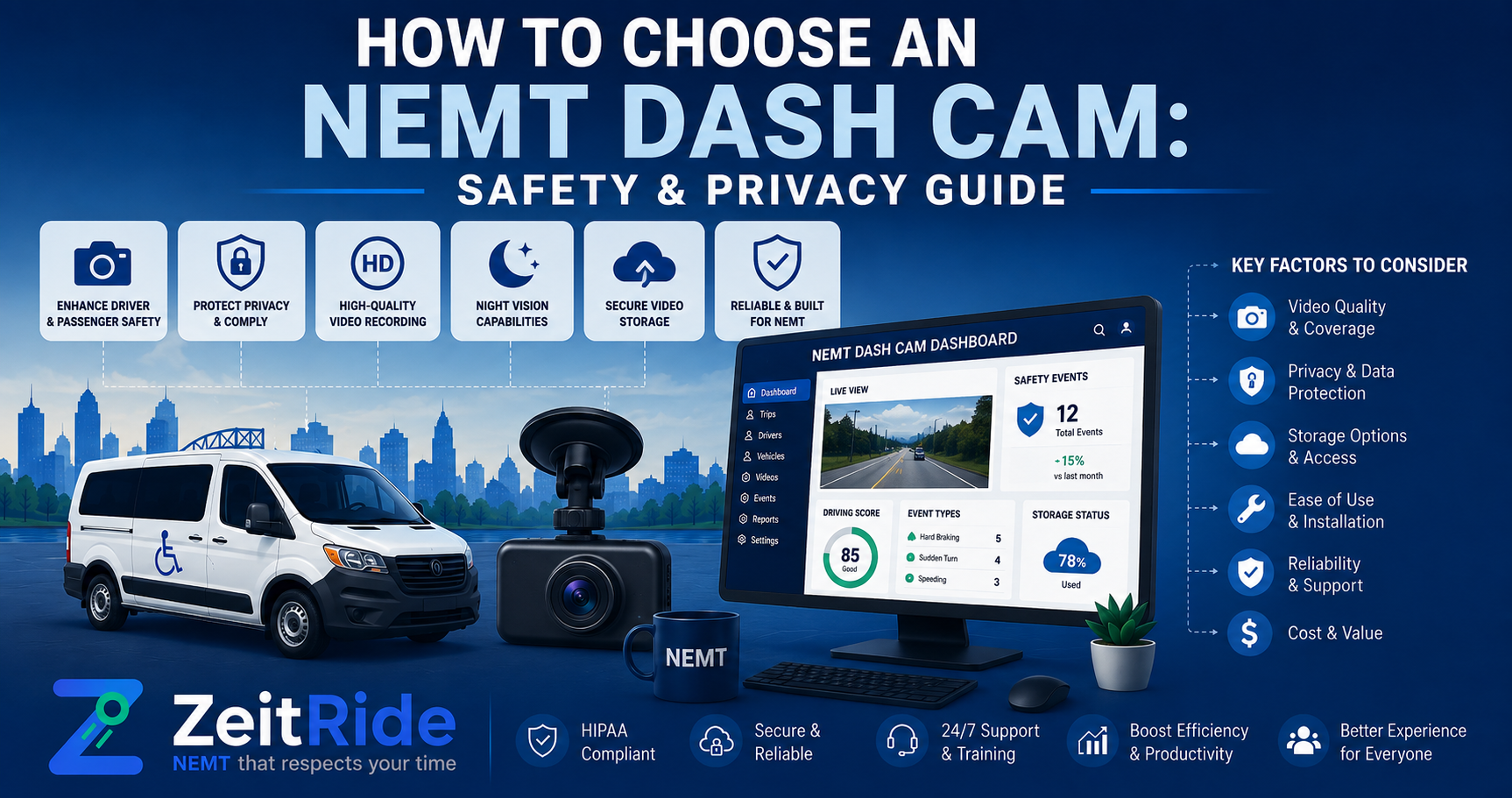
How to Choose an NEMT Dash Cam: Safety & Privacy Guide
Learn how to choose an NEMT dash cam for passenger safety, privacy, incident evidence, driver accountability, and GPS-linked trip records.
Quick answer
Choose an NEMT dash cam that provides clear road or cabin footage, accurate timestamps, GPS-linked trip context, controlled access, and secure video export. Use written policies for passenger notice, audio recording, retention, incident review, and disclosure.
ZeitRide Team
NEMT Operations Expert
Choosing a dash cam for an NEMT fleet requires more than comparing camera resolution and storage space. The right system should help your team connect video footage with the correct vehicle, driver, location, time, and passenger trip.
A well-designed camera setup can support passenger safety, complaint investigations, accident reviews, driver coaching, and trip accountability. Operators evaluating an integrated option can explore ZeitRide's NEMT dash cam add-on, which connects video evidence with GPS trip context.
How Should an NEMT Fleet Choose a Dash Cam?
Choose an NEMT dash cam that records clear footage, provides reliable timestamps, connects video with GPS and trip information, restricts access to authorized employees, and allows relevant footage to be preserved and exported securely.
The camera should not operate as a separate recording device that forces staff to search through memory cards. It should support a consistent incident-review process that connects the footage to the correct trip.
Why NEMT Fleets Need Specialized Dash Cameras
NEMT fleets transport passengers who may require mobility assistance, scheduled medical appointments, facility pickups, or recurring transportation. When a complaint or incident occurs, managers often need information from several systems.
- Did the vehicle arrive at the correct pickup location?
- Which driver and vehicle were assigned to the trip?
- What happened inside or outside the vehicle?
- Was the vehicle following the expected route?
- What time did the incident or disputed event occur?
Video alone may not answer every question. Connecting footage with fleet GPS monitoring, dispatch records, and trip history provides stronger operational context.
Road-Facing vs. Cabin-Facing NEMT Cameras
| Camera Type | Best Used For | Main Consideration |
|---|---|---|
| Road-facing | Accidents, traffic events, road hazards, and external driving behavior | Does not record passenger or driver activity inside the vehicle |
| Cabin-facing | Passenger complaints, driver interactions, and interior incidents | Requires stronger privacy, notice, and access controls |
| Dual-facing | Fleets that need both road and cabin context | Requires clear recording, retention, and review policies |
A dual-facing NEMT dash camera system may provide the most complete evidence, but every fleet should select camera coverage based on its documented safety and operational needs.
Features to Compare Before Buying
A dash cam for NEMT vehicles should provide practical fleet-management capabilities, not just basic video recording.
- Clear footage in daylight, darkness, glare, and poor weather
- Accurate timestamps that match dispatch and trip records
- GPS integration that shows where the vehicle was located
- Vehicle, driver, and trip association
- Individual user accounts and role-based access
- Footage preservation for open complaints or claims
- Controlled video export that protects the original recording
- Alerts when a camera is offline, blocked, or disconnected
During a demonstration, ask the vendor to retrieve footage from a specific vehicle, date, and time. This simple test shows whether the system is practical for daily operations.
How Should NEMT Fleets Handle Passenger Privacy?
Create a written policy before activating the cameras. The policy should explain why recording is necessary, which camera views are active, whether audio is enabled, who may view footage, how long routine recordings are retained, and when evidence may be exported.
- Define the permitted purposes for recording and review
- Provide appropriate driver and passenger notice
- Decide separately whether audio recording is necessary
- Limit footage access according to job responsibilities
- Create a routine retention and deletion schedule
- Preserve footage connected to open incidents or investigations
- Record who exports or discloses video evidence
- Prohibit personal downloading or social-media sharing
Not every vehicle recording automatically qualifies as protected health information. However, footage connected with identifiable passenger, medical destination, or trip information should be handled carefully. Operators should review applicable privacy requirements, state laws, broker agreements, insurance rules, and qualified legal guidance.
Are Dash Cams Legal in NEMT Vehicles?
Dash cams are commonly used in commercial fleets, but there is no single nationwide rule covering every NEMT recording situation. Requirements may differ based on road-facing or cabin-facing recording, audio capture, employee and passenger notice, camera placement, retention, and disclosure.
Audio recording deserves additional caution because consent requirements may vary by state. This article provides general operational information and is not legal advice.
Why GPS-Linked Footage Is More Useful
An NEMT dash cam with GPS tracking connects the evidence chain: video, date and time, vehicle, driver, location, trip, and incident record.
For example, a passenger may report that a driver never arrived. Video may show the road or vehicle interior, while GPS and dispatch data can help confirm whether the vehicle reached the pickup area, how long it remained there, and which trip was assigned.
ZeitRide's NEMT dispatch software connects drivers, vehicles, and trip activity. When camera footage is reviewed with that operational data, managers can investigate incidents more efficiently.
A Simple NEMT Incident-Review Process
- Record the complaint and approximate incident time
- Identify the relevant trip, driver, and vehicle
- Preserve the required footage before it is deleted
- Restrict access to authorized employees
- Compare video with GPS, dispatch, and trip records
- Create a factual timeline of the event
- Document any footage export or disclosure
- Record the final outcome or corrective action
Camera footage should support the fleet's existing NEMT documentation requirements, not replace required trip records.
Final Recommendation
The best NEMT dash cam is not simply the camera with the highest resolution. It is the system that helps authorized staff find the correct evidence, understand the complete trip context, and protect sensitive passenger information.
Choose a solution that combines clear footage, GPS, timestamps, trip association, controlled access, retention rules, and secure evidence export.
See how ZeitRide connects dash-cam footage with GPS trip context for passenger complaints, accident follow-up, and driver accountability. Explore the NEMT dash cam add-on or contact ZeitRide to discuss your fleet.
Frequently Asked Questions
Q: Are dash cams legal in NEMT vehicles?
Dash cams are commonly used in commercial vehicles, but applicable requirements may depend on camera placement, cabin recording, audio, passenger and employee notice, retention, and state consent laws.
Q: Should an NEMT dash cam record inside the cabin?
Cabin-facing footage can help investigate passenger complaints and interior incidents. It should be used with a documented purpose, appropriate notice, restricted access, and clear retention rules.
Q: How long should an NEMT fleet retain dash-cam footage?
There is no universal retention period. Fleets should create a written schedule based on applicable laws, contracts, insurance requirements, operational needs, privacy risks, and open investigations.
Q: What is the difference between a standalone dash cam and an integrated NEMT camera system?
A standalone dash cam organizes recordings mainly by device and time. An integrated system connects footage with GPS, vehicle, driver, and trip information, making relevant incidents easier to locate and review.
Rather see it than read about it?
Bring a real route, a couple of drivers, and your current process. 15 minutes, zero pitch.