Medicaid NEMT Software: What Providers Need in 2026
Learn what Medicaid NEMT software should handle — from broker trip intake and dispatch to documentation, billing, compliance, and reconciliation.
Quick answer
Medicaid NEMT software should connect broker trip intake, scheduling, dispatch, driver and vehicle records, proof of service, billing, reconciliation, and audit history. Exact requirements vary by state, payer, MCO, and broker.
ZeitRide Team
NEMT Operations Expert
Medicaid NEMT software should do more than put rides on a calendar. For a transportation provider, the real job is keeping the same trip connected from broker or payer intake through scheduling, dispatch, driver execution, documentation, billing, payment reconciliation, and audit history. When those stages live in separate portals and spreadsheets, staff spend time rebuilding information that should already follow the trip.
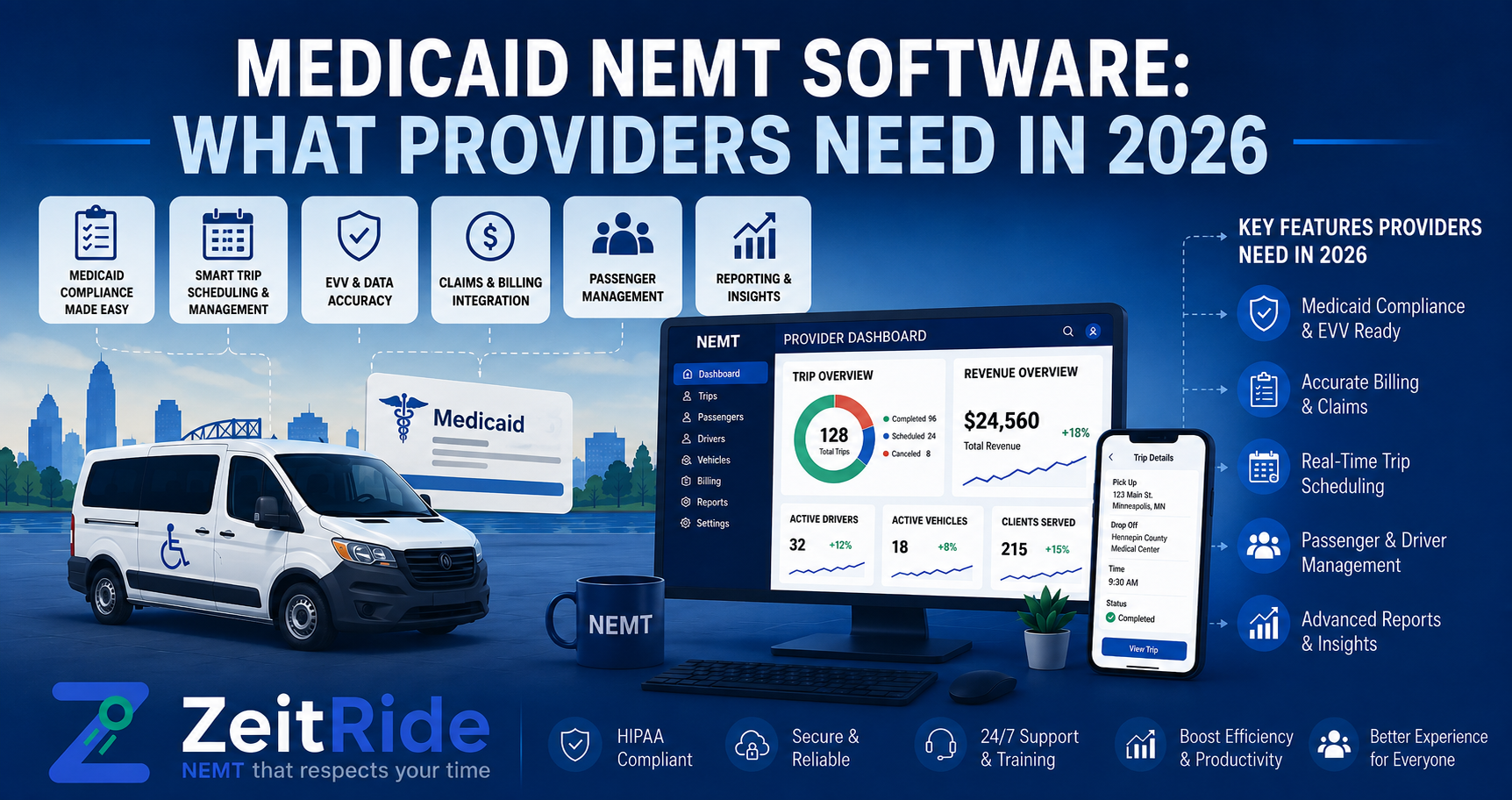
ZeitRide's broader NEMT software platform connects scheduling, dispatch, routing, driver workflows, broker integrations, billing, reporting, and related operational records in one system. For Medicaid-focused fleets, the important question is not how many features a platform lists. It is whether those features stay connected throughout the complete trip lifecycle.
What Is Medicaid NEMT Software?
Medicaid NEMT software is operational software used by non-emergency medical transportation providers to manage Medicaid-funded or Medicaid-related trips from assignment through documented completion and payment. Depending on the provider's market, those trips may be coordinated through a transportation broker, managed care organization, other payer arrangement, or state-specific program.
Federal Medicaid policy requires states to assure necessary transportation to covered services, while states retain flexibility in how transportation programs are structured. CMS also identifies provider enrollment, driver requirements, billing, documentation, brokers, and managed care coordination as important NEMT program areas. Providers should therefore confirm requirements for every state, payer, MCO, and broker they serve. See the official Medicaid assurance of transportation guidance.
Why Medicaid Providers Need More Than Basic Dispatch Software
A basic dispatch tool can show which driver has which ride. A Medicaid transportation operation usually has more information attached to that ride: payer or broker details, authorization information where applicable, service level, mobility needs, driver and vehicle qualifications, actual service times, mileage, proof-of-service information, billing data, and payment status.
The best NEMT software for Medicaid providers keeps those records connected rather than forcing dispatch, drivers, billing staff, and managers to maintain separate versions of the same trip. That distinction matters because an operational mistake can become a billing problem later. A changed pickup that never reaches the driver, an incomplete trip record, an expired credential, or a billing record that does not match completed service can create unnecessary rework.
The Medicaid NEMT Trip Lifecycle Your Software Should Connect
- Trip intake: Receive or enter the trip with the correct payer, broker, member, service level, locations, and timing.
- Scheduling: Match the trip to available capacity and account for recurring or multi-leg transportation.
- Driver and vehicle assignment: Confirm the assigned resources fit mobility, qualification, and availability requirements.
- Live dispatch: Handle cancellations, delays, will-calls, reassignment, and same-day changes without creating duplicate records.
- Proof of service: Capture the timestamps, GPS information, signatures or attestations, mileage, and status information required by the applicable program.
- Billing: Build billing-ready information from the completed trip rather than re-keying the ride from a separate dispatch system.
- Reconciliation and audit: Track payment outcomes and preserve the records needed to explain what happened later.
Medicaid NEMT Software Requirements Checklist
| Capability | What the Software Should Do | Why It Matters |
|---|---|---|
| Broker and payer trip intake | Keep assigned trips, changes, and cancellations connected to operations | Reduces duplicate entry and missed updates |
| Scheduling and dispatch | Use the same trip record from planning through live service | Keeps dispatchers and drivers aligned |
| Driver and vehicle management | Track availability, credentials, qualifications, and vehicle capabilities | Helps assign appropriate resources before service |
| Trip documentation | Capture actual service data during the trip | Supports billing, disputes, and reviews |
| Billing workflow | Build billing records from completed trip information | Reduces re-entry and inconsistent records |
| Reconciliation | Compare completed or billed work with payment information | Helps identify unpaid or mismatched trips |
| Audit history | Preserve relevant records and changes | Makes historical review easier |
How Should Medicaid Broker Trips Enter the System?
For providers receiving assigned work from transportation brokers, trip intake is one of the first places software can remove administrative effort. Manually copying trips from broker portals into dispatch creates another opportunity for addresses, times, service levels, cancellations, or other details to drift between systems.
With supported NEMT broker integrations, trip information can flow into the operating system instead of being retyped manually. The provider should still verify what kind of connection is available for each broker because API, file-based, billing, status, and reconciliation capabilities can differ.
When evaluating NEMT software for Medicaid broker integration, ask a vendor exactly which data moves automatically in each direction — not simply whether a broker logo appears on an integrations page.
Scheduling and Dispatch Should Share One Trip Record
Medical transportation schedules change throughout the day. Facilities adjust appointment times, members cancel, brokers modify trips, drivers become unavailable, and dispatchers need to fit new work into the schedule.
A connected system lets NEMT scheduling software hand the same trip directly into NEMT dispatch software, rather than creating one planning record and another day-of-service record. That creates a simpler operating rule: when the trip changes, everyone who needs the information should be working from the updated version.
Driver and Vehicle Readiness Should Be Visible Before Assignment
Medicaid transportation programs can impose provider and driver requirements, and CMS identifies minimum federal provider and driver safeguards while states may establish additional standards. The software therefore needs to help operations teams see whether the assigned driver and vehicle are appropriate before the trip begins — not discover an issue during an audit.
ZeitRide's NEMT driver management software keeps driver credentials, availability, qualifications, and trip history connected with dispatch. Providers should configure their process around the exact standards that apply in the states and contracts they serve.
Trip Documentation Should Be Captured During Service
The strongest trip record is built while the service is happening. Depending on program requirements, that may include actual pickup and drop-off times, GPS data, mileage, signatures or attestations, driver and vehicle information, status changes, no-shows, cancellations, and exception notes.
Trying to reconstruct those details days or weeks later creates avoidable gaps. ZeitRide's guide to NEMT documentation requirements explains how authorization, trip, driver, vehicle, proof-of-service, billing, and audit records can fit together.
Where electronic verification is required by a state, payer, or broker, verify exactly what information must be captured and how it must be submitted. Do not assume every Medicaid NEMT program uses identical verification rules.
How NEMT Software With Medicaid Billing Closes the Loop
Billing should begin with the trip that was actually completed. When dispatch data lives in one system and billing is prepared somewhere else, staff may need to manually re-enter service dates, mileage, payer information, service details, or other claim-supporting information.
Connected NEMT billing software reduces that gap by keeping billing workflows tied to operational trip records. Providers that need the coding and claims side in more detail can use ZeitRide's guide on how to bill Medicaid for NEMT.
The purpose of NEMT software with Medicaid billing is not simply to generate an invoice. It is to make the completed service record the starting point for the financial workflow.
Payment Reconciliation and Audit History Matter After Billing
The workflow does not end when a claim or broker invoice is submitted. Providers still need to determine whether completed work was paid as expected and retain enough information to investigate discrepancies.
A connected NEMT remittance reconciliation workflow helps tie payment review back to the underlying trip. A searchable NEMT audit trail then helps explain historical changes without relying on multiple spreadsheets or staff memory.
This is where Medicaid NEMT management software becomes more valuable than a standalone scheduler: the system can follow the operational and financial life of a trip instead of stopping after dispatch.
What Should You Ask During a Medicaid NEMT Software Demo?
- Which Medicaid transportation brokers and payer workflows does the platform currently support?
- Is each broker connection API-based, file-based, manual, or a combination?
- How are trip changes and cancellations reflected in dispatch?
- Can the system track driver credentials, qualifications, and expiration dates?
- What proof-of-service information can drivers capture from the mobile app?
- Does completed trip information flow into billing without being manually re-entered?
- Can staff trace a trip from original assignment through payment or reconciliation?
- What records can be exported for payer, broker, or audit review?
- Which requirements still depend on our specific state, MCO, payer, or broker?
- Are billing, broker integrations, driver tools, and support included in the quoted price?
Where ZeitRide Fits for Medicaid NEMT Providers
ZeitRide is built around the connected workflow described above: scheduling, live dispatch, AI-assisted routing, the driver app, broker integrations, billing workflows, remittance reconciliation, reporting, driver management, and audit history. ZeitRide currently lists its core platform at $49 per active vehicle per month, with no per-trip software charge and core operational capabilities included in the plan.
For a Medicaid-focused provider, the best evaluation is still your own workflow. Bring the brokers you work with, a real trip example, your driver and vehicle requirements, your billing process, and the records your contracts require. Then verify what the platform can automate and what remains program-specific.
You can see ZeitRide pricing before the conversation, then talk to the ZeitRide team about your exact Medicaid NEMT operation.
Frequently Asked Questions
Q: What is Medicaid NEMT software?
Medicaid NEMT software is an operations platform for transportation providers managing Medicaid-funded or Medicaid-related non-emergency medical trips. It can connect trip intake, scheduling, dispatch, driver workflows, documentation, billing, payment review, and reporting.
Q: What should NEMT software for Medicaid providers include?
It should connect broker or payer trip intake, scheduling, live dispatch, driver and vehicle information, proof-of-service records, billing workflows, reconciliation, and audit history. Providers should also verify state-, payer-, MCO-, and broker-specific requirements.
Q: Can Medicaid transportation provider software handle broker trips?
Yes, when the software supports the provider's specific transportation broker. Providers should verify whether each connection supports trip imports, changes, cancellations, status updates, billing information, or other data because integration depth varies.
Q: How does NEMT software with Medicaid billing work?
It connects completed trip information with the billing workflow so staff can prepare claims, invoices, or broker billing from the same underlying service record rather than rebuilding trip details in a separate system.
Q: What should I verify before choosing NEMT software for Medicaid broker integration?
Confirm your exact brokers, the connection method, which data moves in each direction, how cancellations and modifications sync, what billing information is supported, and whether the integration carries additional fees.
Q: Is every Medicaid NEMT program managed the same way?
No. Federal Medicaid policy establishes transportation requirements, but program structures and operational rules vary by state and may also differ by managed care organization, payer, broker, and contract. Always verify the requirements that apply to your operation.
See Your Medicaid NEMT Workflow in ZeitRide
A software demo is most useful when it uses your operation instead of a generic slide deck. Bring one real trip, the broker or payer behind it, your current dispatch process, and the billing steps that happen after the ride. ZeitRide can show how that workflow moves through the platform and identify which parts can stay connected from assignment through reconciliation.
Ready to see how the workflow fits your operation? Talk to ZeitRide about your Medicaid NEMT workflow and bring a real trip to the conversation.
Rather see it than read about it?
Bring a real route, a couple of drivers, and your current process. 15 minutes, zero pitch.