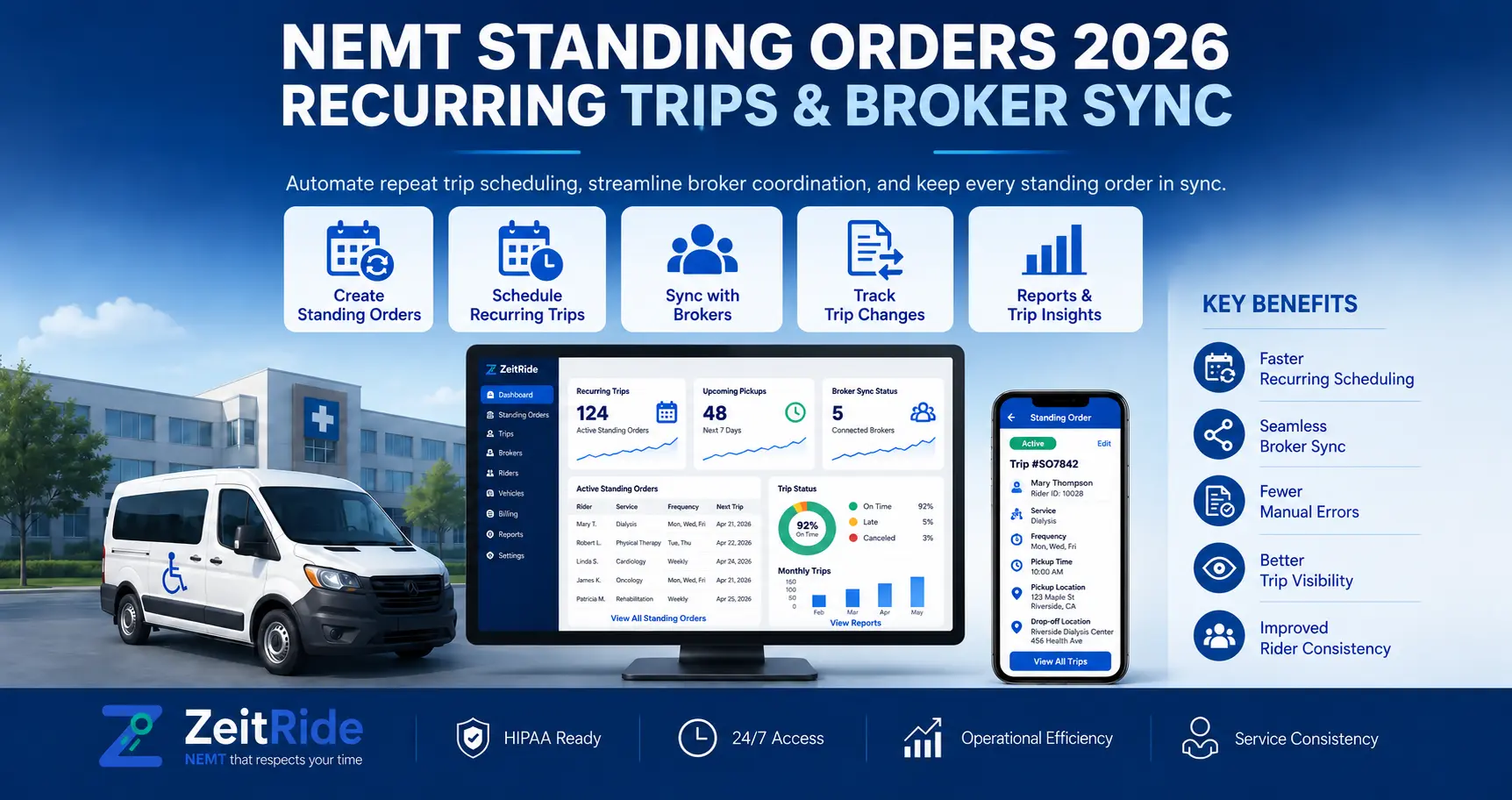
NEMT Standing Orders 2026: Recurring Trips & Broker Sync
Learn how NEMT standing orders work, manage recurring trip changes, prevent duplicate broker trips, and keep schedules accurate.
Quick answer
A NEMT standing order is a recurring transportation schedule for a rider who travels on predictable days. Providers should create the pattern once, manage one-day exceptions separately, prevent duplicate broker trips, and preserve the series for future dates.
ZeitRide Team
NEMT Operations Expert
Recurring transportation should reduce scheduling work, not create another source of errors. For NEMT providers, standing orders make it possible to build a predictable ride once and generate future trips from the same schedule instead of recreating each appointment manually. The challenge begins when the pattern changes: a rider may cancel only Wednesday's trip, a dialysis chair time may move, a facility may close for a holiday, or a broker may send a dated trip after the provider already has the recurring ride on the schedule. Good NEMT standing order management keeps the repeating pattern intact while handling those exceptions safely.
If your operation is still building repeat rides manually, NEMT scheduling software can connect recurring trip planning with dispatch, routing, driver assignments, and broker workflows.
What Is a NEMT Standing Order?
A NEMT standing order is a transportation arrangement for a rider who needs recurring trips on a predictable schedule. Instead of booking each trip separately, the repeating days, pickup details, destination, service requirements, and other core information are established as a recurring series.
Standing orders are commonly used for dialysis, therapy, behavioral health treatment, adult day programs, and other regularly scheduled care. Exact authorization and booking rules can vary by Medicaid program, broker, and state. For example, Rhode Island Medicaid transportation rules describe standing orders for regularly recurring appointments and require the appropriate healthcare provider to request or modify them.
For providers, the operational principle is simple: create the repeating pattern once, then manage exceptions without accidentally changing every future trip.
Standing Order vs. One-Time Trip vs. Transport Route
Not every repeating ride should be handled the same way. One of the most useful distinctions in NEMT recurring trip scheduling is whether the provider is managing one passenger's repeating ride or an entire shared run.
| Trip Type | Best Use | Example |
|---|---|---|
| One-time trip | A ride occurring on one specific date | Specialist appointment next Tuesday |
| Standing order | One rider repeating on predictable days | Dialysis every Monday, Wednesday, and Friday |
| Transport route | Multiple riders sharing a repeatable run | Six riders traveling to the same adult day center |
ZeitRide separates these workflows intentionally. Individual standing rides can be managed as recurring trips, while several compatible riders traveling together can be organized through transport routes. This prevents a single recurring rider record from becoming an awkward substitute for a true shared route.
What Information Should a Standing Order Include?
Reliable NEMT standing order scheduling starts with complete information. If important trip requirements are missing from the recurring record, the same mistake can repeat across every future occurrence.
- Rider or member information
- Pickup address
- Destination or facility
- Days of the week
- Start date
- End date when known
- Pickup or appointment time
- Return-trip setup
- Mobility requirements
- Wheelchair or other vehicle needs
- Escort or attendant requirements
- Broker or payer
- Special driver instructions
- Relevant recurring notes
For treatment types with highly repetitive schedules, such as dialysis, these details should remain attached to the series rather than being re-entered every week. ZeitRide's dialysis transportation software guide covers the additional routing and return-trip issues specific to dialysis operations.
How NEMT Standing Order Scheduling Works
The most efficient workflow treats the standing order as the master recurring pattern and each scheduled date as an occurrence generated from that pattern.
- Create the rider's recurring schedule and service requirements.
- Select the days on which transportation repeats.
- Generate future trip occurrences from the series.
- Match the appropriate driver and vehicle requirements.
- Send each dated occurrence into the active schedule and dispatch workflow.
- Handle cancellations or changes at the correct level.
- Preserve completed-trip history for reporting and billing.
The goal is to avoid rebuilding known work every day while still allowing dispatchers to react when real life does not follow the recurring plan. Providers using ZeitRide can review the detailed product workflow in the recurring trips Help guide.
The Most Important Rule: Series Change vs. One-Day Change
The biggest operational risk with standing orders is applying the right change at the wrong level. Dispatchers need to know whether a change belongs to the recurring master schedule or only one dated occurrence.
Permanent Series Change
Suppose a dialysis patient's normal pickup changes from 6:30 AM to 7:00 AM starting next month. That is a series-level change because future trips should follow the new pattern.
One-Day Exception
If the same patient has a later appointment next Wednesday only, that should be treated as a date-specific exception. Changing the entire standing order would incorrectly move every future trip in the series.
Good NEMT standing order software should make this distinction clear. The same principle applies to temporary pickup addresses, substitute drivers, vehicle changes, and facility schedule adjustments.
How Should Cancellations, Pauses & Holidays Be Handled?
A cancellation does not always mean the standing order itself has ended. If a rider misses one appointment, the provider should normally update or cancel that specific occurrence while preserving future dates when the recurring need remains active.
- One canceled medical appointment
- A facility holiday closure
- Temporary hospitalization
- Vacation or planned absence
- Short-term treatment suspension
- Permanent discontinuation of treatment
- A recurring schedule moving to different weekdays
The key distinction is whether the exception affects one date, a temporary date range, or the entire future series. Historical completed trips should also remain intact. Ending or pausing a series should not erase the provider's past service record.
How Should Broker Trips Sync With Existing Standing Orders?
Broker synchronization is where recurring scheduling can become especially complicated. A provider may already know that a member travels to the same facility every Monday, Wednesday, and Friday, so the internal recurring schedule may generate Friday's trip before the broker sends its final dated booking.
When that broker trip arrives, the system should not blindly create another ride. Otherwise the provider can end up with a recurring occurrence and a broker-imported occurrence representing the same transportation.
A better workflow matches the incoming broker trip to the existing occurrence and attaches the broker information to that scheduled ride. This helps preserve the recurring operating pattern, broker identifiers, updated trip information, dispatch continuity, billing eligibility, and a cleaner audit trail.
When Should Standing-Order Riders Become a Shared Route?
An individual standing order is appropriate when one rider follows a repeating schedule. But when several passengers repeatedly travel to the same facility within compatible time windows, a shared transport route may be more efficient.
- Common destination
- Compatible appointment or program times
- Pickup geography
- Vehicle capacity
- Mobility requirements
- Acceptable ride time
- Driver availability
- Broker or program requirements
For example, five adult day participants traveling to the same center every weekday may be better managed as one recurring route than five unrelated standing-order workflows. ZeitRide's transport routes guide explains how shared recurring runs differ from individual recurring trips.
Common NEMT Standing Order Mistakes
| Mistake | Operational Result |
|---|---|
| Changing the entire series for one exception | Future trips become incorrect |
| Recreating repeat trips manually | Duplicate entry and scheduling errors |
| Ignoring incoming broker changes | Internal schedule no longer matches broker data |
| Missing mobility requirements | Wrong vehicle or capacity assignment |
| Creating both a recurring trip and shared route | Passenger may be duplicated |
| Deleting a series instead of ending it correctly | Historical context becomes harder to manage |
| Treating every cancellation as permanent | Valid future trips may disappear |
What Should NEMT Standing Order Software Handle?
The best standing order software does more than repeat calendar entries. It should keep the recurring schedule connected to the rest of the transportation operation.
- Automatic future-trip generation
- One-occurrence and whole-series editing
- Temporary pauses
- Cancellation handling
- Driver and vehicle requirements
- Broker trip matching
- Duplicate-trip prevention
- Shared route support
- Live dispatch updates
- Historical trip records
- Billing continuity
Recurring scheduling does not operate in isolation. A standing order ultimately affects dispatch, driver manifests, routing, documentation, broker data, and billing. ZeitRide's NEMT software keeps those workflows connected rather than treating recurring trips as a separate calendar.
NEMT Standing Order Management Checklist
- Before activation: verify the rider, destination, service days, times, mobility requirements, payer, and start or end dates.
- When one trip changes: decide whether the change affects one occurrence or the whole series.
- When a broker trip changes: confirm the incoming broker data matches the correct recurring occurrence.
- When the schedule pauses: define the pause period without deleting completed history.
- When the standing order ends: stop future trip generation while preserving prior trip records.
- When several riders share a repeatable destination and time pattern: evaluate whether they belong on a transport route.
Final Takeaway
The difficult part of a standing order is not creating the recurrence. It is protecting the recurring pattern while handling exceptions correctly. Effective NEMT standing order management follows one simple rule: build the repeating schedule once, but manage every exception intentionally.
When providers separate one-day changes from permanent changes, match broker trips instead of duplicating them, and move appropriate riders into shared routes, recurring transportation becomes easier to scale without creating more administrative work.
See How ZeitRide Handles a Real Standing Order
Bring one recurring dialysis, therapy, facility, or broker schedule to a ZeitRide walkthrough. See how the platform handles recurring trips, one-day changes, shared routes, broker-fed transportation, dispatch, and future occurrences without rebuilding the schedule every week.
Book a ZeitRide demo using your own recurring workflow.
Frequently Asked Questions
Q: What is a NEMT standing order?
A NEMT standing order is a recurring transportation arrangement for a rider who travels on predictable days to the same or regularly scheduled destination. It allows future trips to be generated from one repeating schedule rather than booked individually.
Q: Are standing orders the same as recurring NEMT trips?
The terms are often used for the same general concept of repeating transportation, although Medicaid programs and brokers may apply their own authorization and standing-order rules.
Q: Can one standing-order trip be changed without changing the entire series?
Yes. A date-specific occurrence can be changed separately when the underlying recurring schedule remains the same. Permanent changes should be applied to future occurrences in the series.
Q: What happens if a broker sends a trip that already exists as a standing order?
The incoming broker trip should ideally be matched with the existing recurring occurrence instead of creating a duplicate, keeping the provider's schedule, broker identifiers, dispatch data, and billing information aligned.
Q: When should recurring riders be placed on a transport route instead?
A transport route is more appropriate when multiple compatible riders repeatedly travel to the same facility within similar time windows and can safely share the same vehicle.
Rather see it than read about it?
Bring a real route, a couple of drivers, and your current process. 15 minutes, zero pitch.