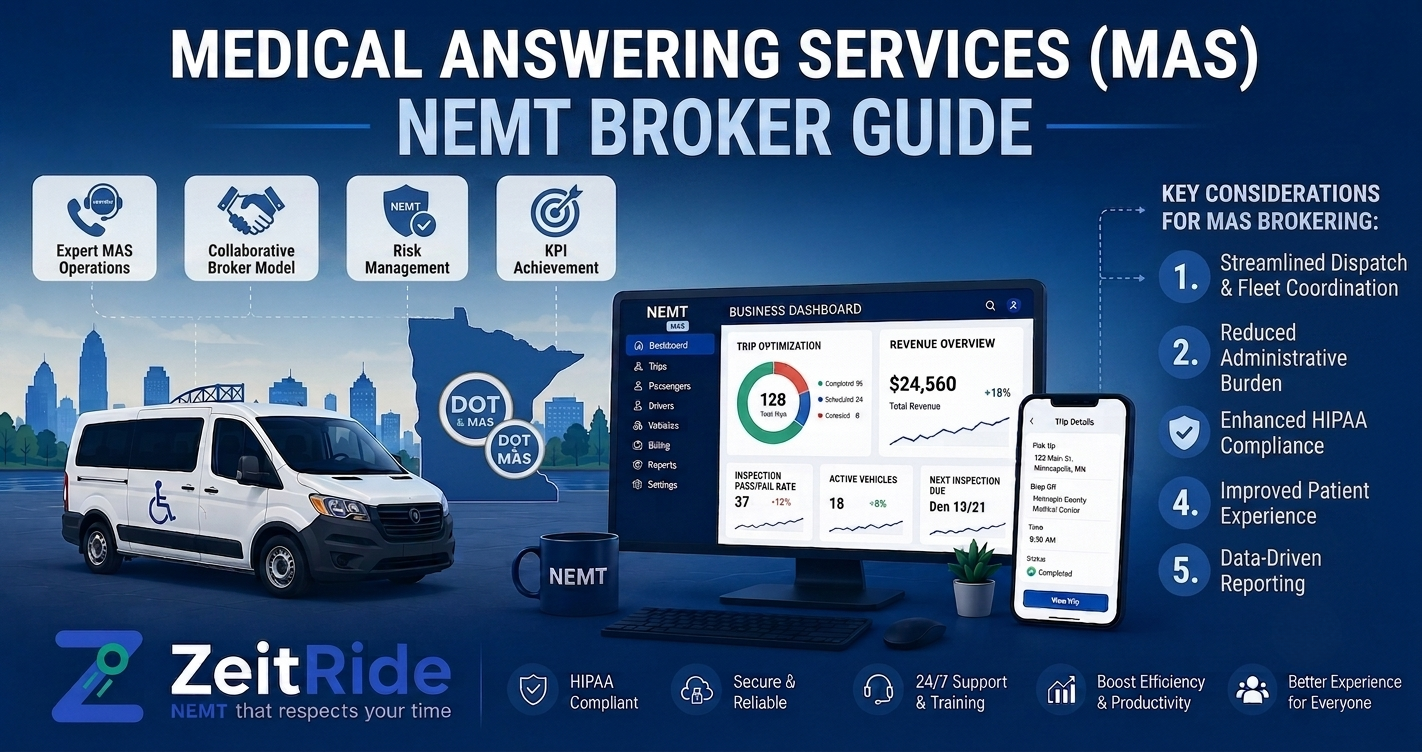
Medical Answering Services (MAS): NEMT Broker Guide
MAS is New York's only Medicaid NEMT broker, coordinating 15M trips a year. Here's how to become a provider, what's required, and what changes after approval.
Quick answer
Medical Answering Services (MAS) is New York State's sole statewide Medicaid Transportation Broker, coordinating about 15 million non-emergency trips a year for roughly 7 million enrollees across all 62 counties.
ZeitRide Team
NEMT Operations Expert
Medical Answering Services, known across the industry simply as MAS, is New York State's only Medicaid transportation broker, coordinating roughly 15 million trips a year for about 7 million enrollees in all 62 counties. For a New York NEMT provider, getting approved as an MAS network provider is the single biggest lever for steady Medicaid trip volume. ZeitRide runs the dispatch, scheduling, and billing side of that work on a flat $49/vehicle/month plan, so approval turns into revenue instead of a paperwork backlog.
What Medical Answering Services Actually Does for NEMT Providers
Medical Answering Services manages non-emergency Medicaid transportation for the entire state of New York, which means every Medicaid trip request in the state — hospital visits, dialysis, physician appointments, rehab — routes through one broker instead of a patchwork of regional managers.
MAS was founded in 2004 by Russ Maxwell and built its footprint region by region out of Onondaga County before New York State named it the sole statewide Medicaid Transportation Broker on August 1, 2023. By March 1, 2024, every Medicaid enrollee — including managed care and MLTC members — had to book non-emergency transportation through MAS. That consolidation changed the math for every NEMT provider in the state: one relationship, one credentialing process, and one source of trip volume that didn't exist before 2023.
That scale is exactly why an NEMT broker relationship like this one only pays off if the back-office side of the business can absorb it. Dispatch software built for high trip volume — assigning drivers, tracking vehicle inspections, running route optimization — is what separates a provider that grows with MAS from one that gets buried by it.
Every state handles Medicaid NEMT broker relationships differently, and New York's single-broker model is one of the more concentrated versions of it. Some states split trips across several regional brokers — MTM Health and Provide A Ride, for instance, operate in states where multiple broker relationships run side by side. New York consolidated that into one relationship, which raises the stakes on the application itself but simplifies the ongoing broker relationship once you're in the network. A provider working one NEMT broker instead of three has one credentialing calendar, one remittance format, and one point of contact to manage — which is a real operational advantage once the trip volume starts arriving.
How to Become an MAS Provider and What Changes After Onboarding
Becoming an MAS provider is a two-step process, and skipping the order costs providers real time. You need a letter of support from MAS before New York State Medicaid will even look at your enrollment application.
- Becoming an MAS provider is a two-step process, and skipping the order costs providers real time. You need a letter of support from MAS before New York State Medicaid will even look at your enrollment application.
- Pass MAS's review and receive a formal letter of support
- Apply for New York State Department of Health provider enrollment through eMedNY — applications submitted without the MAS letter get rejected outright
- Finalize onboarding by meeting MAS's remaining network requirements
Once approved, authorized trips start landing in your queue, and that's where a lot of new MAS providers hit a wall they didn't see coming. A provider used to a handful of private-pay bookings a week is suddenly managing recurring dialysis routes, ad-hoc same-day requests, and broker remittance schedules all at once. ZeitRide's dispatch and scheduling tools handle recurring routes and ad-hoc trips side by side, so a spike in authorized MAS volume doesn't mean hiring a second dispatcher just to keep the board straight.
MAS Requirements NEMT Providers Get Wrong
The published MAS requirements list looks simple on paper — active business license, commercial auto insurance, vehicle inspections, background checks — but a few items consistently trip up new providers.
- CTAA Passenger Assistance, Safety and Sensitivity (PASS) certification has to be completed within three months of network implementation, and providers who treat that as a "someday" task lose network standing fast
- HIPAA compliance training is a hard requirement, not a formality, since MAS trips carry protected health information from intake through drop-off
- ADA-accessible vehicles are required for wheelchair transportation specifically — a fleet that's mostly ambulatory sedans still needs accessible capacity to serve the full range of MAS-authorized trips
- Insurance minimums have to meet New York Medicaid standards specifically, which is a different bar than a general commercial auto policy
None of these requirements are unusual for Medicaid NEMT work, but MAS enforces them at a scale where a single lapsed credential can mean a provider gets pulled from active routing until it's resolved. Providers who track vehicle inspections, driver certifications, and insurance renewals inside the same NEMT software they use for dispatch catch a lapse before it becomes a network problem instead of after.
This is where a lot of new MAS providers underestimate the workload. Credentialing isn't a one-time gate you clear before your first trip — it's an ongoing calendar of renewals running in parallel with dispatch, billing, and driver payroll. A provider tracking PASS certification dates in one spreadsheet, insurance renewals in an email folder, and vehicle inspections on a whiteboard is one missed renewal away from losing standing with the only Medicaid broker in the state. Centralizing that tracking inside the same platform that handles day-to-day dispatch removes the guesswork about which document is about to expire.
Who an MAS Provider Relationship Is Built For
- Fleet owners in New York deciding whether to pursue Medicaid work at scale — MAS is effectively the only door into that market statewide
- Operations directors managing credentialing across a growing driver and vehicle roster as MAS trip volume increases
- Dispatch coordinators who need to absorb recurring and ad-hoc MAS trips without the board turning into guesswork
- Billing staff reconciling broker remittance against MAS-authorized trips, especially as volume climbs into hundreds of trips a week
A single-vehicle operator and a 40-vehicle fleet both go through the same MAS application process, but the operational load after approval scales very differently. The fleet owner running five vehicles can often manage MAS trips manually for a while. The moment that fleet crosses into double digits, dispatch software stops being optional — MAS-authorized volume doesn't slow down to match a provider's back-office capacity. NEMT software that handles scheduling, routing, and billing on one flat monthly rate per vehicle keeps that math predictable as the fleet grows, instead of forcing a provider to add headcount every time trip volume climbs.
Billing staff sit at the center of this scaling problem more than any other role. MAS remittance has to be reconciled against authorized trips, and at 15 million trips a year statewide, even a mid-sized provider's slice of that volume can turn into hundreds of line items a week. Billing software built for NEMT work — matching trips to remittance automatically instead of by hand — is often the difference between a provider that can absorb MAS growth and one whose office staff falls further behind every month volume increases.
Bottom Line
Medical Answering Services is the only real path to Medicaid transportation volume in New York, and the application process is straightforward once you know the letter-of-support step comes first. What separates providers who grow with that volume from providers who get buried by it is the software running underneath — ZeitRide handles dispatch, scheduling, and billing on one $49/vehicle/month plan with no setup fees.
Start your first live route within a day. $49/vehicle. No contracts. Book your demo.
Frequently Asked Questions
Q: What is Medical Answering Services (MAS) in NEMT?
Medical Answering Services (MAS) is New York State's sole statewide Medicaid Transportation Broker, coordinating non-emergency medical transportation for roughly 7 million Medicaid enrollees across all 62 counties.
Q: How do I become an MAS NEMT provider?
Complete the MAS Transportation Provider Network Application, receive a letter of support from MAS, then apply for enrollment with New York State Medicaid through eMedNY using that letter — applications without it are rejected.
Q: What are the MAS requirements for NEMT providers?
Providers need an active business license, commercial auto insurance meeting New York Medicaid standards, current vehicle inspections, driver background checks, HIPAA training, ADA-accessible vehicles, and CTAA PASS certification within three months of implementation.
Q: How many trips does MAS coordinate each year?
MAS coordinates approximately 15 million non-emergency Medicaid trips a year for about 7 million enrollees across all 10 NYSDOH regions in New York State.
Q: Does NEMT software help manage MAS broker trips?
NEMT software like ZeitRide handles the dispatch, scheduling, and billing workload that follows broker approval — assigning drivers to recurring and ad-hoc trips, tracking compliance documents, and reconciling remittance as authorized volume grows. That matters most in the weeks right after onboarding, when authorized trip volume from a broker the size of MAS can outpace whatever process a smaller provider was using before approval.
Rather see it than read about it?
Bring a real route, a couple of drivers, and your current process. 15 minutes, zero pitch.