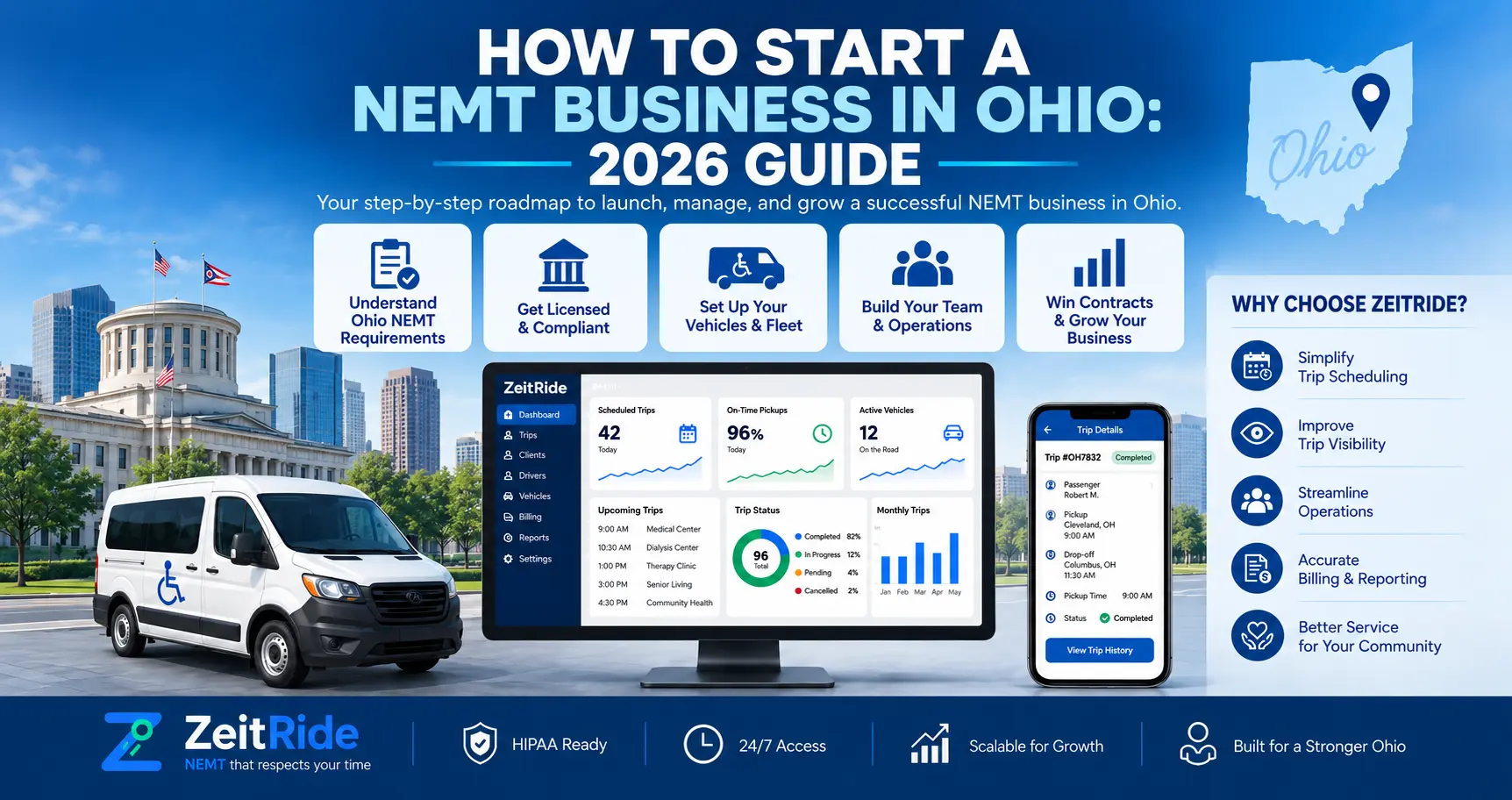
How to Start a NEMT Business in Ohio: 2026 Guide
Starting an Ohio NEMT business? Learn the licensing, PUCO, Medicaid, ambulette, startup cost, GPS, and software steps for 2026.
Quick answer
To start a NEMT business in Ohio, register your company, determine which transportation licenses and PUCO rules apply, secure insurance, prepare vehicles and drivers, arrange payer relationships, and set up compliant scheduling, GPS, documentation, and billing workflows.
ZeitRide Team
NEMT Operations Expert
If you're researching how to start a NEMT business in Ohio, the first thing to understand is that there is no single checklist that applies identically to every transportation company. Your requirements can change based on whether you transport ambulatory passengers, wheelchair users, Medicaid members, private-pay clients, or passengers through contracted transportation networks.
A successful launch requires more than registering a company and purchasing a vehicle. You need to understand Ohio licensing, insurance, vehicle and driver requirements, payer relationships, trip documentation, and the operational systems you'll use once rides begin. Before committing heavily to vehicles or insurance, build a realistic NEMT business plan around your service area, payer mix, fleet, staffing, and expected trip volume.
Quick Answer: How Do You Start a NEMT Business in Ohio?
To start a NEMT business in Ohio, define the transportation services you plan to offer, register your business, obtain an EIN, determine which state licensing and PUCO requirements apply, secure commercial insurance, prepare qualified vehicles and drivers, and establish your Medicaid, transportation-network, facility, or private-pay strategy.
Before your first trip, you should also have scheduling, dispatch, GPS records, mileage tracking, trip documentation, and billing workflows in place. The key is determining which Ohio NEMT requirements apply to your specific operating model instead of assuming every medical transportation company follows the same licensing path.
Ohio NEMT Requirements at a Glance
| Requirement | What a New Provider Should Check |
|---|---|
| Business formation | Register the company and obtain an EIN |
| Service type | Determine whether you will provide ambulatory, wheelchair/ambulette, or mixed transportation |
| Ohio licensing | Confirm whether ambulette or other licensing requirements apply |
| PUCO | Check whether your for-hire operation requires PUCO authority |
| Insurance | Meet applicable state, carrier, payer, and contract requirements |
| Vehicles | Confirm registration, safety equipment, permits, and inspections |
| Drivers | Verify licensing, driving history, training, and credentials |
| Medicaid and payers | Complete applicable enrollment and network requirements |
| GPS and documentation | Maintain reliable trip status, location, mileage, and timestamp records |
| Operations | Set up scheduling, dispatch, routing, billing, and reporting before launch |
Step 1: Register Your Ohio Transportation Business
Start by choosing a legal business structure and registering it with the Ohio Secretary of State. A domestic Ohio LLC currently has a $99 Articles of Organization filing fee.
- Choose and register your legal business structure.
- Obtain an Employer Identification Number from the IRS.
- Open a dedicated business bank account.
- Set up accounting and payroll processes.
- Confirm applicable state and local tax obligations.
- Check business requirements in the cities or counties where you plan to operate.
Business registration creates your company, but it does not automatically authorize every type of paid passenger transportation. Your next step is determining which transportation regulations apply to the service you actually intend to provide.
Step 2: Understand Ohio NEMT License and Ambulette Requirements
One of the most confusing parts of Ohio NEMT license requirements is that NEMT covers several operating models. Ohio specifically regulates ambulette services under Chapter 4766, and state law defines an ambulette around transportation for people who require a wheelchair or another mobility aid.
If your company will provide covered wheelchair or mobility-aid transportation, review the current Ohio ambulette regulations before purchasing vehicles. Applicable providers must account for service licensing, vehicle permits, inspections, vehicle standards, driver qualifications, insurance, equipment, and required documentation.
| Ambulette Requirement | Current Fee |
|---|---|
| Initial or renewal service license | $100 annually |
| Vehicle permit | $50 per ambulette annually |
| Vehicle inspection | $50 per ambulette annually |
Do not assume a vehicle is compliant simply because a seller describes it as wheelchair accessible or NEMT-ready. Review the Ohio ambulette license requirements and vehicle standards before purchasing or modifying a van. Likewise, operators serving only ambulatory riders should verify the regulations that apply to their own service rather than treating ambulette licensing as a universal NEMT license.
Step 3: Check Whether PUCO Requirements Apply
Depending on your operating model, Ohio's for-hire motor-carrier rules may also apply. Providers operating covered intrastate passenger transportation should determine whether they need authority from the Public Utilities Commission of Ohio and which financial-responsibility requirements apply.
For covered for-hire passenger carriers, Ohio's current financial-responsibility rules require at least $1.5 million in public liability coverage for vehicles seating 15 people or fewer, including the driver, and $5 million for vehicles seating 16 or more. Review the current PUCO passenger-carrier insurance rules for applicability.
These figures are not universal insurance quotes for every Ohio NEMT provider. Ambulette licensing, Medicaid plans, transportation networks, healthcare facilities, and insurers may impose additional requirements. For broader budgeting context, review ZeitRide's guide to NEMT insurance costs.
Step 4: Prepare Your Vehicles and Drivers
Your vehicles should match the passengers you intend to serve. An ambulatory transportation company may have different equipment requirements from a wheelchair-focused operation. Applicable ambulette vehicles may require wheelchair securement systems, passenger restraints, approved ramps or lifts, permits, inspections, and other safety equipment.
- Vehicle registration and ownership or lease records
- Commercial insurance documentation
- Required permits and inspections
- Preventive maintenance records
- Wheelchair securement and accessibility equipment where applicable
- Emergency and safety equipment
- Cleaning and inspection procedures
- Driver assignment records
Ohio NEMT Driver Requirements
Drivers need more than a valid driver's license. Depending on the service, Ohio rules and payer contracts may address driver age, driving experience, motor vehicle records, CPR or first-aid credentials, passenger-assistance training, background screening, drug testing, and other qualifications. ZeitRide's NEMT driver requirements guide provides a broader framework to use alongside Ohio-specific and contract-specific requirements.
Step 5: Decide How Your Ohio NEMT Business Will Get Trips
Understanding how to start a medical transportation business in Ohio also means deciding who will pay for your rides. Revenue can come from Medicaid transportation, managed care transportation networks, healthcare facilities, skilled nursing facilities, dialysis centers, adult day programs, private-pay riders, and other contracted transportation organizations.
Medicaid enrollment and transportation-network credentialing are not necessarily the same process. A provider may need to satisfy separate state, payer, network, insurance, driver, and vehicle requirements before receiving trips. For the broader enrollment process, review how to become a Medicaid transportation provider.
If Provide A Ride is active in the area you plan to serve, ZeitRide also has a dedicated guide explaining how to become a Provide A Ride transportation provider in Ohio.
Step 6: Prepare for Ohio's New NEMT GPS Verification Rules
Ohio's Medicaid NEMT compliance environment is changing in 2026. Ohio Revised Code Section 5164.401 takes effect October 6, 2026 and directs the Ohio Department of Medicaid to develop, procure, certify, or approve an electronic verification process using GPS information for Medicaid non-emergency medical transportation.
The framework addresses trip events such as arrival at pickup, beginning transportation, arrival at drop-off, completion, timestamps, route information, and total distance traveled. However, the law's effective date should not be treated as a blanket claim that every provider must immediately switch to one specific system on October 6. ODM controls implementation details and applicable technical guidance.
ZeitRide already covers this subject in depth in its Ohio NEMT GPS requirements and SB 315 guide. New providers should focus on building accurate digital trip records from the beginning rather than waiting until verification rules affect day-to-day billing.
How Much Does It Cost to Start a NEMT Business in Ohio?
There is no single accurate statewide answer to how much does it cost to start a NEMT business in Ohio because the largest expenses vary by vehicle type, insurance, fleet size, accessibility equipment, payroll, fuel, and working-capital needs.
| Startup Expense | Planning Amount |
|---|---|
| Ohio LLC filing | $99 |
| Ambulette service license, if applicable | $100 annually |
| Ambulette vehicle permit, if applicable | $50 per vehicle annually |
| Ambulette inspection, if applicable | $50 per vehicle annually |
| Vehicle purchase or lease | Varies |
| Wheelchair equipment or conversion | Varies |
| Commercial insurance | Varies |
| Driver screening and training | Varies |
| Payroll, fuel, and working capital | Varies |
Vehicle acquisition and commercial insurance can be much larger expenses than government filing fees. Build your budget using actual vehicle and insurance quotes for your service type and keep enough working capital to cover payroll, fuel, maintenance, and operating expenses while waiting for customer or payer payments. For a complete financial framework, see how much it costs to start a NEMT business.
Step 7: Set Up NEMT Software Before Your First Trip
A provider can satisfy licensing requirements and still struggle operationally if trips are managed through spreadsheets, text messages, separate GPS apps, and manual billing records. Before launch, your company should have a reliable way to manage trip requests, recurring rides, driver and vehicle assignments, route planning, dispatch, trip statuses, GPS records, mileage, no-shows, documentation, billing, and reporting.
ZeitRide's NEMT software connects scheduling, dispatch, routing, driver workflows, billing, broker integrations, and reporting in one platform. For a startup, the main advantage is having one trip record move through the complete operational lifecycle rather than reconstructing information from several disconnected systems after the ride is complete.
Ohio NEMT Startup Checklist
- Decide which transportation services you will provide.
- Choose the Ohio counties and cities you plan to serve.
- Register your business and obtain an EIN.
- Determine whether ambulette licensing applies.
- Determine whether PUCO requirements apply.
- Obtain appropriate commercial insurance.
- Acquire and prepare compliant vehicles.
- Recruit, screen, and qualify drivers.
- Determine your Medicaid, transportation-network, facility, and private-pay strategy.
- Build driver and vehicle credential files.
- Set up trip documentation and billing procedures.
- Configure scheduling, routing, dispatch, and GPS workflows.
- Monitor Ohio SB 315 implementation guidance.
- Test the complete trip workflow before accepting regular trip volume.
Ready to Launch Your Ohio NEMT Operation?
Starting the company is only the first step. Once trips begin, you need to know which driver is assigned, where the vehicle is, what happened at pickup and drop-off, how many miles were completed, and whether the trip record is ready for billing.
ZeitRide helps NEMT providers manage scheduling, dispatch, routing, driver communication, GPS-aware trip documentation, billing workflows, and reporting from one platform instead of piecing together several tools.
Ready to see how your first Ohio route could run? Book a ZeitRide demo and bring a sample trip. See the workflow from scheduling through dispatch, driver updates, trip completion, documentation, and billing.
Frequently Asked Questions
Q: How do I start a NEMT business in Ohio?
Start by defining your transportation service, registering the business, determining which Ohio licensing and PUCO requirements apply, obtaining commercial insurance, preparing vehicles and drivers, arranging payer relationships, and setting up scheduling, GPS, documentation, and billing workflows.
Q: Do I need a NEMT license in Ohio?
Ohio does not apply one identical NEMT license to every transportation business. Ambulette services are specifically regulated, while other transportation, PUCO, Medicaid, payer, and local requirements depend on the services and operating model.
Q: What are Ohio ambulette license requirements?
Applicable Ohio ambulette providers must comply with service licensing, vehicle permitting and inspection, driver qualification, insurance, equipment, and recordkeeping requirements. Operators should verify the current rules before purchasing or modifying wheelchair-accessible vehicles.
Q: Does an Ohio NEMT business need PUCO authority?
Some for-hire intrastate passenger operations are subject to PUCO requirements. Whether those rules apply depends on the company's service and operating model, so providers should verify applicability before beginning paid transportation.
Q: How much does it cost to start a NEMT business in Ohio?
There is no single statewide startup total. Ohio business filing and applicable ambulette fees are relatively predictable, but vehicle acquisition, insurance, equipment, payroll, fuel, driver training, and working capital vary significantly by company.
Q: What are Ohio's new NEMT GPS requirements?
Ohio Revised Code Section 5164.401 takes effect October 6, 2026 and directs the Ohio Department of Medicaid to establish or approve GPS-based electronic verification for Medicaid NEMT. Providers should monitor ODM guidance as implementation details are finalized.
Rather see it than read about it?
Bring a real route, a couple of drivers, and your current process. 15 minutes, zero pitch.