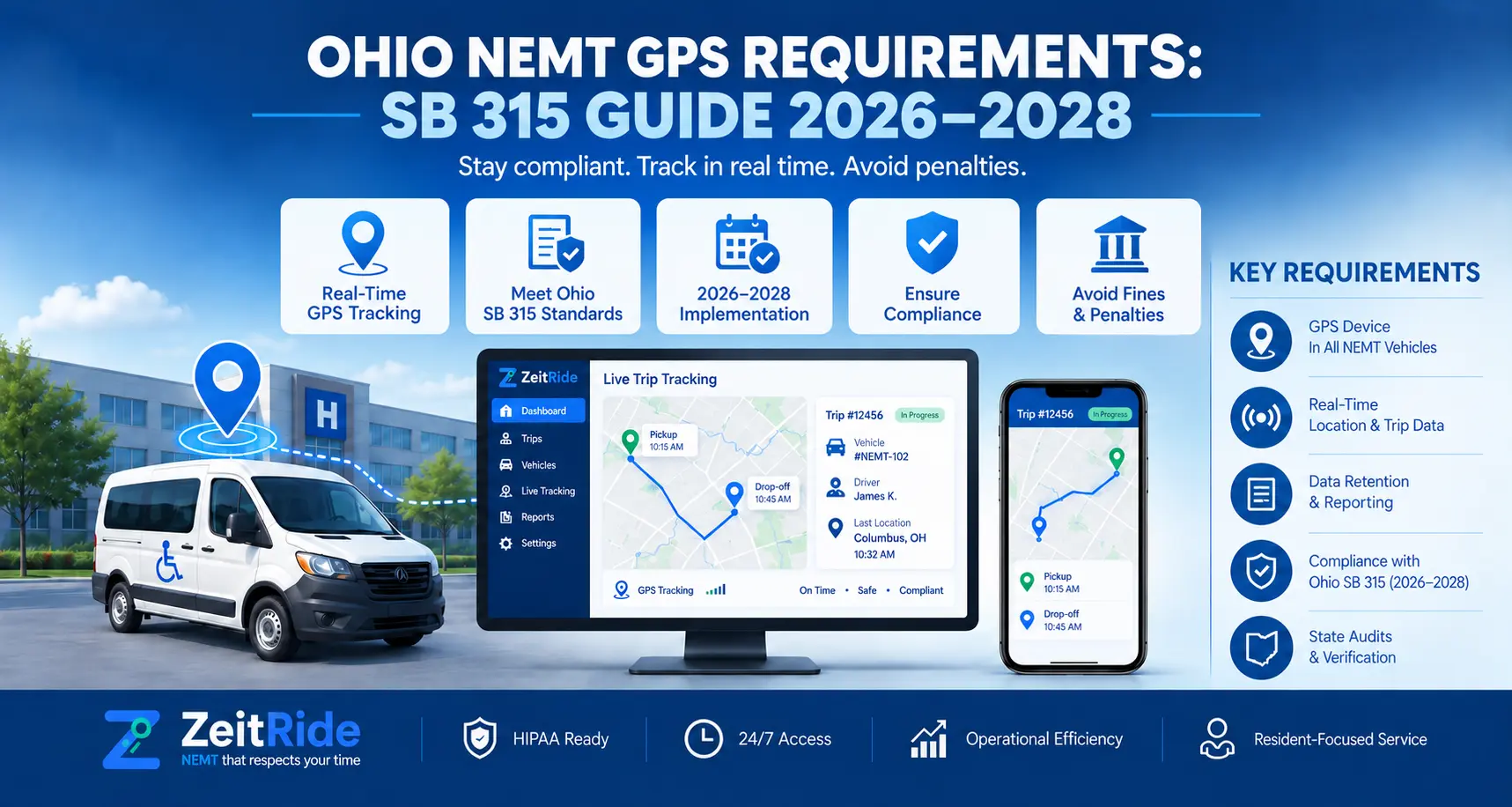
Ohio NEMT GPS Requirements: SB 315 Guide 2026–2028
Ohio SB 315 introduces GPS verification for Medicaid NEMT. Learn the rollout timeline, required trip data, payment rules, and how providers can prepare.
Quick answer
Ohio SB 315 takes effect October 6, 2026, but GPS verification does not become mandatory for all covered NEMT providers that day. ODM has up to 6 months for technical standards, 12 months for a pilot, and no later than 18 months for broader required use.
ZeitRide Team
NEMT Operations Expert
Ohio is changing how covered Medicaid non-emergency medical transportation trips will be verified. Senate Bill 315 creates a new electronic verification framework that directs the Ohio Department of Medicaid (ODM) to use GPS data to verify key NEMT trip events and connect that information with Medicaid payment and program-integrity systems. For transportation providers, one point needs to be clear from the start: October 6, 2026 is the effective date of the law. It is not the date every covered Ohio NEMT provider must suddenly begin using a new GPS verification system. The law creates a phased rollout extending into 2027 and, at the latest, 2028.
Quick Answer: What Are Ohio's New NEMT GPS Requirements?
Ohio's new framework requires ODM to develop, procure, certify, or approve an electronic verification system for Medicaid NEMT. The system must be capable of using GPS to verify arrival at the pickup location, initiation of transportation, arrival at the drop-off location, and completion of transportation. It must also record timestamps, route data, and total distance traveled and be capable of transmitting required information to ODM.
The law takes effect October 6, 2026, but implementation is phased. ODM has up to six months to develop technical standards and an implementation plan, up to twelve months to establish a pilot, and must begin requiring covered NEMT providers to use an established electronic verification system no later than eighteen months after the effective date.
When Do Ohio NEMT GPS Requirements Take Effect?
Providers should distinguish between the law's effective date and the provider implementation timeline. October 6, 2026 starts the statutory framework, but the Ohio SB 315 GPS requirements move through several implementation stages.
| Milestone | Statutory Timing | Approximate Deadline |
|---|---|---|
| SB 315 takes effect | Effective date | October 6, 2026 |
| Technical standards and implementation plan | Within 6 months | April 6, 2027 |
| Provider pilot | Within 12 months | October 6, 2027 |
| Required use by covered NEMT providers begins no later than | Within 18 months | April 6, 2028 |
These dates represent the outside deadlines established in the statute. ODM can move implementation steps earlier, so providers should monitor official rules and notices rather than treating April 2028 as the first date the issue matters. The practical takeaway is simple: SB 315 becomes effective in October 2026, while provider technology implementation happens in phases.
What Trip Data Will Ohio's Electronic Verification System Need?
Ohio Revised Code Section 5164.401 identifies several core capabilities for the NEMT electronic verification system. These requirements show why Ohio Medicaid NEMT GPS verification involves more than simply placing a tracking device in a vehicle.
| Trip Information | Required Capability |
|---|---|
| Pickup arrival | GPS-based verification |
| Transportation start | GPS-based verification |
| Drop-off arrival | GPS-based verification |
| Transportation completion | GPS-based verification |
| Trip timing | Timestamps |
| Route | Route data |
| Mileage | Total distance traveled |
| ODM reporting | Ability to transmit required data |
| Data protection | Encryption, role-based access controls, and audit logs |
A basic vehicle tracker may show where a van is without connecting that location to the correct rider, trip, pickup event, drop-off event, driver activity, or completed transportation record. Providers evaluating their technology should therefore look beyond the map itself. ZeitRide's NEMT GPS tracking software guide explains how GPS becomes more useful when location data, trip statuses, timestamps, routes, and dispatch records remain connected.
Can Missing GPS Data Affect Ohio Medicaid NEMT Payment?
Yes, once the electronic verification framework is fully implemented. Ohio Revised Code Section 5164.402 states that an NEMT provider will not be eligible to receive Medicaid payment for covered transportation unless the necessary data are submitted through an electronic verification system.
- Required GPS-based verification and timestamp data must be present.
- There must be no unresolved discrepancy involving the transportation claim.
That turns verification into more than a dispatch feature. It can become part of the revenue-cycle record supporting payment. For operators, the practical question is whether a completed trip can be traced clearly from assignment through pickup, transportation, drop-off, completion, and billing. If billing staff regularly have to reconstruct trips from driver messages, separate tracking systems, spreadsheets, and broker portals, review ZeitRide's guide on how to prevent NEMT billing errors.
What Happens if GPS or Cellular Service Fails?
Ohio's law recognizes that equipment and networks are not perfect. Section 5164.402 requires ODM to establish a process through which an NEMT provider may seek an exemption from electronic verification requirements.
- Equipment failure
- Network unavailability, including rural connectivity problems
- Emergencies
- Concerns involving the Medicaid recipient's safety
Providers should not treat these situations as automatic exceptions. The statute requires written documentation explaining why an exemption should be granted, and ODM must monitor how frequently providers request exemptions. Final procedures still have to be established through rulemaking.
Operationally, this makes offline workflow testing important. A provider should know what happens to trip statuses, GPS activity, and records when a driver enters an area with weak or no cellular service. ZeitRide's NEMT driver app supports offline GPS workflows and synchronization when connectivity returns. Providers should still compare any existing software capabilities with ODM's final technical standards once those standards are published.
How Will Ohio Use GPS Data for Program Integrity?
SB 315 is not simply a fleet-tracking initiative. Electronic verification is also intended to support Medicaid payment integrity and fraud prevention. The law directs ODM to develop automated tools capable of identifying irregular activity, including discrepancies between location information and submitted claims, and provides for audits and investigations using electronic verification data.
Over the longer term, ODM must develop a system capable of cross-referencing NEMT GPS data with claims submitted by other Medicaid providers. The goal is to help verify that transportation was connected to a Medicaid service and that relevant provider information was valid. The law also recognizes that legitimate exceptions can occur, including appointment rescheduling, provider cancellation, emergency diversion, delayed billing, and administrative errors.
This is why complete trip context matters. A GPS point may show where a driver was, but a useful transportation record should also explain which trip was being performed, what event occurred, and what happened next. ZeitRide's NEMT fraud prevention guide covers trip documentation, record consistency, and operational controls in more detail.
Does SB 315 Apply to Every Ohio Transportation Company?
Not necessarily. The statutory definition applies to nonemergency medical transportation provided to a Medicaid recipient under the applicable Medicaid transportation framework. Ohio law also excludes transportation conducted by certain licensed emergency medical service organizations and nonemergency medical service organizations.
Providers should therefore avoid assuming that every medical transportation business in Ohio falls under the same SB 315 requirements. A company's enrollment type, service model, payer relationships, and state classification may matter. This article provides general operational information and should not be treated as a determination that a particular organization is covered by the statute.
What Ohio NEMT Requirements Are Still Pending?
This is one of the most important issues for providers evaluating technology today. SB 315 establishes the framework, but ODM still has to adopt implementation rules covering several important details.
- Technical standards for electronic verification systems
- GPS intervals
- Criteria for certification of electronic verification systems
- Provider exemption procedures
- Audit and enforcement protocols
- Other standards needed to implement the verification framework
A software platform may already support GPS tracking, timestamps, trip records, offline workflows, or billing integration, but that does not automatically mean it has been formally approved under Ohio standards that are still being developed. Providers should be cautious about unsupported claims that a platform is already "SB 315 certified."
What Should Ohio NEMT Providers Do Now?
Providers do not need to replace their software simply because SB 315 has been enacted. A better first step is to understand the quality of the trip records and workflows they already have.
1. Map Your Trip Events
Confirm how your system records driver arrival, pickup, transportation start, drop-off, and trip completion.
2. Review GPS and Timestamp Records
Determine whether location and event times are captured during the trip or have to be reconstructed later.
3. Test Poor-Connectivity Scenarios
Run a realistic trip workflow with limited connectivity and see what happens to GPS data, statuses, and synchronization.
4. Review Route and Mileage History
Confirm whether a completed trip preserves route information and distance in a form your team can retrieve later.
5. Connect Trip Records to Billing
Make sure dispatch, driver activity, documentation, and billing all describe the same completed trip.
6. Monitor ODM Standards
Watch for technical standards, GPS intervals, certification criteria, pilot information, exemption procedures, and implementation guidance. ZeitRide's NEMT documentation requirements guide provides a broader checklist for keeping completed transportation records organized and easier to review.
How ZeitRide Fits Into Ohio's New Verification Direction
Ohio's final technical and certification standards are still pending, so ZeitRide should not be described as officially SB 315 certified today. What ZeitRide does provide is an operating environment that connects many workflows becoming increasingly important in NEMT verification: scheduling, dispatch, trip-linked GPS activity, driver statuses, offline GPS, electronic trip records, reporting, and billing workflows.
Keeping those functions connected can make it easier for a provider to understand what happened during a trip without rebuilding the record from several disconnected systems. GPS is more valuable when it is connected to the trip it is supposed to verify.
If your Ohio fleet currently relies on separate systems for dispatch, GPS, driver activity, documentation, and billing, explore ZeitRide's NEMT software to see how those workflows can operate together.
Bottom Line for Ohio NEMT Providers
Ohio NEMT GPS requirements are moving toward a formal electronic verification framework under SB 315. The law takes effect October 6, 2026, but covered providers do not all face an immediate technology mandate that day. ODM has a phased process for technical standards, a pilot, and broader required provider use.
The best preparation right now is not buying software based on an unsupported compliance claim. It is understanding whether your operation can reliably connect GPS activity, timestamps, trip events, route information, documentation, and billing, then comparing that workflow against ODM's final standards when they are published.
Want to see what a connected trip record looks like from assignment through billing? Contact the ZeitRide team and walk through one real NEMT workflow with us.
Important: This article reflects enacted Ohio law and publicly available information as of September 8, 2026. It is intended for general operational information and is not legal advice. ODM rules and implementation guidance may change after publication.
Frequently Asked Questions
Q: When do Ohio NEMT GPS requirements take effect?
Ohio Senate Bill 315 takes effect October 6, 2026, but that is not the universal provider implementation deadline. ODM has up to six months for technical standards and an implementation plan, twelve months for a pilot, and must begin requiring covered NEMT providers to use an electronic verification system no later than eighteen months after the effective date.
Q: What GPS information will Ohio NEMT providers need?
The statutory system must use GPS-based verification for pickup arrival, transportation start, drop-off arrival, and trip completion. It must also record timestamps, route data, and total distance traveled.
Q: Can missing GPS information affect Ohio Medicaid NEMT payment?
Upon full implementation, yes. Ohio law requires the applicable GPS-based verification and timestamp information to be present and requires that no unresolved discrepancy exist for a transportation claim submitted through the electronic verification system.
Q: What happens if an Ohio NEMT driver loses GPS or cellular connectivity?
Ohio law requires ODM to establish an exemption process that may cover equipment failure, network unavailability including rural connectivity issues, emergencies, and Medicaid recipient safety concerns. Providers seeking an exemption will need supporting written documentation.
Q: Is ZeitRide already SB 315 certified?
ZeitRide should not currently be described as officially SB 315 certified because ODM still must establish technical standards, GPS intervals, and certification criteria. ZeitRide does provide GPS-aware trip, driver, dispatch, documentation, reporting, and billing workflows relevant to the direction of the new framework.
Rather see it than read about it?
Bring a real route, a couple of drivers, and your current process. 15 minutes, zero pitch.