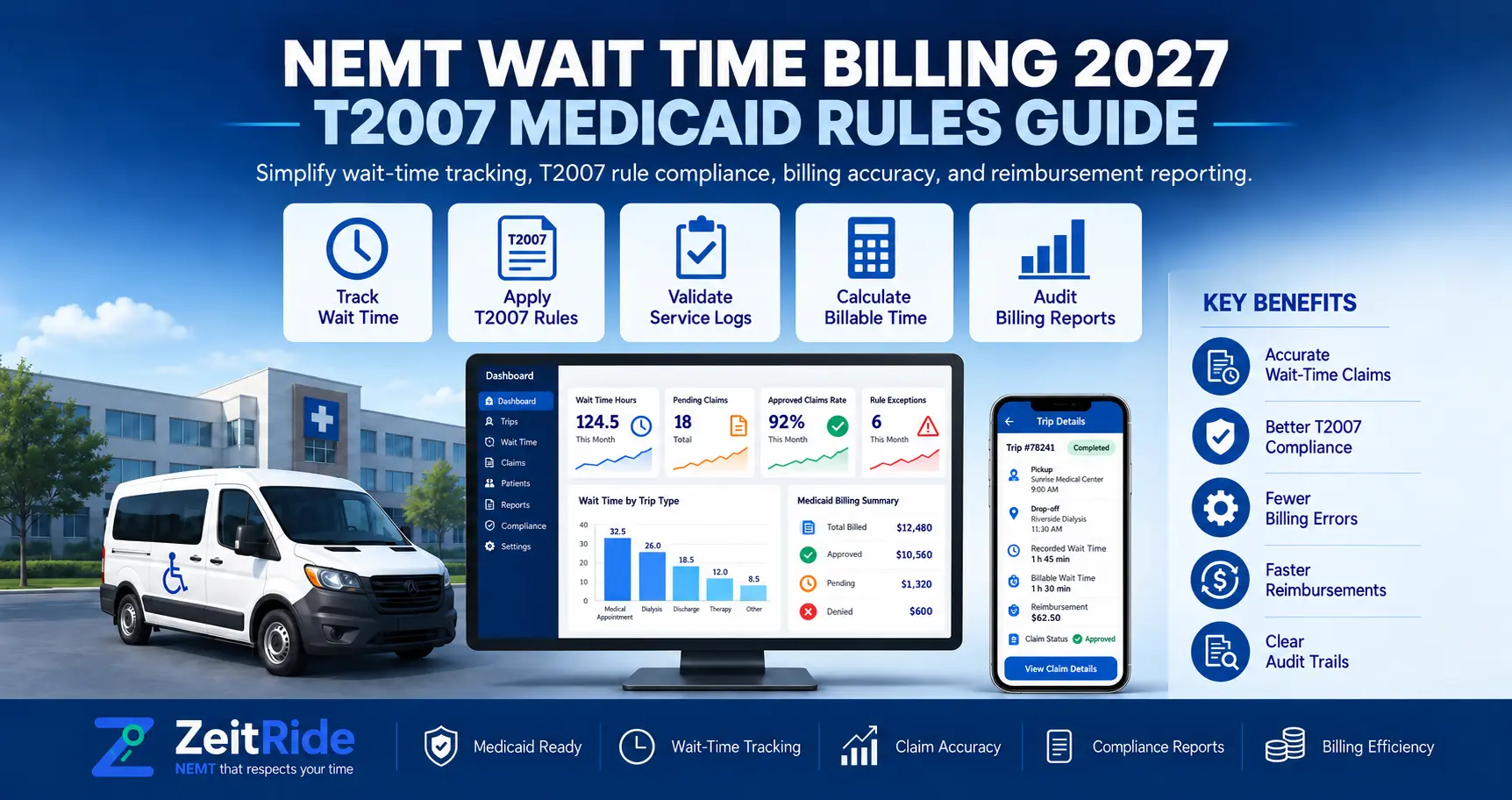
NEMT Wait Time Billing 2027: T2007 Medicaid Rules Guide
Learn how NEMT wait time billing works, including T2007, Medicaid rules, documentation requirements, reimbursement, and common billing mistakes.
Quick answer
NEMT wait time billing depends on the payer's rules for reimbursing time a driver and vehicle wait during a qualifying trip. T2007 represents 30-minute waiting-time units, but coverage, grace periods, limits, authorization, and documentation vary by state and payer.
ZeitRide Team
NEMT Operations Expert
Waiting at a medical facility can quickly turn a profitable NEMT trip into hours of lost driver and vehicle capacity. But a long wait does not automatically mean every minute can be billed. NEMT wait time billing depends on the rules of the Medicaid program, transportation broker, managed-care organization, facility contract, or other payer responsible for the trip.
The T2007 billing code provides a standard way to report transportation waiting time in 30-minute units. However, individual payers decide whether waiting is covered, when billable time starts, whether a grace period applies, how many units can be submitted, and what documentation is required. This guide explains how providers can evaluate waiting time, document it, calculate potential units, and connect the trip record to the billing process.
2027 planning note: This guide was prepared using information available as of October 7, 2026. CMS had published the October 2026 HCPCS update at the time of review, while the January 2027 update had not yet been released. Always verify the payer rule and fee schedule in effect on the actual date of service through the CMS HCPCS Quarterly Update and the applicable state or payer source.
What Is NEMT Wait Time Billing?
NEMT wait time billing is the process of seeking reimbursement for qualifying time that an NEMT driver and vehicle spend waiting during an eligible transportation assignment. The important word is qualifying. A driver's actual waiting time and a payer's billable waiting time may be different.
A payer may exclude an initial grace period, limit payable units, require authorization, restrict waiting to certain transportation levels, require the same vehicle or driver to remain, require exact start and end times, or include ordinary waiting within another transportation rate.
That means billing staff should verify the payer's requirements before turning driver downtime into a charge. Keeping trip activity connected with NEMT billing software can make that review easier because billing staff can work from the same underlying trip record instead of reconstructing events later.
What Is the T2007 Billing Code?
The T2007 billing code is the HCPCS Level II code used for transportation waiting time involving an air ambulance or non-emergency vehicle. One T2007 unit represents 30 minutes.
However, the existence of the code does not guarantee reimbursement. T2007 identifies the service being reported, while the applicable payer or program determines whether that waiting time is covered and what conditions must be satisfied.
| Question | Determined By |
|---|---|
| What does T2007 represent? | HCPCS |
| Length of one unit | 30 minutes |
| Is waiting covered? | Payer or program |
| Is there a grace period? | Payer or program |
| Maximum payable units | Payer or program |
| Authorization requirements | Payer or program |
| Documentation requirements | Payer or program |
| Reimbursement amount | Fee schedule or contract |
Does Medicaid Pay for NEMT Wait Time?
Sometimes. There is no single national rule that guarantees separate NEMT wait time reimbursement for every Medicaid transportation trip. Different state Medicaid programs, managed-care plans, transportation brokers, and provider contracts may treat waiting differently.
Before billing, providers should verify the payer responsible for the trip, whether waiting is separately reimbursable, whether T2007 applies, whether prior authorization is required, whether there is a non-billable grace period, whether units are capped, whether the vehicle must remain at the destination, and what evidence must be retained.
For the broader claims process, providers should also understand how to bill Medicaid for NEMT, because waiting time is only one part of a complete transportation billing workflow.
T2007 Rules by State: Why Requirements Differ
Understanding T2007 rules by state is important because Medicaid transportation programs do not all use identical waiting-time policies. The examples below demonstrate why providers should verify the rule that applies to their own payer rather than copying another provider's billing practice.
| Program Example | General Approach |
|---|---|
| California Medi-Cal | Certain qualifying wheelchair-van and litter-van waiting may be reimbursable after an initial waiting period, subject to program limits and documentation. |
| Arizona AHCCCS FFS | Qualifying actual waiting may be reimbursable when program requirements involving trip circumstances, driver and vehicle continuity, and other conditions are satisfied. |
| Indiana Medicaid | Transportation guidance allows qualifying waiting time within applicable transportation reimbursement rules and fee schedules. |
These examples are not a complete national reimbursement table. They demonstrate the core rule for Medicaid NEMT wait time billing: verify the specific program, contract, effective date, service level, authorization requirements, and documentation requirements before submitting a waiting-time charge.
California providers should verify current requirements in the Medi-Cal ground medical transportation provider manual. Arizona providers should use the current AHCCCS Fee-for-Service Provider Billing Manual. A provider operating in multiple states should never assume one state's policy applies to another.
How to Bill NEMT Wait Time
If you are determining how to bill NEMT wait time, use a consistent process rather than adding a waiting-time charge after the trip without verifying eligibility.
1. Identify the Payer
Determine whether the trip is paid through Medicaid fee-for-service, a managed-care organization, an NEMT broker, a healthcare facility, a private-pay agreement, or another contract. The party responsible for payment determines which rules apply.
2. Verify That Waiting Is Covered
Check the current provider manual, fee schedule, broker agreement, or contract. Do not assume that the existence of T2007 automatically means the payer reimburses waiting time.
3. Check Authorization Requirements
Confirm whether the transportation, service level, waiting period, or number of units requires prior authorization or another payer approval.
4. Record the Wait During the Trip
- Trip and member information
- Payer or broker
- Driver and vehicle
- Medical destination
- Arrival or drop-off time
- Wait-start time
- Wait-end time
- Return-pickup time
- Relevant driver or dispatcher notes
- Any trip exceptions
5. Apply Payer-Specific Rules
Remove any non-billable grace period and calculate units according to the payer's current instructions. Also verify maximum units, transportation-level restrictions, distance requirements, same-driver or same-vehicle rules, and any contract-specific conditions.
6. Reconcile the Payment
After submission, NEMT trip reconciliation can help identify whether the expected charge was paid correctly, reduced, denied, or never processed.
What Documentation Should Support Wait-Time Billing?
Strong documentation makes it possible to explain what happened during the trip and how the billed time was calculated. Exact requirements vary by payer, but the operational record should be detailed enough to connect the waiting-time charge to the actual transportation service.
- Trip ID
- Member information
- Payer or broker
- Authorization number when applicable
- Date of service
- Transportation service level
- Medical destination
- Driver and vehicle
- Arrival time
- Wait-start time
- Wait-end time
- Return-pickup time
- GPS or location information where applicable
- Odometer information where required
- Reason for waiting
- Billing code and units
- Relevant trip notes
Not every payer requires every item above. Always follow the applicable payer's requirements. For a broader framework covering authorizations, mileage, proof of service, driver records, and billing evidence, review ZeitRide's NEMT documentation requirements.
Example: Calculating T2007 Units
Assume a qualifying trip produces 75 minutes of total waiting time. If the applicable payer excludes the first 15 minutes, 60 minutes remain potentially billable. Because one T2007 unit represents 30 minutes, the calculation produces two potential units.
| Calculation | Time |
|---|---|
| Total wait | 75 minutes |
| Non-billable initial period | 15 minutes |
| Potentially billable time | 60 minutes |
| T2007 unit | 30 minutes |
| Potential units | 2 |
This does not automatically mean two units should be billed. The provider still needs to verify that waiting is covered, the transportation qualifies, required authorization exists, driver and vehicle requirements were satisfied, and supporting documentation is complete. A mathematically correct calculation does not make an otherwise ineligible wait payable.
Common NEMT Wait Time Billing Mistakes
- Assuming the T2007 billing code guarantees reimbursement
- Billing the driver's total elapsed waiting time instead of payer-defined billable time
- Using the wrong number of units
- Ignoring grace periods or maximum limits
- Reconstructing waiting-time records days or weeks after the trip
- Ignoring vehicle movement or driver-continuity requirements
- Applying another state's or another broker's rules to the trip
- Submitting a charge without required authorization or supporting documentation
If a waiting-time charge or another transportation claim is rejected, the NEMT claim denials guide can help separate documentation, authorization, coding, and payer-related causes.
Is Reimbursed Waiting Actually Profitable?
Not always. NEMT wait time reimbursement and NEMT wait-time profitability are different questions. A vehicle can receive payment for waiting and still lose money because the driver, vehicle, dispatch team, and fleet capacity remain committed to the trip.
- Driver wages and payroll burden
- Vehicle operating costs
- Dispatch and administrative overhead
- Idle time
- Deadhead if the driver leaves and returns
- Trips that the vehicle could have completed instead
A useful internal model is: Net wait cost = driver cost + vehicle cost + operating overhead + lost trip contribution - wait-time reimbursement. Providers should compare that figure with the cost of leaving and returning. ZeitRide's NEMT cost per trip calculator provides a broader framework for evaluating driver labor, vehicle expenses, deadhead, overhead, and trip profitability.
How NEMT Software Can Support the Workflow
Software cannot decide that a waiting period is legally or contractually billable without the correct payer rules. What it can do is keep the underlying trip activity organized so the billing team is not rebuilding the trip from disconnected records.
A connected workflow can preserve the relationship between the trip request, driver and vehicle, status activity, timestamps, trip history, documentation, billing-ready record, and payment reconciliation.
ZeitRide connects scheduling, dispatch, driver activity, trip documentation, billing workflows, and reconciliation around the same transportation record. The software supports the evidence workflow, while the transportation provider remains responsible for following the applicable payer requirements.
NEMT Wait Time Billing Checklist
- Confirm the correct payer or broker
- Verify that waiting is separately reimbursable
- Use the rule effective on the date of service
- Confirm that T2007 or the payer's required billing method applies
- Verify required authorization
- Document the qualifying wait-start and wait-end times
- Remove any applicable grace period
- Calculate units according to payer instructions
- Apply maximum units and other restrictions
- Verify driver and vehicle requirements
- Make sure trip activity supports the billed wait
- Confirm that the billing record matches the operational record
- Track the expected payment through reconciliation
The Bottom Line
NEMT wait time billing is not simply a matter of counting how long a driver remained at a medical facility. T2007 creates a standardized 30-minute waiting-time unit, but the payer determines whether the service is covered and what conditions must be met.
The strongest process connects payer rules, trip evidence, and billing records. Verify eligibility first, document the wait while it happens, calculate units according to the applicable rule, and track the resulting payment through reconciliation. That approach can protect revenue while reducing unsupported or poorly documented wait-time claims.
See the Trip-to-Billing Workflow in ZeitRide
If your billing team has to reconstruct driver activity, timestamps, trip notes, and billing information after every exception, bring one real completed trip to a ZeitRide demo. See how ZeitRide's NEMT software keeps scheduling, dispatch, driver activity, documentation, billing-ready information, and reconciliation connected around the same trip.
Bring one completed trip plus the payer or broker rule you currently follow and book a 15-minute ZeitRide demo to see how the workflow can be managed in one platform.
Frequently Asked Questions
Q: What is the T2007 billing code?
T2007 is the HCPCS Level II code for transportation waiting time involving an air ambulance or non-emergency vehicle. One unit represents 30 minutes, but reimbursement depends on the applicable payer's coverage, authorization, documentation, and billing rules.
Q: Does Medicaid pay for NEMT wait time?
Some Medicaid programs reimburse qualifying NEMT waiting time, while others apply different restrictions or payment methods. Providers should verify the rules of the state program, managed-care plan, broker, or payer responsible for the trip.
Q: How many minutes are in one T2007 unit?
One T2007 unit represents 30 minutes of transportation waiting time. A payer may still apply a grace period, minimum waiting requirement, maximum units, or other restrictions before determining the number of payable units.
Q: How do you bill NEMT wait time?
Identify the payer, confirm that waiting is covered, verify authorization, document the qualifying wait, apply the payer's grace period and unit rules, check limits, and make sure the billing record matches the trip documentation.
Q: What documentation should support NEMT wait time?
Depending on payer requirements, documentation may include trip and member information, authorization, driver and vehicle details, medical destination, arrival and waiting timestamps, GPS or odometer information, notes, billing code, and billed units.
Q: Can every 30 minutes of driver waiting be billed as T2007?
No. T2007 defines a 30-minute unit, but that does not mean every 30 minutes of waiting is reimbursable. Coverage, grace periods, authorization, maximum units, vehicle requirements, and documentation depend on the payer.
Rather see it than read about it?
Bring a real route, a couple of drivers, and your current process. 15 minutes, zero pitch.