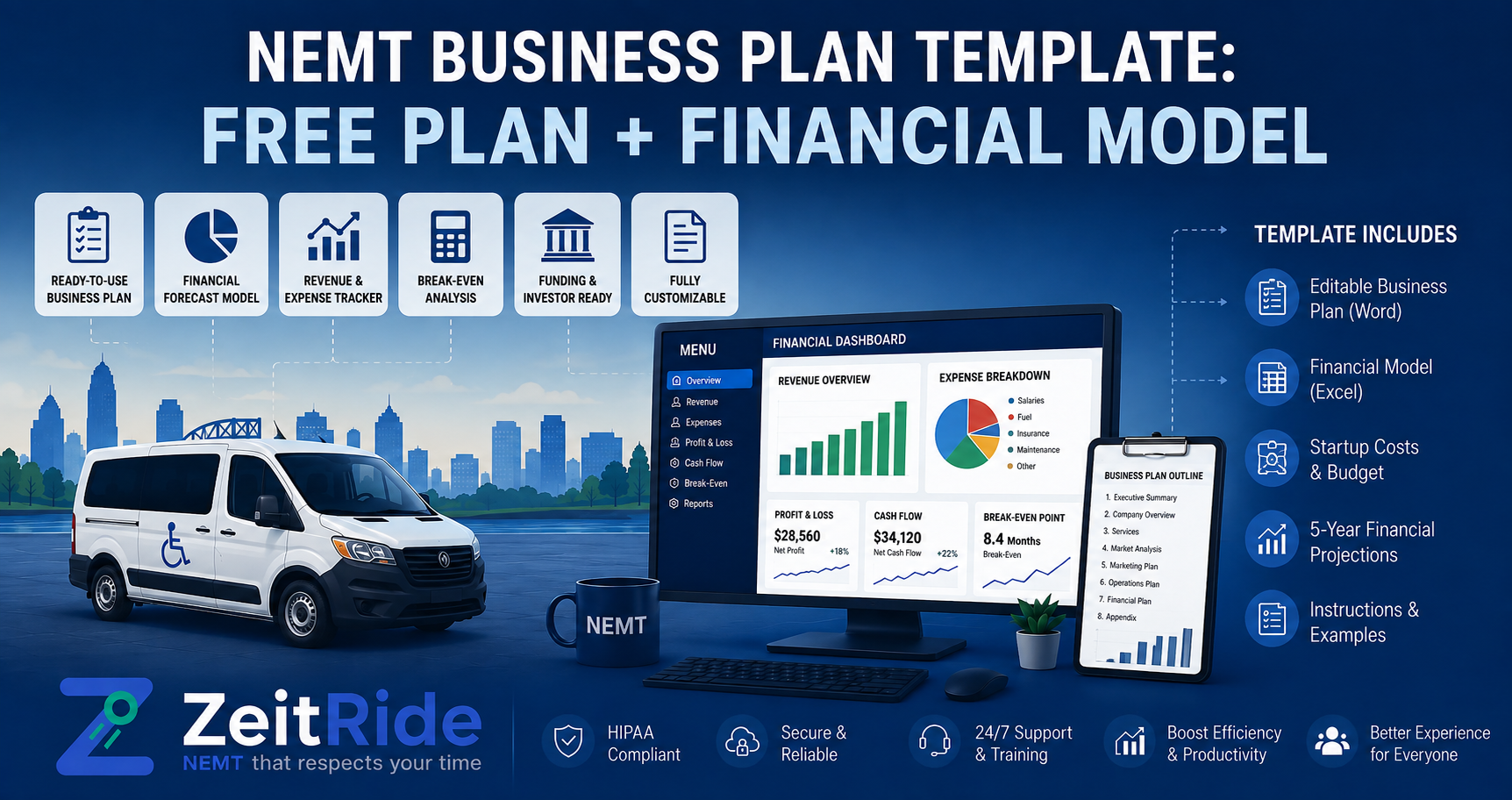
NEMT Business Plan Template: Free Plan + Financial Model
Build a practical NEMT business plan with a free editable framework, financial model, sample assumptions, and U.S. provider guidance.
Quick answer
A NEMT business plan should define your market, services, payer mix, fleet, staffing, compliance, operating workflow, startup costs, pricing, and financial projections. Build the numbers from realistic trips, collected revenue, mileage, labor, and overhead.
ZeitRide Team
NEMT Operations Expert
Starting an NEMT company requires more than choosing a vehicle and finding passengers. You need to know who will pay for trips, what each completed trip costs, how many rides your vehicles need to complete, and whether the business can support its monthly expenses. This NEMT business plan template gives U.S. providers a practical framework for organizing those decisions. You can copy the structure into Word or Google Docs and build the financial section in Excel or Google Sheets. If you are still working through the basic launch requirements, first review what you need to start a medical transportation business.
What Should an NEMT Business Plan Include?
A non emergency medical transportation business plan should explain how the company will attract trips, operate those trips, stay compliant, control costs, and generate sustainable revenue. The strongest plans connect the written strategy directly to real operating assumptions instead of relying on generic transportation-industry language.
| Section | What to Include |
|---|---|
| Executive Summary | Business concept, service area, fleet, target customers, funding needs, and goals |
| Company Description | Ownership, legal structure, location, mission, and launch stage |
| Market Analysis | Local demand, healthcare facilities, competitors, and service gaps |
| Services | Ambulatory, wheelchair, or other services you are qualified to provide |
| Payer Strategy | Medicaid or brokers, healthcare facilities, private pay, and other contracts |
| Operations | Scheduling, routing, dispatch, drivers, documentation, and billing |
| Fleet & Staffing | Vehicles, drivers, administrative needs, and expansion plans |
| Compliance | Insurance, enrollment, driver, vehicle, and state requirements |
| Marketing & Contracts | Broker enrollment, facility outreach, referrals, and private-pay acquisition |
| Financial Plan | Startup costs, revenue, expenses, break-even, working capital, and cash flow |
Free NEMT Business Plan Template
Use the framework below as your free NEMT business plan template. Replace each prompt with information from your own service area, payer relationships, insurance quotes, vehicle costs, staffing plan, and expected trip volume.
Executive Summary
- Company name and operating location
- Cities, counties, or service area
- Transportation services you plan to provide
- Initial fleet size
- Target customers and payers
- Expected launch date
- Funding requirement, if applicable
- First-year business goal
Market and Customer Plan
Identify where your trips are realistically likely to come from. Review hospitals, dialysis centers, rehabilitation facilities, skilled nursing facilities, adult-day programs, Medicaid transportation networks, and private-pay demand in your actual market. National market statistics can provide context, but your plan should be built around local demand you can realistically serve.
Operations Plan
Explain how a trip moves through your company from request to payment. Technology should support this workflow rather than appear as an unexplained software expense. ZeitRide's NEMT software connects scheduling, routing, live dispatch, driver workflows, broker integrations, billing, and reporting in one platform.
- Receive and verify the trip request
- Confirm rider, appointment, mobility, and payer information
- Assign an appropriate driver and vehicle
- Route and dispatch scheduled trips
- Capture trip status, mileage, signatures, and required documentation
- Review completed trips for billing
- Reconcile payments and exceptions
How to Write a NEMT Business Plan Around Real Numbers
If you are researching how to write a NEMT business plan, build the operating and financial assumptions before writing pages of narrative. Start by determining how many vehicles will operate, how many completed trips each vehicle can realistically perform, how much revenue you expect to collect per trip, what each trip costs, and what fixed monthly expenses the company must cover.
Do not copy another provider's rates into your forecast. Their driver wages, insurance, mileage, contracts, vehicle costs, and route density may be completely different. Use the NEMT cost per trip calculator to structure your real trip economics. If you are developing direct-pay or facility pricing, the NEMT rate sheet template can help translate those costs into a practical rate structure.
NEMT Business Plan Example
The following NEMT business plan example shows how a simple two-vehicle operating model can be structured. These numbers are hypothetical examples only. They are not industry averages or recommended rates.
| Planning Assumption | Example |
|---|---|
| Active vehicles | 2 |
| Operating days per month | 22 |
| Trips per vehicle per day | 4 |
| Completed trips per month | 176 |
| Average collected revenue per trip | $60 |
| Variable cost per trip | $18 |
| Monthly fixed costs | $6,500 |
Using these example assumptions, monthly collected revenue would be $10,560. Variable trip costs would be $3,168, leaving an estimated operating result of $892 after the example $6,500 in fixed expenses. The purpose is not to recommend a $60 trip rate. It is to show the relationship between completed trips, collections, variable costs, fixed costs, and profitability. Replace every number with your own verified assumptions.
NEMT Financial Projection Template
A useful NEMT financial projection template should be driven by operating activity rather than an arbitrary annual revenue-growth percentage. At minimum, track active vehicles, operating days, completed trips per vehicle, collected revenue per trip, variable trip costs, fixed monthly expenses, and actual cash collected.
- Completed trips per month = Active vehicles × Operating days × Trips per vehicle per day
- Monthly revenue = Completed trips × Average collected revenue per trip
- Contribution margin per trip = Collected revenue per trip − Variable cost per trip
- Break-even trips per month = Fixed monthly costs ÷ Contribution margin per trip
Your model should also account for payment timing. A trip may be completed today while payment arrives later, but payroll, fuel, insurance, vehicle expenses, and software still have to be paid. For a deeper breakdown of the expenses to model, review how much it costs to start an NEMT business.
Where Will Your NEMT Trips Come From?
A financial forecast is only useful if the trip-volume assumptions have a believable source. Your business plan should identify specific channels you will pursue instead of simply saying the company will market locally.
- Medicaid or transportation broker networks
- Dialysis centers
- Hospitals and discharge teams
- Skilled nursing facilities
- Rehabilitation facilities
- Adult-day programs
- Private-pay customers
Turn those channels into measurable activities such as broker applications, facility outreach, meetings, proposals, and recurring routes. ZeitRide's guide on how to get NEMT contracts explains the main contract and referral channels in more detail.
Do Not Treat Compliance as a Generic Checklist
NEMT requirements can differ by state, payer, broker, service level, and contract. Your plan should document which insurance, driver, vehicle, provider-enrollment, inspection, operating-authority, and documentation requirements apply to your actual operation. If Medicaid transportation will be part of the business, review how to become a Medicaid transportation provider and verify final requirements with the applicable state Medicaid agency or contracted program.
Common NEMT Business Plan Mistakes
- Using billed revenue instead of expected collected revenue
- Ignoring deadhead and nonproductive mileage
- Assuming every scheduled trip will be completed
- Copying competitor rates without knowing your own costs
- Underestimating working capital requirements
- Adding vehicles before existing vehicles are productively utilized
- Using generic compliance requirements from another state
- Forecasting trip volume without identifying where the trips will come from
Turn Your Business Plan Into an Operating Plan
The best NEMT business plan template remains useful after launch. Track planned versus actual trips per vehicle, collected revenue per trip, cost per trip, vehicle utilization, deadhead mileage, cancellations, and cash collections. Those numbers tell you when the operation is improving and when an expansion assumption needs to be reconsidered.
As your fleet grows, the system used to schedule, route, dispatch, document, and bill trips becomes part of the financial model too. ZeitRide combines those workflows in one platform with pricing based on active vehicles, making the software expense easier to model as fleet size changes.
Already know your planned fleet size and expected trip volume? See how ZeitRide works for NEMT providers and evaluate the workflow your business plan will eventually need to run.
Frequently Asked Questions
Q: What should an NEMT business plan include?
An NEMT business plan should cover your market, services, payer strategy, fleet, staffing, operations, compliance, contracts, startup expenses, pricing, financial projections, working capital, and funding needs.
Q: How do I create a NEMT business plan?
Start with your service area, payer channels, fleet, trip workflow, costs, and realistic trip-volume assumptions. Build the financial model first, then write the company, market, operations, and growth sections around those numbers.
Q: Can I use a generic transportation business plan for NEMT?
A generic transportation business plan can provide the basic structure, but an NEMT plan should also address payer relationships, medical transportation service levels, vehicle and driver requirements, scheduling, routing, documentation, billing, and state-specific compliance.
Q: What should an NEMT financial projection template include?
It should include expected completed trips, collected revenue, variable trip costs, fixed expenses, contribution margin, break-even volume, operating profit or loss, and cash-flow timing.
Q: How do I calculate break-even trips for an NEMT company?
Subtract variable cost per trip from average collected revenue per trip to calculate contribution margin. Divide monthly fixed expenses by that contribution margin to calculate the number of completed trips needed to break even.
Rather see it than read about it?
Bring a real route, a couple of drivers, and your current process. 15 minutes, zero pitch.