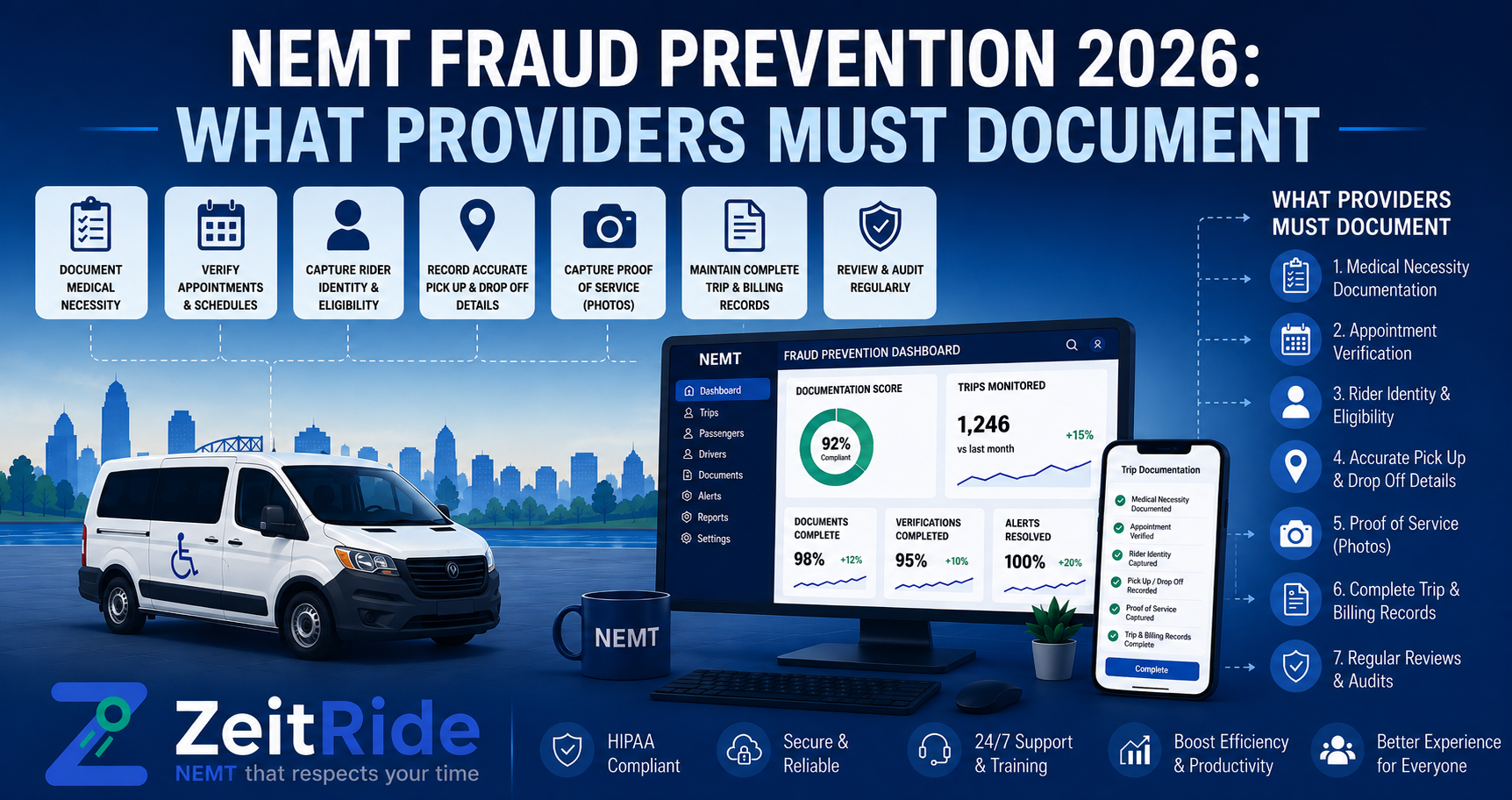
NEMT Fraud Prevention 2026: What Providers Must Document
Recent NEMT fraud cases and audits show why trip records matter. Learn the red flags, controls, and documentation providers should review in 2026.
Quick answer
NEMT fraud prevention means making every billed trip traceable from authorization through payment. Providers should verify rider, driver, vehicle, timestamps, mileage, proof of service, billing, corrections, and reconciliation while preserving an audit trail.
ZeitRide Team
NEMT Operations Expert
A completed NEMT trip should leave behind a record that another person can understand without calling the driver, searching through text messages, or rebuilding the day from a broker portal. That basic operational principle has become especially relevant in 2026.
On August 19, 2026, new reporting from Massachusetts put medical transportation recordkeeping back in the spotlight as an ongoing MassHealth fraud case raised disputes over scheduling and billing records. The underlying indictment itself dates to 2025, so this is not a newly filed case. But the current dispute highlights a question every Medicaid transportation provider should be able to answer: if a trip is challenged months or years later, can your organization independently show what happened?
The Massachusetts story is only one signal. The U.S. Department of Justice's 2026 National Health Care Fraud Takedown included NEMT-related cases, while HHS-OIG launched an active series of Medicaid NEMT audits in May 2026. For legitimate operators, NEMT fraud prevention is not about assuming every mistake is criminal. It is about building enough control around trip execution and billing to identify unsupported records, inconsistencies, and unusual activity before a claim leaves your organization.
Providers that need a deeper field-by-field record checklist should separately review ZeitRide's NEMT documentation requirements. This guide focuses specifically on fraud-prevention lessons, trip integrity, and internal controls.
What Is NEMT Fraud Prevention?
NEMT fraud prevention is the combination of operational controls, documentation, review processes, and staff accountability used to reduce the risk that false, unsupported, duplicate, or improperly billed transportation claims enter the Medicaid payment process.
The word fraud matters. Medicaid fraud generally involves intentional deception or misrepresentation for an unauthorized benefit. A missing field, incorrect timestamp, or ordinary billing mistake is therefore not automatically fraud. However, inaccurate or incomplete records can still create denials, overpayments, repayment demands, audit findings, and situations where a provider cannot adequately support a legitimate service.
The strongest operating model is not to assume everyone is committing fraud. It is to make every claim traceable enough that unusual activity, inconsistencies, and unsupported billing become visible before submission.
Why Is NEMT Fraud Prevention Getting More Attention in 2026?
HHS-OIG Has an Active Medicaid NEMT Audit Series
On May 28, 2026, the HHS Office of Inspector General published an active audit series covering Medicaid non-emergency medical transportation services. According to OIG's published objective, selected states will be reviewed to determine whether they complied with Medicaid payment requirements for NEMT. OIG also notes the importance of providers being properly authorized and maintaining records supporting the transportation services provided.
This is an audit initiative, not a new nationwide NEMT regulation. The practical signal is still important: Medicaid NEMT payments and the records supporting those payments are receiving current federal oversight attention.
DOJ's 2026 Health Care Fraud Takedown Included NEMT Cases
On June 23, 2026, the U.S. Department of Justice announced its National Health Care Fraud Takedown involving 455 defendants and more than $6.5 billion in alleged health care fraud across the broader health care system. Most of those cases were not NEMT matters, but DOJ's published case summaries included Medicaid transportation cases.
In New Mexico, for example, authorities alleged billing for transportation that did not occur, duplicate trips, inflated mileage, and falsified transportation records. These are allegations tied to specific cases, not proof that these issues are widespread across legitimate NEMT providers.
A July NEMT Guilty Plea Shows Why Trip Records Matter
On July 20, 2026, DOJ announced that a New Mexico woman who had worked as an NEMT driver pleaded guilty to conspiracy to commit health care fraud. Court documents described by DOJ involved false trip records, trips that did not occur, false passenger representations, and Medicaid claims connected to those records.
For legitimate providers, the useful lesson is not simply that fraud is illegal. The operational question is whether your systems and review processes make nonexistent trips, improbable trip combinations, unsupported mileage, duplicate billing, or inconsistent rider information easier to identify before claims are submitted.
Massachusetts Is Putting Recordkeeping Under a Fresh Spotlight
Fresh reporting published August 19, 2026 examined an ongoing Massachusetts medical transportation fraud prosecution in which the defense has raised disputes involving broker and vendor recordkeeping. The allegations remain allegations, and the defendant contests them.
Separately, Massachusetts' own audit work involving MassHealth transportation has identified instances where transportation services lacked sufficient supporting documentation. Together, these developments reinforce a practical operational lesson: a transportation provider should understand which trip records it controls, where those records live, and whether they can still be produced after a broker, vendor, driver, or software relationship changes.
What Are the Most Important NEMT Fraud Red Flags?
NEMT fraud red flags are signals that deserve review, not automatic proof that fraud occurred. Some anomalies result from ordinary mistakes, connectivity problems, data imports, unusual trip circumstances, or legitimate changes made during service. A red-flag process should identify records requiring human review before they become claims or unresolved audit problems.
| Red Flag | Why It Deserves Review | Useful Control |
|---|---|---|
| Trip billed with no completed-trip record | Service may be unsupported | Require completed trip information before billing |
| Duplicate trip or claim | The same service may have entered billing twice | Duplicate detection and reconciliation |
| Rider has overlapping trips | Timing may be impossible or incorrectly recorded | Review timestamps and rider history |
| Driver has overlapping trips | Driver assignment may be incorrect | Compare driver status and trip timeline |
| Mileage materially differs from expected trip | Could indicate an error, detour, or unsupported mileage | Compare recorded and billed mileage |
| Completed trip lacks pickup or drop-off evidence | Completion may be difficult to support | Require applicable proof-of-service fields |
| Cancellation or no-show later appears completed | Trip status may have been changed incorrectly | Preserve status and change history |
| Service level differs from authorization | Claim may not match approved transportation | Validate authorization before billing |
| Driver or vehicle was not eligible on service date | Service may conflict with program or contract rules | Validate credential dates |
| Large edits occur after trip completion | The change may require explanation | Maintain user-attributed change history |
| Broker and provider records disagree | One record may be incomplete or incorrect | Run exception reconciliation |
| The same unusual pattern appears repeatedly | Could indicate a workflow or integrity problem | Trend and exception review |
NEMT False Claims: When Is an Error More Than an Error?
Operators should avoid using fraud, error, and false claim as interchangeable terms. An incorrect claim can result from a typo, software mapping issue, missing documentation, misunderstanding of payer rules, or another operational mistake. Fraud generally involves intentional deception or misrepresentation.
Civil false-claims exposure can involve legal standards that go beyond a proven criminal fraud conviction, so providers that discover potentially serious billing issues should follow their compliance process and seek qualified legal or compliance advice when appropriate.
- Do not hide known discrepancies.
- Do not change records simply to make a claim appear supportable.
- Preserve the original record and correction history.
- Investigate repeated or unusual patterns.
- Escalate material issues through the appropriate compliance process.
- Correct or hold claims when supporting information remains unresolved.
A prevention program should help staff distinguish a one-off mistake from a repeated pattern that deserves investigation. Your billing team should also have a defined process to prevent NEMT billing errors before ordinary data-quality problems reach the payer.
Can You Prove Every NEMT Trip You Bill?
This is one of the most useful internal questions a Medicaid transportation company can ask. A reviewer looking at the file months later should be able to move through a logical evidence chain: authorization, rider, driver, vehicle, pickup, transportation, drop-off, proof of service, billing, and payment.
The record does not need to look identical for every payer. Exact requirements vary by state Medicaid program, managed-care organization, broker, contract, and service type. But the individual pieces should tell the same basic story.
| Trip Element | Record to Preserve | What It Helps Establish |
|---|---|---|
| Trip request | Broker assignment, order, or internal booking | Why the trip entered the system |
| Authorization | Authorization or reference data where applicable | Approved service |
| Rider | Member or trip identifier | Who received transportation |
| Driver | Assigned driver and eligibility status | Who performed the service |
| Vehicle | Assigned vehicle and required status | What vehicle performed the trip |
| Pickup | Address, actual time, and status | Where and when service began |
| Trip activity | Status history and route or GPS data where applicable | What happened during execution |
| Drop-off | Destination, actual time, and status | Where and when service ended |
| Proof of service | Required signature, attestation, or equivalent | Supports completion |
| Mileage | Applicable mileage record | Supports mileage-dependent billing |
| Exception | No-show, cancellation, delay, or address change | Explains deviations |
| Claim | Code, units, rate, and submission record | What the provider billed |
| Payment | Remittance or adjustment record | What the payer actually paid |
| Corrections | Who changed what, when, and why | Preserves record integrity |
Why Provider Records Should Not Depend Entirely on a Broker Portal
Brokers play an essential role in many Medicaid NEMT programs, and the goal is not to unnecessarily duplicate every part of broker infrastructure. Providers should, however, understand which operational records they can independently retrieve.
- Can we export completed trips?
- Do we preserve the original broker reference?
- Can we retrieve historical driver assignments?
- Can we retrieve pickup and drop-off information?
- Who retains GPS or location history?
- Can we identify changes made after trip completion?
- How long are records available?
- What happens if our broker changes?
- What happens if our software vendor changes?
- Can finance reconcile broker payments against our completed trips?
This is where NEMT trip reconciliation becomes more than a revenue exercise. Reconciliation can expose completed trips that were never paid, payments with no matching internal record, duplicate records, unexpected rate differences, and other exceptions that deserve investigation.
The goal is not to distrust brokers. The goal is to avoid having a critical part of your operating history exist only in a system your company does not control.
Can GPS Prove That an NEMT Trip Happened?
GPS can strengthen a trip record, but GPS alone does not prove every element necessary to support a Medicaid transportation claim.
| GPS Can Help Establish | GPS Generally Cannot Establish by Itself |
|---|---|
| Approximate vehicle location | Whether the rider was eligible |
| Time at or near a location | Whether the transportation was authorized |
| Route history | Which passenger was physically in the vehicle |
| Travel sequence | Whether the correct service level was delivered |
| Distance context | Whether a required signature was collected |
| Location evidence | Whether the submitted billing code was correct |
That is why GPS should support a broader NEMT trip verification process rather than being treated as a substitute for the rest of the trip record. A GPS point becomes substantially more useful when it is connected to a driver, vehicle, trip identifier, pickup or drop-off event, timestamp, and completed-trip history.
How Should Dispatch, Driver, and Billing Records Match?
Fraud prevention becomes easier when operational and financial records are connected. Consider a legitimate scheduled NEMT trip:
| Record | Example |
|---|---|
| Scheduled pickup | 9:00 a.m. |
| Driver arrival | 8:55 a.m. |
| Pickup status | 9:03 a.m. |
| Location record | Pickup address or area |
| Destination arrival | 9:34 a.m. |
| Drop-off status | 9:36 a.m. |
| Completed status | 9:38 a.m. |
| Service level | Matches authorization |
| Mileage | Consistent with recorded trip |
| Billing | Matches completed service |
Those values do not need to match a theoretical route perfectly. Traffic, detours, facility entrances, member delays, and other real-world conditions happen every day. The question is whether the complete record is reasonable and internally consistent.
Now imagine the billing record says a rider traveled 42 miles while the driver record shows a 12-mile trip and there is no exception explaining the difference. That does not prove NEMT billing fraud, but it does mean the claim probably deserves review before submission.
Staff responsible for Medicaid NEMT billing should have a clear process for holding records that contain unresolved inconsistencies.
10 NEMT Fraud-Prevention Controls Providers Should Review
- Require meaningful trip completion. A completed status should mean required trip information is sufficiently complete, not simply that a driver tapped a button.
- Validate authorization where applicable. Compare the service performed with the approved trip and service level.
- Review duplicate trips and claims. Flag duplicate identifiers, rider and time combinations, and repeat submissions.
- Compare mileage with trip activity. Investigate material unexplained differences before billing.
- Preserve no-shows and cancellations. Do not allow failed trips to silently become completed trips.
- Maintain driver and vehicle eligibility history. Eligibility should be verifiable for the actual date of service.
- Preserve change history. Corrections should identify who changed the record and when.
- Review exception patterns. One unusual trip may have a simple explanation; repeated exceptions may reveal a broken workflow.
- Reconcile payments against completed trips. Compare operations, submissions, and remittance rather than treating them as separate processes.
- Perform sample-based internal reviews. Regularly reconstruct completed claims before an outside reviewer does it for you.
What Happens During an NEMT Medicaid Audit?
There is no single audit script used by every state, payer, broker, or government reviewer. However, an NEMT Medicaid audit can involve comparing claims with records supporting whether the transportation was authorized, performed, properly documented, and billed according to applicable program requirements.
HHS-OIG's active 2026 Medicaid NEMT audit series states that selected states will be reviewed for compliance with Medicaid payment requirements and notes the importance of provider authorization and records supporting the services provided.
ZeitRide's detailed NEMT documentation requirements guide covers the records providers may need to evaluate when creating an audit-ready process. The key operational test is simple: could someone who was not present reconstruct why the claim was submitted?
Does the 2026 Enforcement Activity Create a New Federal NEMT Rule?
No. The DOJ enforcement cases, Massachusetts reporting, and HHS-OIG audit series do not by themselves create a new nationwide documentation rule for every NEMT provider.
States can use different Medicaid delivery models, reimbursement methods, broker arrangements, authorization rules, documentation requirements, and retention periods. Providers should verify the requirements that apply to their state Medicaid program, transportation broker, managed-care organization, payer, contract, and service level.
The reason these 2026 developments matter is not because they created one new federal checklist. They matter because they show how central trip integrity, supporting documentation, and billing accuracy remain to Medicaid program oversight.
What Should an NEMT Provider Do This Week?
You do not need to wait for an audit notice to find out whether your records work. Take a random sample of 10 recently billed Medicaid trips and try this internal review.
- Pull the original trip request or broker assignment.
- Confirm the authorization information that applies.
- Identify the driver and vehicle used.
- Compare scheduled and actual pickup and drop-off activity.
- Review applicable GPS, timestamps, signatures, or attestations.
- Compare recorded mileage with billed mileage.
- Confirm the billed service matches the completed service.
- Review any cancellation, no-show, delay, or correction.
- Match the submitted claim to the completed trip.
- Match the payment or remittance back to the claim.
Try to perform the review without calling the driver first. If the reviewer cannot understand what happened from the existing record, you have identified a process weakness worth fixing. If the same weakness appears across several sampled trips, fix the workflow rather than merely correcting individual files.
Where Software Fits Into NEMT Fraud Prevention
Software cannot determine that a person committed fraud, and installing software does not make a provider automatically compliant. Its more realistic role is to make trip activity structured enough that inconsistencies are easier to identify.
- Trip assignments
- Driver and vehicle information
- Actual trip statuses
- Timestamps
- GPS-aware trip activity
- Electronic forms and signatures
- Billing-ready trip information
- Claim activity
- Reconciliation
- User-attributed changes
ZeitRide's NEMT billing software is designed to keep billing workflows connected with executed trip data rather than forcing finance teams to reconstruct services from disconnected systems.
That connection does not replace Medicaid, payer, broker, legal, or contractual requirements. It gives your team a cleaner operational foundation for applying them.
The Best Fraud-Prevention Question Is Simple: Does the Claim Match the Trip?
The strongest NEMT fraud prevention strategy is not built around fear of investigators. It is built around routine operational discipline.
The trip that was authorized, the trip dispatch saw, the trip the driver performed, the record your system preserved, and the claim billing submitted should describe the same transportation service. When they do not, the discrepancy should be visible and reviewable before payment rather than discovered months later during an audit.
The enforcement and audit activity receiving attention in 2026 gives providers another reason to review these controls now. Clean records are valuable even when no regulator ever asks for them because they improve billing accuracy, reduce avoidable disputes, make reconciliation easier, and give managers a clearer picture of how their operation actually runs.
Test Your Trip-to-Billing Record Before Someone Else Does
Choose one recently completed Medicaid trip and trace it from authorization through payment. If your team has to open multiple spreadsheets, call the driver, search text messages, or manually rebuild the route to explain the claim, that is an operational gap worth addressing.
Want to see what the same workflow looks like when dispatch, driver activity, trip documentation, and billing stay connected? See how ZeitRide works using a real NEMT workflow.
Frequently Asked Questions
Q: What is NEMT fraud prevention?
NEMT fraud prevention is the use of operational controls, accurate documentation, internal review, and billing validation to reduce the risk of false, unsupported, duplicate, or improperly billed transportation claims. Effective prevention also makes unusual activity easier to identify and investigate.
Q: What are common NEMT fraud red flags?
Common review signals include trips with no supporting completion record, duplicate claims, overlapping rider or driver trips, unsupported mileage, mismatched service levels, questionable cancellations, late record changes, and billing records that do not match trip activity. A red flag is a reason to investigate, not proof of fraud.
Q: Does a documentation mistake automatically count as Medicaid fraud?
No. Medicaid fraud generally involves intentional deception or misrepresentation. Documentation mistakes can still lead to denials, overpayments, repayments, or audit findings, but an ordinary error should not automatically be labeled fraud.
Q: Can GPS prove that an NEMT trip occurred?
GPS can support evidence of location, timing, route, and distance, but it does not independently prove rider eligibility, authorization, passenger identity, service level, or correct billing. GPS is strongest when connected with the rest of the trip record.
Q: What records may be reviewed during an NEMT Medicaid audit?
The exact request varies, but reviewers may examine authorization information, trip records, pickup and drop-off details, driver and vehicle information, proof of service, mileage, billing records, exceptions, and other documentation required by the applicable Medicaid program, payer, broker, or contract.
Q: Did the 2026 fraud crackdown create new federal NEMT documentation requirements?
No. Current DOJ enforcement activity and HHS-OIG audits do not themselves create one new nationwide NEMT documentation rule. Requirements continue to vary by state Medicaid program, payer, broker, service type, and contract.
Q: How can NEMT providers reduce billing fraud risk?
Providers can strengthen controls by keeping billing connected with completed trips, reviewing duplicate claims and mileage anomalies, preserving no-shows and cancellations, validating driver and vehicle eligibility, maintaining correction history, reconciling payments, and reviewing unusual patterns before claims are submitted.
Rather see it than read about it?
Bring a real route, a couple of drivers, and your current process. 15 minutes, zero pitch.