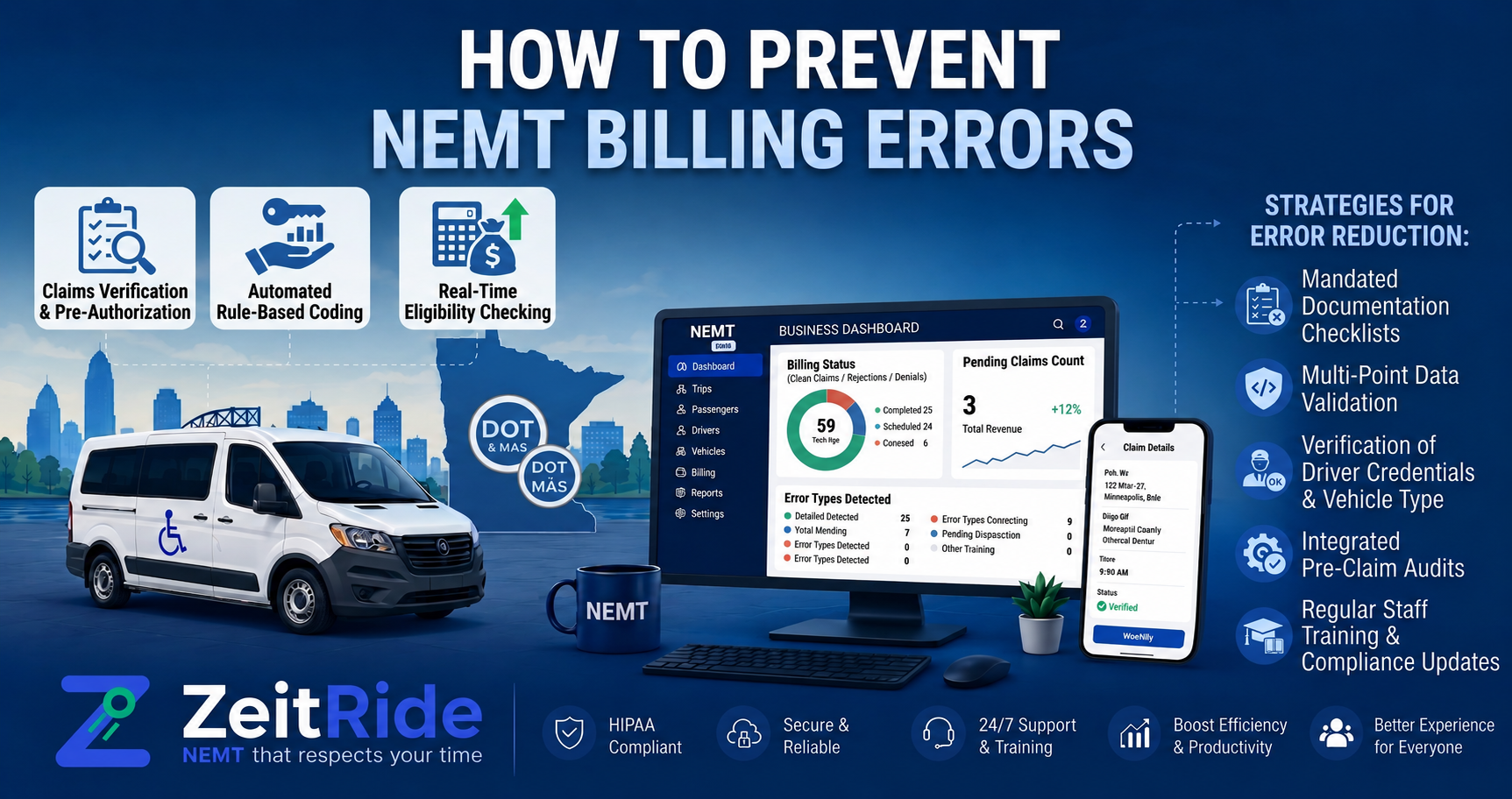
How to Prevent NEMT Billing Errors
Prevent NEMT billing errors by eliminating manual data entry, automating broker-specific claims, and using GPS-verified trip records.
Quick answer
The best way to prevent NEMT billing errors is to eliminate manual data entry by connecting dispatch and billing in one system. Automated broker-specific claim formatting, GPS-verified trip records, and eligibility checks reduce rejected and denied claims while improving payment speed.
ZeitRide Team
NEMT Operations Expert
How to Prevent NEMT Billing Errors comes down to one root cause most operators never fix: the same trip gets typed into two different systems, and every re-entry is a chance for a date, code, or member ID to stop matching. ZeitRide closes that gap by pulling billing data straight from the trip record, so what a dispatcher logs is exactly what gets submitted to your broker. Fleets running on ZeitRide connect a broker and start submitting clean claims within the same 30-minute setup window as the rest of the platform.
What Causes NEMT Billing Errors in the First Place
Most NEMT billing errors trace back to one of three things: data that got re-typed instead of pulled from the original trip, a claim formatted for the wrong broker, or a member eligibility check that happened too late to catch a problem before the trip ran.
Rejected claims happen when something in the claim itself is wrong before it even reaches the payer — a mismatched procedure code, a misspelled member name, or missing insurance information. Denied claims make it further through the process but get flagged by the payer as unpayable, often because eligibility lapsed or the trip didn't match what the broker authorized.
The pattern that causes most errors: dispatch software and NEMT billing software running as two separate systems, with someone on your team manually moving data between them. Every manual step is a place a typo, a dropped digit, or a stale eligibility record can slip through. Broker formatting adds another layer most operators underestimate. MTM Health, Provide A Ride, ProCare, and DD Med Trans each expect claims submitted in a slightly different structure — different required fields, different codes for the same service, different timing on when a trip has to be confirmed. A claim built for one broker's format and sent to another gets rejected before anyone even looks at whether the trip itself was billed correctly. Fleets working with more than one broker feel this the most, since staff have to remember which format applies to which claim.
Real Cost of a Rejected NEMT Claim
A rejected claim isn't just an inconvenience — it's a delay in cash your fleet has already earned. Once a claim bounces, someone has to figure out what went wrong, correct it, and resubmit, and that resubmission often sits in a new queue behind fresh claims. For a fleet running a dozen vehicles, even a small rejection rate adds up to real hours spent on rework instead of dispatching trips. The indirect cost is just as real. Brokers track submission quality, and a fleet with a pattern of rejected or denied claims can end up facing closer scrutiny on future batches, which slows payment further. None of this shows up as a line item on a budget, but it shows up in how long it takes to get paid for a trip you already ran.
This is where the math on software cost changes. A flat $49 per vehicle, per month that prevents most rejections outright is usually cheaper than the staff hours spent chasing down claims after the fact, especially once you factor in how much of that time is spent re-checking data that should have matched the first time.
How ZeitRide Prevents NEMT Billing Errors
ZeitRide builds error prevention into the trip itself instead of trying to catch mistakes after a claim is already written.
- Billing data pulls directly from the trip record — no re-typing member names, codes, or trip details into a separate billing screen
- Broker-specific remittance formatting for MTM Health, Provide A Ride, ProCare, and DD Med Trans, so claims go out matching each broker's required format
- Member and eligibility details are stored on a profile once, not re-entered trip by trip
- GPS-stamped pickup and drop-off times attach automatically, matching what brokers expect to see against their own trip authorization
What NEMT Operators Get Wrong About Billing Error Prevention
The most common mistake is assuming billing errors are a training problem — that a dispatcher or biller just needs to be more careful. In practice, the software architecture causes most of the errors. Legacy platforms like Bambi, RouteGenie, and TripMaster often treat dispatch and billing as separate modules, which means someone is still bridging the gap between what happened on the road and what gets submitted to a broker.
The second mistake: waiting until a claim is denied to check member eligibility. NEMT software that checks eligibility at the point of scheduling — before the trip runs, not after the claim is submitted — catches the problem when it's still cheap to fix.
Who This Is Built For
Fleet owners and operations directors feel billing errors directly in cash flow — a rejected claim delays payment and adds rework that a flat $49-per-vehicle plan doesn't budget for.
- Fleet owners and operations directors feel billing errors directly in cash flow — a rejected claim delays payment and adds rework that a flat $49-per-vehicle plan doesn't budget for.
- Billing staff and dispatchers benefit most from data that only has to be entered once, since every re-entry point is where errors start.
- Drivers using the ZeitRide driver app on iOS or Android confirm trip details in real time, which means the billing record reflects what actually happened, not what someone assumed happened.
- Brokers like MTM Health and Provide A Ride receive claims already formatted to their submission requirements, cutting down on the back-and-forth that comes with a rejected batch.
Bottom Line
How to Prevent NEMT Billing Errors ultimately comes down to removing the manual re-entry step where most mistakes start. ZeitRide pulls billing data directly from GPS-verified trip records and formats claims to each broker's requirements automatically, all at a flat $49 per vehicle, per month with no setup fees.
Start your first live route within a day. $49/vehicle. No contracts. Book your demo.
Frequently Asked Questions
Q: What's the difference between a rejected and a denied NEMT claim?
A rejected claim has an error that stops it from being processed at all — a wrong code or missing data — while a denied claim was processed but the payer decided not to pay it. How to Prevent NEMT Billing Errors starts with catching both types before submission, which ZeitRide does by pulling claim data directly from the verified trip record.
Q: How can NEMT billing software prevent claim rejections?
NEMT billing software prevents rejections by pulling trip data directly from the dispatch record instead of relying on manual re-entry, which removes the step where most typos and mismatched codes happen. ZeitRide formats claims to each broker's requirements automatically before submission.
Q: What's the most common cause of NEMT billing errors?
The most common cause is data being re-typed between separate dispatch and billing systems, where a date, code, or member ID can stop matching the original trip. ZeitRide eliminates that step by running dispatch and billing on one platform for $49 per vehicle, per month.
Q: Does NEMT software integrate with Medicaid brokers to prevent errors?
Yes — ZeitRide integrates directly with MTM Health, Provide A Ride, ProCare, DD Med Trans, and Tennessee Carriers, formatting every claim to each broker's specific submission requirements. This removes the guesswork of manually matching a claim to broker formatting rules.
Q: How much does billing software that prevents errors cost?
ZeitRide includes billing error prevention in its standard $49 per vehicle, per month plan, with no setup fees or separate billing module to purchase. Legacy platforms often charge $5,000 to $25,000 in implementation costs before billing tools are even active.
Rather see it than read about it?
Bring a real route, a couple of drivers, and your current process. 15 minutes, zero pitch.