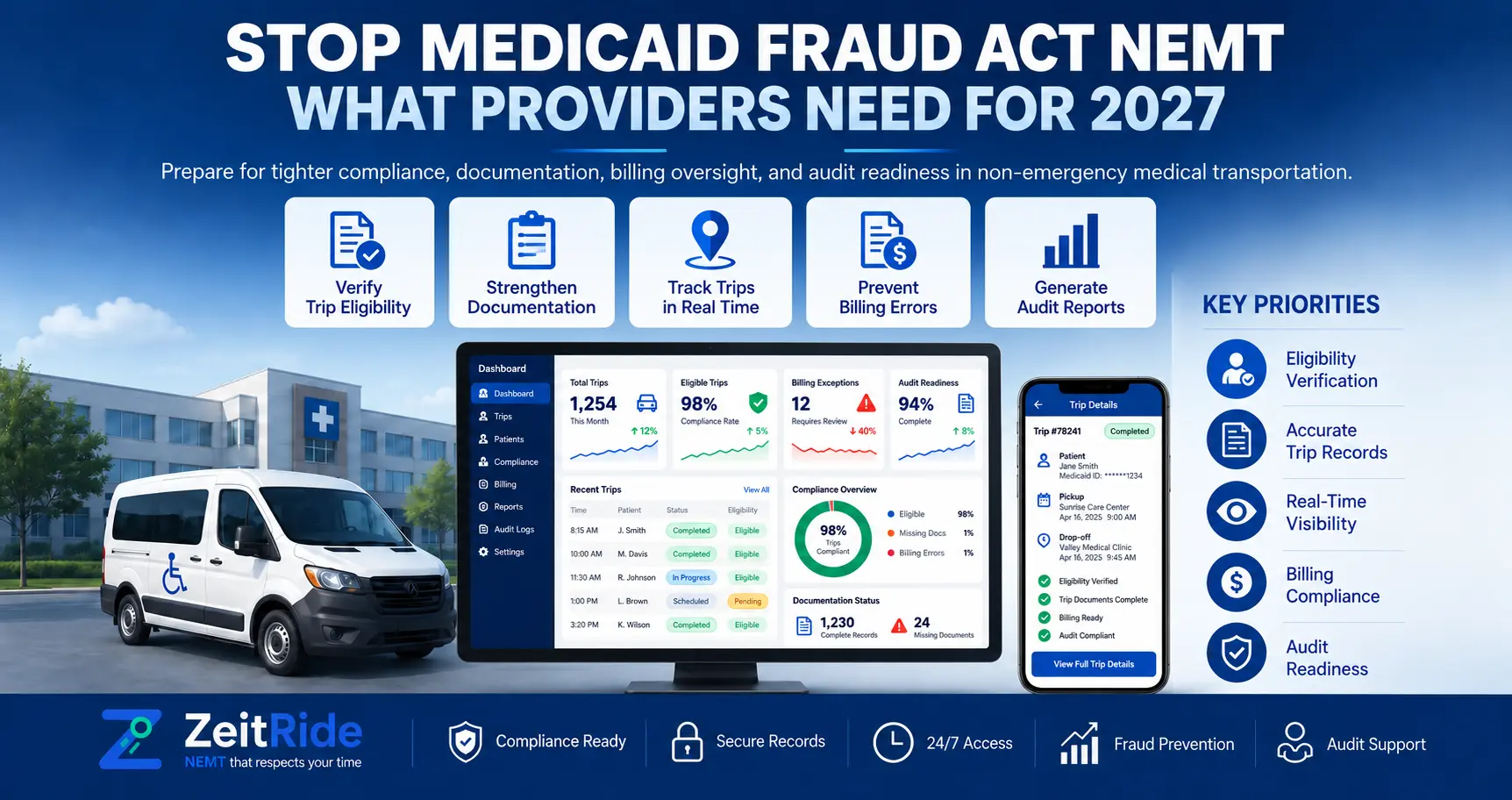
STOP Medicaid Fraud Act NEMT: What Providers Need for 2027
H.R. 10618 proposes federal electronic verification for Medicaid NEMT in 2027. Learn what it says, what is not law yet, and how providers can prepare.
Quick answer
H.R. 10618 would require states to use electronic verification for Medicaid NEMT services furnished on or after January 1, 2027, if enacted. As of October 6, 2026, it remains proposed legislation and is not yet a federal NEMT mandate.
ZeitRide Team
NEMT Operations Expert
The STOP Medicaid Fraud Act NEMT proposal, H.R. 10618, has brought electronic trip verification into a new federal policy discussion for non-emergency medical transportation. Introduced in the U.S. House on September 28, 2026, the bill proposes electronic verification for Medicaid NEMT and applied behavior analysis services. The most important point for providers is that the proposal is not federal law today. As of October 6, 2026, H.R. 10618 has been introduced and referred to the House Committee on Energy and Commerce. You can review the official H.R. 10618 bill text.
Quick Answer: Does the STOP Medicaid Fraud Act Apply to NEMT?
Yes. NEMT is expressly included in H.R. 10618. The introduced bill defines its covered specified services as non-emergency transportation services and applied behavior analysis services. However, the bill has not been enacted, so January 1, 2027 is a proposed effective date rather than a current nationwide NEMT compliance deadline. Providers should monitor the legislation and review the quality of their trip records without treating the proposal as a final federal rule.
STOP Medicaid Fraud Act of 2026 at a Glance
| Item | Current Information |
|---|---|
| Bill | H.R. 10618 |
| Short title | STOP Medicaid Fraud Act of 2026 |
| Introduced | September 28, 2026 |
| Committee | House Committee on Energy and Commerce |
| Services named | NEMT and applied behavior analysis |
| Proposed date | January 1, 2027 |
| Status as of October 6, 2026 | Introduced; not enacted |
What Would H.R. 10618 Change for Medicaid NEMT?
The bill would add a new electronic-verification requirement to Section 1903 of the Social Security Act. Under the introduced text, states would be required to use an electronic verification system for specified Medicaid services furnished under a state plan or waiver on or after January 1, 2027. For providers researching STOP Medicaid Fraud Act 2027 requirements, the key point is that the proposal is structured around state Medicaid implementation rather than a single national provider app or software vendor.
The bill also includes a provision for certain states that already require electronic verification of the specified services when the legislation is enacted. That means providers would still need to follow the technical and operational requirements established for the Medicaid programs and states where they operate rather than assuming every state would use the same workflow.
What Information Would Medicaid NEMT Electronic Verification Cover?
H.R. 10618 defines an electronic verification system by referencing six data elements already used in the federal EVV framework. For Medicaid NEMT electronic verification, those elements would connect the transportation service to the member, service date, location, provider, and service times.
| Verification Element | Practical NEMT Meaning |
|---|---|
| Type of service performed | The transportation service provided |
| Individual receiving the service | The Medicaid member connected to the trip |
| Date of service | The date transportation was furnished |
| Location of service delivery | Location information associated with the service |
| Individual providing the service | The person furnishing the transportation service |
| Time service begins and ends | Electronic start and completion times |
These elements go beyond simply seeing a vehicle on a map. A GPS point can help establish location and time, but a stronger record connects that event to the correct member, driver, trip and service date. That is why NEMT GPS tracking software is more useful when location data stays connected to trip statuses, timestamps and completed-trip history.
Current Federal EVV Rules vs. the H.R. 10618 Proposal
The current federal Electronic Visit Verification requirement created by the 21st Century Cures Act applies to Medicaid-funded personal care services and home health care services that require an in-home visit. H.R. 10618 proposes adding electronic verification for NEMT and applied behavior analysis. CMS explains the existing federal EVV framework in its Electronic Visit Verification guidance.
| Question | Current Federal Framework | H.R. 10618 Proposal |
|---|---|---|
| Personal care and home health services | Covered by existing EVV requirements where applicable | Existing framework remains relevant |
| Nationwide NEMT requirement under this provision | Not created by the current Cures Act EVV provision | Would add NEMT electronic verification if enacted |
| Legal status | Current law | Proposed legislation |
| January 1, 2027 | Not a new nationwide NEMT deadline under current EVV law | Proposed NEMT verification date |
NEMT providers may already face GPS, timestamp, proof-of-service or other electronic documentation requirements from states, Medicaid programs, managed care organizations or transportation contracts. Those requirements should be separated from the proposed federal change so that current obligations are not confused with legislation that has not yet become law.
What Should NEMT Providers Do Now?
Providers do not need to replace software simply because H.R. 10618 was introduced. A better first step is to audit whether one completed Medicaid trip can be reconstructed clearly from scheduling through billing.
- Confirm that each trip is tied to the correct member and service date.
- Verify that the driver or individual providing the service is clearly identified.
- Check whether actual pickup, transport and completion times are preserved.
- Confirm that GPS or location evidence can be tied to the correct trip where required.
- Review how no-shows, cancellations, edits and exceptions are documented.
- Check whether completed trip records remain connected to billing and can be retrieved later.
Your broader NEMT documentation requirements matter because electronic verification is only one part of an audit-ready transportation record. Providers should also test how driver data is captured when connectivity is weak. The ZeitRide Driver App supports trip status workflows, electronic signatures and offline GPS capabilities, but providers should still compare their processes with any final technical standards that may emerge.
Trip execution and billing should also tell the same story. A connected NEMT billing software workflow can reduce the need to reconstruct completed services from separate spreadsheets, text messages and broker portals.
Ohio Shows Why State and Federal Rules Must Be Separated
Ohio provides a useful example. Its separate SB 315 framework takes effect October 6, 2026 and directs the Ohio Department of Medicaid to establish GPS-based electronic verification for Medicaid NEMT. The statute addresses verification of key trip events, timestamps, route information and distance traveled, with implementation occurring in phases. Review the Ohio electronic verification statute for the official state language.
Ohio SB 315 is enacted state law, while H.R. 10618 remains proposed federal legislation. Providers should not merge those legal situations simply because both involve electronic verification. ZeitRide's Ohio NEMT GPS requirements guide explains the state-specific framework in more detail.
How ZeitRide Fits Into Verification-Ready NEMT Operations
ZeitRide's NEMT software connects scheduling, dispatch, driver activity, GPS-aware workflows, electronic signatures, trip records, reporting and billing in one NEMT operating platform. The operational advantage is that information created while a trip is being performed can remain connected to that trip instead of being rebuilt later from disconnected systems.
Providers should avoid claims that any platform is H.R. 10618 certified. The bill has not been enacted, and final implementation requirements do not yet exist. A better technology test is to bring one real Medicaid trip into a demo and follow the record from scheduling and driver assignment through pickup, completion, documentation and billing.
Bottom Line for NEMT Providers
The STOP Medicaid Fraud Act NEMT proposal deserves attention because H.R. 10618 expressly includes non-emergency transportation in a proposed federal electronic-verification framework. But its legal status is equally important. As of October 6, 2026, the bill has been introduced but not enacted.
Providers can use the time now to strengthen the quality and traceability of their trip records while monitoring official federal, state Medicaid and contractual requirements. That preparation can improve operations regardless of how H.R. 10618 ultimately changes.
Want to see whether your current trip workflow is verification-ready? Book a 15-minute ZeitRide demo and bring one real Medicaid trip. Follow it from scheduling and driver assignment through GPS-aware trip activity, documentation and billing.
This article provides general operational information and is not legal advice. Legislative and implementation requirements may change.
Frequently Asked Questions
Q: Is the STOP Medicaid Fraud Act of 2026 already law?
No. As of October 6, 2026, H.R. 10618 has been introduced in the U.S. House and referred to the House Committee on Energy and Commerce. It has not been enacted into law.
Q: Does the STOP Medicaid Fraud Act apply to NEMT?
The introduced bill expressly includes non-emergency transportation among the services that would be subject to electronic verification if the legislation becomes law.
Q: When would NEMT electronic verification begin under H.R. 10618?
The introduced text refers to specified services furnished on or after January 1, 2027. Because H.R. 10618 has not been enacted, this remains a proposed date rather than a current nationwide NEMT compliance deadline.
Q: What would an NEMT electronic verification system need to record?
H.R. 10618 references six EVV data elements: service type, person receiving the service, service date, service location, person providing the service, and the time the service begins and ends.
Q: Does federal EVV already apply to every NEMT trip?
No. The current federal Cures Act EVV requirement applies to qualifying Medicaid personal care services and home health care services requiring an in-home visit. Separate state, payer or contractual requirements may still apply to NEMT.
Q: Should NEMT providers change software now because of H.R. 10618?
Not solely because the bill was introduced. Providers should first review their existing trip records, monitor official developments, and determine whether their systems can keep member, driver, time, location, documentation and billing data connected.
Rather see it than read about it?
Bring a real route, a couple of drivers, and your current process. 15 minutes, zero pitch.