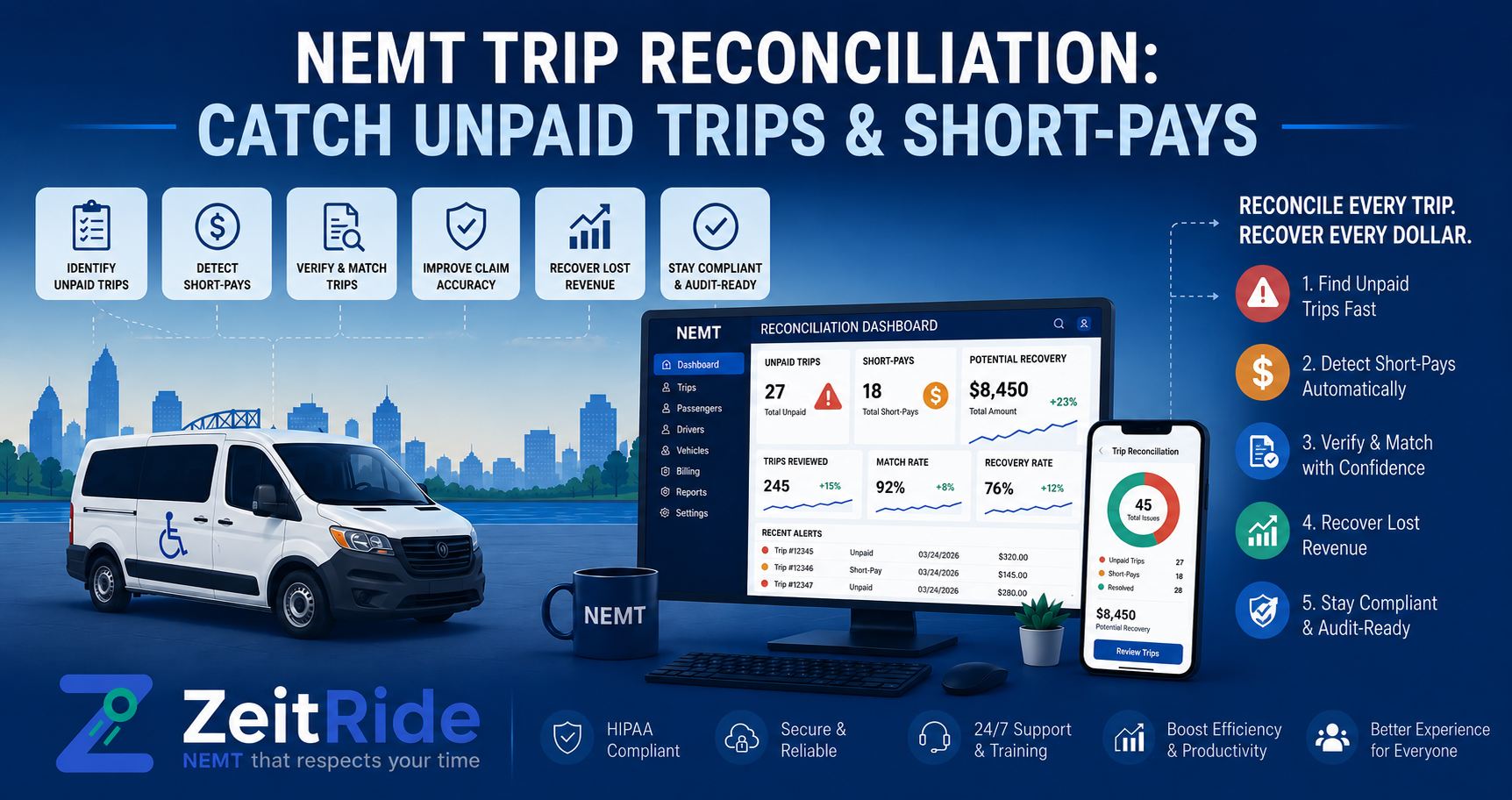
NEMT Trip Reconciliation: Catch Unpaid Trips & Short-Pays
Learn how to reconcile NEMT trips against broker payments to catch unpaid trips, short-pays, missing return legs, and other revenue gaps.
Quick answer
NEMT trip reconciliation matches completed trip records, billing data, and broker payments to confirm every payable leg was billed and paid correctly. It helps providers find unpaid trips, short-pays, missing return legs, and unmatched remittance lines before revenue slips through.
ZeitRide Team
NEMT Operations Expert
A completed NEMT trip is not automatically a paid trip. An outbound leg may be documented and billed correctly while the return leg never reaches billing. A broker may pay less than expected, a remittance line may not match the original trip, or a completed ride may never be submitted at all. NEMT trip reconciliation closes that gap by connecting what was assigned, what the driver actually completed, what was billed, and what the payer or broker ultimately paid. This guide explains how to build that trip-to-payment process and catch revenue problems before they disappear into month-end totals.
What Is NEMT Trip Reconciliation?
NEMT trip reconciliation is the process of matching assigned and completed transportation records with billing and payment data to confirm that every payable trip leg was documented, billed, and paid correctly. It gives operators a clear answer to a basic financial question: did every service we actually performed become the payment we expected?
The process should connect operations and finance rather than begin with a bank deposit. Looking only at the total amount received can hide individual unpaid trips, NEMT short payments, missing return legs, mileage discrepancies, or payments that cannot be connected to the correct trip.
What Records Should You Compare During NEMT Trip Reconciliation?
A reliable reconciliation process compares three layers of information: the trip that was assigned or authorized, the trip that was actually completed, and the billing or payment record created afterward. When those records disagree, the difference becomes an exception that needs investigation.
| Record | What to Verify | Common Warning Sign |
|---|---|---|
| Assigned or Authorized Trip | Trip ID, service date, passenger, service level, pickup, destination, outbound and return legs | A leg exists in the assignment but not in completed-trip records |
| Completed Trip Record | Driver, vehicle, pickup/drop-off status, timestamps, mileage, notes, and required proof of service | Trip was performed but information required for billing is missing |
| Billing and Payment Record | Amount billed, expected payment, amount received, adjustment, denial, or unpaid status | Expected amount does not match the payment or no payment can be matched |
Strong NEMT documentation requirements make reconciliation easier because billing staff can verify what happened without rebuilding a trip from driver calls, paper records, and separate spreadsheets. Where electronic trip verification applies, the NEMT EVV compliance guide also explains why accurate timestamps, service records, and supporting evidence matter before billing begins.
How to Reconcile NEMT Trips Step by Step
1. Start With the Trips That Were Actually Completed
Begin with completed-trip records for the reconciliation period. Do not start with the payment file alone. Your operational records establish the transportation your company believes it actually provided.
For round trips or other multi-leg transportation, account for each payable leg individually. An outbound ride and a return ride can have different completion statuses, timestamps, mileage, documentation, and billing outcomes. A single generic completed status can make an unpaid leg much harder to detect.
2. Match Every Completed Trip to a Billing Record
For every completed trip or leg, confirm that a corresponding billing record exists. Match shared identifiers such as trip ID, service date, rider or member information, pickup and destination, service level, mileage, and any other contract-required fields.
A completed trip with no billing record is one of the clearest reconciliation exceptions. If your team repeatedly finds completed services that never entered billing, review the workflow rather than correcting each trip manually. ZeitRide's guide on how to prevent NEMT billing errors covers several operational and documentation problems that can lead to avoidable billing issues.
3. Compare Billed Trips With Broker or Payer Payments
Once a trip has been billed, compare the expected payment under the applicable contract or rate with the payment information received from the broker or payer. This is where NEMT broker payment reconciliation becomes essential.
The goal is not simply to confirm that a deposit arrived. The goal is to determine which trips the payment belongs to, whether each payable leg was included, whether the amount matches expectations, and whether any adjustment or denial requires follow-up.
When Electronic Remittance Advice data is part of your workflow, CMS explains that payment and remittance information can include claim- and service-line-level adjudication and adjustment details. The HIPAA-adopted electronic remittance transaction uses the X12 835 standard. Providers can review the official CMS guidance on payment and remittance advice for additional context.
4. Compare Expected Payment With Actual Payment
A trip should not be considered fully reconciled simply because some payment was received. Compare the expected amount against the actual amount paid and calculate the difference. A zero balance may indicate a properly paid trip, while a negative variance may indicate a short-pay, partial payment, denial, missing leg, rate discrepancy, or another adjustment that needs investigation.
5. Flag Exceptions Instead of Reviewing Only Totals
A weekly or monthly deposit can look reasonable while individual trips are still missing revenue. Reconciliation is more useful when it identifies exceptions at the trip or claim level instead of comparing only total billed revenue with total deposits.
- Completed trips that were never billed
- Billed trips with no corresponding payment
- NEMT short payments where the amount received is lower than expected
- Broker payments that cannot be matched to a trip
- Missing outbound or return legs
- Mileage or service-level discrepancies
- Denied or adjusted claims
- Duplicate billing or payment entries
- Trips with incomplete supporting documentation
Example: How Unpaid NEMT Trips Appear During Reconciliation
Consider the following simplified example. The trip IDs and amounts are hypothetical and are included only to demonstrate how reconciliation can expose different payment outcomes.
| Trip ID | Leg | Expected | Paid | Variance | Status |
|---|---|---|---|---|---|
| ZR-1048 | Outbound | $42 | $42 | $0 | Paid |
| ZR-1049 | Return | $42 | $0 | -$42 | Unpaid |
| ZR-1050 | Outbound | $58 | $46 | -$12 | Short-paid |
Trip ZR-1048 reconciles cleanly because the expected and received amounts match. ZR-1049 is an unpaid NEMT trip because the completed return leg has no matching payment. ZR-1050 is short-paid because the amount received is lower than expected.
The next question for each exception is not simply "Where is the money?" A useful reconciliation workflow asks where the trip-to-payment process broke: trip completion, documentation, billing submission, adjudication, remittance matching, or payment.
Why Unpaid NEMT Return Legs Are Easy to Miss
Return transportation deserves special attention because a return leg may take place hours after the outbound trip and can involve a will-call pickup, different dispatch timing, a different driver, or a separate operational status. The outbound leg may therefore close correctly while the return remains open, canceled incorrectly, undocumented, or missing from billing.
To catch unpaid NEMT return legs, compare the original round-trip assignment against the actual completed legs first. Then confirm that each completed leg generated the appropriate billing record and can be matched to payment information. A paid outbound trip should never be treated as proof that the entire round trip was paid.
Trip Reconciliation vs. Remittance Reconciliation
Trip reconciliation and remittance reconciliation are closely related, but they answer different questions. Understanding the difference helps prevent gaps between operations, billing, and finance.
| Process | Primary Question |
|---|---|
| Trip Reconciliation | Did every assigned and completed service leg make it into the correct operational and billing record? |
| Remittance Reconciliation | Did the broker or payer payment match what was billed and what the provider expected to receive? |
The strongest workflow connects both processes. Trip reconciliation follows the service from assignment through completion and billing. Remittance reconciliation follows the billed trip into payment and variance resolution. ZeitRide's NEMT remittance reconciliation software connects trip-level financial information with payment tracking so operators can investigate underpaid, unpaid, and unmatched transactions against the original trip record.
How Often Should NEMT Providers Reconcile Trips?
There is no single reconciliation schedule that fits every NEMT provider because trip volume, broker requirements, payer cycles, and internal staffing vary. The important principle is to review exceptions while the underlying trip information is still easy to verify rather than waiting until year-end.
- Review operational trip exceptions promptly while drivers and dispatchers can still verify what happened
- Confirm that completed trips reach billing on a consistent daily or weekly workflow
- Reconcile broker and payer payments as remittance information becomes available
- Use a month-end review to identify unresolved unpaid, short-paid, denied, or unmatched trips
- Assign every unresolved exception an owner, status, and next action
What Should You Check When a Trip Is Short-Paid?
When a payment is lower than expected, avoid assuming that the payer simply made an error. Start with the trip record and work forward through billing and remittance information. NEMT short payments can have different causes, and the correct next action depends on the specific discrepancy.
- Confirm the contracted or expected rate
- Verify service level and trip type
- Check billed mileage against documented mileage
- Review outbound and return legs separately
- Confirm the submitted billing information
- Review any payer adjustment or denial information
- Check whether supporting trip documentation is complete
- Confirm that the payment was matched to the correct trip
- Document the reason for the variance and follow-up action
When a Payment Problem Is Actually a Claim Problem
Reconciliation often exposes problems that started before payment. A trip may appear unpaid because the claim was denied, rejected, submitted with incomplete information, or never submitted correctly in the first place.
If your reconciliation workflow repeatedly finds nonpayment connected to rejected or denied claims, review the underlying causes in ZeitRide's guide to NEMT claim denials. Providers that bill Medicaid can also review how to bill Medicaid for NEMT to understand the relationship between trip documentation, billing information, codes, modifiers, and the claims process.
Spreadsheet Reconciliation vs. Connected NEMT Software
Spreadsheets can work when a provider has a small number of straightforward transactions. The process becomes harder as the fleet adds vehicles, drivers, brokers, recurring trips, return legs, payment cycles, and different billing rules.
| Manual Reconciliation | Connected NEMT Workflow |
|---|---|
| Export completed-trip data | Work from the original operational trip record |
| Export billing data separately | Keep billing connected to completed trip information |
| Manually match spreadsheet rows | Use shared trip identifiers to support matching |
| Search manually for missing payments | Review unpaid, underpaid, or unmatched exceptions |
| Reconstruct context from notes and separate systems | Review operational and financial context together |
| Repeat manual cleanup each reporting period | Maintain an ongoing reconciliation workflow |
The main advantage of connected software is not simply replacing Excel. It is reducing the number of times staff must reconstruct the relationship between what happened on the road and what happened in billing. ZeitRide's NEMT billing software connects operational trip information with billing workflows, while reconciliation extends that visibility into expected and received payments.
NEMT Trip Reconciliation Checklist
- Confirm every assigned or authorized trip leg is accounted for
- Match completed trips to billing records
- Verify trip IDs and service dates
- Check outbound and return legs separately
- Compare expected payment with actual payment
- Flag unpaid NEMT trips
- Flag NEMT short payments
- Investigate unmatched remittance lines
- Review denials and payment adjustments
- Verify supporting trip documentation
- Assign an owner and next action to every open exception
- Maintain an audit trail of corrections and resolutions
The Bottom Line on NEMT Trip Reconciliation
NEMT trip reconciliation gives providers a straightforward financial control: prove that every completed, payable trip leg reached billing and that the resulting payment matches what was expected. The process should connect the original assignment, completed service, billing record, remittance or payment, and any remaining variance.
The most useful reconciliation workflow does not stop at a monthly deposit total. It makes unpaid trips, short-pays, missing return legs, and unmatched payments visible at the level where staff can actually investigate and resolve them.
Connect NEMT Trips, Billing, and Payment Reconciliation in ZeitRide
If your team is matching completed trips against broker payments across separate spreadsheets, portals, and billing records, ZeitRide's NEMT software can keep dispatch, trip execution, billing, and reconciliation connected in one operational workflow.
Instead of discovering missing revenue after the fact, give your team a clearer path from completed trip to resolved payment. Book a 15-minute ZeitRide demo and bring a real billing or reconciliation workflow so you can see how the process fits your operation.
Frequently Asked Questions
Q: What is trip reconciliation in NEMT?
NEMT trip reconciliation is the process of matching assigned and completed trip records with billing and payment data. It helps providers confirm that every payable trip or leg was documented, billed, and accounted for after payment processing.
Q: What is NEMT broker payment reconciliation?
NEMT broker payment reconciliation compares completed and billed trips with broker payment or remittance information to identify unpaid trips, partial payments, adjustments, and transactions that cannot be matched to the original trip.
Q: How do I find unpaid NEMT trips?
Start with completed trip records and confirm that each trip has a corresponding billing record. Then compare billed trips against payment or remittance information. Any completed trip that was not billed or billed trip without a matching payment should be investigated.
Q: What causes NEMT short payments?
NEMT short payments can result from payment adjustments, contract-rate differences, billing errors, mileage or service-level discrepancies, payer decisions, incomplete documentation, or other claim-specific issues. Review the original trip, billing record, and remittance information before determining the cause.
Q: How can I catch unpaid NEMT return legs?
Compare every round-trip assignment against the actual completed outbound and return legs, then verify that both legs reached billing and payment reconciliation separately. A paid outbound trip does not prove that the return leg was also billed or paid.
Q: How often should NEMT trip reconciliation be performed?
Providers should review operational exceptions promptly, reconcile payments as remittance information becomes available, and perform a periodic month-end review for unresolved unpaid, short-paid, denied, or unmatched trips.
Rather see it than read about it?
Bring a real route, a couple of drivers, and your current process. 15 minutes, zero pitch.