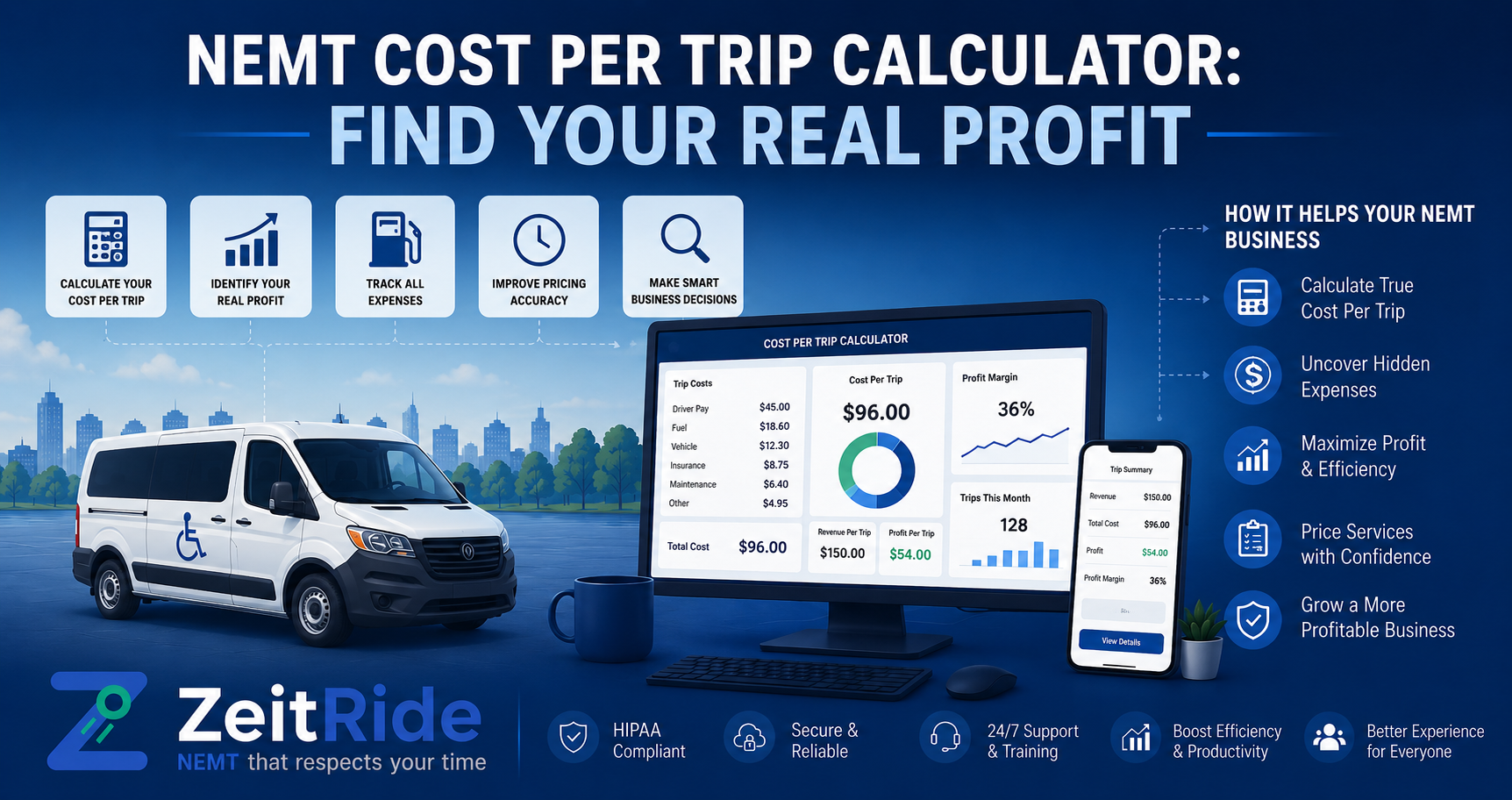
NEMT Cost Per Trip Calculator: Find Your Real Profit
Calculate your true NEMT cost and profit per trip using driver pay, deadhead miles, vehicle expenses, overhead, and payment leakage.
Quick answer
Add driver labor, fuel, deadhead mileage, vehicle expenses, overhead, and expected payment leakage to calculate NEMT cost per trip. Subtract the total cost from collected trip revenue to calculate profit per trip and profit margin.
ZeitRide Team
NEMT Operations Expert
Revenue shows how much an NEMT trip generates, but it does not show how much the trip actually earns. This NEMT cost per trip calculator helps transportation providers estimate fully loaded trip cost, profit per trip, profit margin, and break-even reimbursement using driver time, mileage, vehicle expenses, overhead, and payment leakage. After calculating your current operating cost, use the NEMT ROI calculator to estimate how routing, dispatch, and billing improvements could affect monthly performance.
How Do You Calculate NEMT Cost Per Trip?
Calculate NEMT cost per trip by adding direct trip expenses, allocated vehicle and administrative overhead, and expected losses from denied, reduced, or unbilled claims.
NEMT cost per trip = direct trip costs + allocated overhead + expected payment leakage.
NEMT profit per trip = collected trip revenue - total cost per trip. Profit margin = profit per trip divided by collected revenue, multiplied by 100. Use the amount actually collected whenever possible. A trip billed at $100 but paid at $82 produced $82 in revenue.
Use the NEMT Cost Per Trip Calculator
Enter your base reimbursement, mileage payment, loaded miles, deadhead miles, driver hours, hourly labor cost, fuel price, vehicle fuel economy, maintenance cost, insurance allocation, administrative overhead, and expected payment leakage.
- Base trip reimbursement
- Loaded-mile reimbursement
- Loaded and deadhead mileage
- Driver hours and hourly labor cost
- Fuel price and vehicle fuel economy
- Maintenance cost per mile
- Insurance, vehicle payments, and depreciation
- Dispatch, billing, software, and administrative overhead
- Claim-denial or underpayment percentage
The calculator should display expected revenue, direct trip cost, allocated overhead, total cost per trip, profit per trip, profit margin, cost per loaded mile, and break-even reimbursement.
What Should an NEMT Profit Calculator Include?
A reliable calculator should include more than fuel and driver wages. Insurance, vehicle ownership, dispatch labor, billing work, software, and compliance expenses support every completed trip and should be allocated consistently.
| Cost Category | What to Include |
|---|---|
| Driver labor | Wages, overtime, payroll costs, waiting time, and travel before pickup |
| Fuel and mileage | Loaded miles, deadhead miles, idling, fuel price, and vehicle MPG |
| Vehicle expenses | Maintenance, tires, insurance, payments, registration, and depreciation |
| Administration | Dispatch, billing, compliance, software, phones, and office expenses |
| Payment leakage | Claim denials, underpayments, missing documentation, and unbilled trips |
Deadhead mileage must be included because empty miles consume fuel, driver time, maintenance capacity, and vehicle life without necessarily generating reimbursement. Providers with high empty mileage can use the NEMT route optimization guide to identify practical ways to improve trip sequencing and vehicle utilization.
NEMT Profit-Per-Trip Example
The following example is hypothetical and explains the calculation method. It is not an industry reimbursement benchmark. Assume a wheelchair trip produces $90 in collected revenue. Driver labor costs $28, fuel costs $6, vehicle expenses total $11, administrative overhead is $8, and expected payment leakage is $3.
| Calculation | Amount |
|---|---|
| Collected trip revenue | $90 |
| Driver labor | $28 |
| Fuel | $6 |
| Vehicle expenses | $11 |
| Administrative overhead | $8 |
| Payment leakage | $3 |
| Total cost per trip | $56 |
| Profit per trip | $34 |
| Profit margin | 37.8% |
The same reimbursement could produce a lower margin if the vehicle travels farther without a passenger, the driver waits longer, or the payer reduces the final payment. An effective NEMT profit calculator should use actual operational inputs rather than one universal estimate.
Compare NEMT Profit by Route, Vehicle, and Contract
Route Profitability
Compare total miles, loaded miles, deadhead miles, driver hours, waiting time, completed trips, and collected revenue. A recurring route with several nearby passengers may produce a stronger margin than a higher-paying trip that requires a long empty return.
Vehicle-Type Profitability
Calculate ambulatory, wheelchair, stretcher, and bariatric trips separately. Each vehicle type has different fuel consumption, equipment, insurance, staffing, maintenance, and loading-time requirements. Using one fleet-wide cost assumption can hide an unprofitable service category.
Broker or Facility Contract Profitability
Review each broker or facility contract using collected revenue rather than only the advertised rate. Include deadhead mileage, administrative work, payment delays, no-shows, claim denials, and underpayments. Providers experiencing repeated payment problems should review the guide to reducing NEMT claim denials.
NEMT Cost Per Trip vs. Cost Per Mile
Cost per trip and cost per mile answer different questions. Cost per trip equals total applicable costs divided by completed billable trips. Use it to review contract rates and trip profitability.
Cost per mile equals total applicable vehicle costs divided by total vehicle miles. Use it to compare routes and vehicles. An NEMT cost per mile calculator should separate loaded miles from deadhead miles because combining both can hide inefficient routing.
How to Reduce NEMT Cost Per Trip
- Group nearby pickups and recurring trips
- Reduce deadhead mileage between assignments
- Match each trip with the appropriate vehicle type
- Monitor driver waiting time and overtime
- Improve vehicle utilization
- Connect completed-trip records with billing
- Review denied and underpaid trips
- Compare profitability by broker and facility
- Recalculate trip costs each month
ZeitRide connects scheduling, routing, live dispatch, driver activity, trip records, billing workflows, payroll, and reporting in one NEMT platform. Its NEMT routing software helps operators reduce inefficient mileage, while its NEMT billing software connects completed-trip information with invoicing and payment reconciliation.
Find the Cost Leaks Behind Your Trips
A calculator shows where your margin may be disappearing. The next step is identifying the workflow responsible for the loss. Bring one representative route, including its mileage, driver time, vehicle type, and payment information. ZeitRide will show how that workflow can be scheduled, dispatched, tracked, and closed out in one connected system.
Ready to review a real route instead of relying on a fleet-wide average? Book a 15-minute ZeitRide demo and bring your own trip data.
Methodology note: This calculator is intended for operational planning and educational use. It does not replace accounting, legal, tax, insurance, or state Medicaid guidance. Use your actual payroll records, contracts, vehicle expenses, remittances, and local requirements when making financial decisions.
Frequently Asked Questions
Q: How do you calculate NEMT cost per trip?
Add driver labor, fuel, deadhead mileage, vehicle costs, administrative overhead, and expected payment leakage. Divide fleet-level expenses by completed billable trips when calculating an average monthly cost.
Q: What should an NEMT profit calculator include?
It should include trip revenue, driver labor, loaded and deadhead miles, fuel, maintenance, insurance, vehicle costs, dispatch, billing, software, claim denials, and underpayments.
Q: Should deadhead miles be included in NEMT trip cost?
Yes. Deadhead miles consume fuel, driver time, maintenance capacity, and vehicle life even though they may not generate mileage reimbursement.
Q: How do you calculate NEMT profit per trip?
Subtract the fully loaded cost per trip from the amount actually collected. Divide the remaining profit by collected revenue and multiply by 100 to calculate the profit margin.
Q: How often should NEMT providers calculate trip costs?
Review trip costs monthly and whenever driver wages, fuel, insurance, reimbursement rates, trip volume, vehicle expenses, or payer mix changes materially.
Rather see it than read about it?
Bring a real route, a couple of drivers, and your current process. 15 minutes, zero pitch.