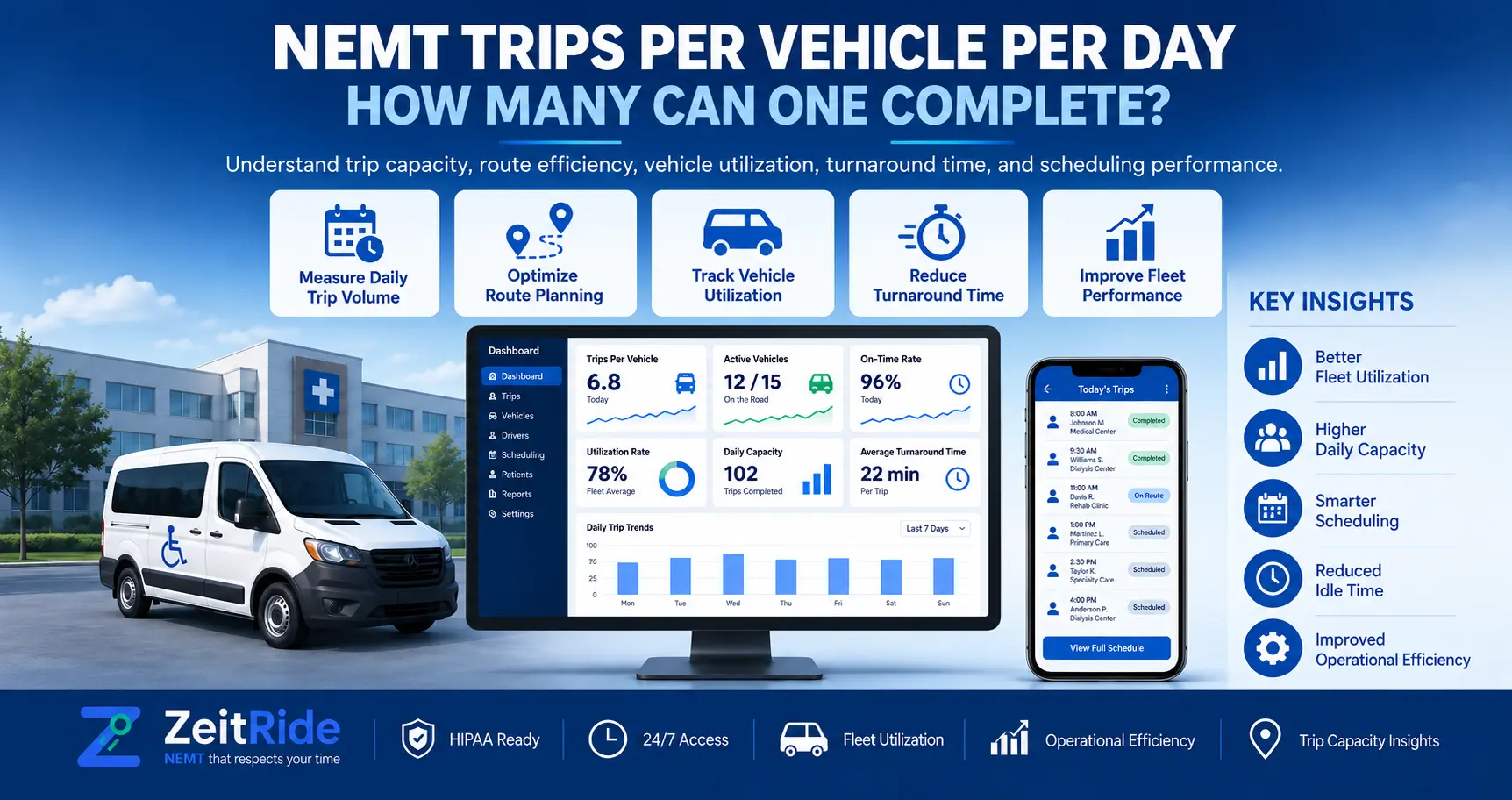
NEMT Trips per Vehicle per Day: How Many Can One Complete?
Learn how many NEMT trips one vehicle can complete per day, what affects capacity, and when to improve utilization before adding another vehicle.
Quick answer
There is no universal NEMT trips-per-vehicle target. Daily capacity depends on trip duration, deadhead, service time, route density, vehicle type, driver hours, and scheduling. Calculate capacity from usable operating time and average trip-cycle time.
ZeitRide Team
NEMT Operations Expert
How many trips should one NEMT vehicle complete in a day? There is no single number that works for every fleet. A sedan handling short recurring trips in a dense service area may complete far more rides than a wheelchair van covering longer distances. Trip duration, deadhead, passenger loading time, appointment windows, route density, driver hours, and same-day changes all affect NEMT trips per vehicle per day. Instead of copying another operator's benchmark, calculate what your own vehicles can realistically complete while protecting on-time performance, rider experience, and profitability. This guide shows you how.
How Many Trips Can One NEMT Vehicle Complete per Day?
A practical estimate starts with two numbers: usable operating time and average trip-cycle time. Use this formula: usable operating minutes divided by average trip-cycle minutes equals estimated daily trip capacity. For example, assume one vehicle has 450 usable operating minutes during the day. If an average trip cycle takes 60 minutes, 450 divided by 60 equals 7.5. That gives the vehicle a theoretical capacity of about 7 completed single-load trips with some remaining time. If the average cycle takes 90 minutes, the same vehicle has a theoretical capacity of about 5 trips.
These are calculation examples, not universal NEMT benchmarks. A real schedule must also account for appointment times, traffic, driver availability, wheelchair requirements, will-calls, geographic constraints, and other operating conditions. The useful question is not how many trips another provider completes. It is how many feasible trips your vehicle can complete within the operating day.
What Does NEMT Trips per Vehicle per Day Mean?
NEMT trips per vehicle per day measures how many completed passenger trips are produced by the vehicles that actually operated during a given day. A simple fleet-level formula is: completed one-way trips divided by active service vehicles equals NEMT trips per active vehicle. If your fleet completes 80 one-way trips using 10 active vehicles, the result is 8 trips per active vehicle.
Use the same definition every time you calculate the metric. Do not mix one-way legs, round trips, canceled rides, and scheduled-but-not-completed trips in the same calculation. For broader vehicle-performance tracking, the NEMT fleet management software guide explains how utilization and fleet metrics fit together.
What Affects NEMT Daily Trip Capacity?
The number of vehicles you own does not tell you how many trips your fleet can realistically produce. Daily capacity is shaped by the amount of time each completed trip consumes and how effectively trips fit together throughout the operating day.
| Factor | Effect on Daily Capacity |
|---|---|
| Trip distance | Longer trips usually reduce the number of separate trips a vehicle can complete |
| Deadhead | Empty repositioning consumes operating time without completing a passenger trip |
| Route density | Nearby pickups and destinations create more scheduling opportunities |
| Passenger service time | Longer boarding and unloading increases total trip-cycle time |
| Wheelchair transport | Loading, securement, and unloading may require additional service time |
| Appointment windows | Tight windows can create gaps that another trip cannot safely fill |
| Will-calls | Uncertain return times make vehicle capacity less predictable |
| Driver hours | Available driver time places a practical ceiling on capacity |
| Multi-loading | Compatible shared rides may increase passenger trips per vehicle cycle |
Deadhead is especially important. A vehicle can appear busy for eight hours while spending too much of the day moving without a passenger. If empty mileage is consuming capacity, the NEMT route optimization guide explains how better sequencing and reduced deadhead can improve fleet efficiency.
How to Calculate Your Vehicle's Real NEMT Capacity
Step 1: Calculate usable operating time
Start with the time the vehicle and qualified driver are genuinely available. For an eight-hour shift, 8 multiplied by 60 equals 480 minutes. Then subtract planned breaks and other known unavailable time. If 30 minutes are unavailable, that leaves 450 usable operating minutes.
Step 2: Measure average trip-cycle time
Do not count only loaded driving time. A realistic trip cycle includes the work surrounding the ride, because all of that time affects how many additional trips can fit into the day.
- Travel or repositioning to the pickup
- Passenger boarding
- Loaded travel time
- Drop-off and unloading
- Required trip documentation
- Repositioning toward the next assignment
- Waiting that prevents the vehicle from serving another trip
Use your own historical trip information where possible rather than selecting a trip-cycle time from another fleet.
Step 3: Estimate theoretical capacity
Divide usable operating minutes by representative trip-cycle time. If a vehicle has 450 usable minutes and a typical trip cycle takes 60 minutes, the calculation is 450 divided by 60, or 7.5 theoretical trip cycles. This gives you a planning baseline, not a guaranteed schedule.
Step 4: Apply real scheduling constraints
Theoretical capacity and schedulable capacity are different. A vehicle may mathematically have enough time for another trip, but the rider's pickup window, vehicle requirement, geography, driver qualification, or existing appointment commitments may make the assignment impossible. This is where NEMT scheduling software becomes important: available time becomes productive capacity only when another feasible trip can actually fit into the schedule.
Two NEMT Vehicle Capacity Examples
Example 1: Dense ambulatory operation
Suppose an ambulatory vehicle has 450 usable minutes and its typical trip cycle takes about 50 minutes. The theoretical calculation is 450 divided by 50, or 9 trip cycles. Short distances and concentrated pickups may allow the vehicle to complete a relatively high number of trips. That does not mean nine should become a universal target. It simply shows how shorter and denser trip cycles create more capacity.
Example 2: Rural wheelchair operation
Now consider a wheelchair-accessible vehicle with the same 450 usable minutes. Longer distances, boarding, securement, unloading, and repositioning increase its typical cycle to 90 minutes. The calculation becomes 450 divided by 90, or 5 theoretical trip cycles. The vehicle can still be operating efficiently even though it completes fewer trips. Comparing these two vehicles by trip count alone would be misleading.
Why Is My NEMT Vehicle Completing Too Few Trips?
If comparable vehicles are producing fewer trips than expected, look for capacity leaks before assuming you need more demand or another vehicle.
- Excessive deadhead between assignments
- Large schedule gaps between trips
- Poor geographic grouping
- Drivers waiting unnecessarily
- Recurring routes that have not been re-optimized
- The wrong vehicle assigned to a trip
- Driver shifts that do not match peak demand
- Same-day cancellations leaving unused capacity
- Manual assignment without fleet-wide visibility
Vehicle productivity is often a scheduling or routing problem before it becomes a fleet-size problem. A connected NEMT routing software workflow can help identify unnecessary mileage and improve trip sequencing, while scheduling helps determine whether another compatible trip can realistically fit into the day.
Should You Add Another Vehicle or Improve Utilization First?
Adding another vehicle increases capacity, but it also adds another asset that must be financed or purchased, insured, maintained, staffed, and kept productive. Before expanding the fleet, determine whether your current vehicles are genuinely close to usable capacity.
| Optimize Existing Vehicles First When | Consider Adding Capacity When |
|---|---|
| Vehicles have large schedule gaps | Efficiently scheduled vehicles still cannot cover demand |
| Deadhead is unnecessarily high | Peak demand regularly exceeds available vehicles |
| Similar vehicles show uneven utilization | Required vehicle types are unavailable during peak periods |
| Drivers spend avoidable time waiting | New service areas create additional simultaneous demand |
| Routes have not been reviewed as volume changed | Optimized routes still leave recurring trips uncovered |
More trips do not automatically mean better performance. If additional trips create excessive mileage, late pickups, driver overtime, or weak economics, the vehicle may be busier without becoming more profitable. Use the NEMT cost per trip calculator to evaluate whether higher trip volume actually improves the economics of your operation.
If you are forecasting future fleet size, the NEMT business plan template can help convert realistic daily trip assumptions into financial projections instead of relying on another provider's numbers.
How Software Can Improve NEMT Vehicle Utilization
Software cannot remove the real time required to transport a passenger. What it can do is reduce avoidable gaps around each trip. ZeitRide connects scheduling, routing, dispatch, driver activity, and fleet information so operators can see how available vehicles are being used across the day.
- Identify underused vehicles
- Spot excessive gaps between assignments
- Reduce avoidable deadhead
- Detect driver and vehicle availability conflicts
- Balance assignments across available vehicles
- Find opportunities to group compatible trips
- Respond to capacity opened by cancellations or same-day changes
The goal is not to maximize trip count at any cost. A useful NEMT vehicle utilization rate should support reliable transportation, reasonable driver workload, appropriate passenger service time, and profitable operations.
The Bottom Line on NEMT Trips per Vehicle per Day
There is no universal number of NEMT trips per vehicle per day that every fleet should target. Start with completed one-way trips divided by active service vehicles to understand your current baseline. Then estimate capacity using usable operating minutes divided by representative trip-cycle time. Finally, apply the real constraints of your operation, including distance, deadhead, appointment windows, vehicle type, service level, driver availability, and route density.
The goal is not to make every vehicle hit the same number. It is to understand how much productive capacity your existing fleet has before adding more vehicles.
Thinking about adding another vehicle? Bring one real operating day — your trips, vehicles, appointment windows, and driver availability. See how ZeitRide works and identify where deadhead, schedule gaps, or underused capacity may be limiting the fleet you already have.
Frequently Asked Questions
Q: How many trips can one NEMT vehicle complete per day?
There is no universal number. Daily capacity depends on trip duration, deadhead, passenger service time, appointment windows, route density, vehicle type, driver hours, and scheduling. Use actual operating time and representative trip-cycle time to estimate realistic capacity.
Q: How do I calculate NEMT trips per active vehicle?
Divide completed one-way trips by the number of vehicles that actually provided service during the same period. For example, 80 completed trips across 10 active vehicles equals 8 trips per active vehicle.
Q: What is a good NEMT vehicle utilization rate?
There is no universal utilization target for every NEMT operation. Compare similar vehicles, shifts, service types, and geographic areas, then track performance over time without sacrificing on-time service or necessary operating buffers.
Q: Do wheelchair trips reduce NEMT trips per vehicle per day?
They can. Wheelchair transportation may require additional boarding, securement, unloading, and service time. Longer trip cycles generally reduce the number of separate trips a vehicle can complete during the same operating period.
Q: Should I add another NEMT vehicle or improve utilization first?
Improve utilization first when existing vehicles have significant deadhead, schedule gaps, avoidable waiting, or uneven assignments. Additional capacity is more justified when efficiently scheduled vehicles still cannot reliably cover recurring demand.
Rather see it than read about it?
Bring a real route, a couple of drivers, and your current process. 15 minutes, zero pitch.