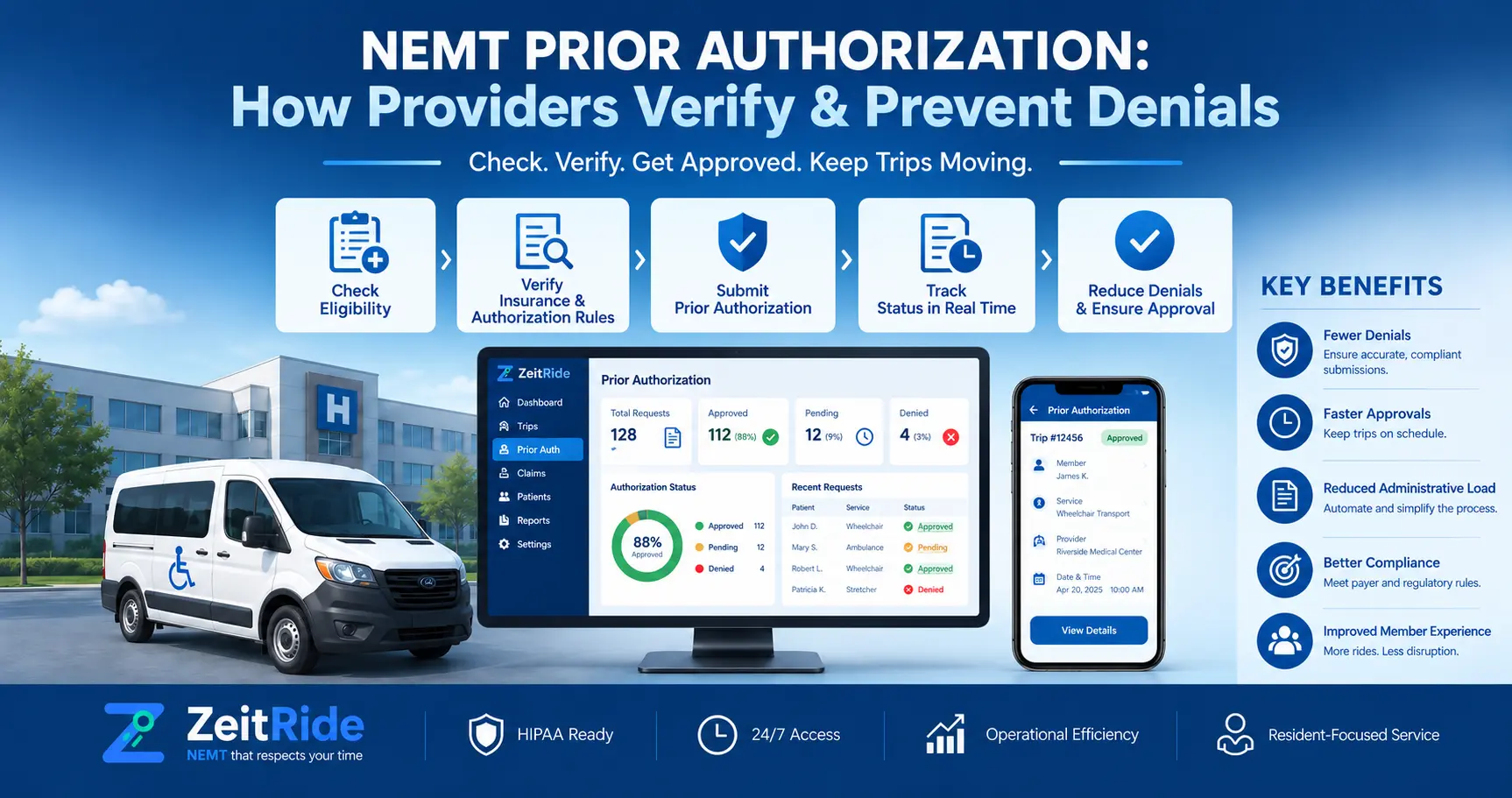
NEMT Prior Authorization: How Providers Verify & Prevent Denials
Learn how NEMT prior authorization works, what providers should verify, how requirements vary, and how to prevent authorization-related claim denials.
Quick answer
NEMT prior authorization is approval required by certain Medicaid programs, MCOs, brokers, or payers before specific transportation is provided or billed. Providers should verify authorization status, dates, service level, trip limits, and payer rules before dispatch.
ZeitRide Team
NEMT Operations Expert
A rider may have active Medicaid coverage, a familiar recurring schedule, and transportation booked for tomorrow — but none of those facts automatically prove that the trip has the authorization required by the program paying for it. That is why NEMT prior authorization should be treated as an operational control, not paperwork that billing checks after the vehicle has already moved. For transportation providers, the goal is to determine whether authorization is required, verify that the approval matches the planned service, keep the authorization connected to the trip, and make unresolved exceptions visible before dispatch.
Exact requirements are not universal. State Medicaid programs, managed care organizations, transportation brokers, health plans, contracts, transportation modes, and trip circumstances can all affect the authorization workflow. Providers should always confirm the requirements that apply to the specific member, payer, and service.
What Is NEMT Prior Authorization?
NEMT prior authorization is advance approval required by certain Medicaid programs, health plans, transportation brokers, or other payers before specified non-emergency medical transportation is provided or billed. Where prior authorization applies, the approval may establish details such as the member, approved transportation type, service dates, trip quantity or units, medical-necessity support, and other program-specific conditions.
Authorization is only one part of trip validation. A member can have active coverage but still lack the authorization required for a particular ride. Likewise, an authorization number does not automatically prove that the member remains eligible or that the service being scheduled matches what was approved. ZeitRide's NEMT eligibility verification guide explains the coverage side of that distinction in more detail.
Eligibility vs. Prior Authorization vs. Medical Necessity
Eligibility, medical necessity, authorization, and supporting documentation often appear in the same workflow, but they answer different questions. Keeping them separate helps prevent staff from treating one successful check as proof that the entire trip is financially valid.
| Concept | Main Question |
|---|---|
| Medicaid eligibility | Does the member have applicable coverage for the service date? |
| Transportation benefit | Does the member's program cover the requested transportation? |
| Medical necessity | Is the requested transportation type justified under the applicable rules? |
| Prior authorization | Has the required payer, program, or broker approval been obtained? |
| Practitioner order or supporting documentation | Does the required clinical documentation support the transportation request? |
A dispatcher should not assume that "Medicaid active" means "trip authorized," just as a billing team should not assume that an authorization number proves the completed transportation matched the approved service.
What Are NEMT Prior Authorization Requirements?
There is no single national checklist of NEMT prior authorization requirements that applies identically to every transportation provider. Requirements can vary by state Medicaid program, fee-for-service or managed care arrangement, health plan, transportation broker, transportation mode, mileage, destination, frequency, recurring-trip status, medical-necessity criteria, and provider contract.
- State Medicaid program and service area
- Fee-for-service versus managed care
- Health plan or managed care organization
- Transportation broker
- Transportation mode or level of service
- Mileage or distance thresholds where applicable
- Recurring versus one-time transportation
- Medical-necessity criteria
- Destination or covered medical service
- Provider and payer contract requirements
A national NEMT company should therefore avoid turning one state's provider manual into a company-wide authorization rule. A better approach is to maintain one consistent internal verification process while applying payer- and program-specific rules to each trip. ZeitRide's NEMT broker requirements guide explains why broker, state, health-plan, and contract requirements need to be separated.
How Does the NEMT Prior Authorization Process Work?
A reliable NEMT prior authorization process should determine whether the transportation is valid before an authorization problem becomes a dispatch, documentation, or billing problem.
1. Identify the Member, Payer, and Trip Source
Start with the member and the organization financially responsible for the transportation. Determine whether the trip is associated with fee-for-service Medicaid, a managed care organization, transportation broker, healthcare facility, or another payer arrangement. The payer and trip source determine which authorization workflow should be followed.
2. Verify Eligibility and Transportation Coverage
Use the official state, payer, MCO, or broker process required for the trip. A previous ride, old coverage information, recurring schedule, or familiar member should not be treated as proof of current eligibility.
3. Determine Whether Prior Authorization Is Required
Apply the requirements governing that specific member and trip. The answer may depend on transportation mode, mileage, destination, trip frequency, medical necessity, payer structure, or other program-specific conditions. If the requirement is unclear, escalate through the authoritative payer or broker workflow instead of guessing.
4. Confirm Required Supporting Documentation
Where required, confirm that the appropriate practitioner order, certification, medical-necessity documentation, or other supporting record has been completed. Do not assume that the same document is required for every Medicaid NEMT program. ZeitRide's NEMT documentation requirements guide explains how authorization information fits into the broader trip and audit trail.
5. Match the Authorization to the Planned Trip
Before dispatch, compare the authorization with the actual transportation being scheduled. Confirm the fields relevant to that program rather than simply checking that an authorization number exists.
6. Hold or Escalate Exceptions
Pending, expired, missing, or mismatched authorizations should remain visible. Do not bury the issue in a dispatcher note, email thread, or spreadsheet cell that may never be checked before the vehicle leaves. Create a defined exception workflow and assign responsibility for resolving it.
7. Preserve Authorization Information Through Billing
After transportation is completed, the service should still be traceable to the authorization or broker approval supporting it. The service date, transportation mode, trip information, documentation, and billing record should describe the same transportation event.
What Should Providers Verify on an NEMT Authorization?
The exact fields depend on the program, but an internal authorization review may need to confirm the following information before transportation moves forward.
- Correct member
- Correct payer, health plan, or transportation broker
- Authorization or reference number
- Approved effective date
- Expiration date
- Transportation mode or service level
- Authorized trips, units, or mileage where applicable
- Pickup or destination conditions where applicable
- Recurring-trip terms
- Required supporting practitioner documentation
- Unresolved restrictions or exceptions
The goal is to match the authorization to the planned transportation, not simply store an authorization number somewhere in the member record.
Why Recurring NEMT Trips Create Extra Authorization Risk
Recurring transportation creates a specific authorization problem: the schedule can continue even when the financial or clinical approval behind it changes. Dialysis, therapy, behavioral-health appointments, adult-day programs, and other repeat transportation may run several days per week for months, while eligibility periods, authorization dates, approved trip quantities, service levels, or payer relationships change on different timelines.
A recurring schedule is not the same as permanent authorization. Providers should review authorization status when a new approval period begins, the payer changes, the transportation mode changes, the destination changes, or another program-defined trigger occurs. ZeitRide's NEMT recurring routes workflow helps operators manage repeat transportation without rebuilding the same schedule manually.
How Missing Authorization Becomes a Claim Denial
An authorization problem often becomes visible only after the provider has already incurred the cost of transportation. A trip is scheduled, the authorization is missing, expired, or mismatched, the driver completes the service, the trip reaches billing, and only then does the payer identify the authorization problem.
- Trip is scheduled.
- Authorization is missing, expired, or does not match the planned service.
- Driver and vehicle complete the transportation.
- The trip enters billing.
- The payer or broker identifies the authorization problem.
- Payment may be delayed, adjusted, or denied.
- Billing staff investigate a problem that began before dispatch.
That is why denial prevention should not belong only to the billing team. Authorization-related exceptions are generally easier to investigate while the trip is still being reviewed than after driver time, fuel, vehicle capacity, and administrative effort have already been spent. If a claim has already failed, ZeitRide's NEMT claim denial guide covers the downstream denial workflow in greater detail.
How Should Providers Handle NEMT Authorization Tracking?
Good NEMT authorization tracking is not simply maintaining a large spreadsheet. The more important goal is keeping the authorization connected to the member and the trip it supports.
- Payer or transportation broker
- Whether prior authorization is required
- Authorization or reference number
- Effective and expiration dates
- Applicable trip, unit, or mileage limits
- Approved transportation mode or service level
- Recurring-trip relationship
- Supporting documentation status
- Pending exceptions
- Verification source and date where required
A spreadsheet may work for a small controlled workflow, but risk increases as the company adds recurring riders, multiple brokers, several service levels, and more staff. The biggest problem is often the loss of connection between the authorization record, schedule, dispatch activity, completed trip, and billing record.
What Should NEMT Authorization Software Help Control?
Software should not replace the official Medicaid program, payer, MCO, or broker responsible for determining whether transportation is authorized. Instead, NEMT software should help providers keep verified information visible and prevent unresolved trip data from disappearing between departments.
- Payer and broker information connected to the trip
- Structured authorization and reference fields
- Effective and expiration dates
- Recurring-trip visibility
- Review and exception statuses
- Transportation mode and service-level information
- Documentation connected to the operational record
- Trip history and changes
- Billing-ready validation
- Traceability from scheduling through completed service
The objective is simple: dispatchers, drivers, operations staff, and billing teams should not each be working from a different version of the same trip.
How ZeitRide Supports an Authorization-Aware NEMT Workflow
ZeitRide is not a state Medicaid eligibility or prior-authorization authority. Providers should continue using the official state, payer, managed care organization, or transportation broker source required to determine actual eligibility and authorization.
Where ZeitRide helps is around that determination. ZeitRide's Medicaid NEMT software connects payer and broker trip information with scheduling, dispatch, driver activity, documentation, billing, reconciliation, and operational history so verified trip information does not have to be rebuilt across separate systems.
The same trip information can also continue downstream into NEMT billing software workflows after service is completed. The goal is not to override payer rules. It is to make those rules easier for the operation to apply consistently from intake through billing.
NEMT Prior Authorization Checklist Before Dispatch
When your organization is responsible for authorization verification, use this checklist as an internal starting point and adapt it to the rules governing the specific payer, broker, state, and trip.
- Confirm the correct member.
- Identify the correct payer, managed care organization, or broker.
- Confirm applicable eligibility.
- Determine whether prior authorization is required.
- Confirm required supporting documentation.
- Verify the authorization or reference number.
- Check effective and expiration dates.
- Confirm the approved transportation mode or service level.
- Check applicable trip, unit, mileage, or other limits.
- Match the authorization to the scheduled transportation.
- Flag unresolved differences before dispatch.
- Record the verification source and date where required.
- Keep authorization information connected to the completed trip.
- Recheck the record before billing where appropriate.
This checklist should not replace a Medicaid provider manual, payer policy, transportation broker agreement, or contract. The most important control is knowing which source is authoritative for each trip.
Frequently Asked Questions About NEMT Prior Authorization
Q: What is NEMT prior authorization?
NEMT prior authorization is advance approval required by certain Medicaid programs, health plans, transportation brokers, or other payers before specified non-emergency medical transportation is provided or billed. Exact requirements vary by program and trip.
Q: Is Medicaid eligibility the same as NEMT prior authorization?
No. Medicaid eligibility confirms applicable coverage, while NEMT prior authorization confirms approval for transportation when authorization is required. A member can have active Medicaid coverage and still require separate transportation approval.
Q: Who is responsible for obtaining NEMT prior authorization?
Responsibility varies by program. The treating provider, healthcare facility, payer, transportation broker, member, or NEMT provider may have a role. Providers should verify responsibility against the rules and contract governing the trip.
Q: Can missing prior authorization cause an NEMT claim denial?
Yes, when authorization is required. Missing, expired, or mismatched authorization can lead to delayed payment, adjustment, or claim denial depending on the payer and program requirements.
Q: How should providers track recurring NEMT authorizations?
Providers should track the authorization number, effective and expiration dates, approved transportation mode, applicable trip or unit limits, payer or broker, supporting documentation, and recurring-trip relationship according to program requirements.
Put One Real Authorization-to-Trip Workflow Through ZeitRide
The easiest way to evaluate an authorization workflow is with a real trip. Bring the payer or broker, how your team confirms authorization, the recurring or one-time schedule, what dispatch needs to see, what the driver records, and what billing receives after service.
ZeitRide can show you how verified trip information stays connected across the operational workflow instead of disappearing between portals, spreadsheets, dispatch tools, and billing. See how ZeitRide works for NEMT operations and bring a real authorization-to-trip workflow to the conversation.
Rather see it than read about it?
Bring a real route, a couple of drivers, and your current process. 15 minutes, zero pitch.