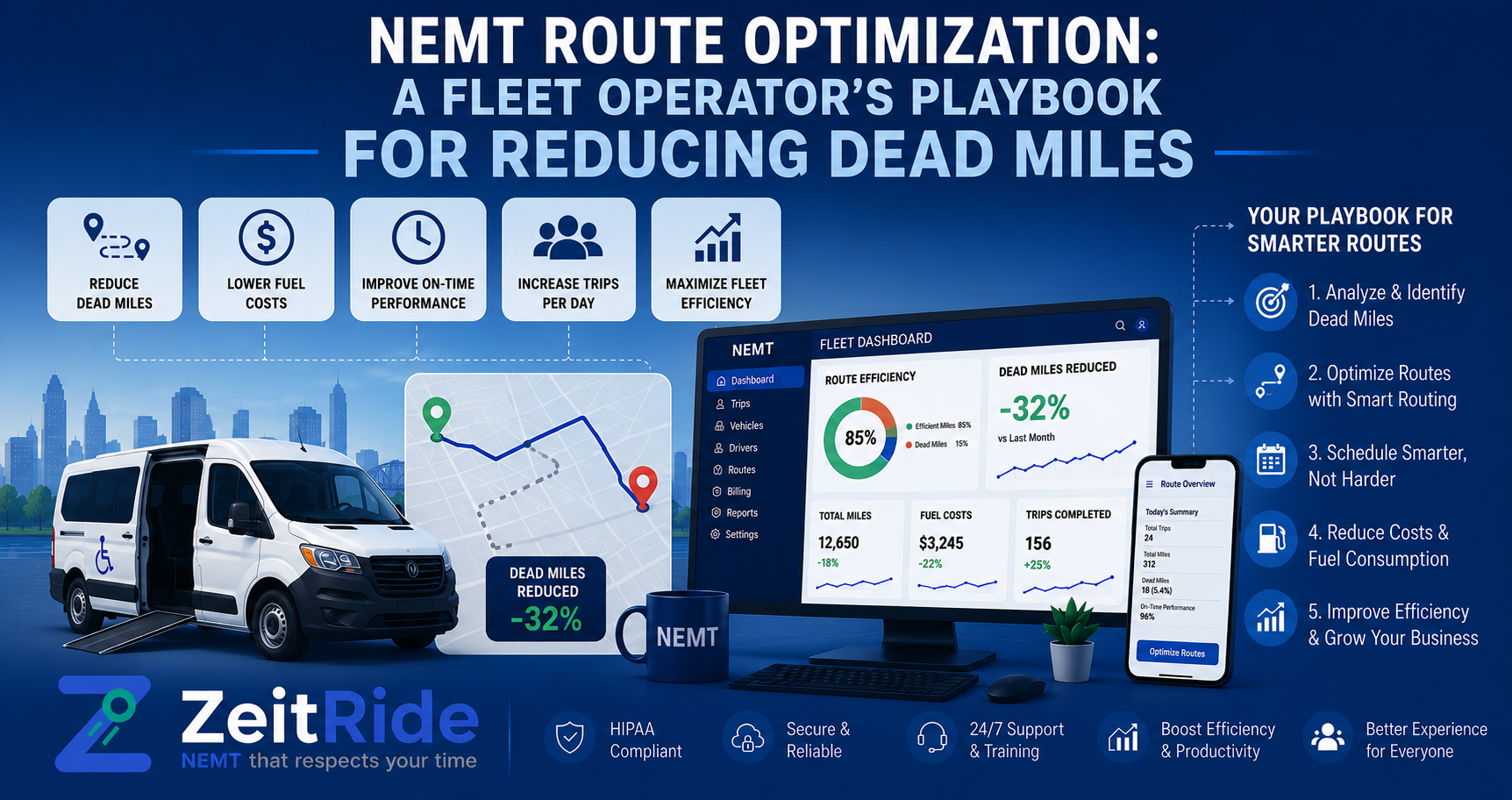
NEMT Route Optimization: A Fleet Operator's Playbook for Reducing Dead Miles
Dead miles drain NEMT margins silently. This playbook covers route optimization strategies, AI sequencing, and seven tips fleet operators use to cut deadhead miles and run more trips per day.
Quick answer
NEMT route optimization sequences and assigns trips to minimize empty miles driven. AI-powered optimization evaluates pickup windows, vehicle capability, and traffic simultaneously. Operators typically see a 15–25% reduction in miles driven, lowering fuel costs and enabling more trips without adding vehicles.
ZeitRide Team
NEMT Operations Expert
NEMT route optimization is the process of sequencing and assigning trips to minimize total miles driven, travel time, and empty vehicle movement. AI-powered optimization evaluates pickup windows, passenger mobility requirements, vehicle capability, and real-time traffic simultaneously — finding the most efficient stop order across your entire fleet. Operators using automated route optimization typically see a 15–25% reduction in miles driven, which translates directly to lower fuel costs, reduced vehicle wear, and the ability to handle more trips without adding vehicles.
The Hidden Cost Draining Your NEMT Operation
Most NEMT operators track revenue per trip. Fewer track what every trip actually costs — and fewer still calculate what dead miles are costing them every month.
Dead miles (also called deadhead miles or non-revenue miles) are the miles your vehicles travel without a paying passenger: driving to the first pickup, returning to base after a drop-off, repositioning between non-adjacent trips. Every one of those miles burns fuel, adds driver hours, and accelerates vehicle wear — without generating a cent of revenue.
Here is the math for a typical 5-vehicle fleet. If each vehicle averages 80 miles per day and 20% of those are dead miles, that is 16 dead miles per vehicle per day. At $0.25 per mile in fuel and maintenance costs, that is $4 per vehicle per day, $20 across the fleet, roughly $400 per month, and nearly $5,000 per year — in miles that paid you nothing.
Scale that to a 10-vehicle fleet and you are looking at close to $10,000 a year evaporating before you have dispatched a single trip. This is not a small-line-item problem. It is an operational leak that compounds every single day — and it is exactly the problem that proper NEMT route optimization is built to close.
What Are Dead Miles in NEMT?
Dead miles in NEMT are the distance a vehicle travels without an active passenger on board. This includes driving from a dispatch center or driver's home to the first pickup location, traveling between drop-off and the next pickup when those points are geographically inefficient, and returning to base at the end of a shift without a return trip loaded.
Dead miles are sometimes reimbursable under certain broker contracts for specific trip types, but in the majority of day-to-day Medicaid NEMT operations they are an unrecovered operating cost. Reducing them is one of the highest-ROI efficiency levers available to fleet operators.
Why Dead Miles Happen: The Root Causes
Dead miles do not appear randomly. They are the direct output of specific operational weaknesses — most of which are fixable once you know where to look.
- Manual stop sequencing — Dispatchers optimize for what they can see, usually proximity on a map. They cannot simultaneously evaluate 40 trips, 8 vehicles, and 12 pickup windows the way an algorithm can. The result is routes that look reasonable but leave significant dead mileage between stops.
- Reactive dispatch — Brokers send trips throughout the morning. If your team loads them one at a time and assigns them individually, you lose the ability to group geographically adjacent trips into a single vehicle run.
- Poor return trip pairing — Dialysis trips, routine appointments, and facility discharges all have predictable return windows. Fleets that do not pair outbound and return trips efficiently send empty vehicles back to origin when a loaded return trip was available minutes away.
- Cancellations without re-optimization — A cancellation mid-route creates a gap. If the dispatcher does not re-optimize remaining trips around that gap, the vehicle continues an inefficient sequence — adding empty miles to close out a route that no longer makes sense.
How Does NEMT Route Optimization Work?
At its core, NEMT route optimization is a constraint-solving problem. The system takes a set of inputs — trip origins and destinations, appointment times, pickup windows, vehicle types, passenger mobility requirements, driver start and end locations — and finds the assignment and stop sequence that minimizes total cost while satisfying all constraints.
Manual routing cannot solve this problem well. A dispatcher managing 40 trips across 8 vehicles is evaluating a combinatorial problem with millions of possible route configurations. They simplify it by using rules of thumb, which produce decent routes but not optimal ones.
AI route optimization handles the full computation in seconds. It considers every trip simultaneously, applies hard rules (wheelchair vehicle required for passenger A, must arrive by 9:15 AM for passenger B), evaluates traffic data, and produces an optimized assignment and stop sequence that a human dispatcher would rarely reach on their own.
The best platforms re-optimize continuously. When a trip is added, cancelled, or delayed, the algorithm re-runs and surfaces updated recommendations. Your dispatcher sees the change as a one-click action rather than manually restructuring a board that is already in motion. This is where AI route optimization for medical transportation moves from a feature to a daily operational advantage.
Manual Routing vs. AI Route Optimization: What the Difference Actually Costs
| Factor | Manual Routing vs AI Route Optimization | |
|---|---|---|
| Stop sequencing | Dispatcher judgment, rule-of-thumb | Algorithm evaluates all combinations |
| Dead miles per shift | Estimated 18–25% of total miles | Typically 10–15% with optimization |
| Response to cancellations | Manual re-sequencing (10–20 min) | Automatic re-optimization (seconds) |
| Multi-stop trip grouping | Limited by dispatcher visibility | AI evaluates full manifest simultaneously |
| Return trip pairing | Often missed under pressure | Built into the optimization model |
| Dispatcher cognitive load | High — managing exceptions and sequencing | Reduced — focus on exceptions only |
| Time to dispatch morning wave | 1–3 hours for large fleets | 20–45 minutes with AI assist |
Sandra Mills, Fleet Manager at SafeTrip NEMT, put it plainly: "The route optimization alone pays for itself. We're running 3 fewer vehicles per day with the same member count."
7 NEMT Fleet Efficiency Tips to Reduce Dead Miles
1. Import Broker Trips the Night Before
The single biggest dead-miles multiplier is reactive morning dispatch. When broker trips arrive in real time and get assigned individually, you lose the ability to group adjacent trips and build efficient runs. Import your full anticipated manifest the evening before, let the optimization run overnight, and start the morning with sequenced routes rather than a blank board.
2. Cluster by Geography and Pickup Window, Not Just Address
Proximity on a map is a poor proxy for routing efficiency. Two pickups that are close together but have a 90-minute appointment window gap will destroy a vehicle's utilization for that period. Real NEMT route optimization clusters by the combination of geography and pickup window — finding the pairings that keep vehicles moving productively throughout the shift.
3. Build Return Trip Pairing Into Morning Dispatch
Dialysis routes are the clearest example: outbound trips run on set days each week, return trips run the same afternoons. If you do not load returns into the same optimization run as outbound trips, you are dispatching vehicles on half-trips. Setting up standing return-trip schedules and pairing them with outbound routes is one of the fastest ways to cut non-revenue miles. Read more on real-time dispatch coordination for return trips.
4. Set Vehicle-Capability Rules and Let the Algorithm Match
A common source of dead miles is a vehicle dispatched to a pickup it cannot efficiently serve — sending a stretcher van to pick up an ambulatory member two miles from a wheelchair-equipped vehicle that is sitting idle nearby. Define your vehicle-capability rules in your dispatch platform so the optimizer always matches member mobility needs to the nearest appropriate vehicle, not just the nearest vehicle.
5. Use Multi-Loading Selectively With Hard Ride Time Limits
Multi-loading — assigning two passengers to the same vehicle on the same run — reduces dead miles between trips when done correctly. The key word is correctly. Multi-load combinations that add more than 15–20 minutes to a passenger's ride time create compliance risk and broker complaints. Use AI-assisted multi-load matching with hard ride time limits as constraints in your optimizer, not as suggestions. For the full framework, see how multi-loading works in NEMT and when to avoid it.
6. Re-Optimize After Every Cancellation
A mid-shift cancellation changes the math on every vehicle that was routing around that trip. Most operators acknowledge the cancellation in their platform and move on — leaving the remaining routes unchanged. The better practice is triggering a re-optimization of the open trip manifest the moment a cancellation is confirmed, so the gap gets filled rather than leaving an inefficient hole in your routing.
7. Review Your Dead-Mile Report Weekly and Set a Target
You cannot improve what you are not measuring. Most modern NEMT routing software for fleet operators includes a dead-miles or non-revenue-miles report. Pull it weekly. Know your baseline. Set a percentage target — if you are currently at 22% dead miles, a realistic 90-day goal is 17–18%. Track progress monthly. This one habit creates accountability and makes it far easier to identify which route, which shift, or which driver is generating the most non-revenue mileage.
What a 20% Dead-Mile Reduction Looks Like Across Fleet Sizes
These numbers use $0.25 per mile as a blended fuel-and-maintenance cost estimate — conservative for most US markets in 2026.
| Monthly Savings (Est.) | Annual Savings (Est.) | |||
|---|---|---|---|---|
| Fleet Size | Current Dead Miles/Day (est. 20%) | Miles Saved Daily at 20% Reduction | Monthly Savings (est.) | Annual Savings (est.) |
| 3 vehicles | ~48 miles | ~9.6 miles | ~$72 | ~$864 |
| 5 vehicles | ~80 miles | ~16 miles | ~$120 | ~$1,440 |
| 10 vehicles | ~160 miles | ~32 miles | ~$240 | ~$2,880 |
| 20 vehicles | ~320 miles | ~64 miles | ~$480 | ~$5,760 |
These figures cover fuel and maintenance only — they do not include driver time recovered, additional trip capacity gained, or vehicle lifespan extended by reduced mileage. The actual ROI of NEMT route optimization is higher than these numbers suggest. Marcus Johnson, Owner of Skyline Medical Transport, described it this way: "ZeitRide saves me about a whole day's worth of time. Once I finish the dispatch, I can go do other things and the system just does the work."
Is Your Current Software the Routing Bottleneck?
Not all NEMT software handles route optimization with the same depth. If your current platform requires dispatchers to manually sequence stops, does not re-optimize in response to cancellations, or treats routing as a separate module with an additional cost, the software itself may be the source of your dead-mile problem.
When evaluating NEMT routing software for fleet operators, ask these specific questions before committing to a platform:
- Does the optimizer run on the full trip manifest simultaneously, or does it assign trips one at a time?
- Does it re-optimize automatically when a cancellation or add-on trip occurs?
- Does it enforce vehicle-capability matching as a hard constraint?
- Does it support multi-stop trip pairing with configurable ride time limits?
- Does it include a dead-miles or non-revenue-miles report?
If the answers are "no," "manually," or "that is an add-on," the software is not doing the work it should be doing — and your fleet is absorbing the cost.
For more on how AI route optimization for medical transportation is changing daily NEMT operations, and on reducing dispatch labor costs through automation, those guides go deeper on both topics.
Bring a Route. We'll Run the Optimization Live.
If dead miles are costing your fleet more than they should, the fastest way to find out what is actually available is to run your own routes through a live optimization. ZeitRide's dispatch, scheduling, and AI routing are all included in one flat plan — $49 per vehicle per month, no setup fees, no add-ons, cancel anytime. Operators go live within a day. Bring a real route, a couple of drivers, and your current trip manifest. Fifteen minutes. Zero pitch. We will show you the exact workflow on your own trips, not a generic demo. Or see what is included in the plan before booking.
Rather see it than read about it?
Bring a real route, a couple of drivers, and your current process. 15 minutes, zero pitch.