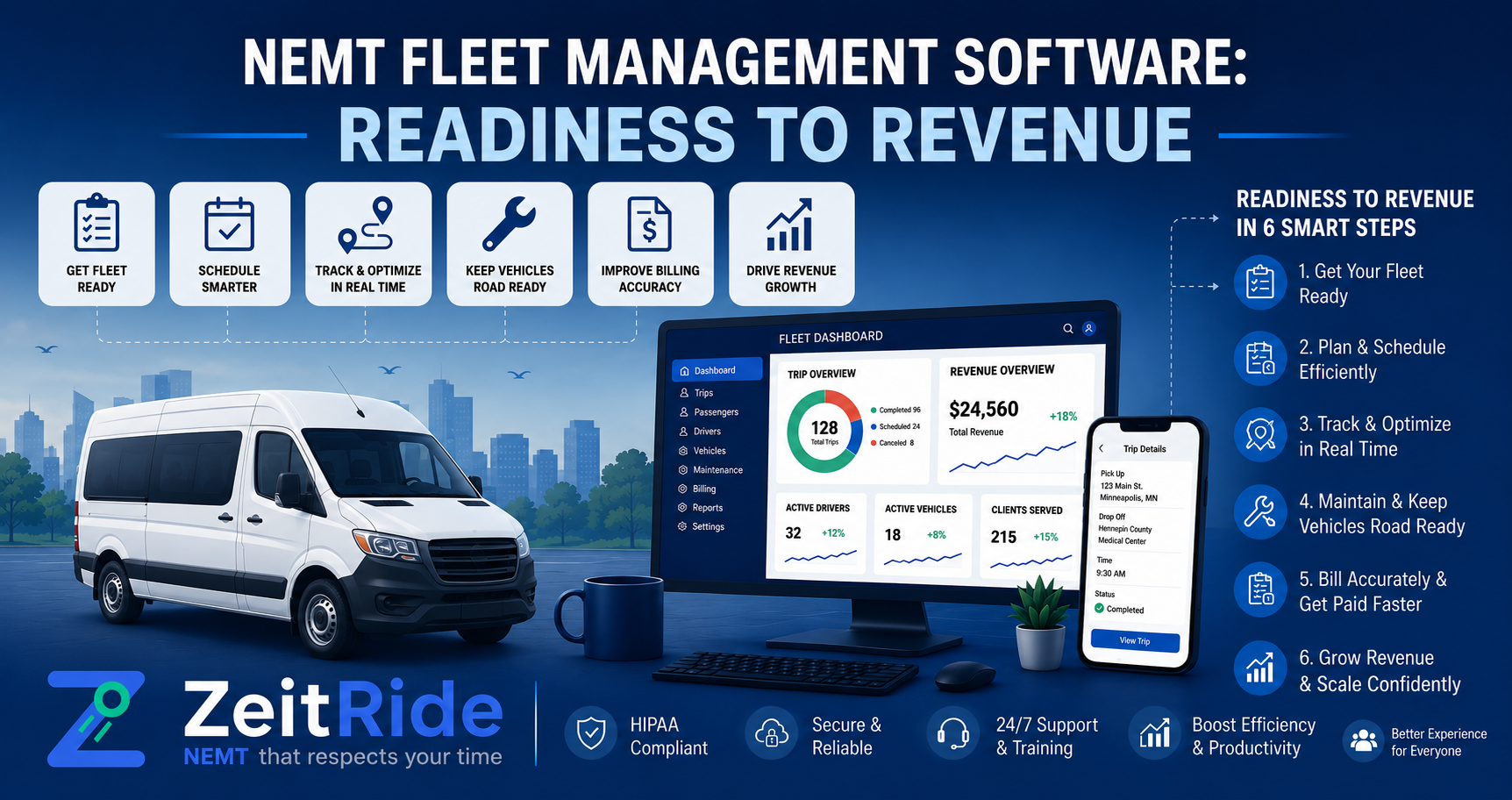
NEMT Fleet Management Software: Readiness to Revenue
Learn how NEMT fleet management software connects vehicle readiness, GPS tracking, inspections, maintenance, dispatch, and fleet utilization.
Quick answer
NEMT fleet management software connects vehicle readiness, driver qualifications, inspections, maintenance, GPS tracking, dispatch, and utilization. It helps operators assign suitable vehicles to trips, respond to disruptions, and manage fleet capacity from one system.
ZeitRide Team
NEMT Operations Expert
An NEMT vehicle can be parked in the lot and still be unavailable. It may have a failed inspection, overdue maintenance, an equipment problem, or no qualified driver available for the trip. That is why managing an NEMT fleet requires more than a spreadsheet, maintenance calendar, or basic GPS application.
NEMT fleet management software connects vehicle readiness, driver information, inspections, maintenance, trip assignments, live locations, and utilization. When it is part of an integrated NEMT software platform, the condition and capabilities of each vehicle can influence scheduling and dispatch decisions before service begins.
What Is NEMT Fleet Management Software?
NEMT fleet management software is a specialized system for managing the vehicles, drivers, inspections, maintenance, locations, assignments, and performance of a non-emergency medical transportation fleet. Unlike a standalone GPS or maintenance tool, NEMT fleet software connects vehicle information with the transportation work assigned to it.
A complete NEMT fleet management system helps operators answer important daily questions:
- Is the vehicle available and road-ready?
- Is it suitable for the rider's mobility needs?
- Is the assigned driver qualified and available?
- Where is the vehicle now?
- Which trips will be affected if it goes out of service?
- Is the vehicle being used efficiently?
NEMT Fleet Software Versus General Fleet Software
General fleet software is often designed for delivery companies, field-service teams, construction vehicles, or commercial trucks. It may track location, repairs, fuel, and mileage, but it may not understand NEMT trip requirements.
Medical transportation fleet management software must connect the vehicle with the driver, passenger, mobility mode, appointment window, dispatch status, and trip documentation.
| Capability | General Fleet Software | NEMT Fleet Management Software |
|---|---|---|
| GPS tracking | Shows vehicle location | Connects location with trips, stops, and statuses |
| Maintenance | Tracks service schedules | Connects maintenance status with dispatch availability |
| Vehicle capacity | Usually general | Includes ambulatory and wheelchair requirements |
| Driver records | Basic license information | Connects qualifications with vehicles and trips |
| Scheduling | Delivery or service based | Supports appointments, recurring trips, and returns |
| Documentation | General asset history | Preserves trip, inspection, signature, and status records |
| Utilization | Mileage and vehicle use | Connects fleet use with completed NEMT trips |
A general platform may show where a vehicle is. A specialized NEMT platform should also show what trip it is completing, what comes next, and whether an exception requires attention.
The NEMT Readiness-to-Revenue Framework
Effective NEMT fleet operations can be organized into five connected stages: readiness, assignment, execution, documentation, and utilization. A weakness in one stage can create operational problems throughout the rest of the workflow.
1. Vehicle Readiness
Before a vehicle receives a trip, the operator needs to know whether it is safe, available, documented, and properly equipped. The vehicle profile should include passenger capacity, accessibility equipment, inspection status, maintenance status, document expirations, and current availability.
Drivers should be able to complete digital NEMT fleet inspections. When a defect is reported, the office should be able to review it and remove the vehicle from new assignments when necessary.
2. Vehicle and Driver Assignment
A road-ready vehicle may still be unsuitable for a particular rider. For example, an ambulatory vehicle should not be assigned to a wheelchair trip, and some assignments may require a driver with specific qualifications or training.
A connected system should evaluate vehicle capabilities together with driver qualification and availability records before the trip is finalized.
3. Trip Execution
Once service begins, dispatch needs more than a GPS pin. Live GPS monitoring is more useful when it is connected to the assigned route, next stop, pickup window, trip status, and driver updates.
When a vehicle breaks down, a member cancels, or a driver becomes unavailable, real-time NEMT dispatch should help the office identify affected trips and available replacements quickly.
4. Trip Documentation
Completed transportation may create records for billing, broker review, customer service, payroll, and compliance. Useful records can include driver and vehicle assignments, pickup and drop-off timestamps, GPS history, signatures, cancellation reasons, inspection records, dispatch changes, and user audit history.
Requirements vary by state, broker, payer, insurer, and contract. Operators should follow the standards that apply to their organization and review official resources such as the CMS NEMT provider guidance.
5. Fleet Utilization
A fleet can appear busy while still wasting capacity. Vehicles may spend too much time parked, traveling without a passenger, waiting between poorly grouped trips, or operating routes that could have been consolidated.
AI-assisted NEMT routing can help operators sequence stops, account for vehicle requirements, and reduce unnecessary mileage. The goal is not to keep every vehicle moving constantly. It is to use the correct number and mix of vehicles to complete required trips reliably.
How to Manage an NEMT Fleet
Operators researching how to manage an NEMT fleet should begin by connecting operational decisions rather than using a separate tool for every task.
- Maintain one authoritative profile for each vehicle, including capacity, equipment, documents, inspection history, maintenance schedule, location, and current status.
- Use consistent vehicle statuses such as Ready, Assigned, In Service, Inspection Review, Maintenance, and Out of Service.
- Connect reported inspection defects with vehicle availability and dispatch decisions.
- Track upcoming maintenance and completed work in the same vehicle record.
- Compare GPS location with the assigned route, next stop, scheduled time, and current trip status.
- Review vehicle defects, deadhead mileage, reassignments, late-trip patterns, and underused capacity every week.
NEMT Fleet Utilization Metrics
There is no single utilization target that fits every NEMT operation. A rural fleet, urban wheelchair provider, dialysis specialist, and mixed-service fleet will produce different patterns. Use consistent definitions and compare performance over time.
| Metric | Basic Formula | What It Shows |
|---|---|---|
| Vehicle utilization rate | Active service hours divided by available hours multiplied by 100 | How much available capacity is used |
| Trips per active vehicle | Completed trips divided by active vehicles | Daily vehicle productivity |
| Revenue-mile ratio | Productive miles divided by total miles multiplied by 100 | Share of mileage connected to service |
| Deadhead-mile share | Non-revenue miles divided by total miles multiplied by 100 | Repositioning and route inefficiency |
| Out-of-service rate | Out-of-service hours divided by scheduled hours multiplied by 100 | Effect of defects and maintenance |
| Reassignment rate | Reassigned trips divided by scheduled trips multiplied by 100 | Stability of the original plan |
Review these metrics by vehicle type, service area, facility, driver shift, broker, and day of the week. Fleet-wide averages may hide a shortage or underused capacity in one part of the operation.
Essential NEMT Fleet Management Features
A complete NEMT fleet management system should support the connected workflows required to keep vehicles ready, trips covered, and fleet performance visible.
- Detailed vehicle and equipment profiles
- Driver qualification and availability records
- Digital pre-trip and post-trip inspections
- Maintenance schedules and service history
- Vehicle availability controls
- Live GPS and route visibility
- Real-time dispatch and reassignment
- Driver mobile workflows
- Fleet-utilization reporting
- Trip and user audit history
- Billing and broker-related records
- Exportable operational reports
The most important consideration is not the number of features. It is whether those features share information. A failed inspection should affect vehicle availability, a dispatch change should reach the driver, and a completed trip should update the operational record without requiring staff to enter the same information in several systems.
How ZeitRide Connects NEMT Fleet Operations
ZeitRide connects fleet records with scheduling, routing, dispatch, driver workflows, GPS, inspections, billing, and reporting. Operators can add vehicles and their capabilities, maintain driver records, import trips, assign suitable vehicles, optimize routes, monitor active service, record inspections, preserve signatures, and review completed work from one platform.
You can see how ZeitRide works or review ZeitRide pricing before scheduling a demonstration.
Turn Vehicle Readiness Into Productive Capacity
A larger fleet does not automatically create a more productive operation. The first priority is understanding whether existing vehicles are ready, appropriately assigned, efficiently routed, and supported by reliable records.
NEMT fleet management software brings those decisions into one workflow. It connects the condition and capabilities of each vehicle with the trips it is expected to complete.
Bring one day of actual trips, your current vehicle list, and driver availability to a practical ZeitRide demonstration. See how your existing fleet could move from readiness through dispatch, documentation, and utilization in one connected system.
Book a 15-minute ZeitRide demo.
Frequently Asked Questions
Q: What is NEMT fleet management software?
NEMT fleet management software is a specialized system for managing vehicles, drivers, inspections, maintenance, GPS tracking, trip assignments, documentation, and utilization for a non-emergency medical transportation operation.
Q: How is NEMT fleet software different from GPS tracking?
GPS tracking mainly shows vehicle location and movement. NEMT fleet software connects location with vehicle readiness, driver qualifications, trip schedules, rider requirements, dispatch statuses, inspections, and maintenance records.
Q: Can NEMT software prevent an unavailable vehicle from being assigned?
A connected platform can use vehicle status to keep an unavailable or out-of-service vehicle from appearing as an appropriate assignment. The exact workflow depends on the provider's inspection, maintenance, and dispatch rules.
Q: Does NEMT fleet management software track maintenance?
It can track service schedules, reminders, completed maintenance, reported defects, and vehicle availability. Maintenance intervals should follow the requirements that apply to the vehicle and transportation provider.
Q: How do you measure NEMT fleet utilization?
Common metrics include active service hours, trips per vehicle, productive mileage, deadhead mileage, out-of-service time, on-time pickups, and reassignment rates.
Q: Can NEMT software match wheelchair-accessible vehicles to trips?
NEMT software can record passenger capacity, mobility equipment, and vehicle capabilities, then use those details when assigning trips. The workflow is stronger when driver qualifications and passenger requirements are stored in the same system.
Q: Is NEMT fleet management software the same as dispatch software?
Dispatch software manages active trips, assignments, and same-day changes. Fleet management software covers the broader vehicle lifecycle, including readiness, inspections, maintenance, GPS, availability, and utilization.
Q: How much does ZeitRide cost?
ZeitRide costs $49 per active vehicle per month. The platform includes scheduling, routing, dispatch, billing workflows, broker integrations, vehicle inspections, reporting, and the ZeitRide driver application.
Rather see it than read about it?
Bring a real route, a couple of drivers, and your current process. 15 minutes, zero pitch.