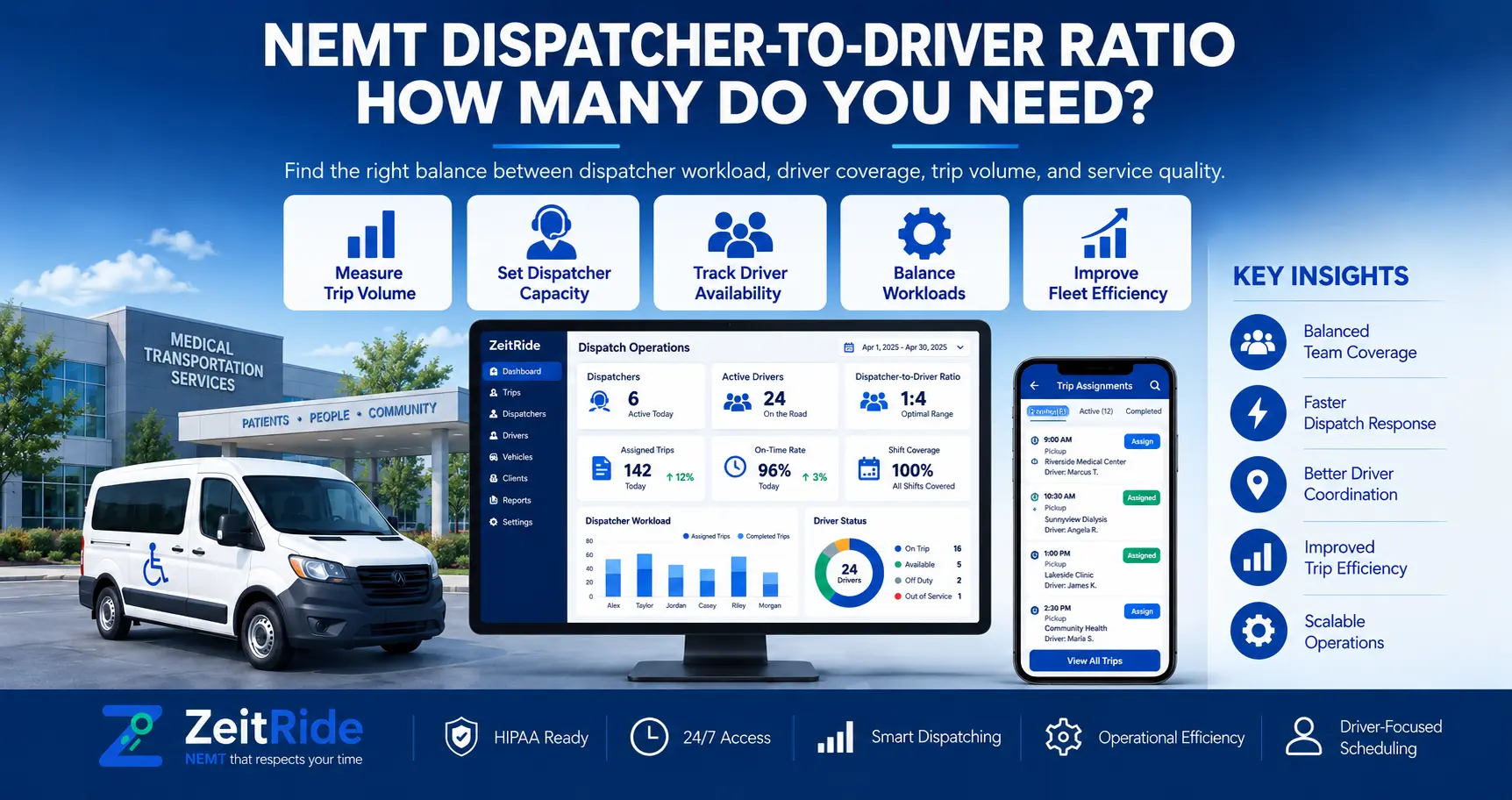
NEMT Dispatcher-to-Driver Ratio: How Many Do You Need?
Learn how to calculate your NEMT dispatcher-to-driver ratio, measure workload, spot overload, and decide when to add staff or automate.
Quick answer
There is no universal NEMT dispatcher-to-driver ratio. Use peak active drivers as a starting point, then evaluate trip exceptions, will-calls, phone volume, manual entry, and automation to decide whether your dispatch team has enough capacity.
ZeitRide Team
NEMT Operations Expert
How many drivers should one NEMT dispatcher manage? The answer cannot be determined by fleet size alone. Two NEMT companies may each have 15 drivers on the road, yet one dispatcher may handle the day comfortably while the other falls behind. The difference is often workload: will-calls, same-day changes, rider and facility calls, manual trip entry, route changes, no-shows, and constant driver check-ins. That is why the NEMT dispatcher-to-driver ratio should be used as a starting point for capacity planning, not as a universal staffing rule. This guide shows you how to calculate your ratio, identify the factors that increase dispatcher workload, spot signs of overload, and determine whether your fleet needs another dispatcher or a more efficient NEMT dispatch software workflow.
How Many Drivers Can One NEMT Dispatcher Handle?
There is no single number that works for every NEMT operation. Start with this simple calculation: peak active drivers divided by dispatchers covering live operations equals your dispatcher-to-driver ratio. If 15 drivers are actively running trips during your busiest period and one dispatcher manages the board, your ratio is 15:1. If two dispatchers cover those same 15 drivers, the ratio is 7.5:1. But the ratio does not tell the whole story. A dispatcher handling predictable recurring routes with live driver updates may have more capacity than another dispatcher managing the same number of drivers while answering calls, activating will-calls, entering trips manually, and chasing vehicle locations. The better question is whether your dispatcher can manage the active workload without important work repeatedly backing up.
What Is an NEMT Dispatcher-to-Driver Ratio?
An NEMT dispatcher-to-driver ratio compares the number of drivers actively operating with the number of dispatchers responsible for live transportation during the same period. When measuring your own NEMT dispatcher staffing ratio, use the drivers who are actually active during your busiest period instead of your total employee roster. A company may employ 25 drivers but have only 14 active during the morning peak. If one dispatcher is responsible for those 14 drivers, the operational ratio during that period is 14:1.
| Peak Active Drivers | Dispatchers on Duty | Calculated Ratio |
|---|---|---|
| 8 | 1 | 8:1 |
| 15 | 1 | 15:1 |
| 18 | 2 | 9:1 |
| 24 | 2 | 12:1 |
These are calculation examples, not recommended staffing standards. A lower ratio can still fail when the dispatcher carries excessive manual work, while a higher ratio may be manageable when routes are predictable and routine tasks are automated.
Is There an Official NEMT Dispatcher Staffing Ratio?
Federal Medicaid transportation guidance focuses on transportation access and provider and driver requirements; it does not establish one universal dispatcher-to-driver ratio for every NEMT provider. That means fleet owners should avoid treating a ratio copied from another operation as a compliance standard. Use external benchmarks only as context, then base staffing on your own peak workload, trip complexity, communication volume, and operating model.
What Determines NEMT Dispatcher Workload?
Fleet size matters, but workload determines whether the ratio is sustainable. Two fleets with the same number of active drivers can create completely different demands on dispatch. A recurring dialysis operation with stable routes may require fewer live interventions than a fleet handling frequent hospital discharges, will-calls, cancellations, same-day changes, and several manual trip sources.
- Number of active drivers during peak hours
- Simultaneous trips and same-day trip volume
- Will-call returns
- Cancellations, no-shows, and late pickups
- Rider and facility phone calls
- Driver calls and status requests
- Manual trip entry and duplicate data entry
- Number of broker or trip-intake sources
- Frequency of route changes and reassignments
- After-hours and weekend coverage
- Level of scheduling, routing, GPS, notification, and driver-app automation
For example, one 12-driver fleet may run mostly recurring trips while drivers receive assignments digitally and update pickup and drop-off statuses from the field. Another 12-driver fleet may require the dispatcher to enter trips manually, answer reservation calls, activate will-calls, call drivers for locations, and change routes throughout the day. Both fleets have a 12:1 ratio, but they do not have the same NEMT dispatcher workload.
How to Calculate Your Real NEMT Dispatcher Capacity
1. Find your busiest operating period
Do not use an all-day average. Identify the hour or operating window when the highest number of drivers, trips, calls, and exceptions overlap. Record how many drivers are actively transporting passengers during that period.
2. Count dispatchers actually covering live operations
Count only staff actively managing the dispatch board. A scheduler preparing tomorrow's routes or a billing employee occasionally answering a call should not automatically count as a full live dispatcher.
3. Calculate the ratio
Use the formula: peak active drivers divided by live dispatchers equals the dispatcher-to-driver ratio. Then move beyond the number and check whether the team consistently keeps up with live work.
4. Measure the workload behind the ratio
For at least one representative operating week, track the work that competes for dispatcher attention during peak periods.
- Unassigned trips during peak
- Will-calls requiring dispatcher action
- Same-day trip changes
- Incoming rider, facility, and broker calls
- Driver status calls
- Manual trip entries
- Route reassignments
- Dispatcher overtime
- Work postponed until later in the day
If the same work repeatedly builds up, you have identified a capacity problem. The next step is deciding whether the problem requires another person or whether avoidable manual work is consuming the capacity you already have.
Signs Your NEMT Dispatcher Is Over Capacity
One difficult day does not necessarily mean you need another dispatcher. Repeated operational patterns are more useful. Watch for signs that live work is consistently arriving faster than the dispatcher can resolve it.
- Unassigned trips regularly sit unresolved
- Late pickups are discovered only after a rider or facility calls
- Will-call returns build up during busy periods
- Drivers repeatedly call dispatch for their next assignment
- Trip statuses fall behind the real operation
- Same-day changes get lost in texts, notes, or separate systems
- Routine phone calls constantly interrupt live dispatch
- Dispatchers regularly work overtime to finish normal daily work
- The owner must step into dispatch whenever volume increases
Phone workload deserves special attention. If reservations, ETA questions, will-calls, billing questions, and live operational calls all reach the same person, even a relatively small fleet can overwhelm the position. ZeitRide already covers that issue in its NEMT call center setup guide, including how to separate reservations from live dispatch and organize call queues.
Should You Hire Another Dispatcher or Fix the Workflow?
Another dispatcher may be justified when genuine live decision-making exceeds available coverage during peak periods. Examples include several simultaneous exceptions, increasing trip complexity, inadequate shift overlap, or predictable demand that cannot reasonably be removed through process improvements. But adding headcount may not solve the underlying problem when dispatchers spend large amounts of time on repetitive administrative work.
| Dispatcher Bottleneck | First Question to Ask |
|---|---|
| Manual trip entry | Can trip information be imported instead of retyped? |
| Frequent driver status calls | Can dispatch see driver and trip status live? |
| Drivers call for assignments | Can assignments and changes go directly to the driver? |
| Rebuilding schedules | Can scheduling stay connected to live dispatch? |
| High phone volume | Can reservations and routine calls be routed separately? |
| End-of-day cleanup | Can field statuses update trip records automatically? |
If scheduling itself creates excessive manual work, NEMT scheduling software can keep recurring and one-time trips connected to dispatch instead of forcing staff to rebuild information between tools. The ZeitRide Driver app keeps assignments, trip statuses, route changes, and field updates connected to dispatch, reducing routine calls between drivers and the office.
The goal is not to force one dispatcher to manage as many drivers as possible. The goal is to make sure skilled dispatchers spend their time on exceptions, service recovery, and decisions that actually require human judgment.
Two NEMT Dispatcher Staffing Examples
Example 1: Predictable 10-driver operation
A provider has 10 active drivers during its morning peak and one dispatcher, giving it a 10:1 ratio. Most trips are recurring, schedules are prepared in advance, drivers send live status updates, and same-day changes are limited. If trips remain assigned, exceptions are addressed promptly, and work does not regularly accumulate, the existing coverage may be workable.
Example 2: Same ratio, much heavier workload
Another provider also has 10 active drivers and one dispatcher, so the ratio is still 10:1. However, the dispatcher manually enters trips, answers rider and facility calls, handles frequent will-calls, calls drivers for updates, and rebuilds assignments when changes occur. The numerical ratio is identical, but the NEMT dispatcher capacity is not. This operator should identify which tasks can be separated or streamlined before assuming another full dispatcher is the only solution.
How NEMT Software Can Affect Dispatcher Capacity
NEMT software does not create a universal staffing ratio. It changes how much repetitive work surrounds each trip. ZeitRide connects scheduling, live dispatch, routing, broker trip intake, driver activity, and trip records in one operational workflow. Dispatchers can work from a live view while drivers receive assignments and update trip status from the field.
- Reduce re-entry of trip information
- Reduce routine driver location calls
- Send assignments and changes digitally
- Keep scheduling and live dispatch connected
- Keep trip statuses visible during the day
- Reduce end-of-day reconstruction of completed trips
If your main question is whether software costs less than continuing a manual workflow, use the existing NEMT software vs manual dispatch guide rather than turning this staffing article into a second page for the same intent. For a deeper look at repetitive office work, the dispatch labor automation guide covers that subject separately.
The Bottom Line on NEMT Dispatcher-to-Driver Ratios
There is no universal NEMT dispatcher-to-driver ratio that tells every provider exactly how many dispatchers to employ. Start by calculating your ratio using peak active drivers, not total drivers on payroll. Then measure the work behind that number. If trip exceptions, will-calls, calls, manual entries, status requests, and route changes repeatedly create a backlog, your dispatch operation needs more capacity. Sometimes the answer is another dispatcher. Sometimes it is better role separation or improved workflows. Growing fleets may need both.
Is your dispatch team reaching capacity? Bring your current active-driver count, routes, and dispatch workflow. Book a 15-minute ZeitRide demo and see where manual work is consuming dispatcher time and how scheduling, dispatch, routing, and driver updates can work together in one system.
Frequently Asked Questions
Q: How many drivers can one NEMT dispatcher handle?
There is no universal number for every NEMT fleet. Start with active drivers during peak hours, then evaluate trip volume, will-calls, same-day changes, phone traffic, manual work, and automation. The sustainable number depends on how much dispatcher intervention the operation requires.
Q: What is a good NEMT dispatcher-to-driver ratio?
A good ratio is one that allows dispatch to manage active trips and exceptions without recurring backlog. The number itself is less important than whether the dispatcher can keep assignments, trip statuses, changes, and communication current during peak periods.
Q: How do I calculate an NEMT dispatcher staffing ratio?
Divide the number of active drivers during your busiest operating period by the number of dispatchers actively covering live operations. For example, 16 active drivers and two dispatchers equals an 8:1 dispatcher-to-driver ratio.
Q: How do I know if my NEMT dispatcher is overloaded?
Warning signs include unresolved trips, delayed will-calls, stale trip statuses, repeated driver check-in calls, frequent overtime, same-day changes falling behind, and routine phone traffic preventing the dispatcher from monitoring live transportation.
Q: Should I hire another NEMT dispatcher or use dispatch software?
Add staff when genuine live operational demand exceeds available coverage. Improve the workflow when substantial dispatcher time is consumed by duplicate entry, routine status calls, disconnected scheduling, or repetitive administrative work. Some growing fleets need both appropriate staffing and better systems.
Rather see it than read about it?
Bring a real route, a couple of drivers, and your current process. 15 minutes, zero pitch.