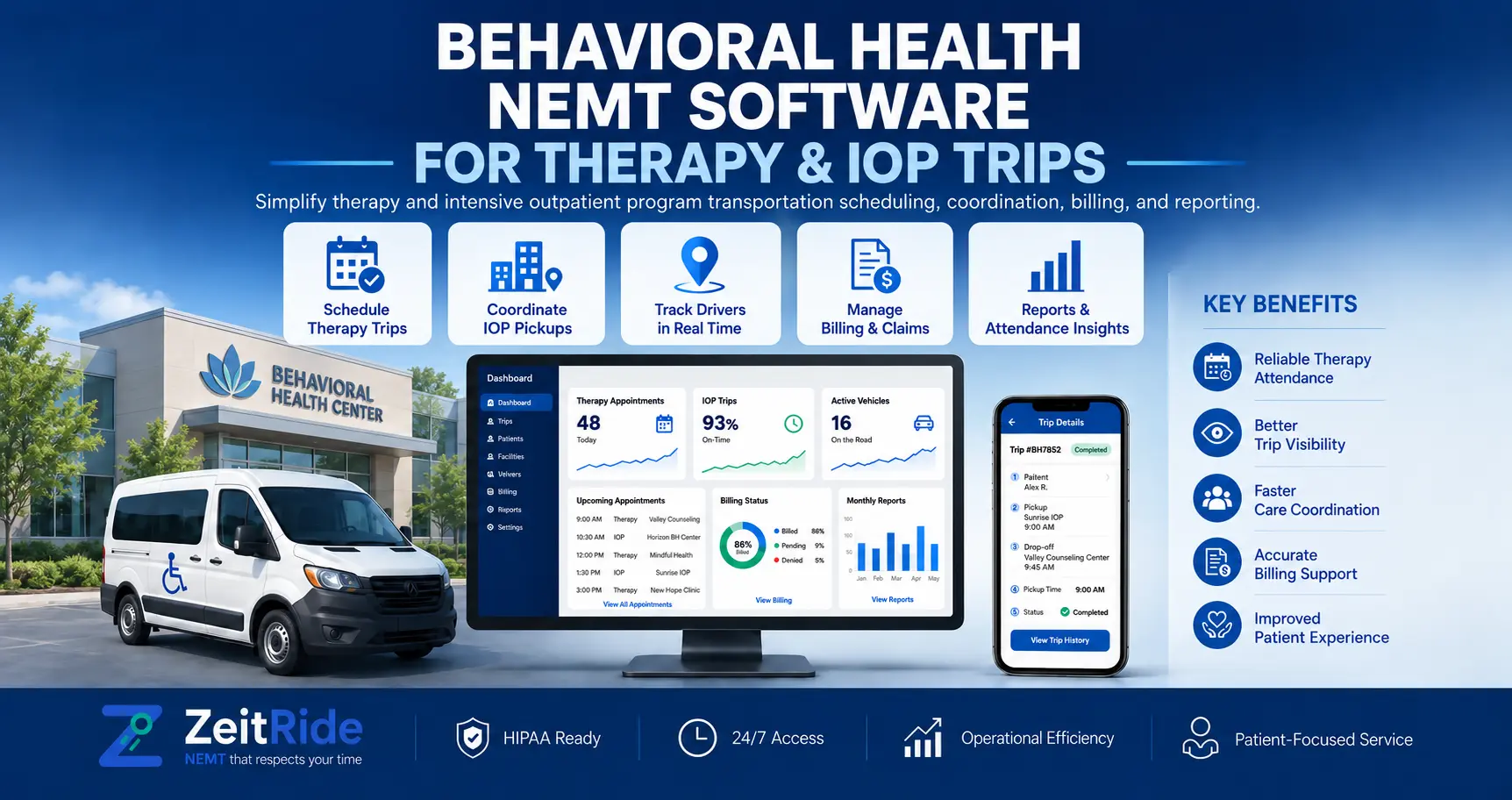
Behavioral Health NEMT Software for Therapy & IOP Trips
Learn how NEMT providers schedule therapy and IOP rides, handle dispatch changes, protect rider privacy, and document completed treatment trips.
Quick answer
Behavioral health NEMT software helps providers coordinate eligible therapy and IOP rides through recurring schedules, driver assignments, live trip changes, and completed-ride records. Providers must still verify payer rules, privacy obligations, and authorized communications.
ZeitRide Team
NEMT Operations Expert
A therapy center moves its morning session by 30 minutes. One passenger has a recurring ride, another needs a one-time pickup, and a third cannot confirm a return time. The dispatcher must adjust today's runs without changing next week's appointments or sharing unnecessary treatment details with drivers.
That is where behavioral health NEMT software can help. For non-emergency medical transportation (NEMT) providers, the real challenge is coordinating approved treatment rides, communicating schedule changes, and keeping reliable trip records—not simply filling a calendar.
What Is Behavioral Health NEMT Software?
Behavioral health NEMT software helps transportation companies organize eligible rides to counseling, intensive outpatient programs (IOPs), and other behavioral-health appointments. It connects recurring bookings, driver assignments, same-day changes, return pickups, and completed-trip documentation.
The software does not determine medical eligibility, authorize a ride, or guarantee privacy compliance. Providers must follow their contracts, applicable payer rules, and legal obligations. The system should make the transportation workflow easier to manage while leaving those decisions with the responsible people.
Why Treatment Transportation Needs a Different Scheduling Approach
Unlike a routine point-to-point ride, a treatment trip may repeat several times a week, depend on a program's attendance window, or end at an uncertain time. Dispatch teams may also receive short-notice changes from an authorized facility or broker contact.
Before assigning a driver, verify the service date, approved pickup and destination, arrival window, mobility or assistance requirements, authorized contact, and return arrangement. A treatment destination alone does not tell a dispatcher which information may be shared or whether two riders can travel together.
For these trips, successful scheduling means the right ride on the right date, with the right instructions not the maximum number of names placed on a route.
A practical safeguard is to review the next day's treatment roster before assigning the first vehicle: compare bookings with approved schedules, flag return trips that lack confirmed pickup times, and identify the staff member responsible for resolving each exception. This can prevent an unresolved question from becoming a driver-side surprise.
How Behavioral Health Transportation Scheduling Software Handles Appointment Types
A good workflow distinguishes the appointment pattern before building a route.
| Trip pattern | Common challenge | Dispatch response |
|---|---|---|
| Weekly therapy session | One appointment moves to a different time | Update the affected trip, not the entire series |
| Repeated IOP visits | Several sessions need reliable arrival windows | Reserve feasible driver and vehicle coverage |
| Shared facility pickup | Several authorized riders travel to one center | Check time windows, capacity, and shared-ride permissions |
| Uncertain return time | The patient is not ready at a fixed hour | Use a will-call return until readiness is confirmed |
ZeitRide's NEMT scheduling software supports individual trips and recurring schedules. The transportation provider still needs to verify the actual appointment details and any program-specific instructions.
IOP Transportation Scheduling Software: Preserve the Arrival Window
IOP transportation scheduling software should make repeated visit days and required arrival times easy to see. Intensive outpatient programs differ in frequency and duration, so use the confirmed schedule rather than assuming that every program follows the same timetable.
If one session changes, document who approved the change and its effective date. A single changed ride should not silently move every future pickup.
Managing Recurring Behavioral Health Transportation
Recurring behavioral health transportation works best when the recurring series is a baseline, not an unchangeable promise that every trip is still approved. Dispatchers should review cancellations, one-day changes, driver coverage, and authorization limits as needed.
For example, a rider normally travels on Tuesdays and Thursdays. This Thursday's visit moves to Friday, but the following Tuesday remains unchanged. Record the Friday exception rather than replacing the original recurring pattern.
The existing NEMT standing orders article covers series setup in detail. Where approved passengers share a destination, ZeitRide's recurring NEMT routes functionality addresses grouped runs. This guide focuses instead on the treatment-day decisions and exceptions.
How Behavioral Health NEMT Dispatch Software Manages Changes
When a driver runs late, a program changes its start time, or a passenger cancels, the dispatcher needs a controlled response. Behavioral health NEMT dispatch software should help keep the affected trip and subsequent stops visible.
- Confirm the change. Verify the instruction with an authorized rider, broker, or facility contact.
- Check the impact. Review arrival windows, driver availability, vehicle suitability, and later stops.
- Choose the correct status. Reassign, reschedule, cancel, or document a verified no-show according to the trip's rules.
- Send only necessary updates. Tell drivers what changed operationally without adding sensitive clinical details.
- Preserve the history. Keep the reason, timing, updated assignment, and completed-trip status available for review.
A cancellation is not automatically a billable no-show. Keep the documentation distinction clear; ZeitRide's no-show and cancellation tracking supports operational records, while billing eligibility depends on the payer or contract.
Example: Three Treatment Rides and One Last-Minute Change
Illustrative scenario: A two-driver fleet has three authorized transportation requests on the same morning. These times and outcomes are examples, not customer performance statistics.
| Time | Event | Appropriate dispatch action |
|---|---|---|
| 7:45 a.m. | Rider A needs to reach counseling by 8:30 | Check travel time and assign Driver 1 |
| 8:05 a.m. | Rider B's IOP arrival window moves later | Confirm the update and adjust today's trip only |
| 8:20 a.m. | Rider C has no confirmed return time | Keep the approved return in the will-call queue |
| 9:00 a.m. | Driver 1 reports a delay affecting Rider B | Review Driver 2's availability and communicate an approved reassignment |
The lesson is not that software can solve every conflict automatically. It is that changes should be visible, traceable, and limited to the rides actually affected.
Before confirming Driver 2, check whether the new pickup can fit around that driver's existing passengers and required arrival windows. If it cannot, communicate the exception through the authorized booking channel instead of silently promising an unrealistic pickup. A clear status history also helps the next dispatcher understand why the original assignment changed. ZeitRide's live NEMT dispatch connects assigned runs and driver updates in one workflow.
Protecting Rider Privacy During Dispatch
Behavioral-health transportation can involve sensitive information, even when a driver sees only a destination or recurring schedule. Use role-appropriate access and share the minimum operational information needed, subject to applicable law and exceptions. Avoid placing diagnoses or treatment notes in routine driver instructions.
HIPAA requirements depend on an organization's role and the information it handles. Transportation companies may have additional duties when acting as business associates; see HHS guidance on business associates.
Certain substance-use disorder treatment records have additional protections under 42 CFR Part 2. The updated HHS Part 2 rule guidance identifies a February 16, 2026 compliance date for parties subject to the rule. Not every NEMT trip record automatically falls under Part 2. Have qualified staff review the organization-specific requirements.
No dispatch platform by itself makes a transportation company HIPAA- or Part 2-compliant.
From Treatment Trip Completion to Billing
Once a ride is completed, staff may need to review trip identifiers, actual times, statuses, mileage, driver information, and supporting evidence required by the payer. Cancellations and no-shows need accurate records rather than assumed charges.
ZeitRide connects completed transportation activity with NEMT billing software workflows. The provider must still verify coverage, authorization, required documentation, and reimbursement rules. That includes confirming whether an altered pickup, incomplete ride, or cancellation changes what may be submitted. A completed status alone does not establish that a claim will be payable. Those requirements vary by state Medicaid program, health plan, broker, and agreement.
What to Test in Behavioral Health Transportation Management Software
Ask a vendor to demonstrate one realistic, anonymized treatment-day schedule rather than relying on a general feature presentation. Check whether the system can:
- Preserve future trips when a single IOP appointment changes.
- Keep a will-call return visible without inventing its pickup time.
- Show affected stops when a driver is reassigned.
- Record cancellations separately from completed trips.
- Limit driver-facing details to appropriate transportation instructions.
- Pass completed trip information into the billing-review process.
ZeitRide combines recurring scheduling, dispatch changes, driver status updates through its driver app, and downstream billing preparation. Confirm the exact features, permissions, and broker integrations your fleet needs during a live demonstration.
Frequently Asked Questions
Q: What is behavioral health NEMT software?
It is software that helps transportation providers schedule, dispatch, track, and document eligible rides to behavioral-health appointments. It supports trip operations but does not independently authorize care or determine payer coverage.
Q: Can NEMT software manage recurring therapy and IOP rides?
Yes. A system can maintain repeated appointments while allowing date-specific adjustments. Providers should confirm current trip requirements and approvals rather than assuming a recurring booking remains authorized indefinitely.
Q: What happens if an IOP appointment time changes?
Confirm the new time with an authorized contact, review its effect on the run, update the affected trip, and notify the relevant driver or booking party. Preserve future appointments unless the ongoing schedule is explicitly changed.
Q: Are behavioral-health NEMT trips automatically covered by Medicaid?
No. Coverage and transportation authorization depend on the member's state program, plan, broker, and individual circumstances. Providers should check applicable rules before dispatching and billing.
Q: Does treatment transportation software guarantee HIPAA or Part 2 compliance?
No. Compliance depends on the organization's role, information handling, agreements, safeguards, and applicable law. Software may support an organized workflow, but it is not a substitute for compliance review.
See Your Behavioral-Health Schedule in ZeitRide
The best way to evaluate behavioral health NEMT software is to test a real operational scenario. Bring an anonymized weekly treatment schedule with a recurring IOP visit, one changed appointment, and a will-call return.
Book a ZeitRide demo to see how scheduling, driver changes, return pickups, and completed-trip records work together and identify which decisions still require your team's approval.
Rather see it than read about it?
Bring a real route, a couple of drivers, and your current process. 15 minutes, zero pitch.